
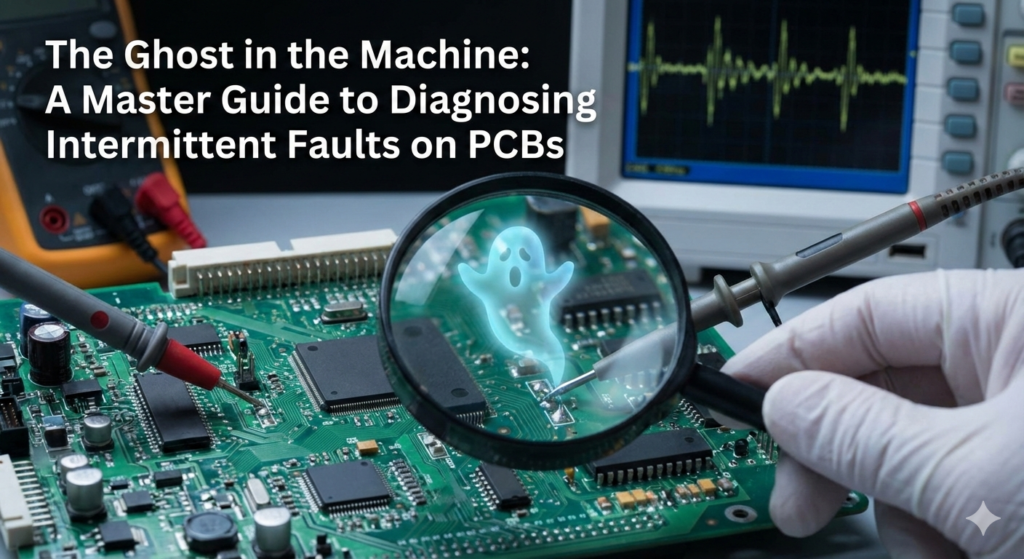
Every electronics technician, engineer, or hobbyist eventually faces the ultimate adversary.
It is not a permanently dead device.
It is not a device that is visibly burnt.
It is the device that works perfectly fine right now, but failed an hour ago, and will likely fail again tomorrow. 🤯
Diagnosing intermittent faults on PCBs (Printed Circuit Boards) is widely considered the most frustrating aspect of electronics repair.
These “ghost faults” are elusive, hard to replicate, and disappear the moment you attach a test probe. 👻
However, they are not magic.
They are physical defects that only manifest under specific conditions.
By adopting a systematic approach and using the right tools, you can track these ghosts down and eliminate them. 🕵️♂️
This guide will provide actionable steps for diagnosing intermittent faults on PCBs, turning a nightmare scenario into a solvable puzzle.
Understanding the Nature of Intermittent Faults
Before you grab your soldering iron, you must understand what you are hunting. 🤔
An intermittent fault is a malfunction that occurs randomly or periodically, rather than continuously.
Because the device works some of the time, you know the fundamental design is likely sound.
The issue is almost always a physical connection that is momentarily breaking or bridging.
The challenge lies in the fact that the connection is on the “hairy edge” of failure. 📉
“The art of debugging is figuring out what you really told your design to do instead of what you thought you told it to do.” — Unknown
When diagnosing intermittent faults on PCBs, patience is your most valuable tool.
Rushing to replace components without verification will often lead to a device that still fails randomly. 🚫
Common Culprits Behind Intermittent Failures
Intermittent faults generally stem from a few common physical phenomena.
Understanding these triggers will help you decide how to stress the board during testing. 💡
- Thermal Stress: As components operate, they generate heat. Different materials on a PCB expand at different rates, causing mechanical stress that can temporarily open a cracked solder joint or internal IC wire bond.
- Mechanical Flexure: Vibration, shock, or simply pressing buttons can slightly bend the PCB substrate. This flexing can cause micro-fractured traces to open momentarily.
- Solder Joint Degradation: Over time, solder joints become brittle due to repeated thermal cycling. Thermal cycling is often the primary trigger for intermittent connectivity issues in older electronics.
- Contamination and Corrosion: Humidity can interact with flux residues or environmental dust to create conductive pathways (dendrites) that cause temporary shorts, which may disappear when the device heats up and dries out.
To successfully master diagnosing intermittent faults on PCBs, you need to become experts at recreating these environmental conditions on your workbench. 🛠️
Essential Tools for the Hunt
A standard multimeter is often insufficient for catching fast, transient faults.
Because the fault appears and disappears instantly, a standard meter’s display update rate is too slow to register it. 🐢
You need tools that provide real-time feedback or can latch onto momentary events.
| Tool | Application for Intermittent Faults |
|---|---|
| Analog Multimeter or Meter with Fast Continuity Bar | Needle movement or instant bargraph response is faster than digital numbers for seeing brief dropouts in continuity. |
| Digital Oscilloscope (DSO) | Essential for setting triggers to capture voltage spikes or dropouts that last only milliseconds. |
| Thermal Imaging Camera | Identifies components that are overheating intermittently or spots cold solder joints that show abnormal thermal patterns. |
| High-Quality Microscope | Required for spotting hairline cracks in solder fillets or broken traces that are invisible to the naked eye. 🔬 |
| Freeze Spray and Heat Gun | Used to rapidly change the temperature of specific areas to induce thermal shock and force the fault to appear. |
Step-by-Step Diagnostic Procedure
Diagnosing intermittent faults on PCBs requires a structured approach to avoid chasing your tail.
Follow these phases to narrow down the possibilities. 🧐
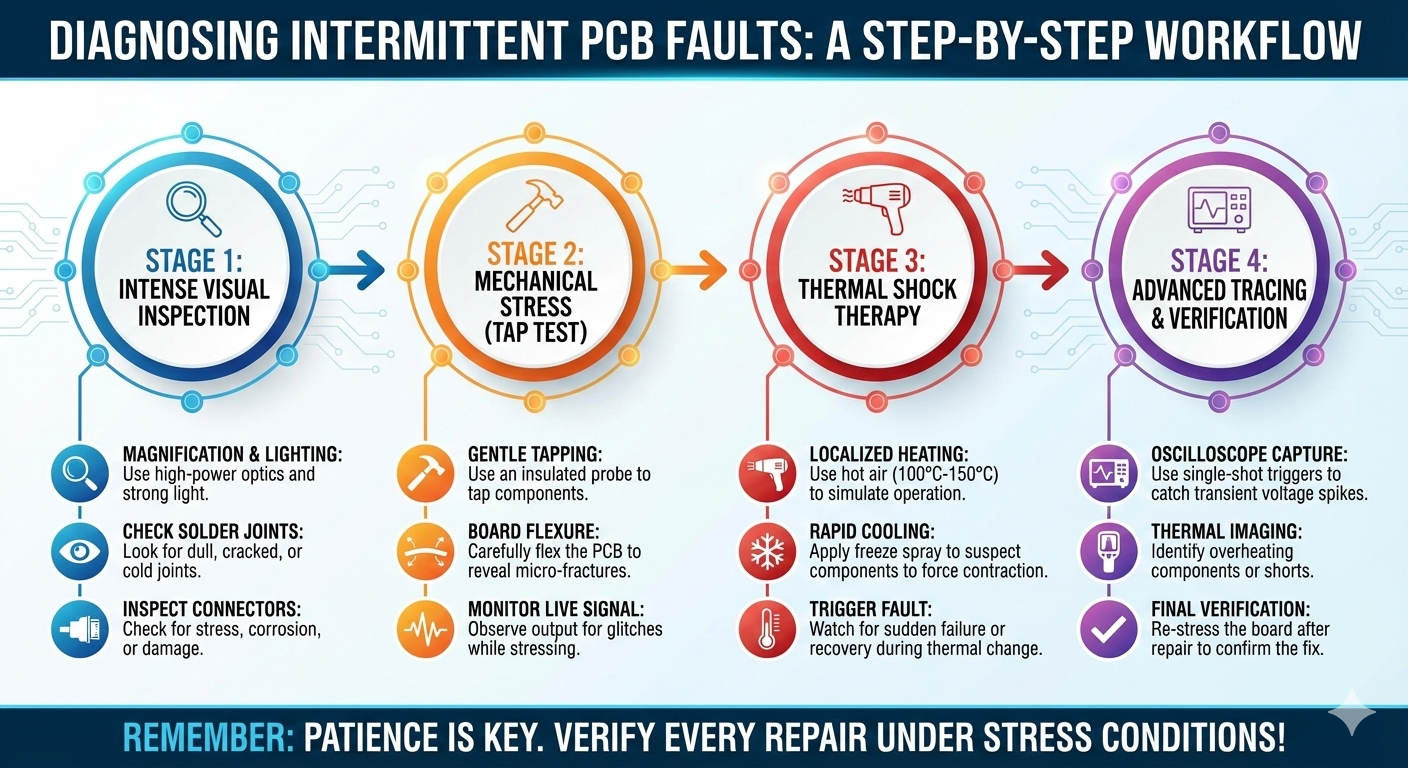
Phase 1: Intense Visual Inspection
Before turning the power on, use your eyes.
Use strong lighting and magnification. 🔎
Look for signs of mechanical stress near connectors and large components.
Check for “cold” or cracked solder joints, which often look dull or have a visible ring around the component lead.
Familiarize yourself with industry standards for what a good joint looks like; resources like the IPC-A-610 Acceptability of Electronic Assemblies are invaluable here.
Micro-cracks within solder fillets are often invisible to the naked eye but are devastating to circuit reliability over time.
Phase 2: Mechanical Stress Testing (The Tap Test)
If the device is temperature stable, the fault might be mechanical.
While the device is running and monitored (perhaps connected to a scope or listening to audio output), gently tap the PCB with an insulated probe. 🔨
Use a plastic pen or a wooden spudger; never use metal.
Tap specific components, connectors, and areas of the board.
Gently flex the PCB slightly by pressing on corners (be very careful not to crack surface mount components like ceramic capacitors).
If tapping a specific area causes the fault to trigger, you have successfully localized the issue to that vicinity. 🎯
Phase 3: Thermal Shock Therapy
If mechanical stress yields nothing, thermal issues are the next likely culprit when diagnosing intermittent faults on PCBs. 🔥🧊
Start by using a hot air station set to a moderate temperature (around 100°C to 150°C) to gently warm up sections of the board while it is operating.
Do not overheat components; the goal is to simulate operating temperature, not to reflow solder.
If heating doesn’t trigger it, use freeze spray.
Apply small bursts of freeze spray to suspect components like processors, memory, or power regulators.
The rapid cooling causes contraction, which will often momentarily reconnect a broken internal bond wire or a cracked solder joint.
Freeze spray is incredibly effective at temporarily shocking a bad joint back into connection, instantly revealing the faulty component.
If the device suddenly starts working when you freeze a specific chip, you have found your problem.
Advanced Tracing Techniques
Sometimes tap tests and thermal shocks are not enough.
You may need to catch a fleeting electronic signal glitch. 📉
This is where a digital oscilloscope becomes mandatory.
You must learn how to set up “single-shot” triggers.
Set the trigger level just above or below the normal operating voltage of the line you are monitoring.
When the intermittent fault occurs and the voltage spikes or drops, the scope will capture that exact moment on the screen and hold it for you to analyze. 📸
Tektronix provides excellent resources on oscilloscope basics and triggering that are essential for this type of work.
Another powerful tool for live monitoring is a thermal camera.
While expensive, they can instantly show you a component that is running hotter than it should, indicating internal failure or a short circuit somewhere on its output line. 🌡️
Companies like FLIR offer extensive guides on using thermal imaging for electronics testing.
The BGA Nightmare
Ball Grid Array (BGA) packages are notorious sources when diagnosing intermittent faults on PCBs.
Because the solder joints are hidden beneath the chip, you cannot inspect them visually without X-ray equipment. 🚫👀
Intermittent BGA faults are almost always caused by thermal cycling cracking the solder balls underneath.
The “tap test” involves applying firm, steady pressure on top of the BGA chip while the device is running.
If the device stabilizes while you are pressing down, it confirms cracked solder balls under the chip.
The only reliable fix for this is a professional BGA rework (reflow or reballing).
“If you think good design is expensive, you should look at the cost of bad design.” — Ralf Speth
Environmental Cleanup
Sometimes the fault isn’t a broken connection, but an unwanted one.
If a board has been exposed to moisture, “dendrites” can grow between traces. 🌿
These are microscopic metallic tendrils that grow via electrochemical migration.
They can cause intermittent shorts that burn away when current passes through them, only to grow back later.
You can learn more about the science of electrochemical migration and dendrites from research institutions like NPL.
Thoroughly cleaning the PCB with isopropyl alcohol (IPA) and a brush, followed by proper drying, is essential if contamination is suspected. 🧼
Verification: The Most Important Step
You found a cracked joint on a resistor. 🎉
You resoldered it. 👨🏭
Are you done?
Absolutely not.
The most critical part of diagnosing intermittent faults on PCBs is verifying that the fault is truly gone.
A successful repair is only complete when you can reliably verify that the intermittent behavior has ceased entirely under stress conditions.
You must subject the board to the same stresses that caused it to fail previously.
Tap it again. 🔨
Heat it up again. 🔥
Run it for several hours or days if possible.
Only when you cannot force the unit to fail again can you consider the repair complete.
For reliable repairs, always adhere to best practices for soldering, such as those outlined by Weller Tools in their educational resources.
Conclusion
Diagnosing intermittent faults on PCBs is a true test of a technician’s skill and patience.
It requires moving beyond simple static testing and embracing dynamic troubleshooting methods. 🚀
By understanding the physical causes of these faults—thermal, mechanical, and environmental—you can systematically stress the board to reveal the hidden defect.
Equip yourself with the right tools, follow a logical process, and never skip the final verification step.
When you finally capture that ghost fault and fix it permanently, the sense of accomplishment is unmatched in the world of electronics repair. 🏆