



Welcome, startup trailblazers! 🚀
Are your weekly team meetings a source of dread, or do they propel your startup forward?
For many young companies, meetings can feel like a necessary evil, a black hole where precious time and energy disappear without a trace. 😩
But what if they didn’t have to be that way?
What if your weekly sync-up could be the most valuable hour of your week, a catalyst for growth, innovation, and unwavering team alignment?
Imagine a world where every team member leaves a meeting feeling energized, clear on priorities, and ready to tackle the week’s challenges with renewed vigor. 🤩
This isn’t just a dream; it’s an achievable reality with the right framework.
In the fast-paced, ever-evolving world of startups, effective communication and strategic alignment are not just beneficial – they are absolutely critical for survival and success. 🎯
A well-structured weekly meeting agenda is your secret weapon. 🤫
It transforms chaotic conversations into focused discussions, clarifies roles and responsibilities, and ensures everyone is pulling in the same direction.
This comprehensive guide will equip you with the ultimate startup team weekly meeting agenda, designed to maximize productivity, foster collaboration, and drive tangible results. 💪
We’ll delve into each critical component, providing actionable tips and best practices to help you transform your meetings from time sinks into strategic assets.
Get ready to supercharge your startup, one productive meeting at a time! 💥
Why Your Startup Needs a Rock-Solid Weekly Meeting Agenda 📌
Before we dive into the “how,” let’s quickly address the “why.”
Why is a structured agenda so vital for your startup?
Many startups operate on the fly, believing that agility means eschewing formal processes. While agility is crucial, a lack of structure in meetings often leads to inefficiency, misunderstanding, and wasted effort. 😬
Here’s why a rock-solid agenda is non-negotiable:
- Enhanced Clarity and Focus: An agenda ensures everyone knows the meeting’s purpose and what will be discussed. This eliminates aimless chatter and keeps conversations on track. 💡
- Improved Decision-Making: By outlining specific discussion points and decision items, an agenda facilitates more informed and timely decisions.
- Increased Accountability: When actions are assigned and noted in the agenda, it creates a clear record of who is responsible for what, boosting accountability across the team. 🤝
- Optimal Time Management: Time boxing each agenda item prevents topics from derailing the entire meeting and ensures all critical points are covered within the allotted time. ⏱️
- Boosted Team Morale: Productive meetings leave team members feeling valued and effective, rather than frustrated and drained. This significantly contributes to a positive team culture. 😊
- Proactive Problem Solving: Regular check-ins and dedicated problem-solving slots in the agenda allow teams to identify and address issues before they escalate.
As the famous management consultant Peter Drucker once said, “Meetings are by definition a concession to deficient organization for one either meets or one works. One cannot do both at the same time.”
While that might sound a bit harsh, it underscores the importance of making your meetings truly productive, so they contribute to work, rather than detract from it. 🤓
The Ultimate Startup Team Weekly Meeting Agenda Template 📋
This template is designed to be comprehensive yet flexible, allowing you to adapt it to your startup’s unique needs and culture.
The key is consistency and adherence to time limits. Let’s break it down! 👇
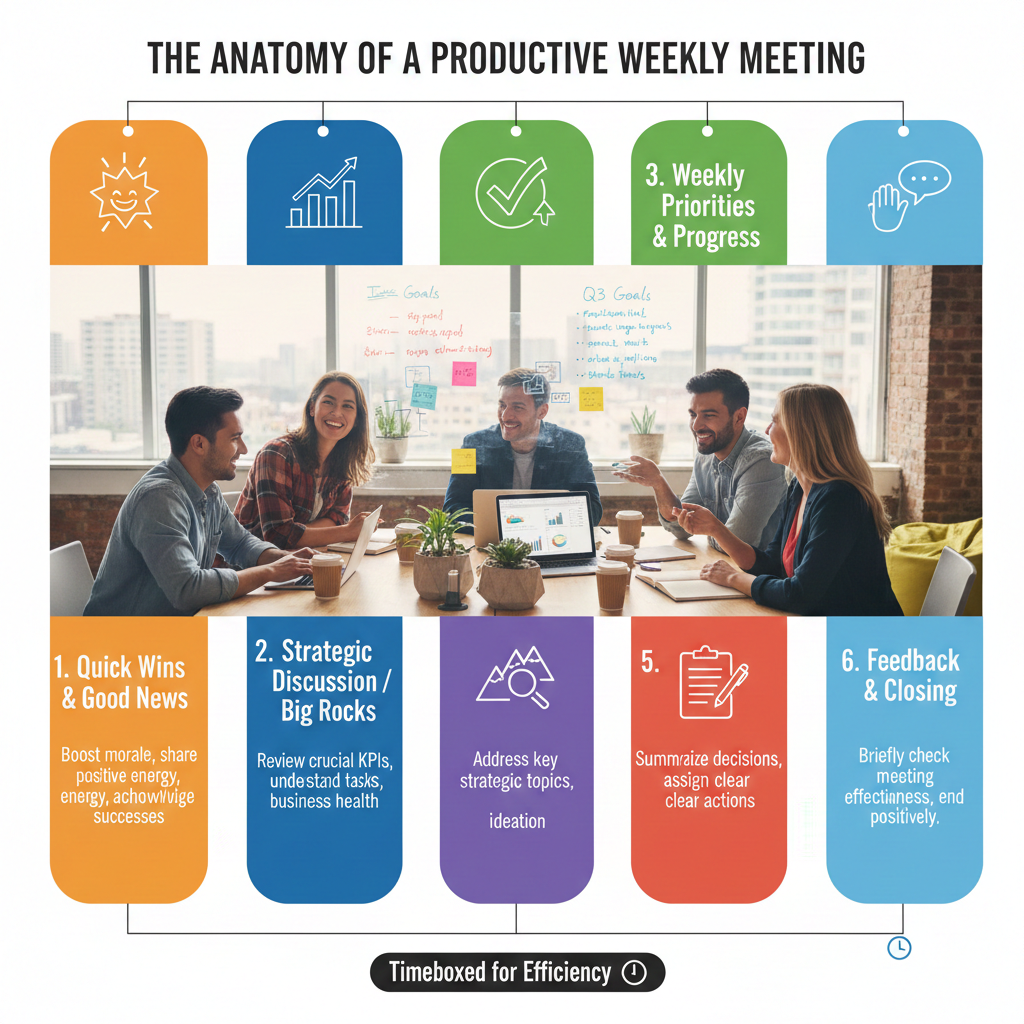
Total Meeting Time: 60-90 minutes (Adjust based on team size and complexity)
1. Quick Wins & Good News (5-10 minutes) 🎉
Purpose: Start the meeting on a positive note, boost morale, and acknowledge achievements.
This segment is crucial for building a positive team dynamic.
It sets an optimistic tone and reminds everyone of the collective progress being made.
- Each Person Shares: One quick win from the past week (personal or professional) or something they’re grateful for.
- Keep it Brief: Encourage concise sharing, 30-60 seconds per person.
- Example: “Closed that deal we’ve been working on!” or “Finally cracked that coding bug.”
2. Key Metrics & Performance Review (10-15 minutes) 📊
Purpose: Review critical performance indicators (KPIs) and understand the overall health of the business.
This is where data meets discussion.
It’s essential to have key metrics readily available and visualized.
- Pre-circulate a Dashboard: Share a brief report or dashboard before the meeting with key metrics (e.g., sales, marketing leads, website traffic, user engagement, support tickets).
- Brief Review by Department Lead: Each department head (or relevant person) quickly highlights key metric changes, trends, or notable successes/challenges.
- Focus on “Why”: Don’t just state the numbers; briefly explain the “why” behind significant changes.
- No Deep Dives: If a metric requires extensive discussion, flag it for a separate deep-dive meeting.
3. Weekly Priorities & Progress (20-30 minutes) ✅
Purpose: Align on current priorities, review progress on last week’s tasks, and identify potential roadblocks.
This is the core of your operational sync-up. It ensures everyone knows what’s important and where things stand.
- Last Week’s Commitments Review: Go through the key tasks/commitments from the previous meeting. Each person briefly states if they are “Done,” “In Progress,” or “Stuck.”
- New Week’s Top 1-3 Priorities: Each team member (or department) shares their top 1-3 priorities for the upcoming week that contribute directly to company goals.
- Identify Blockers/Challenges: This is a critical moment. Encourage team members to voice any obstacles preventing them from completing their tasks.
- No Problem Solving Here: Simply identify the blocker. Assign it to a specific person to follow up outside the meeting, or schedule a separate session if it affects multiple team members.
4. Strategic Discussion / Big Rocks (15-20 minutes) ⛰️
Purpose: Discuss one or two strategic topics that require collective input, ideation, or decision-making beyond daily operations.
This slot prevents strategic discussions from being pushed aside by urgent operational matters.
It’s where you address the “big rocks” that move your startup forward.
- Pre-Planned Topics: This isn’t a free-for-all. Topics should be decided in advance (e.g., “Review Q3 Marketing Strategy,” “Discuss new product feature roadmap,” “Brainstorm hiring process improvements”).
- Facilitated Discussion: The meeting leader (or a designated person) facilitates the discussion, ensuring everyone gets a chance to contribute.
- Aim for Outcome: The goal is usually to make a decision, generate solutions, or gain alignment on a strategic direction.
5. Decisions & Action Items (5-10 minutes) ✍️
Purpose: Summarize key decisions made and assign clear action items with owners and deadlines.
This is arguably the most critical part of the meeting.
Without clear action items, even the most brilliant discussions remain just that – discussions.
- Review Decisions: Quickly recap any major decisions made during the meeting.
- Assign Action Items: For every action identified, clearly state:
- What needs to be done?
- Who is responsible?
- When is the deadline?
- Document Everything: Ensure all decisions and action items are recorded in a shared document or project management tool.
6. Feedback & Closing (2-5 minutes) 👋
Purpose: Briefly check in on meeting effectiveness and close with a forward-looking statement.
Ending strong ensures the meeting’s impact carries into the week.
- “One Word” Feedback: Ask everyone to share one word that describes how they feel about the meeting (e.g., “clear,” “productive,” “focused”).
- Next Meeting Prep: Briefly mention any pre-work for the next meeting.
- Thank You: Thank everyone for their time and contributions.
Best Practices for Running Highly Effective Startup Meetings 🌟
An agenda is just one piece of the puzzle. The way you run the meeting is equally important.
Here are some best practices to ensure your meetings are consistently productive:
1. Send the Agenda in Advance 📧
Always send the agenda at least 24 hours before the meeting. This gives everyone time to prepare, gather data, and formulate their thoughts. Preparation is the bedrock of productive discussions.
2. Appoint a Meeting Facilitator 🧑⚖️
This person is responsible for keeping time, guiding discussions, and ensuring everyone participates. They are the guardian of the agenda and the meeting’s efficiency.
3. Time Box Everything ⏰
Strictly adhere to the time allocated for each agenda item. If a discussion runs over, table it for a separate meeting or offline discussion. This shows respect for everyone’s time.
4. Encourage Active Participation 🗣️
Create an environment where everyone feels comfortable contributing. The facilitator should actively draw out quieter team members and manage dominant voices.
5. Document Decisions and Action Items Religiously ✍️
Use a shared document (Google Docs, Notion, Asana, Trello) to capture decisions, action items, owners, and deadlines in real-time. This eliminates confusion and ensures follow-through.
6. Start and End on Time ⏳
This simple rule builds trust and respect for everyone’s schedule. Punctuality demonstrates professionalism and value for time.
7. Minimize Distractions 📵
Encourage team members to close laptops, put away phones, and fully engage. If a laptop is needed for notes, make sure it’s used solely for that purpose.
8. Review Action Items at the Start of the Next Meeting 💪
This fosters accountability and ensures that commitments are being met. It closes the loop and keeps everyone on trac.
Adapting the Agenda for Remote or Hybrid Teams 💻
In today’s global and often remote work landscape, adapting your meeting strategy is crucial.
The core agenda remains the same, but execution requires a few adjustments:
- Leverage Technology: Utilize video conferencing tools with features like screen sharing, virtual whiteboards, and chat functions. Tools like Zoom, Google Meet, or Microsoft Teams are essential.
- Visual Aids Are Key: Share screens often. A shared agenda, dashboard, or project board helps everyone stay on the same page, especially when not in the same room.
- Dedicated Note-Taker: Ensure someone is specifically assigned to take public notes in a shared document, visible to all participants during the meeting.
- Breaks for Longer Meetings: If your meeting extends beyond an hour, consider a quick 5-minute break to combat Zoom fatigue.
- Clear Audio & Video: Encourage everyone to have their cameras on and ensure good audio quality to foster connection and reduce misunderstandings.
The Power of Iteration: Continuously Improve Your Meetings ⚙️
Just like your product or service, your meetings should be subject to continuous improvement.
Don’t set it and forget it! 🔄
- Gather Feedback: Periodically ask your team what’s working well and what could be improved about the weekly meeting. A quick anonymous survey can yield valuable insights.
- Experiment: Try different time allocations, add a new segment, or remove one that isn’t adding value.
- Review Effectiveness: Look at your action item completion rate. Are decisions being made and followed through? This is the ultimate measure of meeting effectiveness.
Remember, the goal isn’t just to have meetings, but to have effective meetings that drive your startup’s mission forward.
Table 1 – Startup Meeting Agenda Template
| Time Allotted | Agenda Item | Purpose / Focus | Key Activities |
|---|---|---|---|
| 5-10 min | Quick Wins & Good News 🎉 | Boost morale, share positive energy, acknowledge successes. | Each person shares one win or positive update. |
| 10-15 min | Key Metrics & Performance Review 📊 | Review crucial KPIs, understand business health. | Quick review of pre-circulated dashboard, highlights trends. |
| 20-30 min | Weekly Priorities & Progress ✅
|
Align on current tasks, review last week’s commitments, identify blockers.Review last week’s tasks, share top 1-3 priorities, flag challenges.
15-20 min
Strategic Discussion / Big Rocks ⛰️
Address one or two key strategic topics, ideation, decision-making.Facilitated discussion on pre-selected strategic topic(s).
5-10 min
Decisions & Action Items ✍️Summarize decisions, assign clear actions with owners & deadlines.Recap decisions, document “who does what by when.
“2-5 min
Feedback & Closing 👋Briefly check meeting effectiveness, end positively.Quick “one word” feedback, thank participants.
Conclusion: Transform Your Meetings, Transform Your Startup ✨
Your weekly team meeting doesn’t have to be a dreaded obligation.
With a thoughtful, structured agenda and consistent execution, it can become a powerful engine for your startup’s success. 🚀
By implementing the ultimate startup team weekly meeting agenda outlined in this guide, you’ll foster a culture of clarity, accountability, and proactive problem-solving.
You’ll transform fragmented efforts into a cohesive force, driving your mission forward with remarkable efficiency.
Remember, the goal is not to eliminate meetings, but to make every minute count.
Invest the time to plan, facilitate, and follow up, and you’ll see a dramatic improvement in team cohesion, productivity, and ultimately, your startup’s growth trajectory. 📈
So, take this agenda, adapt it to your unique needs, and start making your weekly meetings the most productive time of your week.
Your startup, and your team, will thank you for it! 🙏
Go forth and conquer! 🌟
External Resources for Further Reading 📚
For more insights on effective meetings and startup growth, check out these high-authority resources:
- Harvard Business Review: How to Run a More Effective Meeting
- Forbes: 13 Effective Ways To Run A Meeting
- First Round Review: This Is How You Run an All-Hands Meeting at a Fast-Growing Startup
- Asana: Meeting Agenda Template & Best Practices
- Medium: Why Startups Need to Get Their Meetings Right