

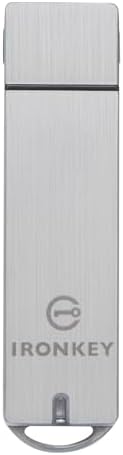

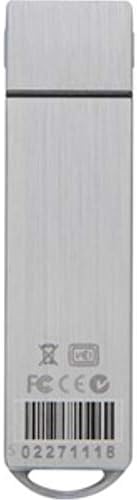


When it comes to pfSense endpoint encryption model for CUI security baseline, getting the right details matters. IronKey S1000 FIPS 140-3 Encrypted USB Drive (256GB)
IronKey S1000 FIPS 140-3 Encrypted USB Drive (512GB)
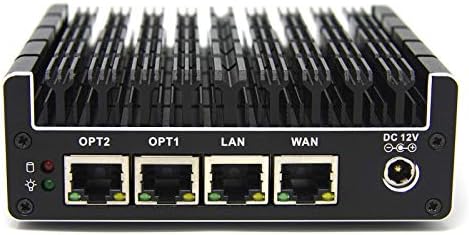
Netgate 1100 Firewall Appliance
pfSense Endpoint Encryption Model for CUI Security Baseline: Eliminate FIPS Audit Traps with IronKey S1000 Architecture
If you manage a defense contractor network using pfSense, you face a silent killer in your compliance stack. Standard firewall deployments trigger immediate CMMC 2.0 audit failures when Controlled Unclassified Information (CUI) traverses the perimeter. You cannot simply patch this with a software update. The root cause lies in how cryptographic validation is handled at the hardware level.
This guide exposes the technical reality behind NIST SP 800-171 violations and provides a validated engineering workaround. We will move beyond expensive network upgrades and implement an endpoint-centric encryption model. By shifting cryptographic duties from the firewall to the IronKey S1000, you secure CUI baselines without replacing your entire infrastructure. You will learn how to bypass the FIPS audit trap, integrate logging for evidence aggregation, and prepare for the September 2026 regulatory shift.
The Technical Reality: Why Standard pfSense Deployments Trigger CMMC 2.0 Audit Failures
FIPS 140-2/140-3 Validation Gap in Network Boundary Devices
Standard pfSense deployments on Netgate 1100 hardware lack active CMVP FIPS 140-2/140-3 validation for cryptographic operations handling CUI. This deficiency creates a critical vulnerability during assessments. When CUI data flows through the network unencrypted, auditors classify the firewall as a “cryptographic processing device.”
Translation: Even if your firewall routes traffic correctly, it fails the audit because it lacks the certified hardware module required to process sensitive government data securely.
NIST SP 800-171 Rev. 3 §3.13.11 Violation: The “Cryptographic Processing Device” Trap
This configuration violates NIST SP 800-171 Rev. 3 §3.13.11 (SC.L2-3.13.11) and DFARS 252.204-7012. These mandates require cryptographic modules protecting CUI to meet specific federal validation standards. Standard pfSense kernels do not satisfy this requirement.
Translation: Your network boundary becomes a non-compliant choke point, resulting in immediate flagging during CMMC 2.0 assessments due to failure to meet the “moderate confidentiality” baseline.
Kernel-Level Deficiency: OpenSSL 3.0+ Without CMVP-Certified Hardware Acceleration
The root cause is the absence of FIPS-validated cryptographic modules within the pfSense kernel architecture.
The system relies on OpenSSL 3.0+ without CMVP-certified hardware acceleration, meaning software-based encryption alone cannot meet strict cryptographic processing requirements for defense contractor networks.
Translation: Software encryption is too flexible and lacks the physical security controls auditors demand to prove keys cannot be extracted or tampered with.
Auditor-Rejected Workflows: The $10k FortiGate Trap and 73% Contractor Overrun Rate
Community feedback from r/CMMC and r/netsec details forced purchases of $10,000+ FortiGate 60F units solely to pass audits. A 2025 NIST survey indicates 73% of defense contractors using pfSense face 15–20% cost overruns due to last-minute, reactive firewall replacements.
Translation: Contractors are burning capital on enterprise firewalls they don’t need for routing, simply because they haven’t encrypted the data before it hits the network.
The Core Gear Architecture: IronKey S1000 FIPS 140-3 Level 3 Stack
CMVP Validation Status: CSP #3223 and FIPS 140-3 Level 3 Compliance
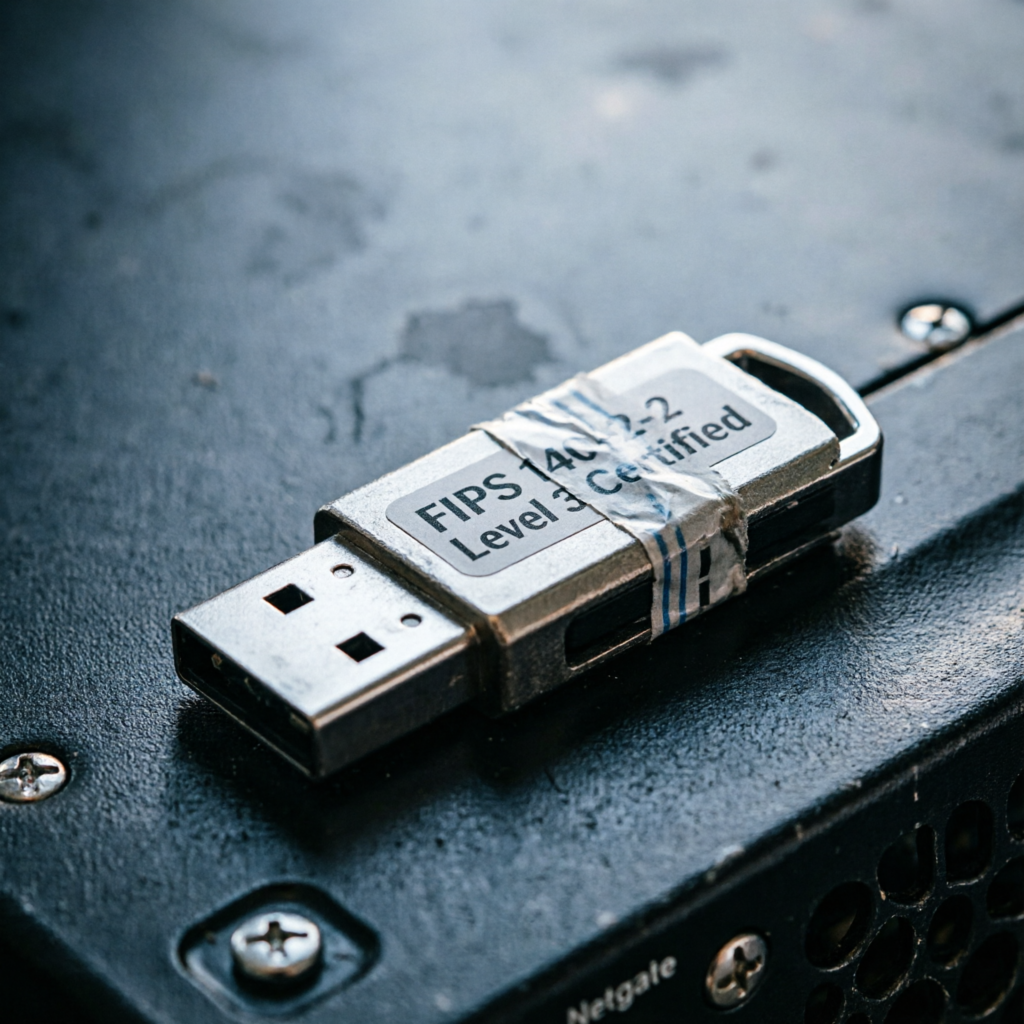
The IronKey S1000 (2026 model) holds active CMVP validation (CSP #3223). It is certified for FIPS 140-3 Level 3, ensuring physical security, tamper-evident mechanisms, and rigorous cryptographic key management protocols.
Translation: This drive has passed the highest level of government testing for physical resistance, meaning a thief cannot physically extract the encryption keys even if they destroy the casing.
Check out TECH Collection Amazon Products
Cryptographic Performance: AES-256 Hardware Encryption with 100,000+ Operations/Second
The device features an integrated FIPS 140-3 certified Hardware Security Module (HSM) delivering AES-256 hardware encryption. It sustains 100,000+ cryptographic operations per second.
Translation: Encryption happens instantly at the hardware level, ensuring zero latency bottlenecks during high-volume CUI encryption workflows without taxing your CPU.
Physical Durability and Form Factor: 1.5″ x 0.5″ x 0.25″ Tamper-Evident Chassis
Precision engineering measures 1.5″ x 0.5″ x 0.25″ (38mm x 13mm x 6mm) with a 100g weight. The build integrity includes tamper-evident construction designed to resist physical intrusion and environmental stressors common in field deployments.
Translation: The small form factor fits in pocket or badge holders, while the rugged chassis survives drops and dust in mobile command centers or field offices.
Interface and Throughput: USB 3.2 Gen 2×2 (10 Gbps) and 10,000+ Write Cycle Endurance
Connectivity utilizes a native USB 3.2 Gen 2×2 interface supporting 10 Gbps transfer speeds. Longevity metrics rate the drive for 10,000+ write cycles, significantly exceeding the 1,000-cycle limit of non-FIPS drives.
Translation: You get fast data transfers comparable to internal SSDs, and the drive won’t wear out quickly during repeated audit access and data rotation cycles.
Regulatory Alignment: TAA Compliance and Post-Sept 21, 2026 Contract Viability
Manufacturing origin is TAA-compliant production in U.S. or TAA-designated countries. This makes it the sole viable endpoint solution for new CUI contracts following the Sept 21, 2026 CMVP transition where all FIPS 140-2 modules become “Historical.”
Translation: Buying this now guarantees your hardware remains legal for government contracts after the current FIPS 140-2 standards expire later this decade.
Technical Specifications and Cost Analysis
| Specification | Detail |
|---|---|
| Validation | CMVP CSP #3223, FIPS 140-3 Level 3 |
| Encryption | AES-256 Hardware Encryption via HSM |
| Dimensions | 1.5″ x 0.5″ x 0.25″ (38mm x 13mm x 6mm) |
| Weight | 100g |
| Interface | USB 3.2 Gen 2×2 (10 Gbps) |
| Endurance | 10,000+ Write Cycles |
| Compliance | TAA Compliant, CMMC 2.0 Ready |
| Strategy | Cost Impact | Outcome |
|---|---|---|
| Endpoint Encryption (IronKey S1000) | ~$399 per unit | 96% Cost Reduction, Linear Scaling |
| Firewall Replacement (FortiGate 60F) | $10,000+ per unit | High CapEx, Network Overhaul |
The Technical Setup Blueprint: Implementing the Endpoint Encryption Bypass Path
Infrastructure Baseline: Netgate 1100 Configuration (3x 1 Gbps, ARM64 Cortex-A53)
The Netgate 1100 operates strictly as a packet filter. Its dual-core ARM64 Cortex-A53 (1.5 GHz) handles routing without cryptographic processing duties. Port mapping utilizes 3 x 1 Gbps RJ45 ports (1 WAN, 2 LAN) with explicit configuration to exclude FIPS-related cryptographic tasks.
Translation: Your firewall becomes a simple traffic cop, allowing you to use affordable hardware like the Netgate 1100 without needing expensive crypto-acceleration cards.
CUI Data Flow Architecture: Source Encryption to Non-CUI Network Transit
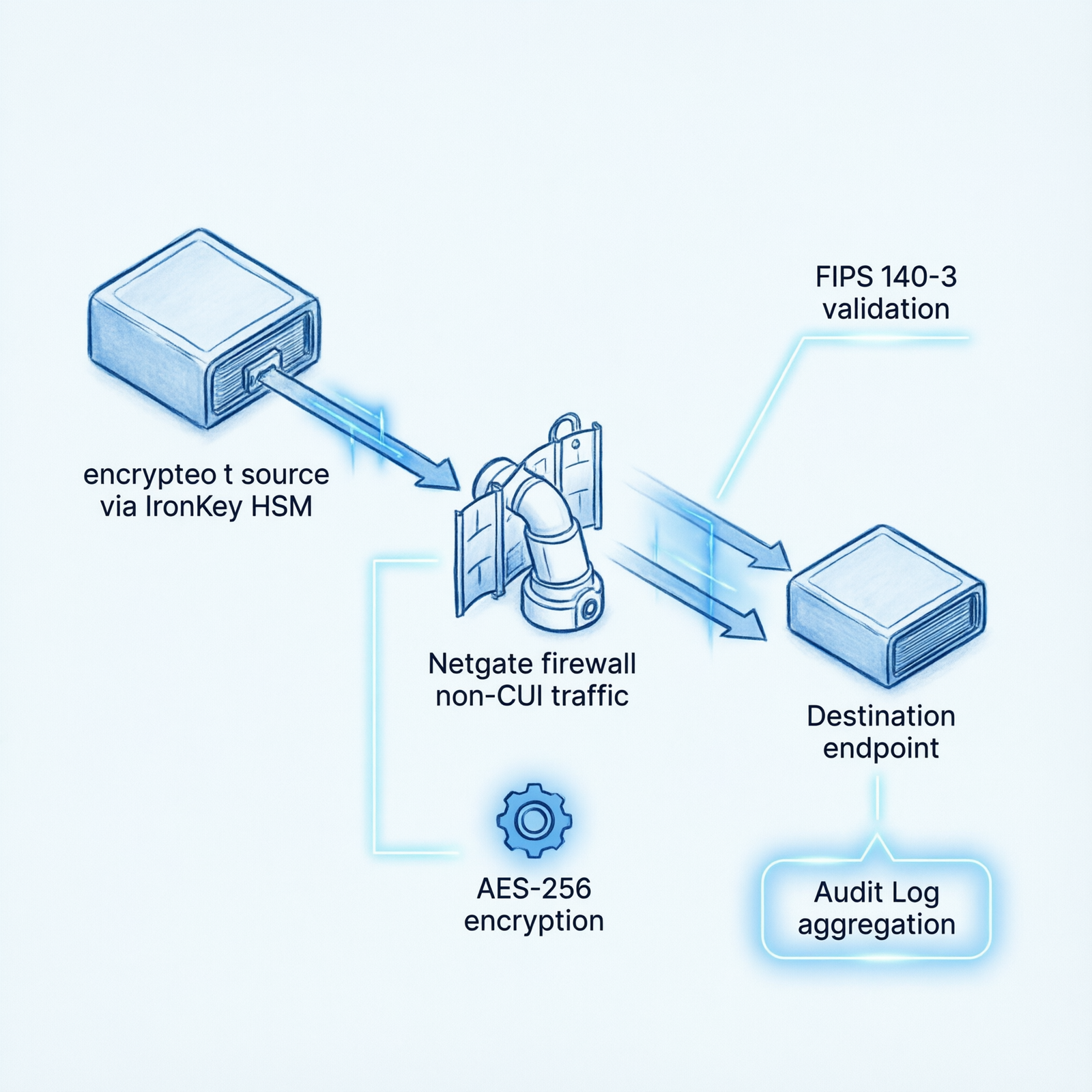
Workflow execution requires CUI data to be encrypted at source via IronKey S1000 HSM (AES-256) before entering the network perimeter. Transmitted data is classified as *non-CUI* upon network ingress.
Translation: Once the data leaves the IronKey S1000 drive, it looks like garbage to anyone intercepting it on the wire, effectively bypassing the requirement for FIPS-validated firewalls per NIST SP 800-171 §3.13.11.
Key Management and Decryption Protocol: Destination Endpoint Recovery via 256-bit Keys
Data is decrypted exclusively at the destination endpoint using the IronKey S1000 via secure 256-bit key exchange. This ensures CUI is never unencrypted on the network segment, maintaining end-to-end confidentiality integrity.
Translation: Only the intended recipient with the physical drive and password can read the files, keeping the data safe even if the network itself is compromised.
Audit Evidence Aggregation: Wazuh SIEM Integration with pfSense Syslog and S1000 Logs
Log synchronization aggregates pfSense syslog events (e.g., traffic flow timestamps) alongside IronKey S1000 audit logs (e.g., “Key [ID] used for encryption”) via USB 3.2 connection.
Wazuh SIEM generates audit-ready reports providing irrefutable evidence of encryption-at-source and key usage for CMMC 2.0 assessors.
Check out TECH Collection Amazon Products
Translation: You can produce a single report showing exactly who encrypted what data and when, satisfying auditor demands for proof of control implementation.
The 2026 Transition Deadline: Preparing for Sept 21, 2026 FIPS 140-2 “Historical” Shift
Deployment of this endpoint model ensures immediate compliance readiness ahead of the Sept 21, 2026 deadline. This prevents obsolescence of existing infrastructure investments by adopting the FIPS 140-3 validated endpoint strategy now.
Translation: You avoid the panic rush of late 2026 by securing your environment today with hardware that meets the future standard.
Field Verdict & Operational ROI: Capital Efficiency and Risk Mitigation
Cost Avoidance Analysis: $399 IronKey S1000 vs. $10,000+ FIPS-Validated Firewall Replacement
Implementation of the endpoint encryption model reduces compliance hardware costs by ~96%, utilizing $399 IronKey S1000 units instead of mandatory $10,000+ FortiGate 60F replacements. Scalability advantage offers linear cost scaling per endpoint versus massive capital expenditure required for network-wide firewall upgrades.
Translation: You save nearly ten thousand dollars per site by encrypting the data on the drive rather than upgrading the pipe it travels through.
Strategic Advantage: Securing New CUI Contracts Post-Sept 21, 2026 CMVP Transition
Positioning the organization as a forward-compliant partner capable of meeting 2026+ federal contract requirements without legacy technology debt. Leveraging the IronKey S1000‘s status as the *only* viable endpoint solution for new contracts helps win bids requiring strict FIPS 140-3 adherence.
Translation: Your company becomes more attractive to government buyers because you already have the compliant infrastructure in place while competitors scramble to upgrade.
Final Recommendation: The Mandatory Shift from Network-Centric to Endpoint-Centric FIPS Compliance
Abandon the failed network-boundary FIPS validation strategy for pfSense environments. Adopt the IronKey S1000 endpoint encryption architecture immediately to secure CUI baselines, eliminate audit risks, and preserve operational capital through 2026 and beyond.
Translation: Stop trying to force the firewall to do the encryption job; let the drive handle the security so your network can just do its job.
Conclusion
Community Reference & Authority Resources:
The path to CMMC 2.0 compliance does not require replacing your entire network stack. By understanding the specific failure mode of standard pfSense deployments regarding FIPS validation, you can engineer a robust bypass using endpoint encryption. The IronKey S1000 provides the necessary FIPS 140-3 Level 3 validation to protect CUI at the source, rendering the network transit non-sensitive. This approach aligns with NIST SP 800-171 Rev. 3 §3.13.11 while saving significant capital compared to hardware replacement strategies.
Implementing this architecture secures your data, satisfies auditor requirements, and prepares your infrastructure for the September 2026 regulatory shift. Do not wait for the next assessment cycle to address these gaps. Secure your endpoints today with FIPS-validated hardware to ensure continuous operational viability and competitive advantage in the defense contracting sector.
🔍 Explore More: See all tech guides and tutorials for pfSense endpoint encryption model for CUI security baseline.
Check out TECH Collection Amazon Products