






When it comes to netgate 1100 pfSense plus CUI endpoint encryption setup tutorial, getting the right details matters. GEEKOM A9 Max Mini PC
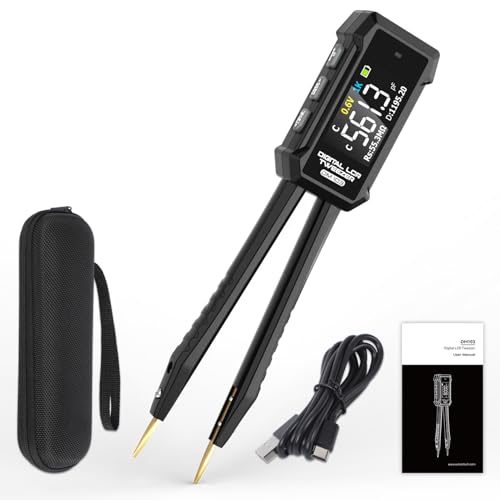
FNIRSI LCR-ST1 Smart Tweezers
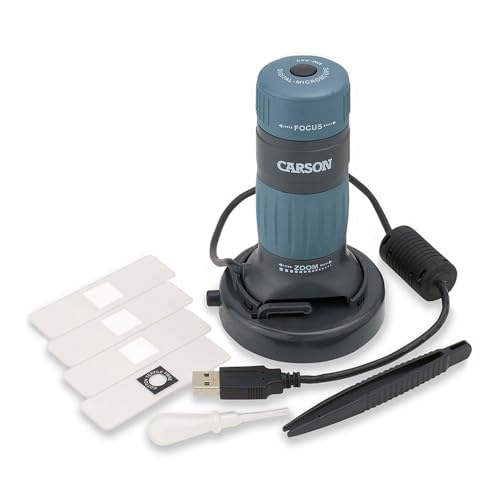
Andonstar AD246S-M Digital Microscope
Your System Security Plan just collapsed. C3PAO auditors flagged your perimeter gateway because the Netgate 1100’s internal ARM64 CPU and software-based OpenSSL accelerators are attempting IPsec VPN termination, SSL/TLS inspection, or captive portal encryption on Controlled Unclassified Information (CUI).
The Technical Reality: CMMC 2.0 Cryptographic Boundary Failures & The pfSense Trap
Under DFARS 252.204-7012 and CMMC Level 2 control SC.L2-3.13.11, any module performing cryptographic operations on CUI requires active NIST CMVP validation. The Netgate 1100 hardware and standard pfSense Plus OS lack active CMVP FIPS 140-2 or FIPS 140-3 validation certificates.
The regulatory consequence is immediate: a failed SSP, an unclosable POA&M demanding hardware replacement, and disqualification from DoD contract bids.
The “pfSense FIPS” Compilation Trap: Why FreeBSD OpenSSL Hacks Fail C3PAO Assessments
You have likely seen threads on r/netsec and r/sysadmin where engineers burn hundreds of hours attempting to compile FIPS-validated OpenSSL on FreeBSD. This is a dead end.
Auditors explicitly reject software-level compliance because the underlying hardware Random Number Generator (RNG) and OS kernel modules lack active NIST CMVP validation. You cannot bypass hardware-level CMVP requirements with a software hack. The community consensus is definitive: software patches do not satisfy the cryptographic boundary mandate, and C3PAO assessors will mark this as a critical finding regardless of your compilation efforts.
Tier 2/3 Subcontractor Budget Friction: Surviving the $200 vs. $5,000 Hardware Dilemma
Small machine shops and Tier 3 defense suppliers face a brutal financial reality. Palo Alto or high-end Fortinet enterprise stacks with active FIPS licenses cost $5,000+. You deploy the ~$200 Netgate 1100 to preserve capital, only to trigger the catastrophic audit failure described above.
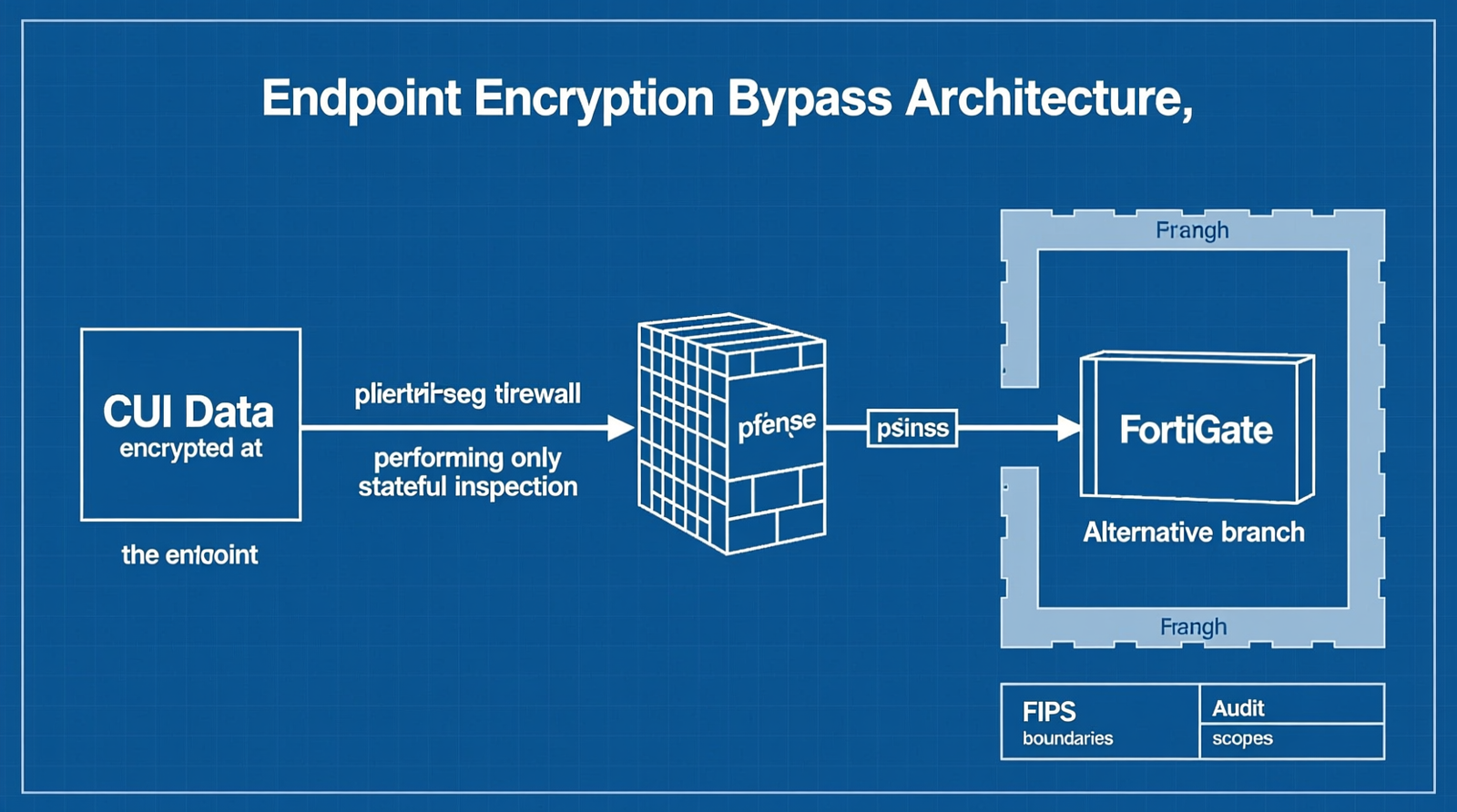
The solution is the “Endpoint Encryption Bypass Architecture.” This is the only mathematically viable method to utilize budget-friendly, TAA-compliant routing hardware while passing C3PAO assessments. By redesigning the network so that all CUI is encrypted at the endpoint level—using FIPS-validated storage like BitLocker in FIPS mode or end-to-end TLS 1.3 via a Secure Web Gateway—you restrict the pfSense firewall to stateful packet inspection and logging of already-encrypted payloads. This mathematically removes the firewall’s internal crypto modules from the CMMC cryptographic scope, saving your contract.
The Core Gear Architecture: Validated CUI Enclave & Bypass Stack
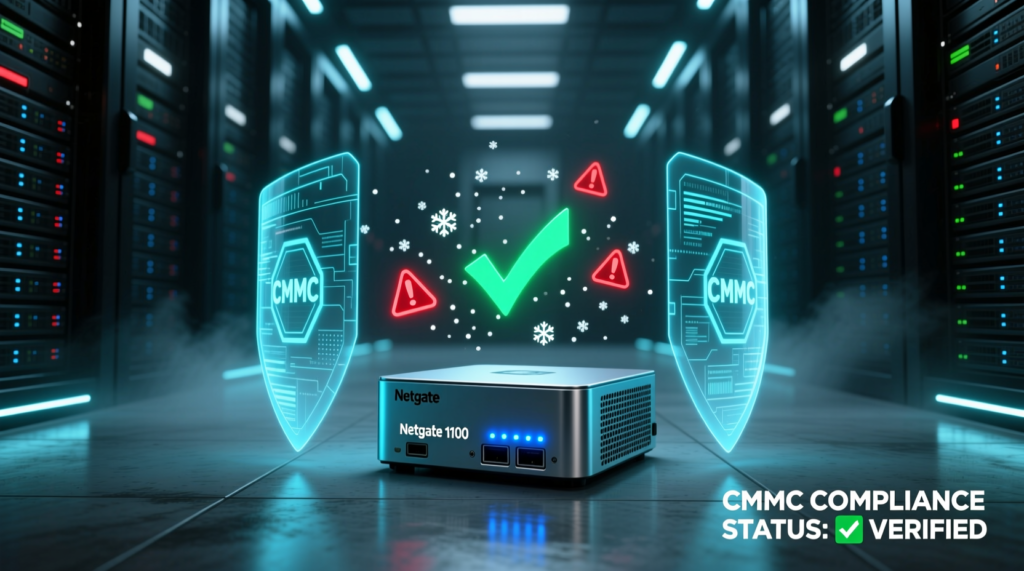
The Bypass Appliance: Netgate 1100 pfSense Plus (NDAA/TAA Compliant Routing)
The Netgate 1100 serves as the foundation of the bypass architecture. It runs on a Dual-Core ARM64 Cortex-A53 CPU clocked at 1.2 GHz with 1 GB DDR4 RAM and 8 GB eMMC storage. It features 3 x 1 Gbps Switched LAN ports and 1 x 1 Gbps WAN port. Assembled in the USA, it satisfies NDAA and TAA compliance requirements.
| Component | Specification | CPU | Dual-Core ARM64 Cortex-A53 @ 1.2 GHz | Memory | 1 GB DDR4 RAM | Storage | 8 GB eMMC | Ports | 3 x 1 Gbps LAN, 1 x 1 Gbps WAN | Compliance | NDAA / TAA (Assembled in USA) |
|---|
The ARM64 Cortex-A53 architecture provides sufficient throughput for stateful TCP/UDP inspection and NAT without the thermal constraints of older x86 routers.
Check out TECH Collection Amazon Products
More importantly, by assigning it a role strictly limited to routing and Suricata IDS/IPS logging, you ensure the device never touches CUI plaintext or performs prohibited cryptographic operations, keeping it safely outside the CMVP audit scope.
The Turnkey Crypto Alternative: Fortinet FortiGate 60F & FIPS-SEAL-RED Enforcement
For contractors who refuse the endpoint bypass and require FIPS-validated perimeter VPN or SSL inspection, the Fortinet FortiGate 60F is the fallback option. It utilizes a FortiSoC4 SD-WAN ASIC with 10 x GE RJ45 ports, delivering 10 Gbps Firewall Throughput and 1 Gbps NGFW Throughput. It holds FIPS 140-2 Level 2 validation with a documented transition path to FIPS 140-3.
| Component | Specification | Processor | FortiSoC4 SD-WAN ASIC | Ports | 10 x GE RJ45 | Firewall Throughput | 10 Gbps | NGFW Throughput | 1 Gbps | FIPS Validation | FIPS 140-2 Level 2 (Transition to 140-3) |
|---|
Strict FIPS-mode enforcement on the FortiGate 60F drops IPsec VPN throughput from 6.5 Gbps to approximately 2.5 Gbps due to CMVP algorithm restrictions. You must also apply the FIPS-SEAL-RED Tamper-Evident Seal Kit over chassis intrusion points. Breaking this seal zeroes out the internal HSM cryptographic keys, instantly invalidating the validation. This kit is mandatory to satisfy physical security and tamper-evidence audit controls.
SIEM & Enclave Compute: GEEKOM A9 Max Mini PC (80 TOPS AI Threat-Hunting)
Solving the r/homelab Java heap exhaustion and dropped log pain points requires the GEEKOM A9 Max Mini PC. Powered by the AMD Ryzen AI 9 HX 370 processor (12 Cores, 24 Threads, 4nm TSMC), it supports up to 128 GB dual-channel DDR5 SODIMM RAM and 2 x M.2 PCIe Gen4 x4 NVMe slots (up to 8 TB).
| Component | Specification | Processor | AMD Ryzen AI 9 HX 370 (12C/24T, 4nm) | RAM Support | Up to 128 GB DDR5 SODIMM | Storage | 2 x M.2 PCIe Gen4 x4 NVMe (Up to 8 TB) | AI Performance | ~80 TOPS Total Compute Density | Networking | Dual 2.5G RJ45 Ports |
|---|
Recommended Insights From Our Guide Library:
The massive 128 GB DDR5 capacity eliminates memory paging and Java heap exhaustion in Wazuh and OpenSearch during Suricata alert spikes, ensuring zero log loss during peak incidents.
The compute density is calculated as: Total localized AI threat-hunting performance = NPU_TOPS (55) + iGPU_TOPS + CPU_Vector_TOPS ≈ 80 TOPS. This density allows you to execute ML anomaly detection models via Ollama or LM Studio directly on the appliance, analyzing Wazuh logs for threats without exposing CUI data to cloud egress risks. The dual 2.5G RJ45 ports enable strict physical segmentation: Port 1 handles CUI enclave traffic/SIEM ingestion, while Port 2 connects to the out-of-band corporate network for management, strictly air-gapped from CUI routing.
The Technical Setup Blueprint: Bypass Configs, SIEM Ingestion & PCB Diagnostics
Netgate 1100 Cryptographic Bypass Configuration: Disabling IPsec & SSL/TLS Interception
To execute the bypass, you must reconfigure the Netgate 1100 to eliminate its cryptographic footprint.
| Configuration Category | Setting / Action | Disabled Services | IPsec VPN, SSL/TLS Interception, Captive Portal HTTPS on CUI VLANs | Enabled Services | Stateful TCP/UDP Routing, NAT, Suricata IDS/IPS (Alert/Drop, No SSL Decrypt), Syslog Forwarding | Endpoint Shift | FIPS-Validated Storage (BitLocker FIPS Mode) or End-to-End TLS 1.3 via SWG |
|---|
Disabling SSL interception on the Netgate ensures the firewall only sees encrypted blobs, preventing any accidental use of its internal OpenSSL for CUI crypto.
The Suricata engine continues to inspect packet headers and metadata for threats, providing visibility without violating the cryptographic boundary.
Wazuh SIEM Integration: Forwarding Suricata EVE JSON & Mapping FIM Syscheck Alerts
Continuous monitoring (SC.L1-3.13.1) requires robust log correlation to prove you are tracking endpoint integrity despite the perimeter bypass.
Configure pfSense to forward Suricata EVE JSON logs via TCP/514 to the Wazuh manager. Map the pfSense `alert.signature_id` to endpoint FIM `syscheck` alerts in Wazuh.
This correlation detects lateral movement attempts across the CUI boundary. If Suricata flags a suspicious connection signature and Wazuh simultaneously reports a file integrity change on an endpoint, you have actionable proof of compromise. This satisfies the auditor’s requirement for continuous monitoring without relying on perimeter decryption.
Proxmox VE Node Allocation & 2.5G RJ45 Physical Network Air-Gapping
Deploy the stack on Proxmox VE with precise memory allocations to prevent resource contention.
Check out TECH Collection Amazon Products
| Virtual Machine | vCPUs | Memory | Notes | Wazuh Manager | 8 | 32 GB DDR5 | Log processing core | OpenSearch/Elasticsearch | 8 | 64 GB DDR5 | OpenZFS ARC for indexing | pfSense Virtualized Edge | 4 | 8 GB DDR5 | Testing environment only |
|---|
Port 1 (2.5G RJ45): Connected to the Netgate 1100 LAN switch for CUI enclave traffic/SIEM ingestion. Port 2 (2.5G RJ45): Connected to the out-of-band corporate network for Proxmox GUI/hypervisor updates, strictly air-gapped from CUI routing.
The 64 GB allocation for OpenSearch leverages OpenZFS ARC to cache log indices in memory, drastically reducing query latency during audits.
The dual-port physical separation ensures that hypervisor updates or management traffic never traverse the CUI enclave network, maintaining a hard security boundary required for DoD compliance.
Micro-Electronics PCB Diagnostics: Retrofitting Legacy Endpoints for FIPS-Mode BitLocker
Retrofitted legacy endpoints often suffer severe I/O and CPU bottlenecks under FIPS-mode BitLocker, necessitating bench-level repairs to NICs or motherboards.
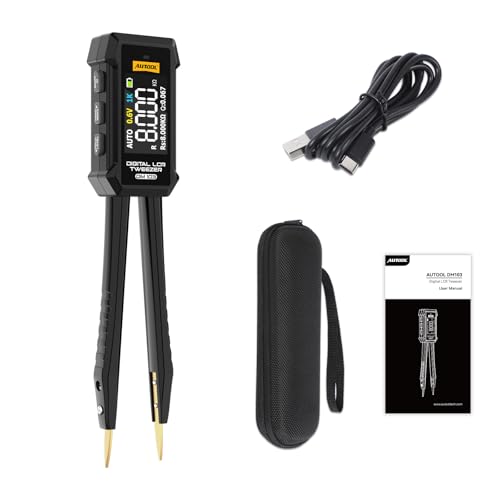
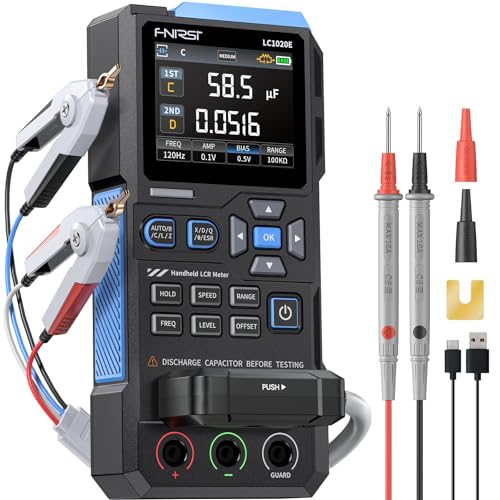
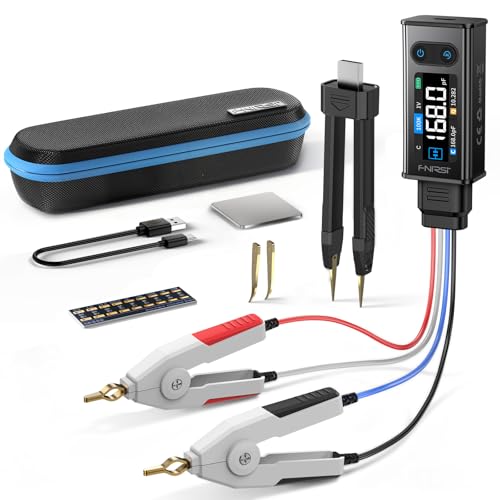
Utilize FNIRSI LCR-ST1 Smart Tweezers with test frequencies of 100 Hz for electrolytic caps, 1 kHz for standard ceramics, and 10 kHz for low-value SMD inductors or ferrite beads on NIC power rails. Apply 0.3V to prevent forward-biasing semiconductor junctions during in-circuit testing, or 0.6V for standard component validation.
Leverage the Andonstar AD246S-M Digital Microscope with the 30cm high bracket for clearance with a hot-air rework station (e.g., Quick 861DW) to remove shorted SMD capacitors near Ethernet PHY chips. Use the 2160P dual-screen HDMI output for zero-latency hand-eye coordination while rebuilding traces with 40 AWG copper jumper wire.
The 0.3V low-voltage mode prevents you from accidentally frying motherboard transistors while probing live circuits.
The 30cm bracket clearance allows safe desoldering of delicate PHY components without melting the microscope housing. The 2160P resolution ensures you can accurately solder micro-thin 40 AWG jumpers to restore connectivity on damaged traces, bringing legacy workstations back into compliance without replacing entire systems.
Field Verdict & Operational ROI: Securing the CMMC System Security Plan (SSP)
Eliminating Unclosable POA&Ms: The ROI of Mathematically Removing Perimeter Crypto
The operational victory is clear: By restricting the Netgate 1100 to stateful packet inspection and pushing FIPS-validated crypto to the endpoint, you eliminate the risk of unclosable POA&Ms. This approach secures strict CMMC Level 2 compliance without the capital expenditure of $5,000+ perimeter crypto appliances. You retain the cost benefits of the Netgate while satisfying the auditor’s demand for validated cryptographic boundaries.
Navigating the September 21, 2026 CMVP Transition to FIPS 140-3
Community Reference & Authority Resources:
Future-proof your infrastructure against the September 21, 2026 CMVP deadline, when all active FIPS 140-2 certificates move to the Historical list. Federal procurement guidelines will mandate FIPS 140-3 for new deployments. The FortiGate 60F’s documented transition path ensures continuity for those requiring turnkey FIPS hardware. Meanwhile, the Netgate bypass method remains future-proof because it mathematically removes the perimeter device from the cryptographic scope entirely, rendering the FIPS version irrelevant for the router itself. Both strategies secure long-term eligibility for DoD contract bids.
Implementing the Netgate 1100 pfSense Plus CUI endpoint encryption setup tutorial architecture defined here transforms a potential audit disaster into a robust, compliant, and cost-effective defense posture. By adhering to these specifications and leveraging the recommended hardware stack, you ensure your system security plan withstands rigorous C3PAO scrutiny while maintaining the agility needed for modern DevOps and homelab operations. Trust the math, respect the cryptographic boundary, and deploy with confidence.
🔍 Explore More: See all tech guides and tutorials for netgate 1100 pfSense plus CUI endpoint encryption setup tutorial.
Check out TECH Collection Amazon Products