





When it comes to NIST SP 800-171 moderate baseline firewall configuration guide, getting the right details matters. Recommended Hardware Stack:
Andonstar AD246S-M Digital HDMI Microscope
FNIRSI LCR-ST1 Smart LCR Tweezers
GEEKOM A9 Max Mini PC
The 2026 NIST SP 800-171 Moderate Baseline Firewall Configuration Guide: Surviving the FIPS 140-3 Mandate and CMMC 2.0 Audits
The primary infrastructure failure mode associated with the NIST SP 800-171 moderate baseline firewall configuration occurs at the cryptographic boundary of the network perimeter.
This failure triggers audit failures under Defense Federal Acquisition Regulation Supplement (DFARS) clause 252.204-7012 and Cybersecurity Maturity Model Certification (CMMC) 2.0 Level 2 requirements, caused by deploying standard commercial off-the-shelf (COTS) or open-source firewall appliances that lack active Cryptographic Module Validation Program (CMVP) certification.
When these unvalidated devices perform cryptographic operations, such as IPsec VPN termination or TLS inspection, on Controlled Unclassified Information (CUI), they violate security control SC.L2-3.13.11, which mandates the use of FIPS-validated cryptography.
This guide provides the engineering blueprint to resolve cryptographic boundary collapses and continuous monitoring blind spots.
You will learn how to deploy FIPS 140-3 validated perimeter gateways, configure high-performance DDR5 SIEM compute stacks for log aggregation, and maintain physical hardware integrity using specialized micro-electronics diagnostic tools to survive the September 2026 CMVP transition.
The Technical Reality: Cryptographic Boundary Collapses and the September 2026 CMVP Failure Point
The Cryptographic Boundary Collapse: Why COTS and Open-Source Firewalls Fail SC.L2-3.13.11
Standard commercial firewalls fail because their internal cryptographic modules lack CMVP validation.
When a non-FIPS appliance terminates an IPsec VPN tunnel or inspects TLS traffic containing CUI, the encryption process itself becomes non-compliant, directly violating DFARS clause 252.204-7012, CMMC 2.0 Level 2, and security control SC.L2-3.13.11.
Non-FIPS Fortinet models or standard Netgate pfSense hardware performing IPsec VPN termination or TLS inspection on CUI result in immediate violation of SC.L2-3.13.11.
This generates audit findings that cannot be remediated via software patches alone, requiring hardware replacement to restore compliance.
The September 21, 2026 CMVP Cliff: FIPS 140-2 to Historical Migration
A compounding architectural failure emerges from the impending CMVP transition scheduled for September 21, 2026.
On this date, the CMVP will migrate all remaining active FIPS 140-2 certificates to the Historical list, causing organizations relying on legacy FIPS 140-2 perimeter gateways to face immediate procurement and compliance failures.
Federal guidelines prohibit historical modules in new procurements, instantly bricking legacy FIPS 140-2 perimeter gateways for any new contract work or system refreshes after the transition date.
Continuous Monitoring Blindspots: Fragmented Logs and the SC.L1-3.13.1 Audit Trap
A secondary failure mode exists in continuous monitoring (SC.L1-3.13.1), where the lack of centralized Security Information and Event Management (SIEM) integration results in fragmented, uncorrelated firewall logs.
Without a unified view, security teams cannot detect unauthorized configuration alterations in real-time.
This prevents detection of unauthorized configuration changes and generates non-compliant audit reports, leaving the organization vulnerable to supply chain audit revocations by upstream prime contractors.
The Core Gear Architecture: 2026 FIPS 140-3 Perimeter Gateways and DDR5 SIEM Compute Stacks
The High-Ticket Perimeter Gateway: Fortinet FortiGate 60F & 40F FIPS SKUs
To resolve the cryptographic boundary failure, the 2026 hardware solution mandates the deployment of next-generation, FIPS 140-3 validated perimeter gateways.
The primary high-ticket solution is the Fortinet FortiGate 60F FIPS SKU, engineered with dedicated ASIC hardware acceleration and native FIPS-CC operating modes.
| Model | Ports | Firewall Throughput | NGFW |
|---|---|---|---|
| FortiGate 60F (FIPS SKU) | 10 x GE RJ45, 2.5G/10G SFP+ | 10 Gbps | 1 Gbps |
| FortiGate 40F (FIPS SKU) | 5 x GE RJ45 | 5 Gbps | 800 Mbps |
Dedicated ASIC acceleration handles Next-Generation Firewall (NGFW) throughput without degrading cryptographic performance at the boundary, ensuring line-rate security processing.
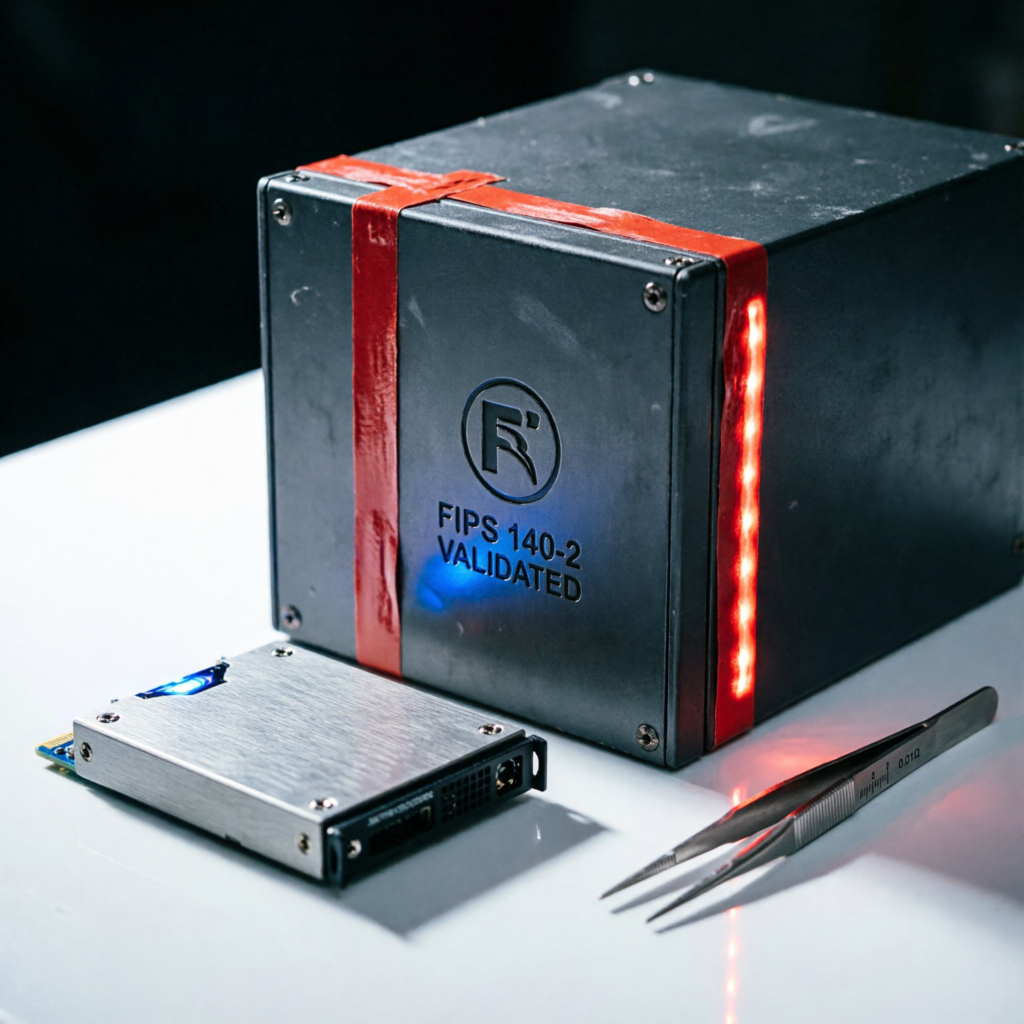
Both appliances are FIPS 140-3 Validated (2026 Mandate Compliant) and mandate the FIPS-SEAL-RED Tamper Kit for physical security compliance.
The FIPS-SEAL-RED Tamper Kit satisfies physical security requirements of the moderate baseline, preventing unauthorized physical access to the cryptographic modules during audits.
The Budget-Constrained Bypass: Netgate 1100 (pfSense Plus) & Endpoint Encryption
For organizations operating under strict budget constraints, the alternative architectural solution utilizes the TAA-compliant Netgate 1100 (pfSense Plus) paired with an endpoint-level encryption bypass strategy.
| Device | Ports | CPU |
|---|---|---|
| Netgate 1100 | 3 x 1 Gbps Switched | Dual-Core ARM64 Cortex-A53 |
This device operates strictly as a stateful inspection router while offloading all cryptographic processing to FIPS-validated endpoint storage via TLS.
This effectively removes the firewall from the cryptographic scope to satisfy auditors without purchasing expensive FIPS appliances.
The DDR5 SIEM Compute Cluster: GEEKOM A9 Max & A8 for Wazuh Log Aggregation
Continuous monitoring failures are resolved by integrating these firewalls with high-performance, DDR5-based centralized SIEM nodes running Wazuh.
This integration aggregates security event logs in Common Event Format (CEF), correlating raw network traffic with endpoint file integrity monitoring to generate audit-ready compliance reports.
| Model | CPU | Memory | Network |
|---|---|---|---|
| GEEKOM A9 Max Mini PC | AMD Ryzen™ AI 9 HX 370 | Up to 128 GB DDR5 | Dual 2.5G RJ45 |
| GEEKOM A8 | AMD Ryzen™ 9 8945HS | Up to 64 GB DDR5 | Single 2.5G RJ45 |
Massive memory expansion on the GEEKOM A9 Max Mini PC accommodates the OpenZFS Adaptive Replacement Cache (ARC), accelerating log read/write operations to prevent I/O bottlenecks during high-volume syslog ingestion.
The GEEKOM A8 supports mixed services like TrueNAS Log Storage and Nextcloud while maintaining strict network segmentation for SIEM node-to-node communications.
Micro-Electronics & PCB Diagnostic Stack: Maintaining Cryptographic Hardware Integrity
Physical layer faults, such as severed copper traces on the firewall motherboard or shorted surface-mount device (SMD) capacitors in the power supply unit, require specialized diagnostic tools.
Recommended Insights From Our Guide Library:
- The Silent Audit Killer: Why Your Firewall Logs Are Failing CMMC and How to Fix It » Z A D A
- Mastering Log Integrity: The Hardware Blueprint for Unbreakable SIEM and Firewall Compliance » Z A D A
- The CMMC-Auditable Firewall Bypass: How to Keep pfSense Out of CMVP Scope While Meeting FIPS 140-3 » Z A D A
- Understanding the NIST Cybersecurity Framework: A Comprehensive Guide » Z A D A
Standard diagnostic tools fail due to probe imprecision on multi-layer boards.
| Tool | Key Specs | Application |
|---|---|---|
| Andonstar AD246S-M Digital HDMI Microscope | 7-inch LCD, 2160P, 30cm Bracket | Multi-layer PCB trace repair |
| FNIRSI LCR-ST1 Smart LCR Tweezers | 0.3V/0.6V Test Voltage, 41g | SMD testing without forward-biasing |
The critical 30cm high bracket on the Andonstar AD246S-M Digital HDMI Microscope provides adequate vertical working space for hot-air rework during multi-layer PCB trace repair without damaging adjacent components.
The exact 0.3V/0.6V Test Voltage on the FNIRSI LCR-ST1 Smart LCR Tweezers prevents forward-biasing adjacent semiconductor junctions during power supply SMD testing, ensuring accurate measurements without parallel-component interference.
The Technical Setup Blueprint: FIPS-SEAL-RED Installation, ZFS ARC Tuning, and CEF Log Parsing
Perimeter Zoning and ASIC Acceleration: Segmenting the CUI Enclave
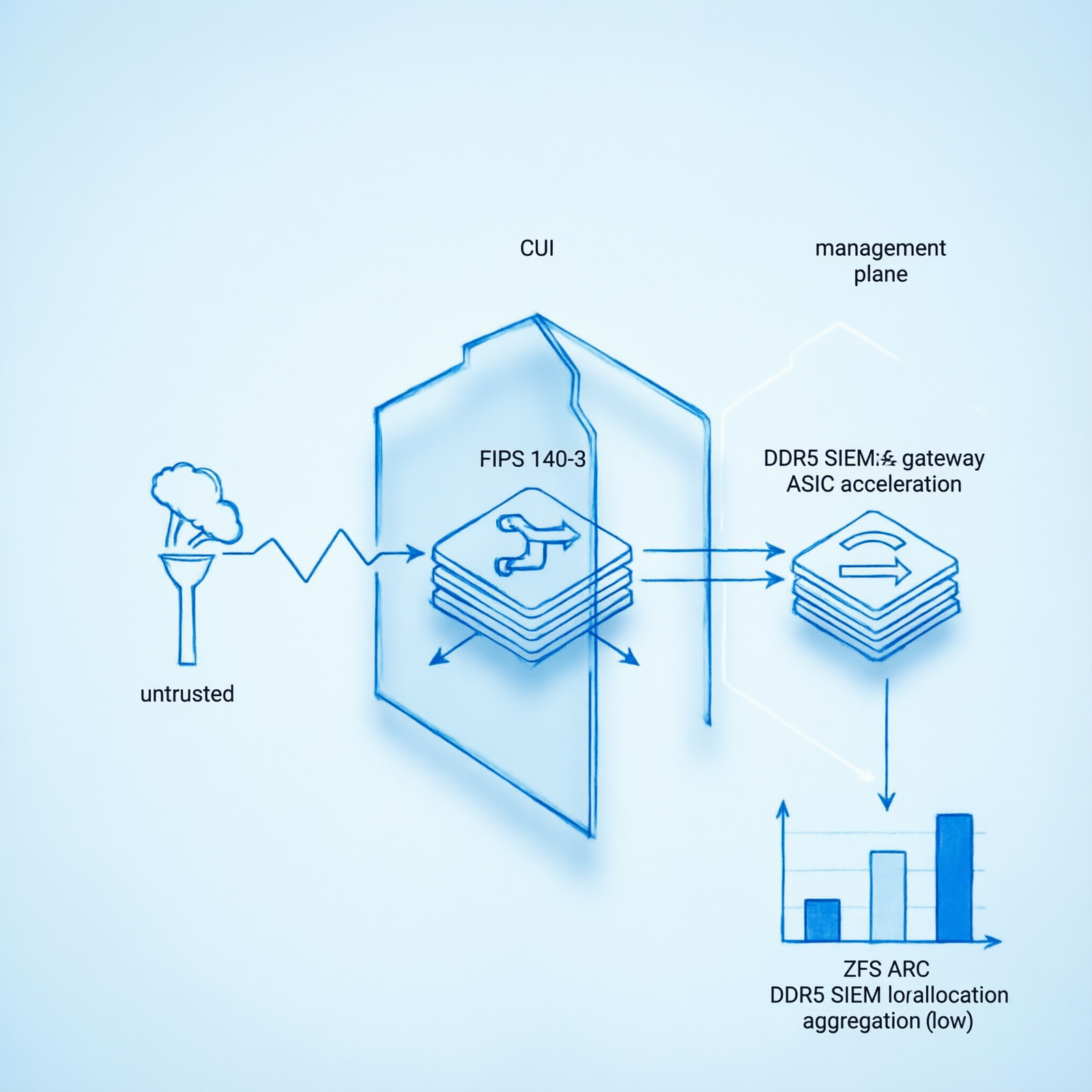
The network perimeter architecture for the NIST SP 800-171 moderate baseline requires strict segmentation between the untrusted external network, the CUI enclave, and the management plane.
The physical firewall must possess dedicated ASIC acceleration to handle NGFW throughput without degrading cryptographic performance.
This isolates sensitive data flows, ensuring that even if the external perimeter is breached, the CUI enclave remains protected by hardware-accelerated encryption policies.
Physical Security Execution: Installing the FIPS-SEAL-RED Tamper-Evident Kit
Physical installation presents a hurdle; rack-mount technicians frequently damage the delicate FIPS-SEAL-RED tamper-evident screws during initial deployment.
This requires expensive replacement kits to pass the physical security audit.
Proper installation procedures provide the exact blueprint for deploying the tamper-evident kit to satisfy moderate baseline physical security requirements without triggering expensive replacement kit orders due to technician error.
Overcoming Fortinet FIPS Mode Friction: Navigating Config Wipes and CLI Shifts
Within the Fortinet user base, a major structural pain point is the operational friction of enabling FIPS mode.
Technicians consistently report that activating FIPS mode on FortiGate appliances forces a complete configuration wipe, alters the command-line interface (CLI) syntax, and restricts advanced features like deep packet inspection.
This requires pre-deployment backup strategies and acceptance of reduced feature sets to achieve compliance, preventing unexpected downtime during the transition to FIPS-CC operating modes.
SIEM Integration and CEF Parsing: Fixing Syslog Mismatches in Wazuh
Sysadmins managing CMMC compliance express severe frustration with getting Fortinet or pfSense logs to parse correctly in open-source SIEM platforms like Wazuh.
The technical friction involves mismatched syslog formatting and CEF parsing failures.
This blinds the security team to configuration changes and fails the continuous monitoring audit; fixing this ensures raw network traffic correlates with endpoint file integrity monitoring for SC.L1-3.13.1 compliance.
ZFS ARC Memory Allocation: Preventing I/O Bottlenecks in High-Volume Syslog Ingestion
Check out TECH Collection Amazon Products
The DevOps homelab architecture serves as the centralized SIEM infrastructure and virtualized testing environment required to satisfy the continuous monitoring controls (SC.L1-3.13.1).
The physical hardware must support massive memory expansion to accommodate the OpenZFS Adaptive Replacement Cache (ARC).
The optimal cache size is defined by the equation M_ARC = M_physical / 2, where M_physical is the total installed DDR5 SODIMM capacity.
This mathematically defines the cache allocation to accelerate log read/write operations on the DDR5 mini PC clusters, preventing I/O bottlenecks during high-volume syslog ingestion.
Field Verdict & Operational ROI: Neutralizing Audit Revocations and the 2026 Compliance Payoff
Neutralizing the “pfSense FIPS Compliance” Debate: CapEx vs. Operational Overhead
Technical communities reveal intense friction regarding the “pfSense FIPS compliance” workaround.
Engineers argue over the operational overhead of managing endpoint certificates versus the capital expenditure of purchasing commercial FIPS appliances.
This delivers a definitive verdict on the forum debate, allowing leadership to weigh the long-term maintenance costs of certificate management against the upfront cost of compliant hardware.
Securing the Supply Chain: Preventing Prime Contractor Audit Revocations
Centralized Wazuh SIEM integration and audit-ready CEF reporting act as the ultimate shield against supply chain audit revocations.
Continuous monitoring transforms fragmented logs into defensible compliance evidence.
This frames the technical setup as a business continuity tool, highlighting how continuous monitoring (SC.L1-3.13.1) prevents loss of eligibility for federal contracts due to audit failures.
The 2026 Compliance ROI: Future-Proofing Against the FIPS 140-2 Historical Sunset
The financial and operational ROI of deploying FIPS 140-3 validated hardware now explicitly bypasses the panic and procurement failures associated with the September 21, 2026 CMVP transition.
This summarizes the financial benefit of early adoption, ensuring organizations avoid the procurement blackout where federal guidelines prohibit historical modules in new procurements.
Conclusion
This guide has detailed the exact technical failure modes threatening NIST SP 800-171 moderate baseline deployments, specifically the cryptographic boundary collapse and the September 2026 CMVP cliff.
By implementing FIPS 140-3 validated perimeter gateways like the Fortinet FortiGate 60F, configuring DDR5 SIEM compute clusters using the GEEKOM A9 Max Mini PC with precise ZFS ARC tuning, and utilizing specialized diagnostic tools like the Andonstar AD246S-M Digital HDMI Microscope, you secure your infrastructure against both technical failure and regulatory revocation.
Community Reference & Authority Resources:
The path forward requires precise adherence to hardware specifications and configuration blueprints, transforming fragmented compliance efforts into a robust, audit-ready defense posture.
Deploy these architectures now to neutralize audit risks and ensure uninterrupted supply chain eligibility through 2026 and beyond.
🔍 Explore More: See all tech guides and tutorials for NIST SP 800-171 moderate baseline firewall configuration guide.
Check out TECH Collection Amazon Products