








When it comes to how to achieve CMMC 2.0 level 2 with pfSense and endpoint TLS, getting the right details matters. FNIRSI LCR-ST1 Smart LCR Tweezers
Andonstar AD246S-M Digital Microscope
GEEKOM A9 Max Mini PC
Netgate 4100 (pfSense Plus)
Fortinet FortiGate 40F & 60F
FIPS-SEAL-RED Tamper-Evident Kits
GEEKOM A8 Mini PC
The Technical Reality: Perimeter Cryptographic Failure & The CMVP Cliff
The OpenSSL Validation Gap: Why pfSense Fails CUI in Transit
NIST SP 800-171 Revision 3 and DFARS 252.204-7012 mandate FIPS 140-2 or 140-3 validated cryptography for Controlled Unclassified Information in transit, specifically under control SC.L2-3.13.11. Standard open-source firewall deployments utilize OpenSSL libraries that lack active Cryptographic Module Validation Program certification.
When auditors inspect the perimeter gateway, they flag the absence of a FIPS certificate, resulting in a failed audit or a mandatory Plan of Action and Milestones. This creates a fundamental cryptographic validation gap where the software library does not meet federal standards for protecting data at the network edge.
Auditor Rejection Mechanics: IPsec/OpenVPN Failures & The POA&M Trap
System administrators frequently report that auditors reject IPsec and OpenVPN implementations because the underlying cryptographic modules are absent from the active CMVP list. Even if the traffic is encrypted, the module performing the encryption is not validated, triggering immediate non-compliance findings.
This creates a POA&M trap where organizations must document the deficiency and plan for remediation, which delays contract awards and exposes the supply chain to risk. The friction point is that the encryption exists technically, but legally and procedurally, it fails the audit criteria required for defense contracts.
The CMVP Transition: FIPS 140-2 Deprecation & Procurement Bans
The impending transition relegates all remaining active FIPS 140-2 certificates to Historical status. Procuring legacy FIPS 140-2 hardware for new federal supply chain contracts post-transition violates federal procurement guidelines.
This renders non-upgraded perimeter gateways non-compliant for upcoming Department of Defense bids. Organizations relying on current FIPS 140-2 hardware face an unacceptable risk for contracts extending beyond the transition window, forcing an immediate architectural shift toward FIPS 140-3 validated solutions to avoid procurement bans.
The Core Gear Architecture: Validated Hardware & Diagnostic Stack
Perimeter Routing Layer: Netgate 4100 (pfSense Plus) TAA-Compliant Specs
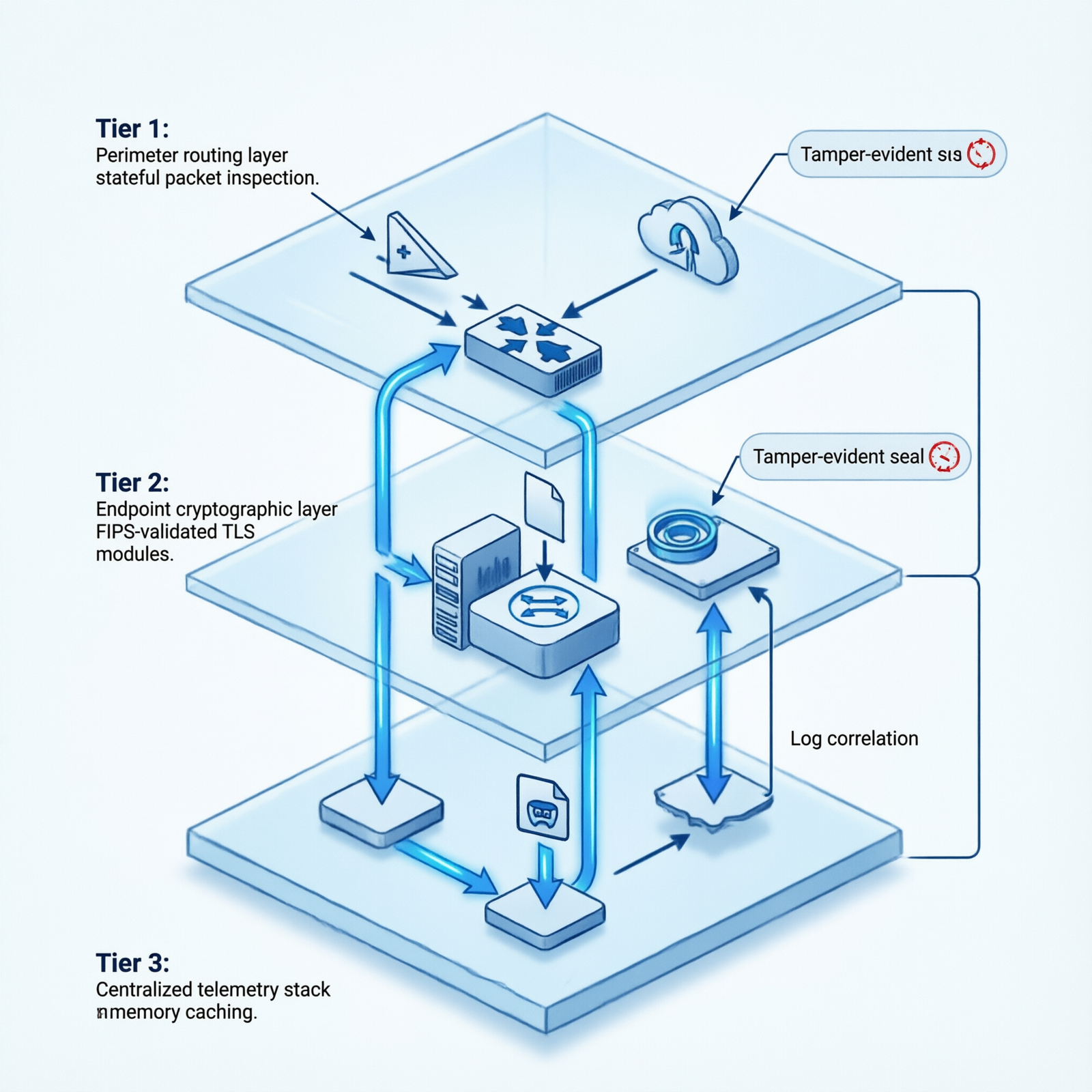
To resolve the cryptographic gap while adhering to FIPS 140-3 mandates, the architecture utilizes a dual-layer hardware approach. The perimeter routing layer utilizes TAA-compliant, high-throughput hardware operating strictly as a stateful packet inspector and router.
| Component | Specification |
|---|---|
| Processor | Intel Atom C3538 |
| Network Ports | 4 x 1G/2.5G RJ45 Switched |
| Primary Function | Stateful Packet Inspection & Routing |
| Cryptographic Role | Stripped / Bypassed |
Its role is entirely stripped of cryptographic processing duties to bypass perimeter crypto scope. By removing the burden of encryption from this device, you eliminate the OpenSSL validation gap while maintaining robust routing and access control capabilities.
Turnkey FIPS 140-3 Gateways: Fortinet FortiGate 40F & 60F with FIPS-SEAL-RED
For organizations requiring a turnkey, pre-validated perimeter gateway, the Fortinet series must be deployed with native FIPS 140-3 operating modes. Both models require the physical installation of FIPS-SEAL-RED tamper-evident kits to satisfy physical security controls.
| Model | Ports | Throughput | NGFW Performance |
|---|---|---|---|
| FortiGate 40F | 5 x GE RJ45 | 5 Gbps | 800 Mbps |
| FortiGate 60F | 10 x GE RJ45 | 10 Gbps | 1 Gbps |
These devices provide direct FIPS 140-3 validation, ensuring all cryptographic operations on CUI are performed by formally validated modules out-of-the-box. This eliminates the need for complex software workarounds and guarantees audit readiness from day one.
Endpoint Cryptographic Shift: FIPS 140-3 Validated SWG/HSM for End-to-End TLS
When utilizing the endpoint-bypass strategy, the cryptographic burden shifts to the endpoint layer using FIPS 140-3 validated Secure Web Gateways or hardware security modules. These devices enforce end-to-end Transport Layer Security before data traverses the network boundary.
This removes the firewall from the cryptographic scope entirely. By encrypting data at the source using validated modules, you satisfy SC.L2-3.13.11 requirements without needing FIPS-validated perimeter firewalls, allowing the use of cost-effective routing hardware for pure packet inspection.
Micro-Electronic Diagnostic Stack: FNIRSI LCR-ST1 Tweezers & Andonstar AD246S-M
The physical maintenance of FIPS-validated endpoint hardware requires specialized micro-electronic diagnostic equipment. The FNIRSI LCR-ST1 Smart LCR Tweezers feature a 41g weight, 1.14-inch Color Display, 250mAh battery, selectable 100 Hz/1 kHz/10 kHz frequencies, and 0.3V/0.6V test voltage.
| Device | Key Specifications | Diagnostic Application |
|---|---|---|
| FNIRSI LCR-ST1 | 41g, 1.14″ Display, 0.3V/0.6V Test Voltage | In-circuit SMD measurement without forward-biasing |
| Andonstar AD246S-M | 7″ LCD, 30cm Clearance, 2160P Video, Dual HDMI | Zero-latency visual diagnostics during hot-air rework |
These parameters allow single-handed measurement of surface-mount components without forward-biasing adjacent semiconductor junctions. For visual diagnostics, the Andonstar AD246S-M Digital Microscope provides a 7-inch LCD, 30cm high bracket clearance, 2160P video, Dual-Screen HDMI Output, and 3 interchangeable lenses. This setup enables zero-latency visual diagnostics during hot-air rework on high-security NICs.
DevOps Homelab Compute Cluster: GEEKOM A9 Max & A8 for Wazuh SIEM
Correlating raw network traffic logs with endpoint file integrity monitoring requires a high-performance, centralized SIEM infrastructure. The GEEKOM A9 Max serves as the ultimate hypervisor host, powered by an AMD Ryzen AI 9 HX 370 processor supporting up to 128 GB of dual-channel DDR5 SODIMM memory.
| Node | Processor | Max Memory | Storage & Networking |
|---|---|---|---|
| GEEKOM A9 Max | AMD Ryzen AI 9 HX 370 (12C/24T) | 128 GB DDR5 | Dual 2.5G RJ45, 2x M.2 PCIe Gen4 NVMe |
| GEEKOM A8 | AMD Ryzen 9 8945HS (8C/16T) | 64 GB DDR5 | Single 2.5G RJ45, 1x M.2 PCIe Gen4 NVMe |
These massive memory pools are critical for allocating resources to the OpenZFS Adaptive Replacement Cache when running TrueNAS or OpenSearch nodes for high-volume log ingestion. The GEEKOM A8 complements this setup with an AMD Ryzen 9 8945HS, up to 64 GB DDR5 SODIMM, Single 2.5G RJ45 LAN, and 1 x M.2 2280 NVMe PCIe Gen 4×4 up to 4 TB.
The Technical Setup Blueprint: Segmentation, SIEM Tuning & PCB Rework
Cryptographic Bypass Path Configuration: Stripping Crypto from the Netgate Data Flow
Configuring the Netgate 4100 involves handling routing, access control, and logging while strictly bypassing cryptographic processing on the CUI data flow. You must configure VLANs and firewall rules to ensure that encrypted traffic passes through the appliance without being inspected or decrypted by the engine.
This segmentation blueprint ensures the device remains TAA Compliant and functional as a router while staying out of the cryptographic scope that triggers auditor flags. It effectively isolates the routing function from the compliance-critical encryption function.
SIEM Log Correlation: Forwarding Syslog to Wazuh via Proxmox VE
Integrating firewall logs with endpoint TLS failure metrics requires rigorous SIEM tuning. You must forward syslog data to an open-source SIEM platform like Wazuh, aggregating security event logs to detect unauthorized configuration alterations.
This process runs on Proxmox VE using OpenZFS ARC memory caching on the compute nodes for high-volume log ingestion. The dual 2.5G RJ45 physical NIC segmentation separates control plane API traffic and node-to-node SIEM communications from the standard user network. This eliminates log correlation blind spots inherent in the endpoint TLS bypass strategy.
Physical Security Execution: Installing FIPS-SEAL-RED Tamper-Evident Kits
Physical compliance requires the exact installation protocol for applying FIPS-SEAL-RED kits to gateway chassis to satisfy physical security controls. These tamper-evident kits maintain FIPS 140-3 Level 2/3 validation by preventing unauthorized physical access to the cryptographic modules.
If a seal is broken, the module is considered compromised, and the FIPS validation is voided. This step satisfies continuous monitoring requirements regarding physical security and ensures the hardware remains in a trusted state throughout the audit period.
Endpoint Hardware Maintenance: Bridging Severed Traces with 40 AWG Micro-Jumper Wire
When a trace is severed on a multi-layer endpoint motherboard handling CUI, technicians must use 40 AWG micro-thin copper jumper wire to bridge the break. Standard multimeters fail to identify micro-short circuits in modern SMDs due to probe precision limitations.
Check out TECH Collection Amazon Products
Using 40 AWG wire under stereomicroscope magnification allows for precise repairs on high-density boards without damaging adjacent traces. This micro-electronic repair protocol ensures that endpoint hardware remains operational and physically intact to support the cryptographic load.
In-Circuit SMD Diagnostics: Utilizing FNIRSI LCR-ST1 Test Voltages
Diagnosing surface-mount components requires using the FNIRSI LCR-ST1’s 0.3V/0.6V dual test voltage levels and specific frequencies to perform in-circuit measurements. Selecting 100 Hz, 1 kHz, or 10 kHz frequencies allows you to measure capacitance and resistance without forward-biasing adjacent semiconductor junctions.
This diagnostic methodology prevents false parallel circuit readings during SMD testing. It ensures that technicians can verify component health on live or sensitive boards without causing electrical damage that would invalidate the hardware warranty or compliance status.
Field Verdict & Operational ROI: Surviving the Audit Gauntlet
Neutralizing the Endpoint TLS Complexity Penalty via Rigorous SIEM Tuning
The operational ROI of the compute cluster lies in its ability to handle the complexity penalty of endpoint TLS strategies. Massive DDR5 memory pools and dual 2.5G RJ45 physical NIC segmentation eliminate the log correlation blind spots inherent in the endpoint TLS bypass strategy.
By offloading heavy log processing to dedicated mini-PCs with high-speed storage, you ensure that audit trails are complete and searchable. This transforms a potential compliance liability into a verifiable asset that demonstrates continuous monitoring capability.
Securing the Supply Chain: Why Legacy Hardware is a Dealbreaker for Post-Transition Bids
Adopting FIPS 140-3 is not just an IT upgrade; it is a mandatory business continuity measure to avoid procurement bans after the transition window. Relying on legacy hardware poses an unacceptable risk for contracts extending beyond the compliance deadline.
The financial impact of losing a defense bid due to non-compliant hardware far outweighs the cost of upgrading to validated solutions now. This decision secures the supply chain against future regulatory shifts and ensures eligibility for upcoming government contracts.
The Ultimate Compliance Investment: Merging TAA Routing, FIPS 140-3 Endpoints & High-Performance Telemetry
Combining the TAA-compliant routing layer, FIPS 140-3 validated endpoint cryptography, and specialized micro-electronic diagnostic tools is the only bulletproof blueprint for achieving compliance without triggering a POA&M. This architecture addresses the OpenSSL validation gap, meets the CMVP transition requirements, and provides the telemetry needed for continuous monitoring.
It represents a convergence of networking, cryptography, and hardware maintenance that delivers a resilient, audit-ready infrastructure. Organizations that implement this hybrid model will maintain uninterrupted supply chain eligibility while reducing long-term operational overhead.
Conclusion
Community Reference & Authority Resources:
Achieving CMMC 2.0 Level 2 in the post-transition landscape requires moving beyond standard open-source configurations and embracing a hybrid architecture that respects cryptographic validation boundaries. By stripping crypto duties from the routing layer and shifting them to FIPS 140-3 validated endpoints, you bypass the OpenSSL validation gap that causes audit failures.
Supporting this stack with high-performance telemetry hardware and precise diagnostic tools ensures your infrastructure remains compliant, repairable, and ready for the rigors of federal contracting. Implementing this blueprint protects your organization from the regulatory cliff and secures your position in the defense supply chain.
🔍 Explore More: See all tech guides and tutorials for how to achieve CMMC 2.0 level 2 with pfSense and endpoint TLS.
Check out TECH Collection Amazon Products