







When it comes to pfSense plus endpoint encryption bypass for moderate confidentiality cui baseline, getting the right details matters.
Recommended Products
Netgate 1100 (pfSense Plus)
Fortinet FortiGate 40F
GEEKOM A9 Max
pfSense Plus Endpoint Encryption Bypass for the Moderate Confidentiality CUI Baseline: A CMMC 2.0 Level 2 Perimeter Architecture
If you are running pfSense Plus as your perimeter firewall for Controlled Unclassified Information, you have a cryptographic-boundary problem. NIST SP 800-171 Rev. 3 and CMMC 2.0 Level 2 require FIPS-validated cryptography when a network device performs cryptographic operations on CUI. Netgate‘s pfSense Plus appliances do not hold active CMVP FIPS 140-2 or FIPS 140-3 validation certificates. The moment pfSense Plus terminates a VPN, inspects TLS, or forwards plaintext CUI, it lands inside the cryptographic scope and an auditor can write a non-compliance finding.
This guide shows you how to bypass that failure mode with an endpoint-first architecture. You will learn the exact control mapping that trips up pfSense Plus deployments, how to move the cryptographic boundary to the endpoint, which hardware stack supports the design, and how to document the build so an auditor believes the firewall never decrypts CUI.
The Brutal Compliance Reality: Why pfSense Plus Alone Fails the CUI Cryptographic Boundary
The Regulatory Trigger — NIST SP 800-171 Rev. 3, CMMC 2.0 Level 2, and DFARS 252.204-7012
The “moderate confidentiality” CUI baseline applies to non-federal systems that process, store, or transmit CUI. DFARS clause 252.204-7012 requires contractors to implement the NIST SP 800-171 security requirements on those non-federal systems. That obligation does not disappear just because the environment is small, virtualized, or running open-source routing software.
For a defense subcontractor, this means every laptop, server, and boundary device that touches CUI must either operate outside the cryptographic scope or carry a CMVP-validated cryptographic module. There is no “small business” exception in the clause.
Control SC.L2-3.13.11 — When the Firewall Becomes the Crypto Boundary
Control SC.L2-3.13.11 demands FIPS-validated cryptography for VPNs and external boundary protection when the device performs cryptographic operations on CUI.
The key phrase is “when the device performs cryptographic operations,” which means a firewall routing encrypted packets is safe, but terminating VPNs or decrypting TLS places the device in the cryptographic scope and triggers the requirement. A firewall that merely routes already-encrypted packets is not performing cryptography on CUI. A firewall that terminates an IPsec/SSL VPN, decrypts TLS, or forwards CUI plaintext is performing cryptography on CUI.
This control is where most pfSense Plus deployments stumble. The device is powerful, flexible, and TAA-compliant, but it is not a CMVP-validated cryptographic module.
The Production Failure Mode
Here is the exact sequence that produces a finding:
1. The organization deploys pfSense Plus as the perimeter firewall in a CUI environment.
2. The firewall terminates or forwards CUI-bearing traffic, placing it inside the cryptographic scope.
3. The auditor asks for the CMVP validation certificate for the cryptographic module.
4. The organization produces Netgate documentation showing “FIPS-capable OpenSSL” or general OpenSSL FIPS configuration notes.
5. The auditor rejects the evidence because the appliance itself lacks a CMVP certificate.
6. The result is a non-compliance finding against SC.L2-3.13.11.
This is not a theoretical risk. It is the recurring pattern reported in CMMC/DFARS practitioner communities.
The CMVP Gap on Netgate Hardware
Netgate hardware running pfSense Plus is excellent routing and filtering gear, but it does not currently satisfy the cryptographic-module requirement.
Netgate 1100 (pfSense Plus)
| Specification | Details |
|---|---|
| Ports | 3 × 1 Gbps switched RJ45 |
| CPU | Dual-core ARM64 Cortex-A53 |
| Software | pfSense Plus pre-installed |
| Compliance Status | TAA compliant; No active CMVP FIPS 140-2 or FIPS 140-3 validation |
Netgate 4200 (pfSense Plus)
| Specification | Details |
|---|---|
| Ports | 4 × 2.5 GbE RJ45 + 2 × 10 GbE SFP+ |
| CPU | Intel Atom C3558R 4-core |
| Memory | 8 GB DDR4 |
| Software | pfSense Plus |
| Compliance Status | TAA compliant; No active CMVP FIPS 140-2 or FIPS 140-3 validation |
Standard pfSense community builds also lack active CMVP validation. The absence of a certificate is the absence of a certificate, regardless of how the software is compiled.
Forum Myth-Buster: “FIPS-Capable OpenSSL” ≠ CMVP-Validated Appliance
The r/sysadmin and r/netsec consensus is clear: pfSense is not FIPS-validated and cannot be the sole cryptographic boundary for CUI. Netgate forums report the same recurring auditor rejection of “FIPS-capable OpenSSL” claims.
The distinction matters. OpenSSL can be built with FIPS support, and individual software libraries can be validated. But SC.L2-3.13.11 looks for a full CMVP-validated appliance certificate covering the cryptographic module in its deployed form. Only a complete CMVP validation satisfies the control. Anything less is a conversation with an auditor that ends in a finding.
The Architectural Bypass: Moving the Cryptographic Boundary to the Endpoint
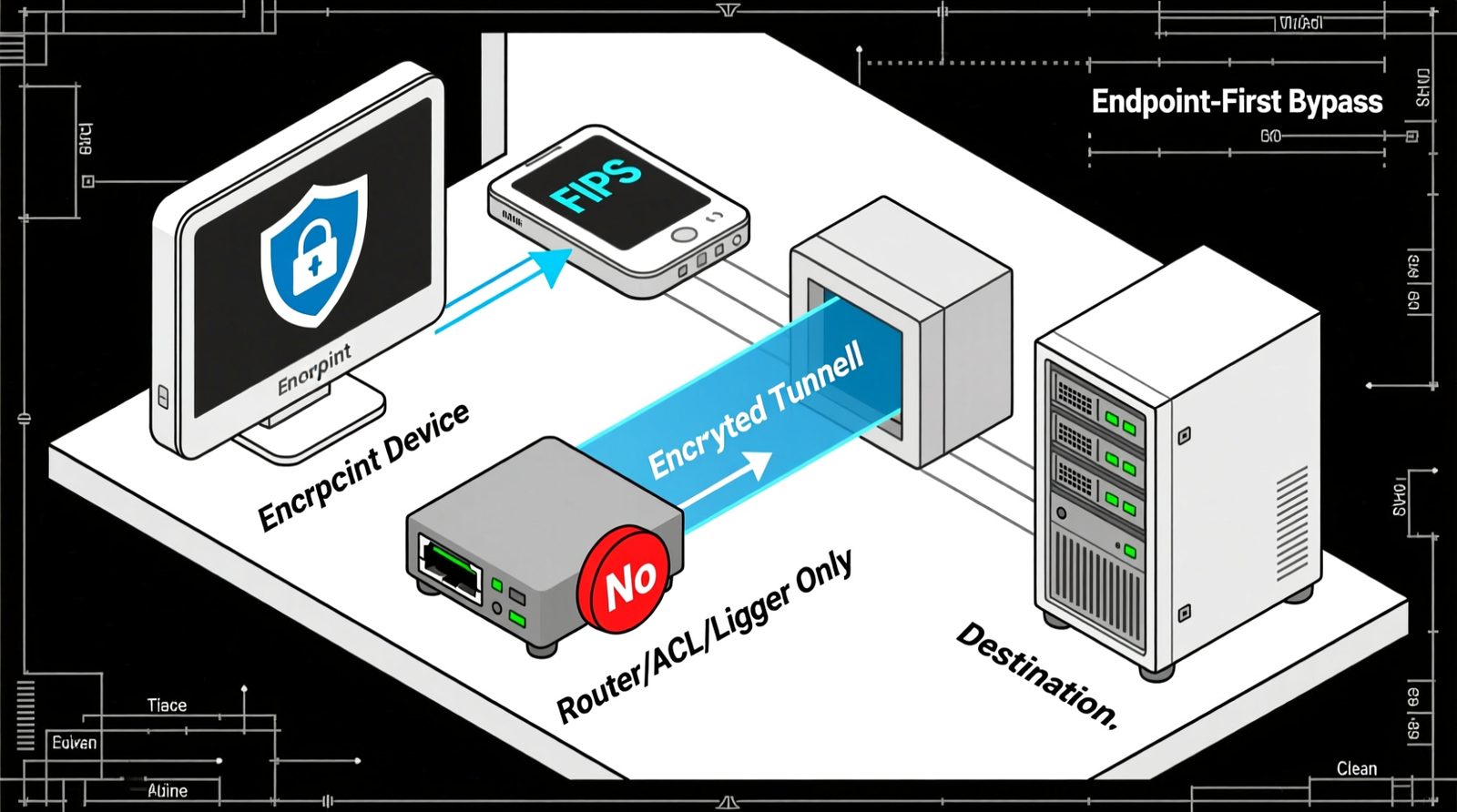
The bypass is simple in concept and rugged in practice: encrypt CUI at the endpoint, then let pfSense Plus route and log the encrypted packets without ever decrypting them.
The Endpoint-First Data Flow
The structural spine of the architecture is this exact path:
CUI endpoint → FIPS-validated TLS 1.3 / application-level encryption / compliant SWG → encrypted transit → pfSense Plus router/ACL/logger → destination.
The firewall never decrypts CUI. It sees only encrypted payloads, metadata, and session headers. Because the plaintext never appears on the firewall, the firewall is not performing cryptography on CUI and is outside the cryptographic scope.
Why This Removes pfSense Plus from the Cryptographic Scope
pfSense Plus is limited to three functions in this design:
– Routing
– ACL enforcement
– Logging of already-encrypted packets
It does not:
– Perform TLS inspection on CUI traffic
– Terminate CUI VPNs
– Decrypt CUI-bearing traffic
As long as those prohibitions are documented, configured, and monitored, the device is a router and logger, not a cryptographic boundary.
Endpoint Encryption Stack Options
To make the bypass defensible, the endpoint encryption must itself be FIPS-validated. Choose from:
Check out TECH Collection Amazon Products
– FIPS 140-3 validated TLS libraries for application and web traffic.
– Endpoint full-disk encryption operating in FIPS mode for data at rest.
– FIPS-validated Secure Web Gateway (SWG) for web-bound CUI traffic.
Each of these moves the cryptographic operation to a validated module on the endpoint, before the data reaches the network.
Audit Evidence: Proving the Firewall Never Decrypts CUI
An auditor will not take your word for it. Build evidence that includes:
– Traffic-flow diagrams showing encryption originates at the endpoint.
– pfSense Plus rule sets that explicitly deny TLS inspection and VPN termination for CUI VLANs.
– Configuration baselines and change logs proving the rules have not been altered.
The goal is to make the absence of decryption provable and repeatable.
The Core Gear Architecture: Validated 2026 Hardware Stack
pfSense Plus Perimeter Nodes (Router / ACL / Logger — Not Crypto Boundary)
Netgate 1100 (pfSense Plus)
**Role:** Budget/TAA-compliant perimeter router/ACL/logging node for the endpoint-encryption bypass architecture.
| Specification | Details |
|---|---|
| Ports | 3 × 1 Gbps switched RJ45 |
| CPU | Dual-core ARM64 Cortex-A53 |
| Software | pfSense Plus pre-installed |
| Compliance Status | TAA compliant; No active CMVP FIPS validation |
This is the entry point for small defense subcontractors that need a reliable perimeter device but are willing to handle encryption at the endpoint.
Netgate 4200 (pfSense Plus)
**Role:** Current-generation upgrade path with higher throughput and modern interface speeds.
| Specification | Details |
|---|---|
| Ports | 4 × 2.5 GbE RJ45 + 2 × 10 GbE SFP+ |
| CPU | Intel Atom C3558R 4-core |
| Memory | 8 GB DDR4 |
| Software | pfSense Plus |
| Compliance Status | TAA compliant; No active CMVP FIPS validation |
The extra 2.5 GbE and 10 GbE SFP+ ports matter when you are moving encrypted traffic at multi-gigabit speeds and need headroom for logging and ACL processing.
Turnkey FIPS-Validated Gateway Alternatives (When the Firewall Must Be Inside the Crypto Scope)
If your architecture genuinely requires the firewall to terminate VPN or inspect traffic for CUI, you need a CMVP-validated appliance.
Fortinet FortiGate 40F
| Specification | Details |
|---|---|
| Ports | 5 × GE RJ45 |
| Firewall Throughput | 5 Gbps |
| NGFW Throughput | 800 Mbps |
| Validation | FIPS 140-2 Level 2 validated |
| Requirement | Requires FIPS-SEAL-RED tamper-evident seal kit |
This is the smallest turnkey FIPS-validated gateway for shops that want the firewall inside the crypto scope.
Fortinet FortiGate 60F
| Specification | Details |
|---|---|
| Ports | 10 × GE RJ45 |
| Firewall Throughput | 10 Gbps |
| NGFW Throughput | 1 Gbps |
| Validation | FIPS 140-2 Level 2 validated |
| Requirement | Requires FIPS-SEAL-RED tamper-evident seal kit |
The 60F doubles the port count and roughly doubles the throughput, making it a better fit for mid-sized contractors with more segmented networks.
Recommended Insights From Our Guide Library:
2026 CMVP Transition Rule
On September 21, 2026, all remaining active FIPS 140-2 certificates move to Historical status. New procurements should target FIPS 140-3 validated modules. Existing FIPS 140-2 hardware already in production may remain in use depending on contract language, but new bids should not rely on Historical certificates as a primary compliance argument.
Continuous Monitoring Layer
Wazuh Open-Source SIEM
Wazuh provides log aggregation, file-integrity monitoring, and audit-ready reporting. It supports SC.L1-3.13.1 and gives you the centralized visibility you need to prove the bypass architecture is functioning as designed.
The Technical Setup Blueprint: Implementing the pfSense Plus + Endpoint Encryption Bypass
Network Zoning and Traffic Flow
1. Place CUI endpoints on a dedicated VLAN.
2. Enforce the path: endpoint encryption → encrypted transit → pfSense Plus routing/ACL/logging → destination.
3. Document that pfSense Plus never holds CUI plaintext or keys.
VLAN isolation keeps CUI traffic segmented from general corporate traffic and makes rule enforcement simpler.
pfSense Plus Hardening Rules
– Disable TLS inspection for CUI traffic.
– Disable VPN termination of CUI on pfSense Plus; offload to the endpoint or a FIPS-validated gateway.
– Use ACL-only enforcement and comprehensive logging.
These rules should be treated as configuration baselines. Any change should require a ticket, a review, and a logged approval.
Endpoint Encryption Deployment
– Select FIPS 140-3 validated TLS libraries, application encryption, or a FIPS-validated SWG.
– Implement certificate and key management at scale before the endpoint count grows.
– Enable endpoint full-disk encryption in FIPS mode.
Certificate and key management is the real-world pain point in CMMC/DFARS practitioner communities. Plan for it early.
Audit Logging and Continuous Monitoring
– Deploy Wazuh SIEM for log aggregation and file-integrity monitoring.
– Produce audit-ready reporting aligned with SC.L1-3.13.1.
Wazuh turns the “prove the firewall never decrypts” conversation into a data-driven review of logs and file-integrity alerts.
Supporting Lab & Diagnostic Bench Specs
Micro-Electronics & PCB Diagnostic Architecture
– 40 AWG micro-thin copper jumper wire for severed motherboard trace repair.
FNIRSI LCR-ST1 Smart LCR Tweezers
| Specification | Details |
|---|---|
| Test Frequencies | Selectable: 100 Hz, 1 kHz, 10 kHz |
| Test Voltages | Dual: 0.3 V and 0.6 V |
| Display | 1.14-inch color display |
| Weight | 41 g |
| Battery | 250 mAh |
The selectable 100 Hz / 1 kHz / 10 kHz frequencies let you match the test signal to the component, while the 0.3 V low-voltage mode prevents false readings on sensitive SMD parts.
Andonstar AD246S-M
| Specification | Details |
|---|---|
| Display | 7-inch LCD |
| Bracket | 30 cm high bracket |
| Lenses | Three interchangeable lenses |
| Video | 2160P video |
| Output | Dual-screen HDMI output (local + external simultaneously) |
The dual-screen HDMI output lets one technician inspect a trace on the built-in LCD while another watches the same feed on an external monitor.
DevOps Homelab & Compute Cluster Architecture
GEEKOM A9 Max
| Specification | Details |
|---|---|
| CPU | AMD Ryzen AI 9 HX 370 (12 cores / 24 threads) |
| Memory | Up to 128 GB DDR5 SODIMM |
| Storage | 2 × M.2 PCIe Gen4 x4 NVMe (up to 8 TB) |
| Networking | Dual 2.5G RJ45 LAN |
| Wireless | Wi-Fi 7 ready |
The 128 GB DDR5 ceiling and dual 2.5G LAN ports make this a strong Proxmox node with memory for ZFS ARC and separate control-plane traffic.
GEEKOM A8
| Specification | Details |
|---|---|
| CPU | AMD Ryzen 9 8945HS (8 cores / 16 threads) |
| Memory | Up to 64 GB DDR5 SODIMM |
| Storage | 1 × M.2 2280 NVMe PCIe Gen4 x4 (up to 4 TB) |
| Networking | Single 2.5G RJ45 LAN |
| Wireless | Wi-Fi 6E |
GEEKOM A6
| Specification | Details |
|---|---|
| CPU | AMD Ryzen 7 6800H (8 cores / 16 threads) |
| Memory | Up to 64 GB DDR5 SODIMM |
| Storage | 1 × M.2 2280 PCIe Gen4 x4 + 1 × M.2 2242 SATA |
| Networking | Single 2.5G RJ45 LAN |
| Wireless | Wi-Fi 6E |
Proxmox VE + TrueNAS/OpenZFS
– KVM/LXC virtualization
– TrueNAS/OpenZFS requires sufficient DDR5 for ARC cache
– Dual NICs allow control-plane API traffic segmentation from node/user traffic
Running Proxmox VE on a dual-NIC mini PC lets you keep management traffic off the user data plane, which is exactly what a CUI-hardened lab needs.
Field Verdict & Operational ROI: Why the Bypass Architecture Wins for Defense Subcontractors
Cost and Procurement Reality
A FortiGate-class FIPS-validated appliance is the right answer when the firewall must sit inside the crypto scope. It is also expensive and can carry long lead times. The pfSense Plus + endpoint encryption bypass lets a small or mid-sized contractor use a TAA-compliant Netgate 1100 or Netgate 4200 for routing and ACLs while pushing the cryptographic boundary to validated endpoint software or a FIPS-validated SWG.
Auditor-Ready Defense
The architecture wins in audits because the evidence is concrete:
– Network diagrams show encryption originating at the endpoint.
– pfSense Plus rule sets explicitly block TLS inspection and VPN termination for CUI VLANs.
– Wazuh SIEM logs and file-integrity monitoring back up the claim that the firewall never decrypts CUI.
Certificate and Key-Management Overhead
The biggest operational challenge is not the firewall; it is scaling endpoint encryption. Invest in a certificate lifecycle management tool and a key-escrow policy before the endpoint count grows. Doing this after the fact is the fastest way to turn a clean architecture into an audit mess.
Continuous Monitoring ROI with Wazuh
Wazuh satisfies SC.L1-3.13.1 on an open-source SIEM path. Centralized logging and file-integrity monitoring reduce audit friction and give you early warning when a configuration drifts away from the baseline.
2026 Readiness and the FIPS 140-2 Historical Transition
The September 21, 2026 CMVP transition is real. Existing FIPS 140-2 hardware can often remain in production, but new procurements should specify FIPS 140-3 validated modules. If you are writing a proposal today, do not bet it on a FIPS 140-2 certificate that will be Historical by the time the contract starts.
Conclusion
Community Reference & Authority Resources:
pfSense Plus is a capable perimeter platform, but it is not a CMVP-validated cryptographic module. For the moderate confidentiality CUI baseline under CMMC 2.0 Level 2, that gap is fatal if the firewall terminates VPNs, inspects TLS, or handles plaintext CUI. The endpoint encryption bypass solves the problem by moving the cryptographic boundary to the endpoint: CUI is encrypted before it reaches the network, and pfSense Plus is restricted to routing, ACL enforcement, and logging.
This architecture keeps you out of the crypto scope, preserves budget, and gives you an auditor-ready evidence package. Pair a Netgate 1100 or Netgate 4200 with FIPS 140-3 validated endpoint encryption, harden the rule set, and feed everything into Wazuh for continuous monitoring. If the firewall must be inside the scope, step up to a Fortinet FortiGate 40F or Fortinet FortiGate 60F. Either way, design the boundary deliberately, document it completely, and prepare now for the September 2026 FIPS 140-2 Historical transition.
🔍 Explore More: See all tech guides and tutorials for pfSense plus endpoint encryption bypass for moderate confidentiality cui baseline.
Check out TECH Collection Amazon Products