
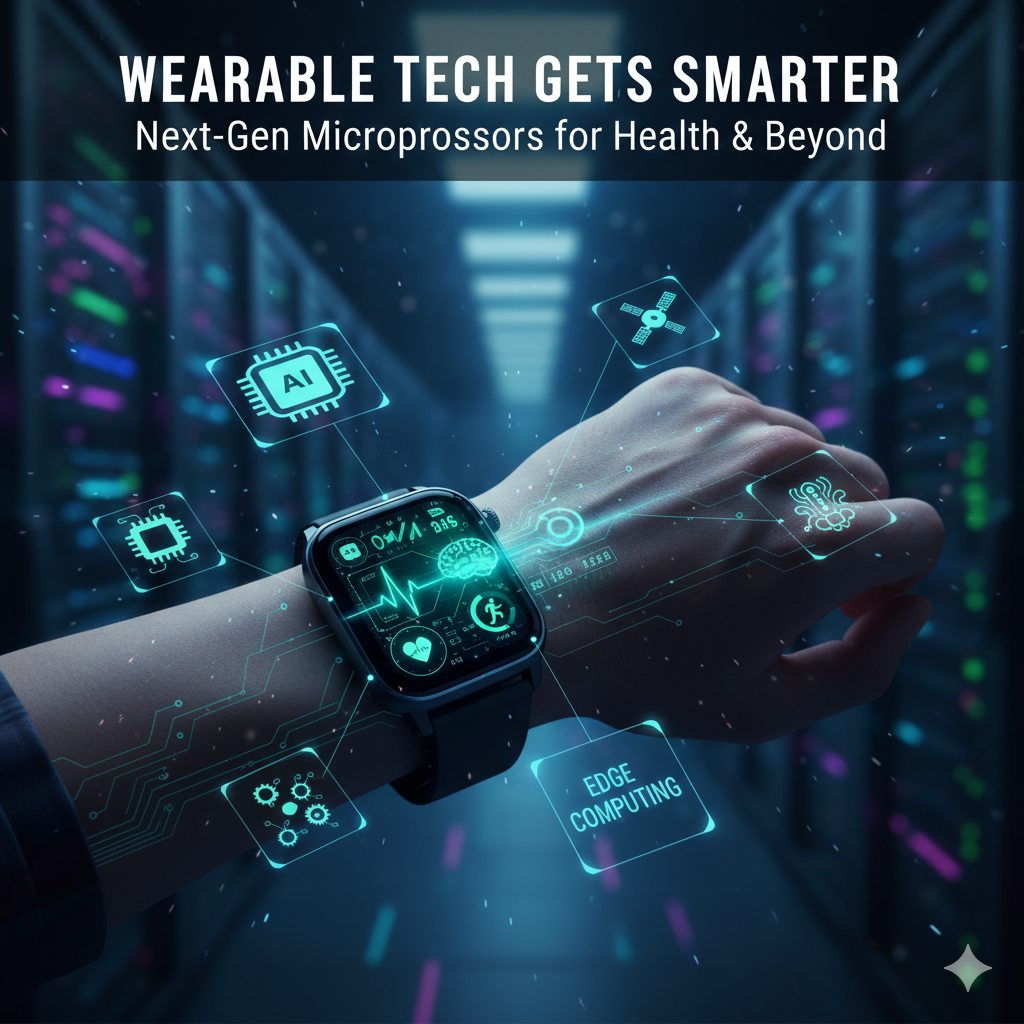


Wearable technology is experiencing one of the fastest innovation cycles in consumer electronics, and almost all of that progress is fueled by massive improvements in microprocessor design. 🤓
Today’s smartwatches, fitness trackers, smart rings, earbuds, and medical devices rely on advanced chips that are smaller, faster, more power-efficient, and smarter than any previous generation. 💡
These new microprocessors allow wearable devices to analyze biometric information in real time, run on-device AI, support multiple high-frequency sensors, and maintain longer battery life—all while fitting into ultra-compact casings designed for everyday use.
As consumer demand shifts toward accurate health monitoring and proactive wellness insights, microprocessors are becoming the foundation of next-gen digital health innovation. 📌
The transformation happening in wearable processors is not incremental—it is revolutionary, enabling capabilities once thought impossible in tiny devices.
Why Microprocessors Matter in Wearables
The microprocessor inside a wearable is the main intelligence engine that powers every function the device performs.
It collects raw data from sensors, processes biometric signals, supports wireless communication, and generates meaningful insights for the user. 🤓
Without a powerful processor, wearables would merely be simple step counters, but today’s chips allow them to become advanced health companions capable of continuous monitoring and predictive analysis.
Next-gen processors also determine how fast a wearable reacts, how accurate its measurements are, how long the battery lasts, and how securely data is stored.
In short, the processor defines the entire performance, reliability, and intelligence of a wearable device.
How Wearable Microprocessors Are Becoming Smarter
Modern wearable processors are not just faster—they are fundamentally redesigned to meet the demands of health monitoring, AI, and always-on sensing.
New architectures combine machine learning, energy efficiency, biomonitoring, and secure processing into a single chip. 💡
This enables wearables to deliver continuous insights and medical-grade accuracy while remaining lightweight and comfortable to wear.
1. AI Accelerators Built Directly Into Chips
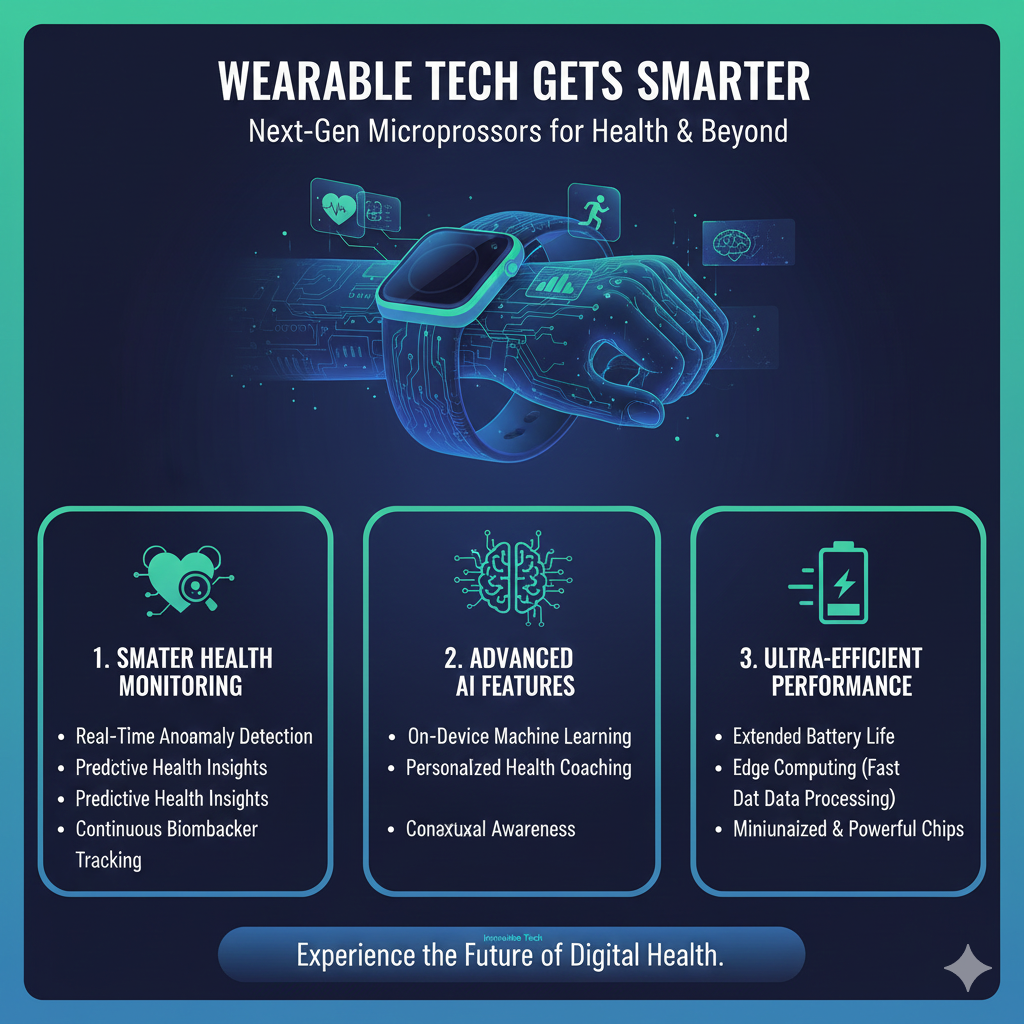
One of the most significant advancements in wearable processors is the integration of AI accelerators.
These specialized cores allow devices to run machine-learning models locally, without relying on cloud processing.
On-device AI improves speed, reduces latency, enhances privacy, and enables wearables to make instant decisions about health data.
For example, a smart band can analyze heart rhythm anomalies immediately and alert the user in real time.
AI-enhanced chips elevate wearable health monitoring from passive data logging to intelligent analysis.
2. Lower Power Consumption for Longer Battery Life
Battery life remains one of the biggest limitations of wearable tech.
Wearables need efficient processors that can perform complex calculations while conserving energy.
Today’s chips use advanced fabrication nodes—such as 5nm, 4nm, and even 3nm—that minimize power consumption.
These improvements enable devices to support continuous heart rate monitoring, GPS tracking, sleep analysis, and sensor fusion without draining the battery quickly. 🔋
Some wearables now last days or even weeks on a single charge thanks to microprocessors optimized for low-power modes.
3. Enhanced Biosensing Support
The shift toward health-focused wearables requires processors that can support sophisticated biosensors.
Modern chips can manage multiple sensor inputs simultaneously, including optical, electrical, and thermal signals.
These sensors monitor important biomarkers such as:
- ECG readings to detect heart irregularities
- Blood oxygen saturation for respiratory insights
- Skin temperature for stress, illness, or recovery patterns
- Continuous glucose trends using new optical technologies
Wearable processors not only capture this data but also interpret it through advanced signal-processing algorithms.
This combination of hardware and software makes modern wearables incredibly precise and reliable.
4. On-Device Data Encryption
As wearables collect more sensitive health information, data security becomes essential.
New microprocessors integrate specialized security modules that encrypt data directly at the hardware level.
This protects biometric data even if the device is compromised.
Secure enclaves and hardware-level key protections ensure privacy across wireless transfers, storage, and cloud syncs.
These measures are crucial as wearables evolve into medical-grade devices.
Top Microprocessors Powering the Future of Wearable Tech
The following processors are at the forefront of wearable technology, powering everything from smartwatches to medical wearables.
They offer cutting-edge performance, AI processing, sensor support, and energy efficiency.
| Processor | Key Features |
|---|---|
| Qualcomm Snapdragon W5+ | 4nm efficiency, AI support, sensor fusion, ultra-low power, responsive interactions |
| Apple S9 SiP | Neural engine, advanced motion sensors, health algorithms, seamless OS integration |
| Samsung Exynos W1000 | 3nm node, high efficiency, strong ECG support, optimized for circular wearables |
| ARM Cortex-M55 + Ethos-U55 | AI edge processing, robust medical wearable integration, low-power machine learning |
These processors represent the cutting edge of wearable silicon innovation.
Real-World Applications Changing Daily Life
Microprocessor advancements are enabling wearables to become essential tools in everyday health, fitness, and medical care.
Below are the most impactful real-world applications of these technologies.
Smart Health Monitoring
Wearables now provide users with continuous health insights that once required clinical equipment.
Microprocessors analyze movement, heart rate, blood oxygen, and sleep patterns in real time.
They detect abnormalities such as irregular heartbeats, stress, early illness signs, or sleep disruptions.
These early warnings empower users to take action before issues worsen. ❤️
Sports & Fitness Performance
Athletes depend on precision data to optimize their performance.
Wearable processors help monitor biomechanics, pace, endurance, and recovery quality.
AI-enhanced chips translate sensor data into actionable recommendations for training improvement. 🏃♂️
This kind of personalized coaching was once available only to elite athletes, but is now accessible to everyone.
Medical Wearables & Diagnostics
Microprocessors designed for medical devices meet higher standards for stability and signal accuracy.
These chips enable long-term monitoring of chronic conditions such as heart disease, diabetes, and respiratory disorders.
Doctors use data from medical wearables to adjust treatment plans, track recovery, and monitor at-risk patients remotely.
Wearable processors are playing a crucial role in modern telemedicine systems.
External Links for Further Reading
HealthTech Innovation Resources
Recommended YouTube Resources
https://youtu.be/Z6L4rraF2g8
https://youtu.be/3x1V6aO4wTA
Future Trends in Wearable Microprocessors
The future of wearable processors is incredibly promising, with innovations underway that will reshape digital health and personal technology.
Chips are expected to become even smaller, more intelligent, and more energy efficient.
They will also support new sensing technologies, enabling wearables to analyze broader ranges of biological signals.
- Ultra-miniaturized chips that blend seamlessly into smart clothing and skin patches
- Nanotechnology integration for molecular-level health monitoring
- Advances in AI that allow predictive and preventive health insights
- More medical-grade sensors built into consumer wearables
- Enhanced neural interfaces for brain-health tracking
These innovations will push wearables beyond tracking into full-scale wellness management systems.
Conclusion
Wearable technology is evolving rapidly, and microprocessor innovation is at the core of this transformation.
New chips enable smarter, more accurate, and more powerful health monitoring features.
They support next-generation AI processing, extended battery life, advanced biosensing, and robust data security.
As microprocessors continue to advance, wearables will shift from basic trackers into essential, intelligent health companions capable of proactive wellness management.
The future of wearable tech is not just smart—it is becoming predictive, personalized, and profoundly transformational. 🤖✨