
🤓
A Virtual Private Network (VPN) is an essential tool for modern network security, creating a secure, encrypted tunnel over a public network like the internet.
The core technology that makes this tunnel possible is the VPN tunneling protocol.
Choosing the right protocol is a critical decision that balances security strength, connection speed, and ease of deployment [1].
This guide provides a detailed comparison of the most widely used VPN tunneling protocols, helping you understand their strengths, weaknesses, and ideal use cases.
The Modern Standard: WireGuard
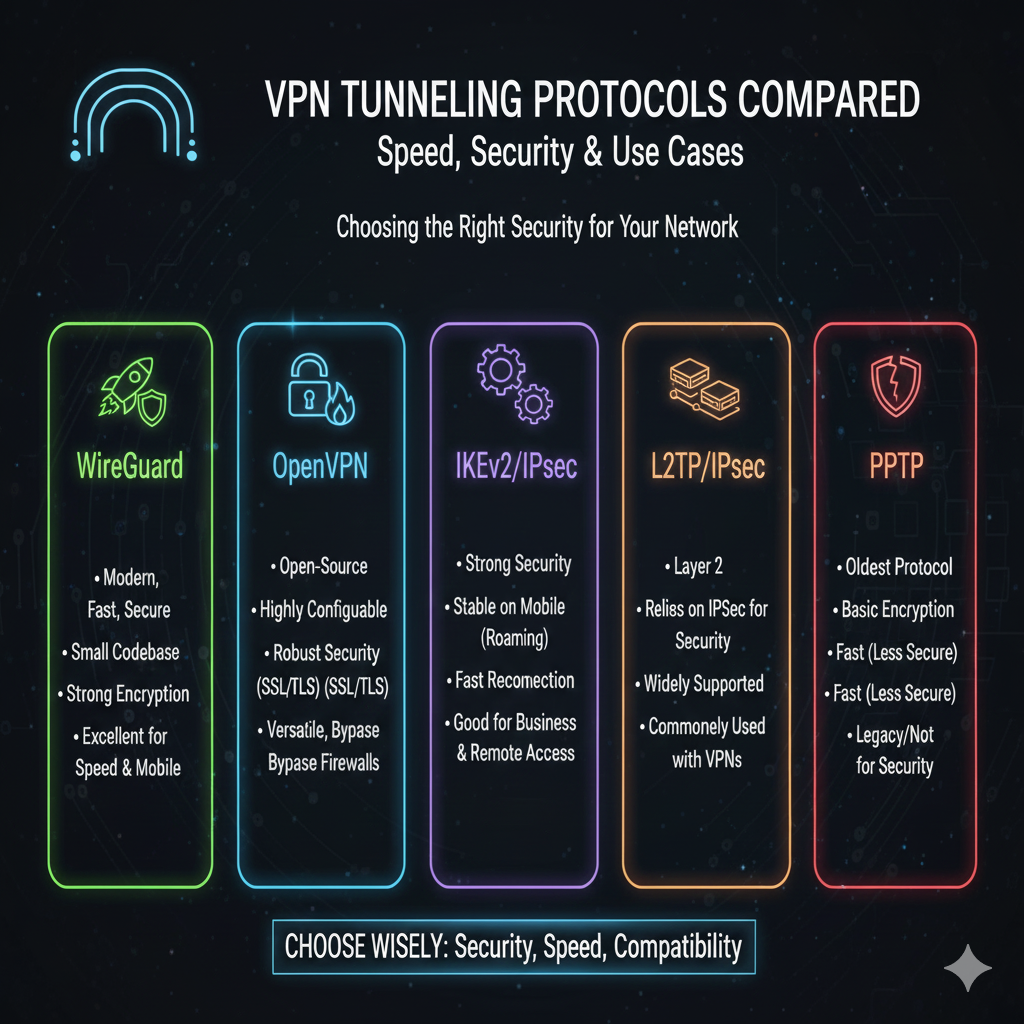
WireGuard is the newest and arguably the most revolutionary VPN protocol to emerge in recent years.
Its design philosophy focuses on simplicity and performance.
Key Features and Advantages
WireGuard’s codebase is remarkably small—around 4,000 lines of code—compared to the hundreds of thousands in protocols like OpenVPN [2].
This small footprint makes it easier to audit, reducing the attack surface and potential for bugs.
Speed and Performance
WireGuard uses modern, high-speed cryptographic primitives, resulting in significantly faster connection times and higher throughput than its predecessors.
It is often cited as the fastest protocol available.
Simplicity
The protocol is designed to be simple to configure and deploy, which translates to a more stable and reliable connection.
Modern Cryptography
It exclusively uses state-of-the-art encryption algorithms, such as ChaCha20 for symmetric encryption and Poly1305 for data authentication.
WireGuard is rapidly becoming the industry standard for high-performance, secure VPN connections due to its lean design and superior speed.
The Open-Source Titan: OpenVPN
OpenVPN is the most widely trusted and deployed open-source VPN protocol.
It has been the gold standard for security and flexibility for over a decade.
Flexibility and Security
OpenVPN can be configured to run over either the Transmission Control Protocol (TCP) or the User Datagram Protocol (UDP).
TCP vs. UDP
Running over UDP is generally faster and preferred for most uses, while TCP can be useful for bypassing restrictive firewalls that block UDP traffic.
Encryption
It supports a wide range of encryption algorithms, most commonly AES-256, and uses the OpenSSL library for its cryptographic functions.
Community Trust
As an open-source project, its code has been extensively reviewed by the security community, building a high level of trust in its security posture.
The primary drawback of OpenVPN is its complexity and overhead.
Its large codebase can be a performance bottleneck, and establishing a connection can take longer than with WireGuard or IKEv2.
https://www.youtube.com/watch?v=0h59gY0t4sI
The Native Protocol: IKEv2/IPsec
Internet Key Exchange version 2 (IKEv2), often paired with the IPsec (Internet Protocol Security) suite, is a robust and widely supported protocol developed by Microsoft and Cisco.
Stability and Mobility
IKEv2/IPsec is particularly valued for its stability and ability to handle network changes.
MOBIKE
It includes the Mobility and Multihoming Protocol (MOBIKE) feature, which allows a VPN connection to seamlessly transition between different networks (e.g., switching from Wi-Fi to cellular data) without dropping the connection.
This makes it an excellent choice for mobile users.
Native Support
It is natively supported on many operating systems, including Windows, macOS, and iOS, simplifying deployment as no third-party software is required.
While highly secure and fast, IKEv2/IPsec is not as simple as WireGuard, and its reliance on IPsec can sometimes lead to firewall configuration issues, as IPsec uses specific ports and protocols that may be blocked.
https://www.youtube.com/watch?v=v5g9t31343E
The Legacy Protocols: L2TP/IPsec and PPTP
While still in use, L2TP/IPsec and PPTP are generally considered legacy protocols with significant drawbacks compared to the modern options.
L2TP/IPsec
Layer 2 Tunneling Protocol (L2TP) does not provide encryption on its own; it relies entirely on the IPsec suite for security [3].
Double Encapsulation
L2TP encapsulates data twice, which adds significant overhead and slows down performance.
Security Concerns
While IPsec is strong, L2TP/IPsec can be easily blocked by firewalls, and there have been historical concerns about its security due to potential NSA interference, though these remain unproven.
PPTP
Point-to-Point Tunneling Protocol (PPTP) is one of the oldest VPN protocols, dating back to the 1990s.
Speed
It is fast because it offers minimal encryption overhead.
Security Risk
PPTP is considered fundamentally insecure and should be avoided for any use case requiring strong privacy or security.
Its encryption methods have been compromised for years [4].
https://www.youtube.com/watch?v=3Qh8j0v0_t0
Comparison of VPN Tunneling Protocols
The choice of protocol fundamentally affects the security, speed, and reliability of your VPN service.
The table below summarizes the key differences.
| Protocol | Security | Speed | Complexity | Ideal Use Case |
|---|---|---|---|---|
| WireGuard | Excellent | Fastest | Low | All-around, high-performance, modern deployment |
| OpenVPN | Excellent | Good | High | Maximum security, bypassing restrictive firewalls |
| IKEv2/IPsec | Very Good | Very Fast | Medium | Mobile devices, connection stability |
| L2TP/IPsec | Good | Fair | Medium | Legacy systems, when other options are unavailable |
| PPTP | Poor | Fast | Low | Should be avoided entirely for security reasons |
Conclusion
The landscape of VPN protocols is clearly shifting towards modern, lean, and high-performance options.
While OpenVPN remains a trusted, flexible choice, WireGuard represents the future of VPN technology, offering a superior blend of speed, security, and simplicity.
For mobile users, IKEv2/IPsec provides unmatched stability.
The key takeaway is to always prioritize a protocol with strong, modern cryptography and to completely decommission any use of PPTP [5].
Making an informed choice about your tunneling protocol is the first and most crucial step in securing your network communications.
https://www.youtube.com/watch?v=7hK94y1qf7I
References
[1] OpenVPN, WireGuard, SSTP, L2TP/IPsec, and PPTP — Comparing VPN Protocols – Xtom
[2] PPTP vs IPSec IKEv2 vs OpenVPN vs WireGuard – IVPN
[3] What Are the Different Types of VPN Protocols? – Palo Alto Networks
[4] Best VPN Protocols: OpenVPN vs PPTP vs L2TP vs Others – The Best VPN
[5] Which VPN protocol is the best? – ProtonVPN
YouTube Videos
https://www.youtube.com/watch?v=0h59gY0t4sI
https://www.youtube.com/watch?v=v5g9t31343E
https://www.youtube.com/watch?v=3Qh8j0v0_t0
https://www.youtube.com/watch?v=7hK94y1qf7I
https://www.youtube.com/watch?v=k9h9g-69w0k