

The desire to write a memoir is often born from a profound, singular experience or a period of intense personal growth. 💡
But for the beginner, the vastness of one’s own life story can feel overwhelming.
Where do you begin to excavate decades of memories and shape them into a cohesive, compelling narrative? 🤔
The answer lies not in a single, grand writing session, but in a series of focused, manageable Memoir Writing Exercises for Beginners.
Memoir, unlike autobiography, is not a chronological account of your entire life.
It is a focused slice of life, a story about a specific theme or struggle, such as a career change, a relationship, or overcoming an addiction.
These exercises are designed to help you break through the initial paralysis, retrieve vivid details, and, most importantly, discover the universal theme hidden within your personal truth. 🧭
Phase I: The Archaeologist’s Toolkit: Digging for Detail ⛏️
Memoir is built on the bedrock of sensory detail.
Your memories are not stored as perfect video files; they are fragments, and your job is to become the archaeologist who unearths and reconstructs them.
These exercises focus on memory retrieval and the mining of sensory information.
Exercise 1: The Five Senses Snapshot 📸
Choose a single, pivotal moment from the period your memoir will cover.
Set a timer for 15 minutes and write down everything you can recall about that moment using only your five senses.
What did you see (colors, light, objects)?
What did you hear (specific sounds, voices, silence)?
What did you smell (perfumes, food, environment)?
What did you taste (coffee, fear, metal)?
What did you feel (texture of clothing, temperature, physical pain)?
Do not worry about narrative or grammar; focus only on the raw data of the senses.
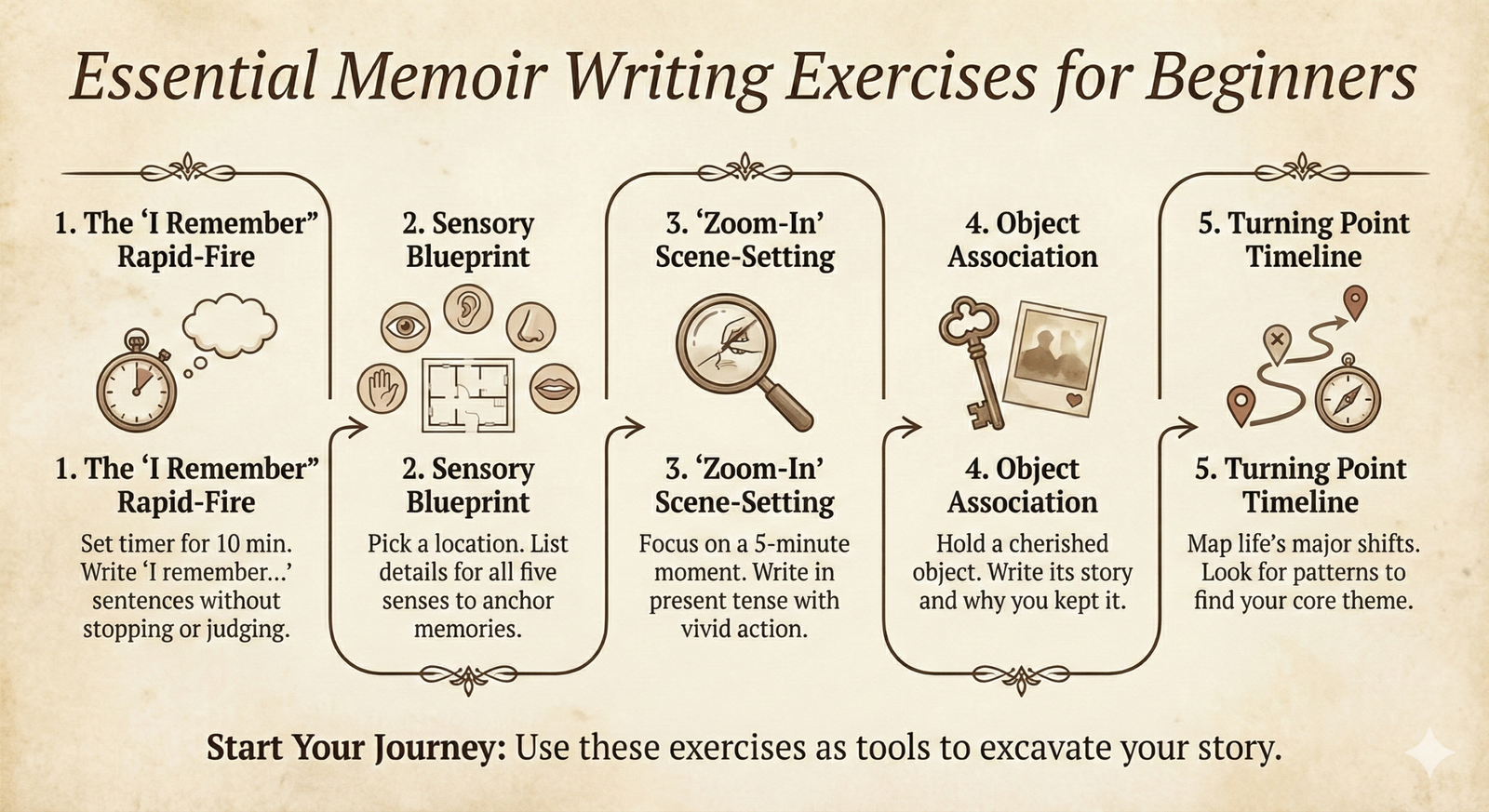
Exercise 2: The Inventory of Artifacts 🗝️
Identify three objects that are central to your memoir’s theme—a photograph, a piece of clothing, a letter, or a piece of furniture.
For each object, write a detailed history: where it came from, who gave it to you, where it was kept, and what happened to it.
This exercise uses the object as a physical anchor to pull up associated memories and emotions.
Often, the story of the object is the story of your emotional journey.
This technique is a powerful way to deal with the reconstructive nature of memory, as discussed in articles on Memory Retrieval Techniques for Writers.
Exercise 3: The Firsts and Lasts 📌
List every “first” and “last” related to the central conflict of your memoir.
First time you felt the conflict, first time you tried to solve it, first time you failed, last time you saw a key person, last time you felt a certain way.
These moments are natural scene breaks and often contain the highest emotional charge.
Phase II: Building the World: From Memory to Scene 🏗️
A memoir is a series of scenes, not a summary of events.
The reader must feel like they are experiencing the moment alongside you.
These exercises help you translate raw memory into compelling, dramatic scenes.
Exercise 4: The Dialogue Replay 🗣️
Recall a conversation that was particularly tense, funny, or revealing.
Write the dialogue exactly as you remember it, focusing on the rhythm and the specific words used.
Then, add the subtext: what was each person really saying?
What were the non-verbal cues—the shifting eyes, the nervous fidgeting, the long silence?
Dialogue is a powerful tool for characterization and advancing the plot of your memoir.
Exercise 5: The Flashback Frame 🖼️
Memoirs often jump between the past and the present.
A successful jump requires a “frame”—a moment in the present that triggers the memory.
Write a short present-day scene (the frame) where you are doing something mundane, like washing dishes or waiting for a bus.
Then, introduce a sensory trigger (a smell, a song, a phrase) that instantly transports you to a past scene.
Write the past scene, and then return to the present frame.
This practice helps you master the seamless transition that keeps the reader engaged.
For more on this, consider the principles of Scene Writing in Nonfiction, which emphasizes that every scene must advance the story.
Exercise 6: The “Show, Don’t Tell” Drill 🎭
Take five sentences from your current writing that tell an emotion (e.g., “I was angry,” “She was sad,” “I felt relieved”).
Rewrite each sentence to show the emotion through action, dialogue, or sensory detail.
For example, “I was angry” becomes “My knuckles were white on the steering wheel, and the air conditioner was blasting, but I was still sweating.”
This drill is fundamental to all narrative writing, especially memoir, where emotional honesty is paramount.
Phase III: Finding the “Why”: The Universal Resonance 🌟
The difference between a diary and a memoir is the universal theme.
The reader is not just interested in what happened to you; they are interested in what your story means for them.
These exercises help you move from the personal “I” to the universal “we.”
Exercise 7: The Premise Statement 📝
Write your memoir’s premise in a single, concise sentence using this structure:
“This is the story of [Protagonist] who [Action] and learned [Universal Truth].”
For example: “This is the story of a young woman who left her high-paying job to travel the world and learned that true security is found not in a bank account, but in self-reliance.”
This exercise forces you to articulate the core conflict and the ultimate takeaway, which is the heart of your theme.
This is a technique widely used by publishing professionals to assess a book’s marketability.
Exercise 8: The Lie You Believed 🤥
Identify the core, false belief you held at the beginning of your memoir’s journey.
This “lie” is the emotional engine of your story.
For example, the lie might be “I am only valuable if I am successful,” or “Love is conditional.”
Then, write the truth you discovered by the end of the journey.
The entire memoir is the process of moving from the lie to the truth.
This focus on transformation is a key element in Finding the Themes of Your Memoir.
Exercise 9: The Letter to Self 💌
Write a letter to your younger self at the most difficult point of the story.
What advice would you give?
What comfort would you offer?
What future truth would you reveal?
This exercise is a powerful way to access the reflective voice—the voice of the wiser, older narrator—which is essential for a successful memoir.
Memoir vs. Autobiography: Knowing the Difference 🧐
Before you dive too deep, it is crucial to understand the distinction between memoir and autobiography.
The two terms are often confused, but they represent fundamentally different literary forms.
| Feature | Memoir | Autobiography |
|---|---|---|
| Scope | A focused slice of life; a single theme or period. | The entire life story, from birth to the present. |
| Focus | Emotional truth, reflection, and universal meaning. | Factual record, historical events, and chronological order. |
| Narrative Arc | The journey from a “lie” to a “truth.” | The arc of a career or public life. |
Conclusion: The Courage to Begin ✍️
Writing a memoir is an act of profound Vulnerability in Writing.
It requires not only skill but also the courage to look honestly at your past.
These exercises are your first steps on that journey.
Embrace the messiness of the first draft; it is where the real discoveries are made.
The goal is not perfection, but momentum.
Once you have a solid draft, you can begin to think about the next steps, such as reviewing Memoir Submission Guidelines for literary journals.
Consistency is more important than intensity in the early stages of memoir writing.
Do not self-edit while performing these exercises; let the memories flow freely.
Trust that your story has a universal truth that readers need to hear.
Remember that memoir is about what you learned, not just what you lived.
Start today. Your story is waiting. 🌟