
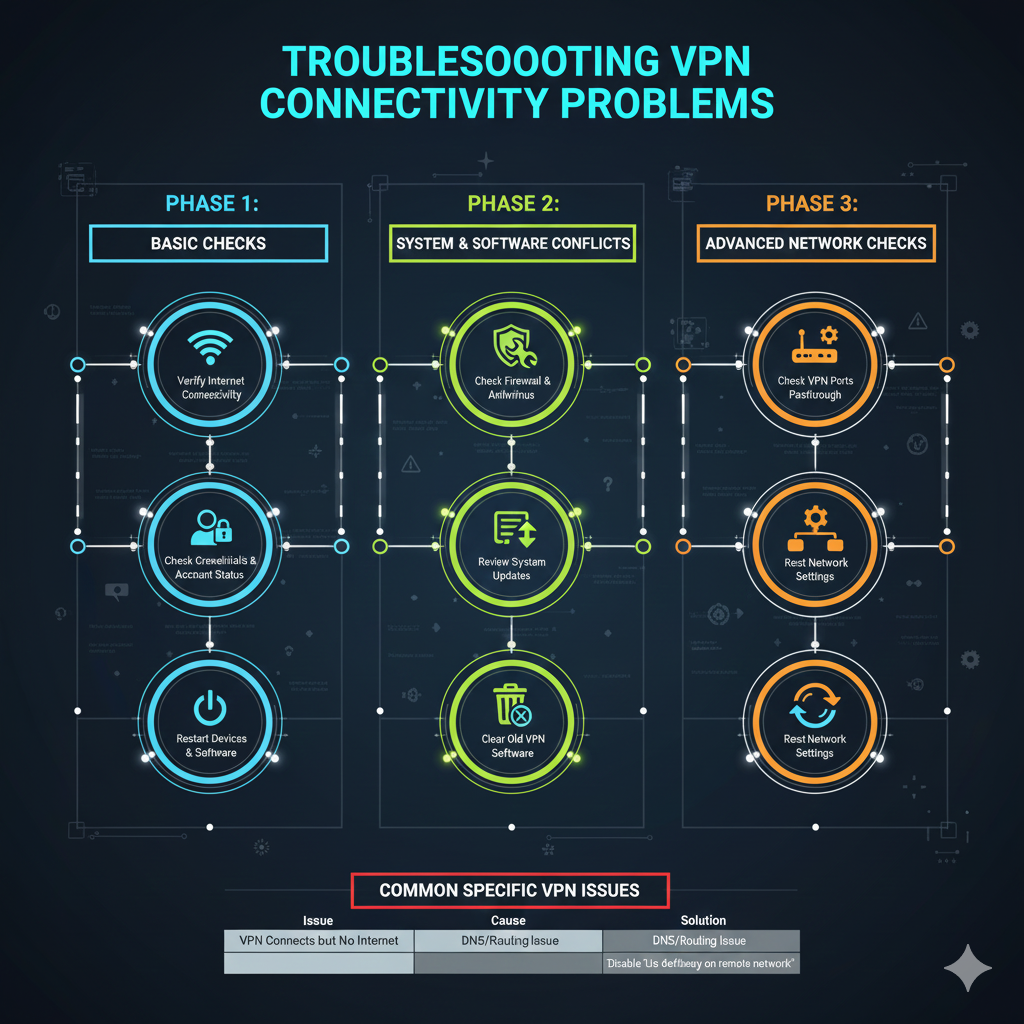
Troubleshooting VPN Connectivity Problems: How AI Can Help Diagnose Issues 🔧
Virtual Private Networks (VPNs) are the backbone of modern remote work and secure enterprise connectivity. 🌐
However, they are notoriously prone to frustrating and complex issues that can disrupt productivity.
From agonizingly slow speeds to sudden, inexplicable connection drops, VPN problems create significant challenges.
The traditional manual troubleshooting approach is simply too slow for today’s dynamic, cloud-centric environments.
The next generation of network management is turning to Artificial Intelligence (AI) for instant, end-to-end visibility and proactive diagnostics. 🤖
The Common Culprits of VPN Failure 🚨
VPN connectivity issues stem from a complex interplay of client-side, network-side, and server-side factors.
Understanding these common failure points is crucial for appreciating AI-driven solutions.
The most frequent problems encountered by users and administrators include several critical issues.
- Connection Failure: The VPN client fails to establish a tunnel due to incorrect credentials, blocked ports, or incompatible protocols. 🔌
- Slow Performance: Latency and low throughput caused by server overload, long distances, or insufficient local bandwidth. 🐢
- Dropped Connections: Frequent disconnections triggered by unstable Wi-Fi, NAT timeouts, or security software interference. 📉
- IP/DNS Leaks: Critical security failures where real IP addresses bypass the VPN tunnel due to misconfiguration. 🕵️
Diagnosing these issues manually requires multi-point investigation that can take hours or even days to resolve.
AI’s Role in Proactive VPN Diagnostics 🧠
AI and Machine Learning (ML) models are transforming VPN troubleshooting from reactive to predictive and automated.
By continuously monitoring vast operational data streams, AI identifies subtle problem precursors before they fully manifest.
This capability is particularly powerful in complex environments like Always On VPN (AOVPN) and multi-cloud deployments. ☁️
Predictive Failure Analysis 🔮
AI models analyze historical connection logs, server load metrics, and user-specific performance data.
They build comprehensive models of normal VPN operation for comparison and anomaly detection.
When user connections deviate from established norms, AI flags them as potential failures in progress.
This predictive capability allows proactive alerts before connections actually drop or become unusable.
AI detects VPN issues before users even notice performance degradation.
Automated Root Cause Identification 🎯
AI-powered diagnostic agents instantly correlate data across the entire connection path when issues occur.
For slow connections, AI simultaneously checks Wi-Fi strength, server load, ISP latency, and firewall logs.
This rapid, holistic analysis pinpoints exact root causes in seconds rather than hours.
The result is precise, actionable diagnosis that eliminates manual trial-and-error troubleshooting.
AI correlates multiple data points to identify the true source of VPN problems instantly.
Intelligent Server and Protocol Selection 🧭
AI optimizes VPN performance by dynamically recommending optimal servers and protocols.
Based on real-time network conditions, AI can automatically switch users to better options.
This intelligent routing ensures users consistently experience the fastest possible connections.
For more on AI applications, see this article on AI network troubleshooting.
AI automatically selects the fastest server and protocol combination for each user.
AI-Powered Solutions for Specific VPN Issues ⚡
AI provides targeted solutions for persistent VPN problems, addressing underlying complexity.
| VPN Problem | Traditional Fix | AI-Driven Solution |
|---|---|---|
| Connection Failure | Manual port/firewall check | Client-side self-healing with automatic adjustments |
| Slow Speeds | Manual server switching | Intelligent load balancing in real-time |
| Dropped Connections | Router restarts, Wi-Fi checks | Predictive tunnel maintenance preempting drops |
| IP/DNS Leaks | Manual leak tests | Continuous security auditing and blocking |
The key takeaway is that AI provides granularity and speed impossible with human-driven processes.
Implementing an AI-Driven VPN Strategy 🚀
For organizations, integrating AI into VPN management enhances both security and user experience.
This strategic move requires adopting tools that leverage ML for performance monitoring and security analytics.
- Centralized Telemetry: Feed all VPN logs and metrics into a central data lake for AI analysis. 📊
- User Experience Monitoring (UEM): Use AI to track remote user digital experiences proactively. 👥
- Security Correlation: Leverage AI to correlate VPN failures with potential security threats. 🛡️
AI’s ability to analyze encrypted VPN traffic for anomalies is a growing research area.
This paper on Deep Learning for VPN Optimization provides deeper insights.
AI can detect hidden threats within encrypted VPN tunnels that traditional methods miss.
The Future of Secure Remote Access 🌟
The evolution of VPNs is inextricably linked to AI advancement and machine learning capabilities.
As networks become more distributed, manual troubleshooting becomes entirely unsustainable.
AI-powered VPN solutions build fundamentally more resilient, secure, and self-optimizing infrastructure.
The ultimate goal is a “zero-touch” VPN experience with automatic, invisible issue resolution.
This shift ensures VPNs remain reliable business enablers rather than IT support burdens.
For traditional fixes that AI can automate, refer to this Remote Access troubleshooting guidance.
AI ensures remote workers remain securely connected regardless of network complexity.
The integration of AI into VPN diagnostics represents a critical step toward fully autonomous networks.
Security and performance are maintained proactively and intelligently through automated systems.
This intelligent automation layer defines the next era of secure remote connectivity.
Proactive anomaly detection and autonomous issue resolution maintain high-quality user experiences.
AI transforms VPNs from complex, temperamental tools into seamless, self-managing utilities.
The future of secure remote access is intelligent, automated, and relentlessly proactive.