
🥎
Wireless mesh networks have revolutionized home and office Wi-Fi, promising seamless coverage and eliminating dead zones. 📡
However, their distributed nature also introduces a new layer of complexity when things go wrong. 😅
Issues like inconsistent speeds, node disconnections, and inefficient client roaming can be notoriously difficult to diagnose.
The traditional approach of manually repositioning nodes and tweaking settings is often a frustrating game of trial and error. 🎯
Enter Artificial Intelligence (AI), the key to unlocking the full potential of mesh technology.
AI is transforming mesh networks from static setups into dynamic, self-optimizing ecosystems that can predict, diagnose, and resolve issues autonomously. 🤖
The Unique Challenges of Mesh Networks 🔍
Unlike traditional single-router setups, mesh networks are a cooperative system of multiple nodes.
Their performance depends on a delicate balance of factors that can easily be disrupted.
Backhaul congestion creates invisible bottlenecks that strangle your network speed.
The wireless link between nodes can become overwhelmed, especially in environments with heavy traffic.
Suboptimal node placement remains one of the most common causes of mesh network failure.
Placing nodes too far apart creates weak signals, while placing them too close causes unnecessary interference.
Inefficient client steering leads to the frustrating “sticky client” phenomenon.
Devices may stubbornly cling to a distant node instead of seamlessly roaming to a closer one with a stronger signal.
RF interference from competing Wi-Fi networks and household devices creates constant challenges.
Everything from Bluetooth devices to microwave ovens can disrupt the delicate balance of a mesh system.
AI-Powered Optimization: The Self-Healing Network 💊
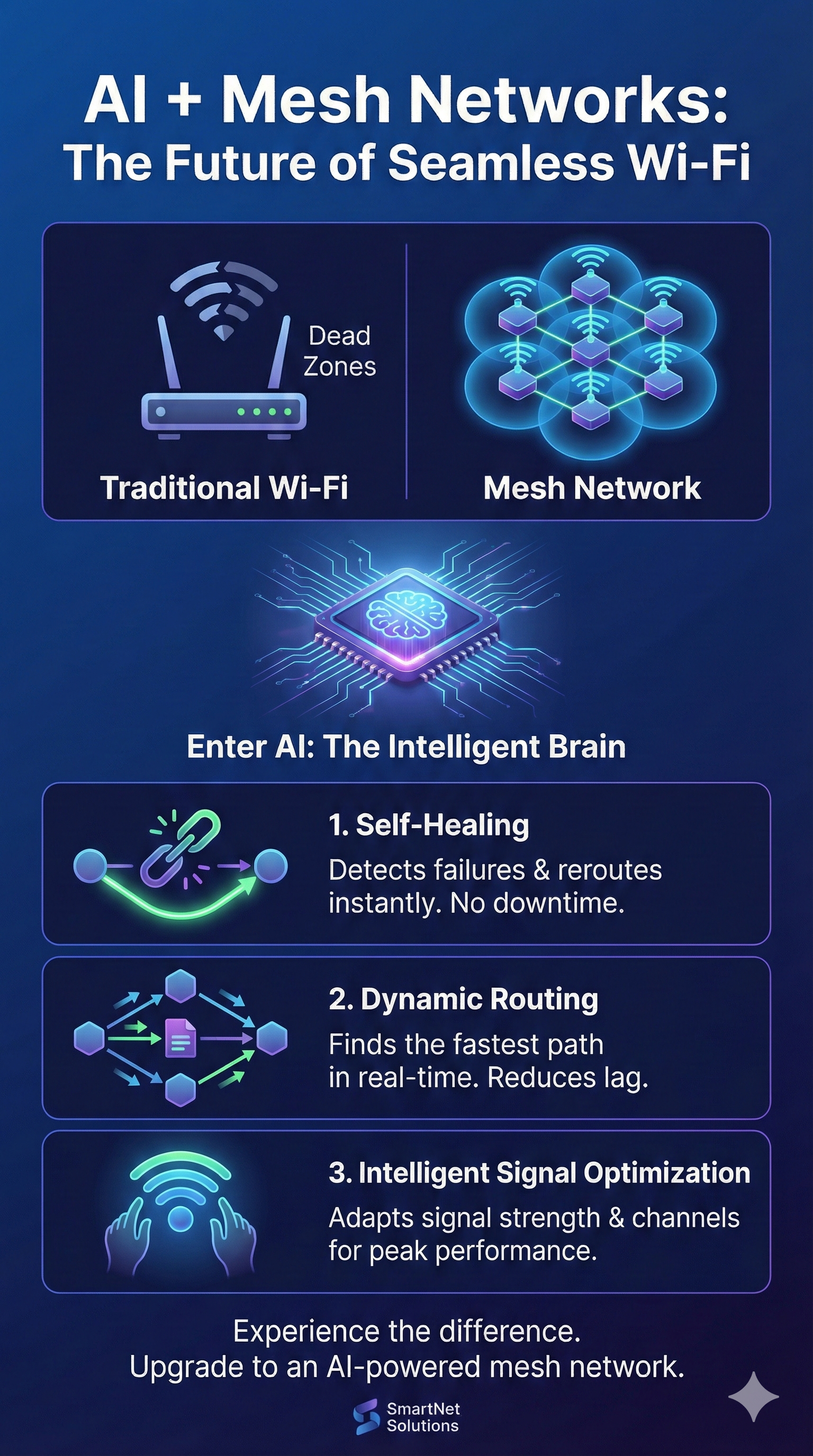
The most profound impact of AI on mesh networking is the concept of the self-healing network.
An AI-powered mesh system continuously monitors its own health and performance, making real-time adjustments to maintain optimal operation.
Dynamic Path and Channel Selection 🔄
AI algorithms constantly analyze the radio frequency environment, detecting interference and congestion.
If the backhaul channel for a particular node becomes congested, the AI can automatically switch it to a cleaner channel.
This happens seamlessly without any user intervention or network disruption.
In multi-hop mesh setups, AI determines the most efficient path for data to travel back to the primary router.
AI dynamically reroutes traffic to avoid bottlenecks before they impact your experience.
Intelligent Client Steering 🧭
AI-assisted roaming ensures that your devices are always connected to the best possible node.
The system analyzes signal strength, band utilization, and device capabilities in real-time.
AI proactively steers clients to new nodes before their current connection begins to degrade.
This eliminates the frustrating “sticky client” problem that plagues traditional mesh networks.
Your devices seamlessly transition between nodes as you move through your space.
Smart Beamforming and Signal Optimization 📡
Modern mesh systems use beamforming to focus Wi-Fi signals directly at connected devices.
AI enhances this technology by creating dynamic, intelligent beamforming patterns.
The system adapts to the location and movement of devices throughout your environment.
This ensures stronger, more stable connections for mobile devices like smartphones and laptops.
AI-driven beamforming creates personalized signal paths for each connected device.
AI-Driven Troubleshooting in Action 🛠️
When problems arise, AI-powered mesh systems provide unprecedented diagnostic insight.
Traditional troubleshooting methods are being replaced by intelligent, automated solutions.
| Mesh Issue | Traditional Approach | AI-Assisted Solution |
|---|---|---|
| Dead Zone Appears | Manually move nodes, guess at placement | AI provides heat maps and suggests optimal placement |
| Slow Speeds on One Node | Reboot node, check firmware | AI identifies root cause and auto-fixes channels |
| New Device Causes Slowdown | Manual QoS configuration | AI automatically prioritizes traffic by device type |
The goal of AI is to make the network invisible, handling complexity behind the scenes.
Users experience seamless connectivity without understanding the technical wizardry involved.
Practical Steps to an AI-Optimized Mesh Network 🎯
While AI optimization happens automatically, you can take steps to maximize performance.
Follow these actionable guidelines to ensure your mesh system performs at its best.
- Choose Systems with Strong AI Engines: Research brands that explicitly market AI capabilities like intelligent channel selection and client steering. 🧠
- Enable Wired Backhaul Where Possible: Ethernet connections free up wireless spectrum, giving AI more optimization room. 🔌
- Trust the Optimize Button: Use the one-touch optimize feature regularly, especially after adding new devices. ⚡
- Follow Placement Guidance: AI-driven placement suggestions during setup create a strong network foundation. 🗺️
For foundational concepts, this article on Self-healing and Mesh Networks provides valuable insights.
Proper node placement remains the most critical factor in mesh network performance.
The Future is a Cognitive Mesh 🔮
The integration of AI into mesh networking is still evolving toward truly cognitive systems.
Future networks will not only react to their environment but also learn and anticipate user needs.
Imagine networks that understand your daily routines and automatically prioritize bandwidth.
Morning video calls receive priority, while evening movie streaming gets optimized bandwidth allocation.
Cognitive mesh networks will anticipate your needs before you even recognize them.
This intelligence becomes essential as smart homes host dozens of connected devices.
Each device has unique bandwidth requirements that AI can dynamically manage and optimize.
By leveraging AI, mesh networks evolve from simple access points to smart, adaptive utilities.
They become the invisible foundation supporting our increasingly connected digital lives.
For security aspects, consider this survey on cybersecurity mesh architecture.
The result is Wi-Fi that’s not just faster, but intelligently adaptive to your lifestyle.
AI-powered mesh networks represent the future of seamless, intelligent connectivity. 🌐
Your network should work for you, not the other way around.