
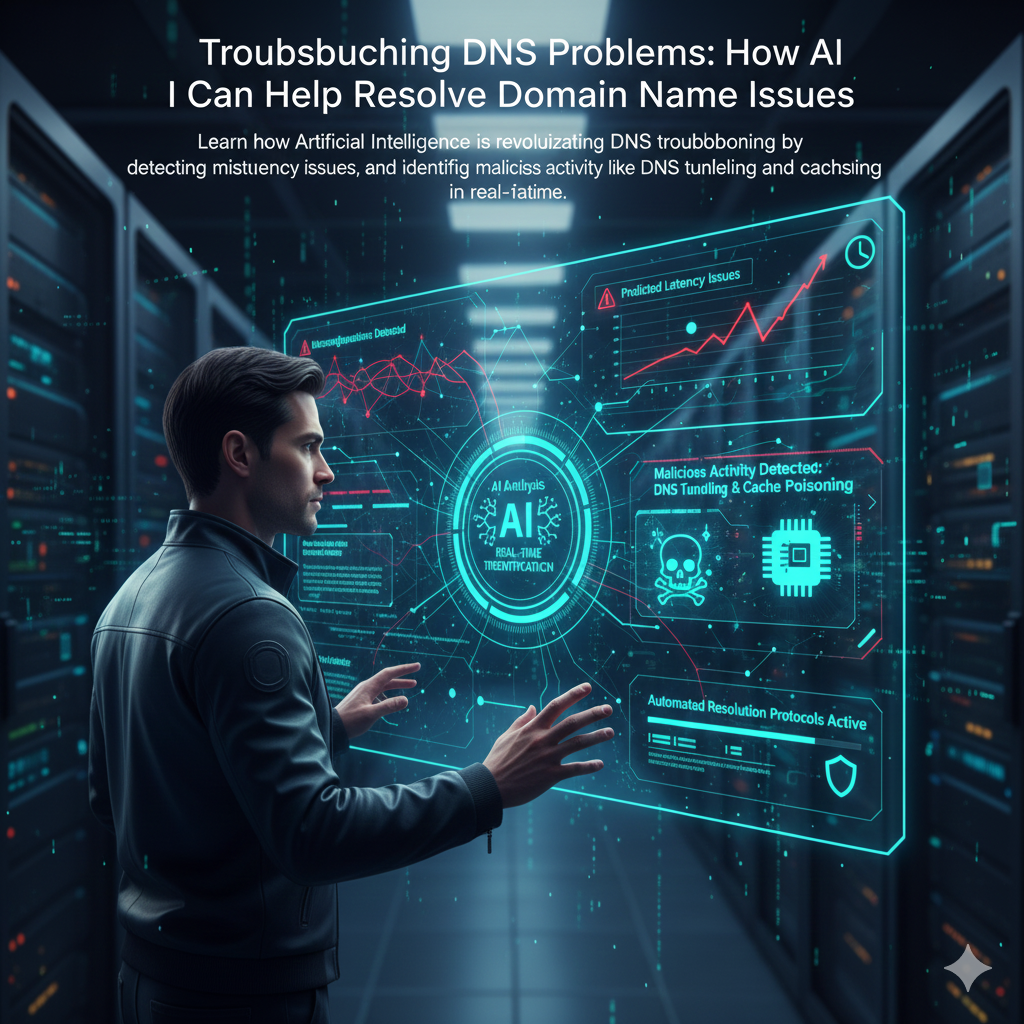
The Domain Name System (DNS) is often called the phonebook of the internet, translating human-readable domain names into machine-readable IP addresses.
When DNS fails, the internet effectively stops working, leading to frustrating “server not found” errors, application downtime, and security vulnerabilities.
Traditional DNS troubleshooting involves manual checks of records, cache flushing, and log analysis—a process that is slow, reactive, and ill-equipped to handle the scale and complexity of modern, distributed DNS infrastructure.
The solution lies in integrating Artificial Intelligence (AI) and Machine Learning (ML) to transform DNS management from a manual chore into an autonomous, self-healing system.
The Hidden Complexity of DNS Failures
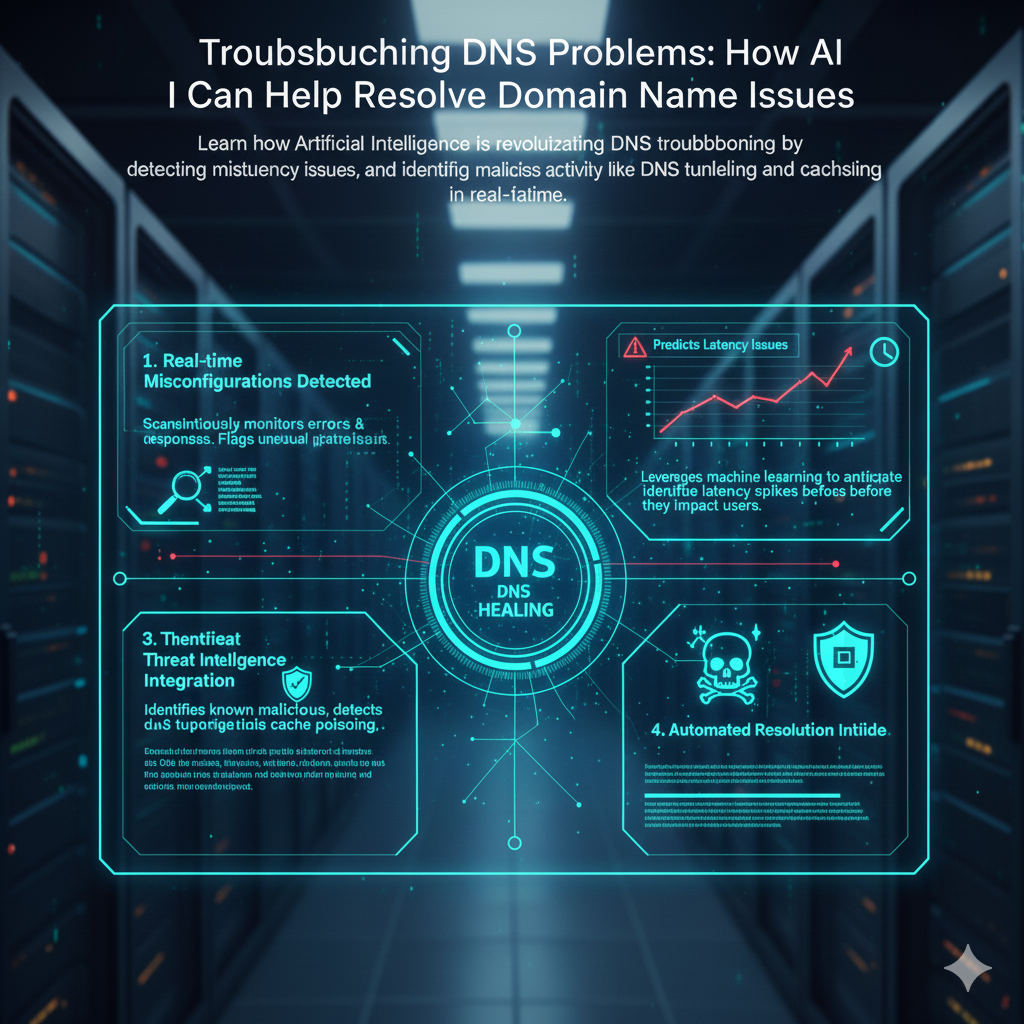
DNS issues are often subtle and can be categorized into three main areas: misconfiguration, performance, and security.
- Misconfiguration: Simple errors like incorrect A records, missing MX records, or an overly long Time-to-Live (TTL) setting can cause widespread service disruption.
- Performance: High DNS query latency, often due to an overloaded resolver or network congestion, can make applications feel slow, even if the underlying network is fast.
- Security: Malicious attacks like DNS cache poisoning, DNS tunneling (for data exfiltration), and DNS-based DDoS attacks pose a significant threat.
The sheer volume of DNS queries—often billions per day in large enterprises—makes manual anomaly detection virtually impossible.
AI: The Autonomous DNS Guardian
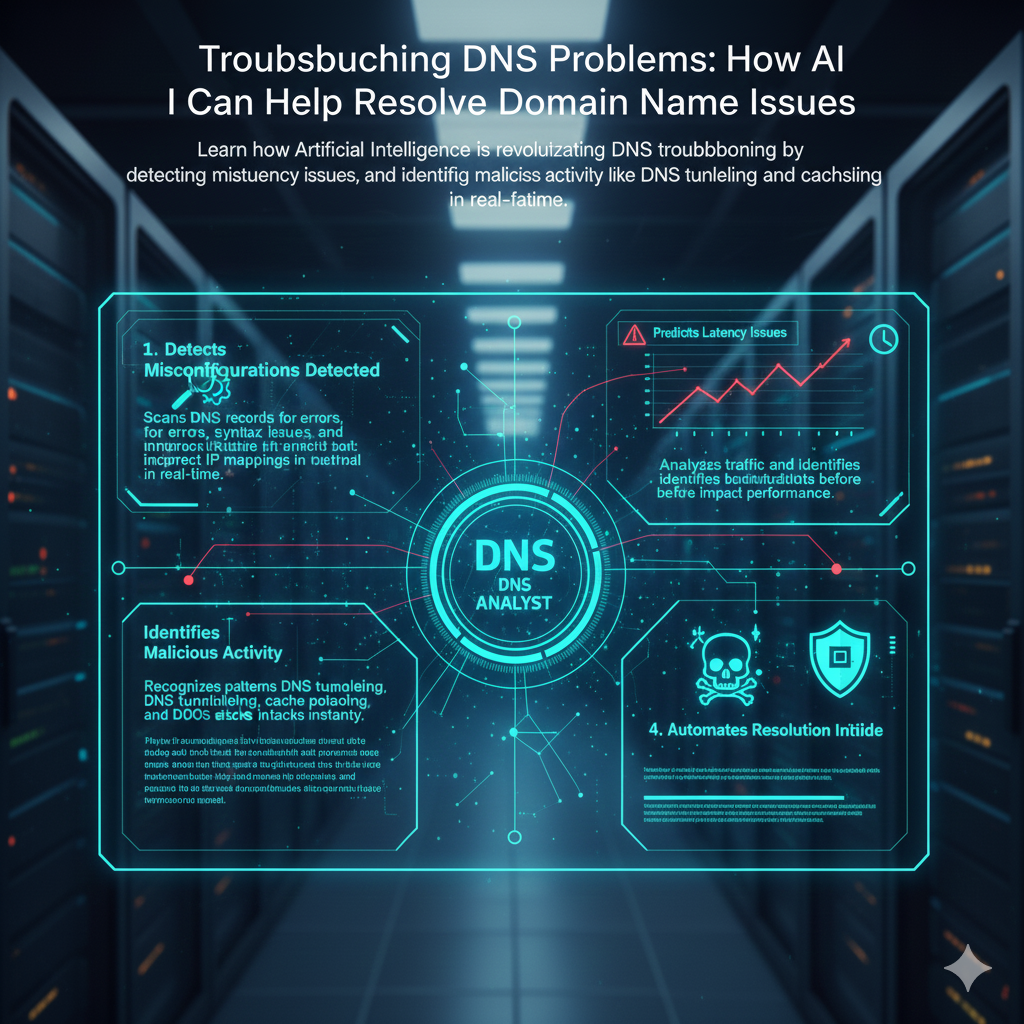
AI-powered DNS solutions leverage ML models to establish a baseline of normal DNS behavior, allowing them to detect and resolve issues with unprecedented speed and accuracy.
1. Real-Time Anomaly Detection
ML algorithms, particularly unsupervised learning models like autoencoders, are trained on massive datasets of legitimate DNS traffic.
They can instantly spot deviations from the norm, such as a sudden spike in queries for a non-existent domain (NXDOMAIN), an unusual geographic distribution of queries, or a dramatic change in query size.
This capability is crucial for identifying zero-day threats and sophisticated attacks that bypass traditional signature-based security tools.
2. Predictive Latency and Performance Optimization
AI can predict when a DNS resolver is likely to become overloaded or when network conditions will lead to high query latency.
Using time-series forecasting, the system can proactively shift traffic to a less-utilized resolver or adjust routing policies to ensure the fastest possible resolution time for every user.
This predictive optimization ensures a consistently high-quality user experience, eliminating the frustrating perception of a slow network.
3. Automated Misconfiguration Correction
AI can act as a “smart linter” for DNS records. By analyzing the entire zone file and correlating it with network traffic patterns, the system can identify and flag misconfigurations, such as a CNAME pointing to a non-existent A record or an incorrect SPF record.
In advanced systems, the AI can even suggest the correct record value or, with administrator approval, automatically deploy the fix, drastically reducing the Mean Time To Resolution (MTTR) for human errors.
For more on how AI handles this, check out this resource on AI-powered DNS request tracking.
AI-Driven Solutions for DNS Security
Security is where AI truly shines in the DNS domain, providing a robust defense against increasingly complex attacks.
| DNS Security Threat | Traditional Defense | AI-Driven Solution |
|---|---|---|
| DNS Tunneling | Signature-based detection, rate limiting. | Deep Packet Inspection (DPI): AI analyzes query payload size and frequency to detect the subtle, low-volume data transfer characteristic of tunneling. |
| DNS Cache Poisoning | DNSSEC implementation, source port randomization. | Behavioral Analysis: AI monitors the resolver’s response patterns for suspicious, unverified records and instantly quarantines the cache entry. |
| Domain Generation Algorithms (DGA) | Blacklisting known malicious domains. | Linguistic Modeling: AI uses ML to analyze the entropy and structure of domain names to identify algorithmically generated domains used by botnets. |
By operating at the DNS layer, AI provides a powerful, early-stage defense mechanism, stopping threats before they can reach the application or endpoint.
Implementing an AI-Assisted DNS Strategy
For network administrators, the transition to an AI-assisted DNS environment involves a few key steps:
- Adopt Cloud-Based DNS Services: Cloud providers often have the necessary scale and infrastructure to deploy sophisticated AI/ML models for security and performance optimization.
- Integrate DNS Telemetry: Ensure DNS query logs and response times are integrated with your existing Network Performance Monitoring (NPM) and Security Information and Event Management (SIEM) tools.
- Focus on Proactive Validation: Use AI tools to continuously validate DNS records against best practices and business requirements, rather than waiting for a failure report.
The ability of AI to correlate DNS data with other network events is a game-changer for Root Cause Analysis (RCA), as discussed in this article on How Middleware Detects and Resolves DNS Issues.
The Future of the Domain Name System
The future of DNS is intelligent, secure, and highly automated. AI is moving beyond simple troubleshooting to become an integral part of the DNS resolution process itself.
This evolution is driven by the need for hyper-scale security and ultra-low latency, which manual systems can no longer guarantee.
By entrusting the complex, repetitive tasks of monitoring and optimization to AI, network teams can focus on strategic architecture and innovation.
The result is a more resilient internet, where the foundational service of name resolution is protected and optimized by machine intelligence.
For a traditional guide to complement the AI approach, refer to this Microsoft DNS Troubleshooting Guide.
Embracing AI in DNS management is not just an option; it is a necessity for maintaining a secure and high-performing digital presence in the face of ever-increasing complexity and threat sophistication.