

Bandwidth issues—the frustrating slowdowns, buffering, and dropped connections—are the most common complaints in any network environment, from the home office to the enterprise data center.
These problems are often symptoms of a deeper issue: a network bottleneck where the demand for data transfer exceeds the available capacity at a specific point.
Traditional troubleshooting methods rely on reactive monitoring, only alerting administrators after a bottleneck has already impacted service.
The modern solution is to employ Artificial Intelligence (AI) to move beyond simple monitoring and into the realm of predictive and autonomous network optimization.

The Challenge of Bottleneck Identification
Identifying the true source of a bandwidth bottleneck is a complex task because the network is a dynamic system.
A slowdown perceived by a user could be caused by:
- Physical Link Saturation: A cable or port is genuinely overloaded.
- Application-Specific Throttling: A single application is consuming disproportionate resources.
- Device Misconfiguration: A faulty or misconfigured network device is dropping packets.
- Invisible Bottlenecks: Congestion occurring in a cloud or service provider network segment outside the local administrator’s visibility.
AI provides the necessary intelligence to correlate data from diverse sources—flow records, device metrics, application logs, and user experience data—to pinpoint the exact location and root cause of the bottleneck in real-time.
AI’s Role in Predictive Capacity Planning
The most significant contribution of AI to bandwidth management is its ability to predict future demand, allowing for proactive capacity planning.
1. Time-Series Forecasting of Demand
Machine Learning models, such as ARIMA and Long Short-Term Memory (LSTM) networks, analyze historical traffic patterns, identifying daily, weekly, and seasonal trends.
This allows the AI to accurately forecast when and where bandwidth demand will peak, giving administrators a window of opportunity to provision additional resources or implement traffic shaping policies before a bottleneck occurs.
This predictive approach replaces the costly and often inaccurate method of over-provisioning bandwidth based on guesswork.
2. Real-Time Bottleneck Detection
AI systems continuously analyze network telemetry, looking for subtle indicators of impending congestion, such as rising queue depths, increasing latency on specific links, or a sudden change in traffic mix.

By correlating these weak signals across multiple network segments, the AI can detect a bottleneck forming in a specific path or device, even if the overall link utilization is still below a traditional alert threshold.
This is a crucial step in maintaining high performance, as a bottleneck can severely degrade user experience long before a link is fully saturated.
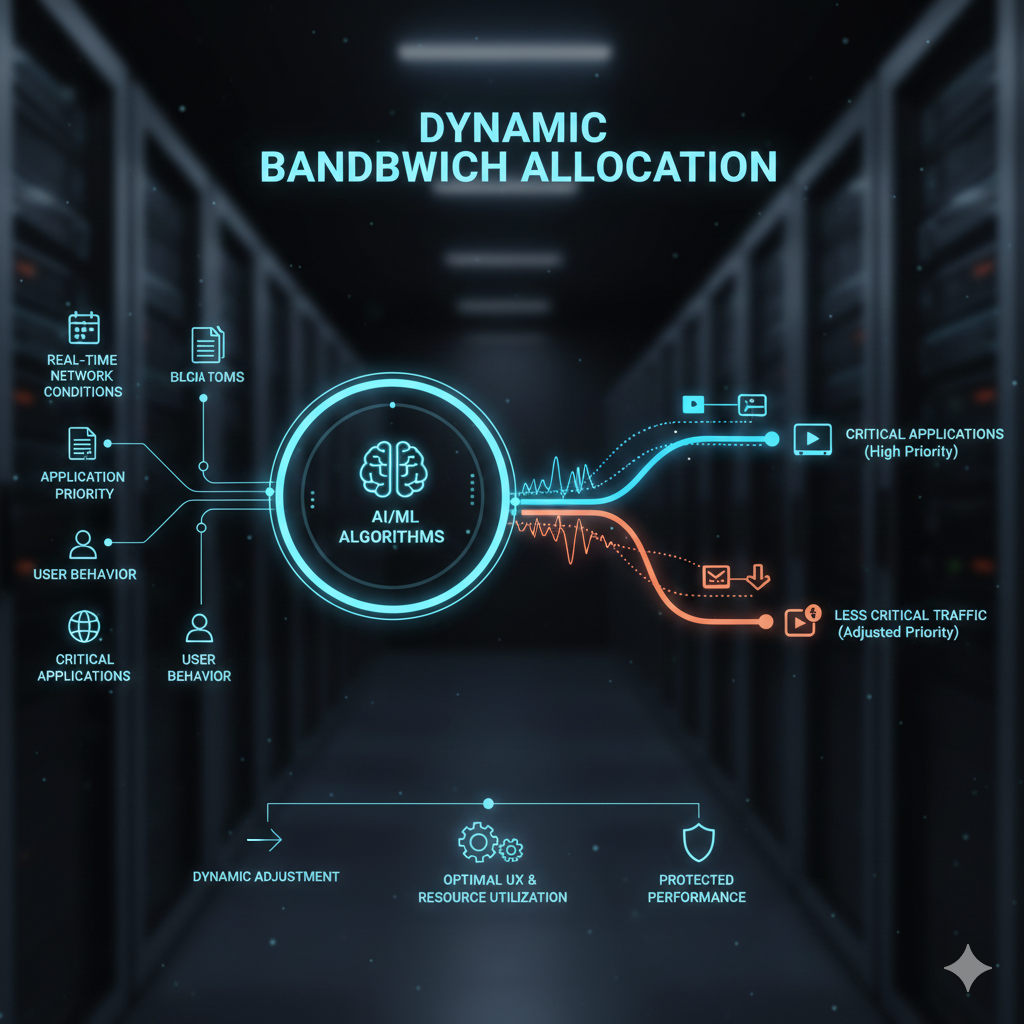
3. Dynamic Bandwidth Allocation
In an AI-optimized network, bandwidth is not a static resource. Reinforcement Learning (RL) agents can be deployed to dynamically adjust bandwidth allocation based on real-time application needs and business priority.
For example, during a critical business video conference, the AI can temporarily prioritize that traffic over a large file transfer, ensuring the quality of service for the most important task.
This intelligent, automated Quality of Service (QoS) management ensures that the network resources are always aligned with the organization’s operational goals.
For a deeper dive into the models used, refer to this article on Optimizing Bandwidth Usage with AI.
AI-Driven Bottleneck Resolution Strategies
Once a bottleneck is identified, AI can initiate a range of automated or assisted resolution strategies.
| Bottleneck Type | Traditional Resolution | AI-Driven Resolution |
|---|---|---|
| Link Saturation | Manual traffic shaping, link upgrade. | Intelligent Rerouting: AI automatically shifts non-critical traffic to alternate, less-utilized paths. |
| Application Hogging | Manual policy creation, user notification. | Adaptive QoS: AI identifies the application signature and dynamically throttles its non-essential traffic until the peak demand subsides. |
| Device Fault/Error | Manual log analysis, device replacement. | Predictive Maintenance: AI correlates error logs with performance degradation to predict device failure and recommends preemptive replacement. |
The ability to resolve issues at machine speed is what sets AI-driven bandwidth management apart, minimizing the duration of any performance impact.
Implementing an AI-Driven Bandwidth Strategy
To effectively leverage AI for bandwidth optimization, organizations should focus on three core areas:
- Data Granularity: Collect high-fidelity data (e.g., NetFlow/IPFIX) at short intervals to provide the AI with the detailed information it needs to build accurate models.
- Closed-Loop Automation: Move toward a system where the AI not only detects the bottleneck but also has the authority to implement the fix (e.g., rerouting traffic) without human intervention.
- Focus on User Experience: Use AI to monitor key performance indicators (KPIs) that directly impact the end-user, such as application response time and video quality, rather than just raw link utilization.
The concept of using AI to identify bottlenecks is also critical in non-network environments, such as optimizing AI training workflows, as discussed in this video on AI’s Invisible Bottleneck.
The Future of Bandwidth Management
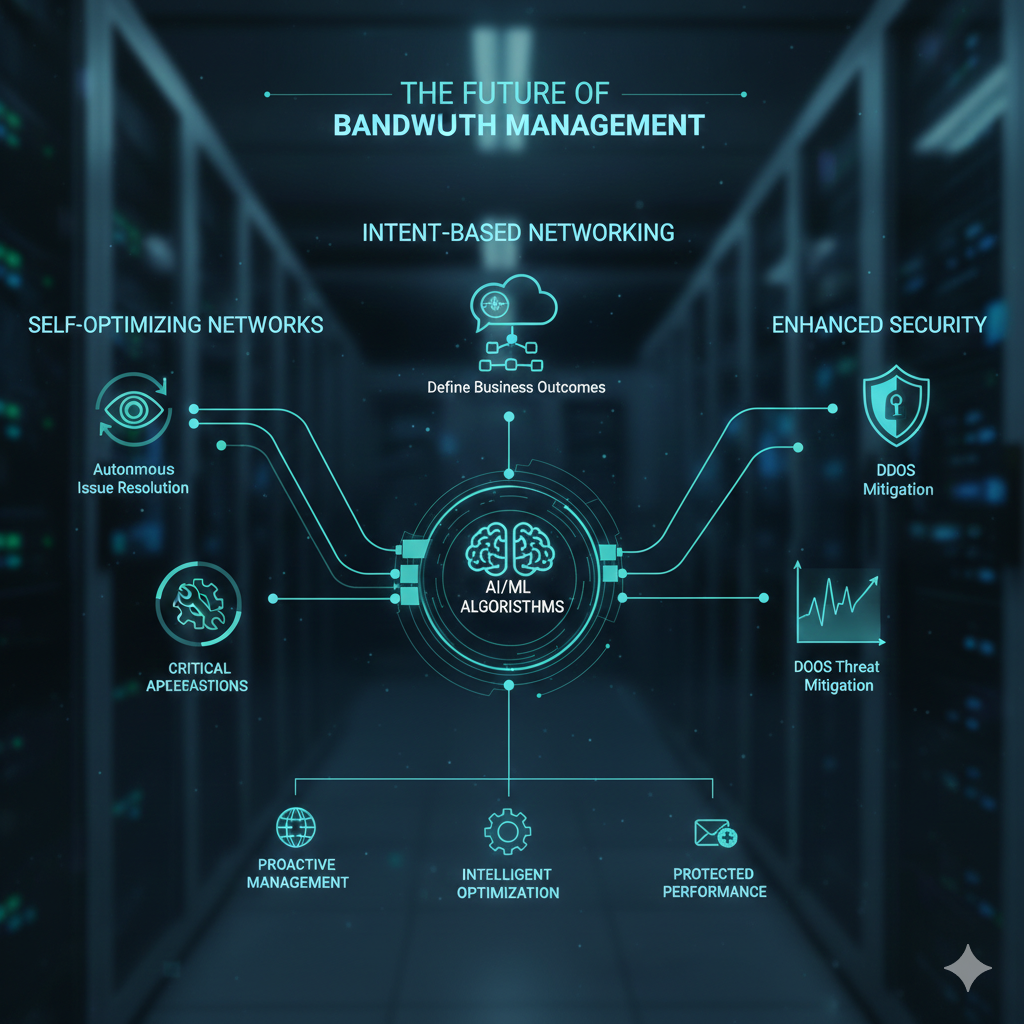
The future of bandwidth management is a network that is fully self-aware and self-optimizing.
AI will manage the entire network lifecycle, from predicting the need for a link upgrade months in advance to dynamically adjusting traffic flows in milliseconds to prevent a micro-bottleneck.
This level of automation will be essential to support the massive bandwidth demands of 5G, IoT, and next-generation cloud services.
By adopting AI-driven solutions, network administrators can ensure their infrastructure remains a competitive advantage, providing consistent, high-speed performance that is always one step ahead of demand.
For a detailed look at how AI agents can manage this process, see this resource on AI Bandwidth Optimization Solutions.
The era of reactive bandwidth troubleshooting is over; the age of intelligent, predictive optimization is here.