
For any business aspiring to grow beyond its local market, its brand is its most valuable asset. 💎
The name, logo, and slogans that identify your goods or services are the core of your commercial identity.
Protecting this identity is not merely a legal formality; it is a foundational strategy for sustainable business growth.
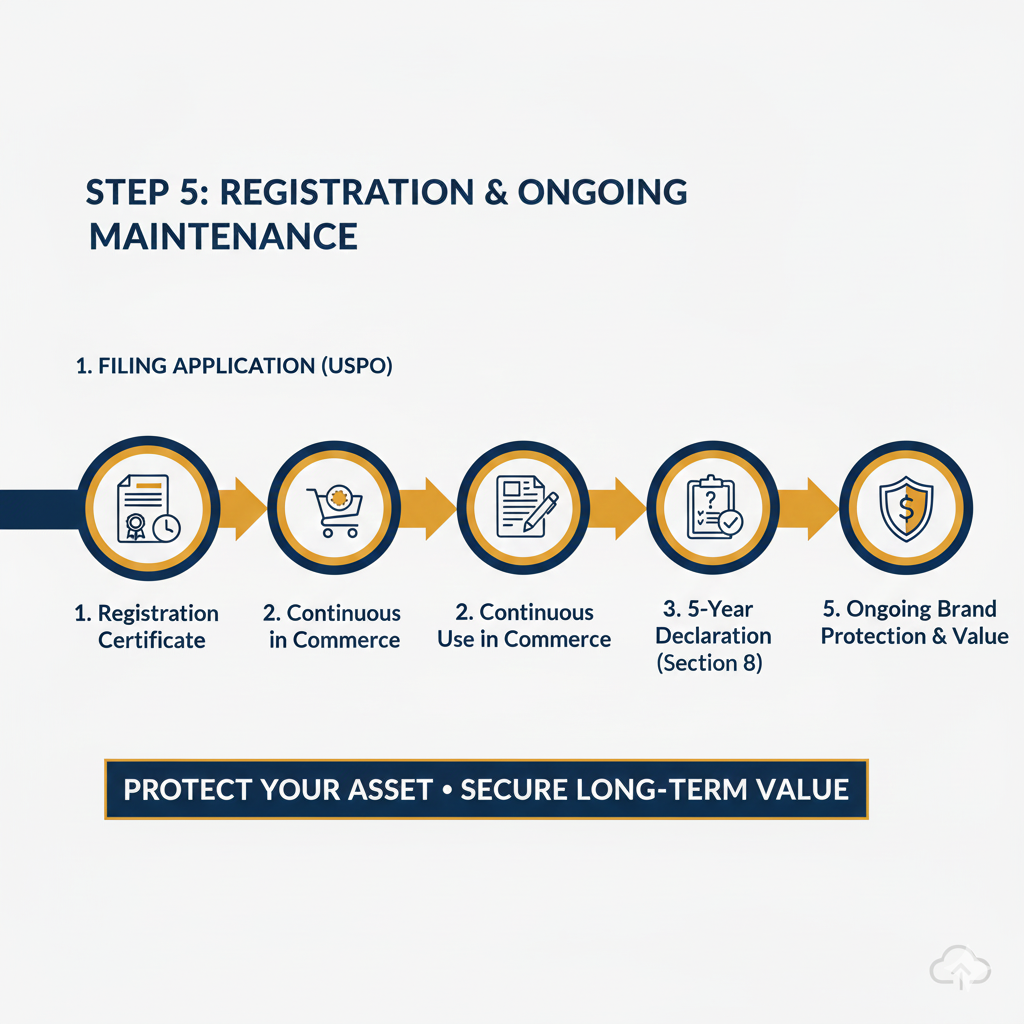
The formal process for achieving this protection is the trademark registration process. 🛡️
A registered trademark grants you exclusive rights to use your brand identifiers nationwide, providing a powerful legal shield against competitors and counterfeiters.
This comprehensive guide breaks down the complex, multi-stage trademark registration process into clear, actionable steps, focusing primarily on the system administered by the United States Patent and Trademark Office (USPTO).
Understanding these steps is crucial for any business owner looking to secure their brand’s future and unlock new avenues for expansion.
The Strategic Value of Trademark Registration for Growth 📈
Many small businesses operate under the misconception that simply using a name grants them sufficient protection.
While common law rights exist, they are geographically limited and difficult to enforce.
Federal registration, symbolized by the ® mark, transforms your brand into a legally recognized piece of property.
The USPTO highlights that registration allows you to use the ® symbol and provides nationwide legal notice of your claim of ownership. This national scope is vital for businesses with e-commerce or multi-state operations.
How a Trademark Fuels Business Expansion 📌
The benefits of a registered trademark are directly tied to a company’s ability to scale and attract investment.
- Legal Presumption of Ownership: A federal registration is prima facie evidence of the validity of the trademark and your exclusive right to use it in commerce. This makes enforcement in court significantly easier and cheaper.
- Enhanced Brand Value: Trademarks are intangible assets that can be valued on a balance sheet. A strong, protected brand increases the company’s valuation, which is critical for mergers, acquisitions, or securing loans.
- Basis for International Protection: A U.S. federal registration is a prerequisite for seeking protection in many foreign countries through international treaties like the Madrid Protocol.
- Licensing and Franchising Opportunities: A registered trademark is a necessary component for legally licensing your brand to others or building a franchise system, creating new, passive revenue streams.
- Deterrence: The mere existence of a federal registration often deters potential infringers from using a similar mark, saving the business significant legal costs.
In essence, a trademark transforms a mere identifier into a powerful, defensible asset that supports all future growth initiatives.
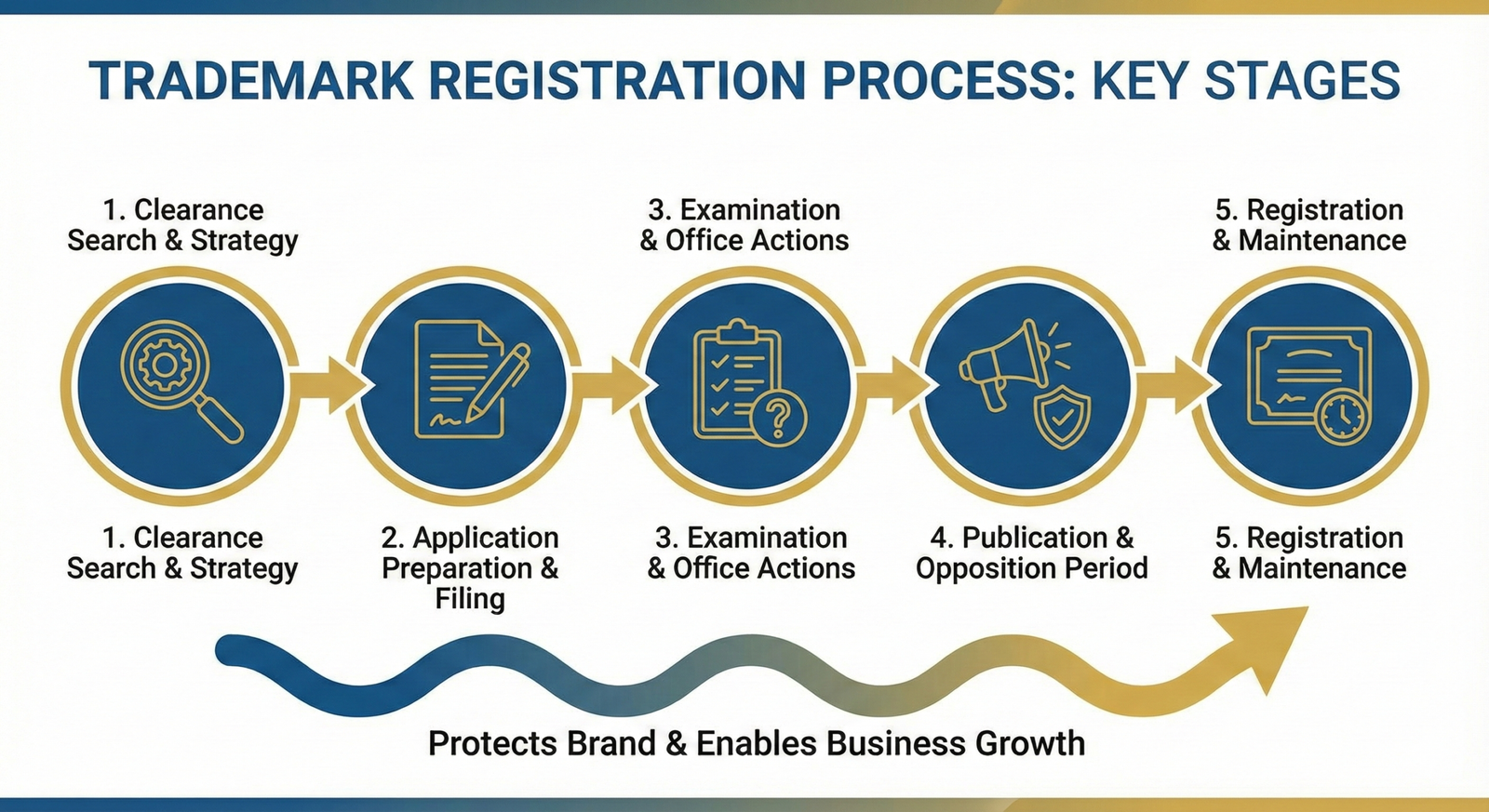
The 7-Step Trademark Registration Process (USPTO) 🗺️
The trademark registration process is methodical and can take anywhere from 9 to 18 months, provided there are no complications.
Each step requires careful attention to detail and adherence to strict legal requirements.
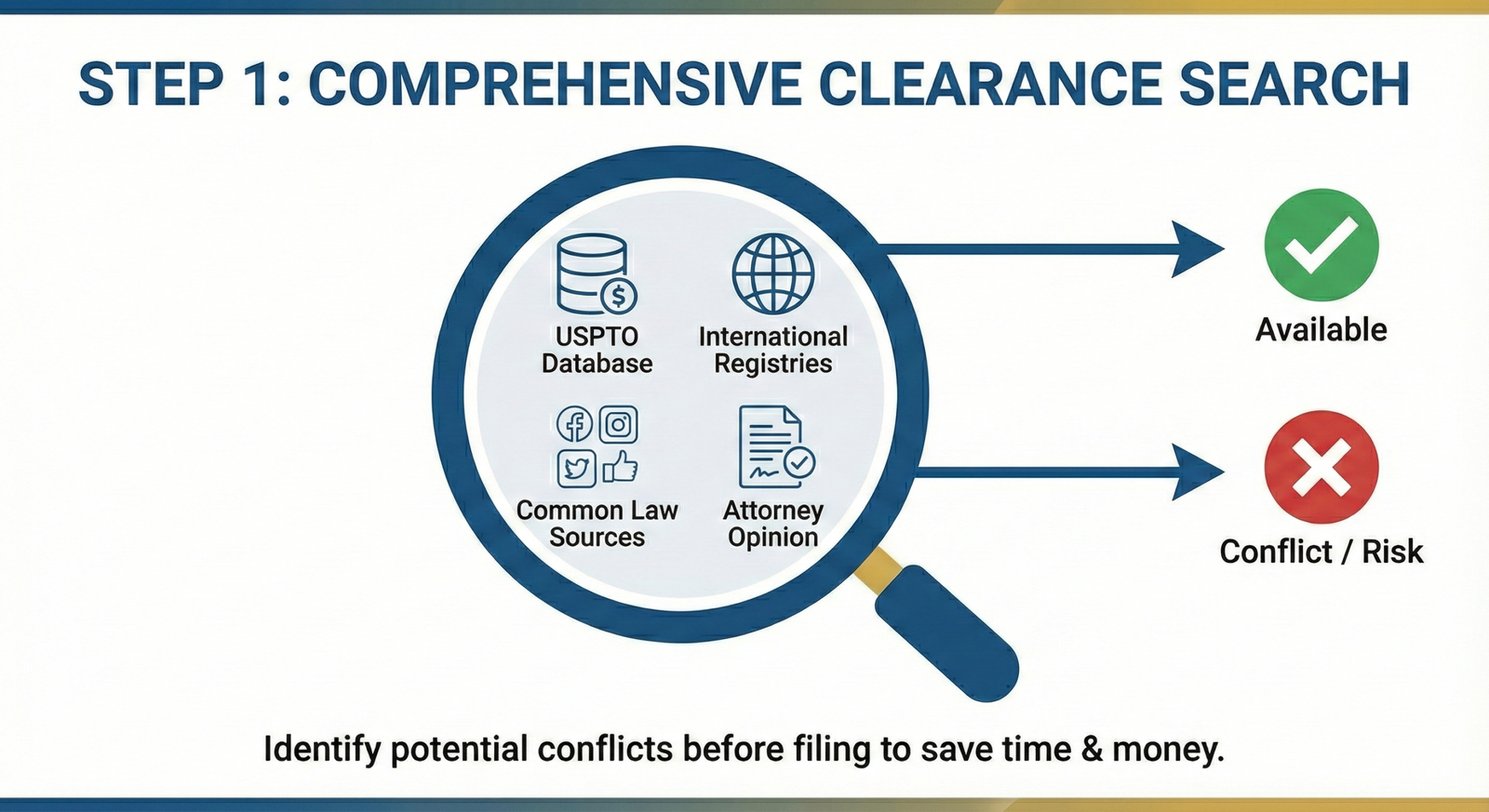
Step 1: Conduct a Comprehensive Clearance Search
Before spending time and money on an application, you must ensure your mark is available and not confusingly similar to an existing one.
This involves searching the USPTO’s Trademark Electronic Search System (TESS) database, state registries, and common law sources (e.g., business names, domain names, social media handles).
A thorough search is the single most important step to prevent rejection later in the process.
Step 2: Determine the Basis for Filing
You must file based on either “use in commerce” (you are already selling goods/services under the mark) or “intent to use” (you plan to use the mark soon).
The “intent to use” basis requires an additional fee and a Statement of Use once the mark is actually in use.
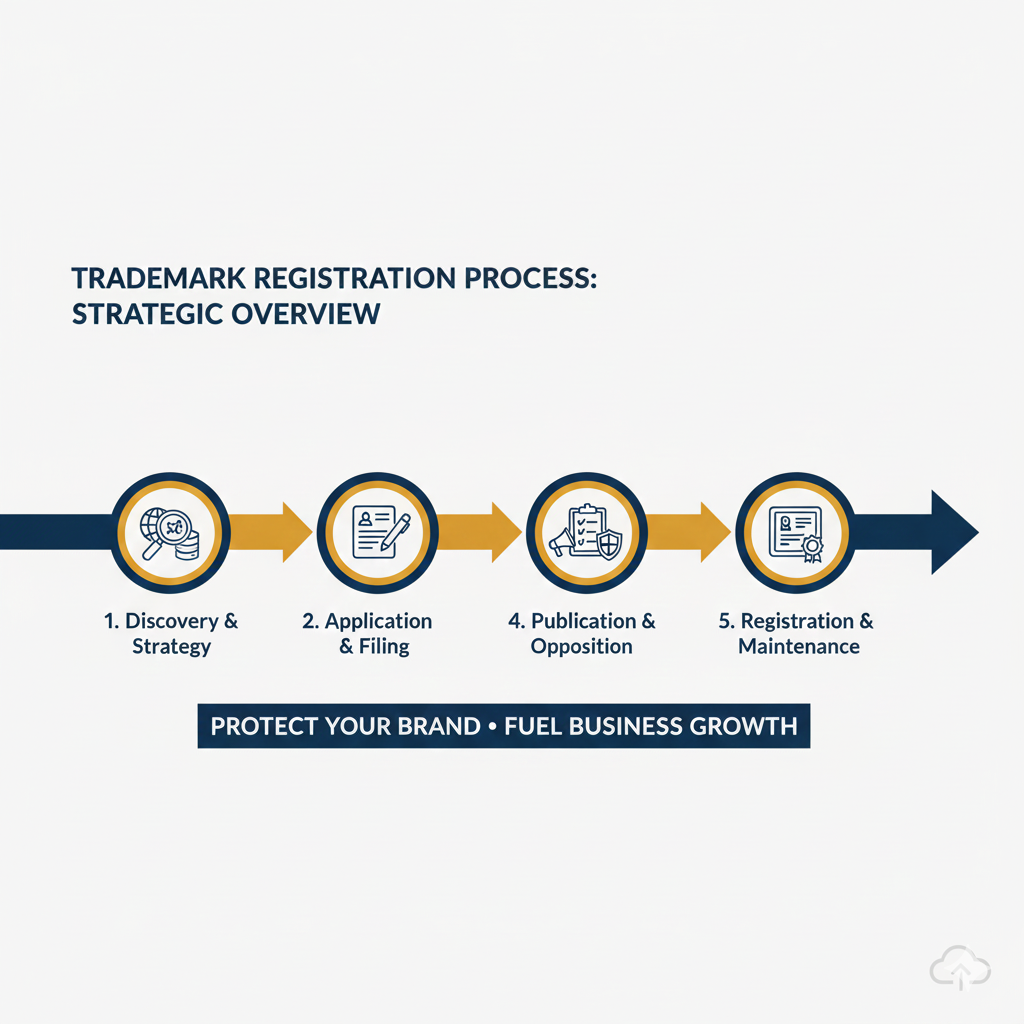
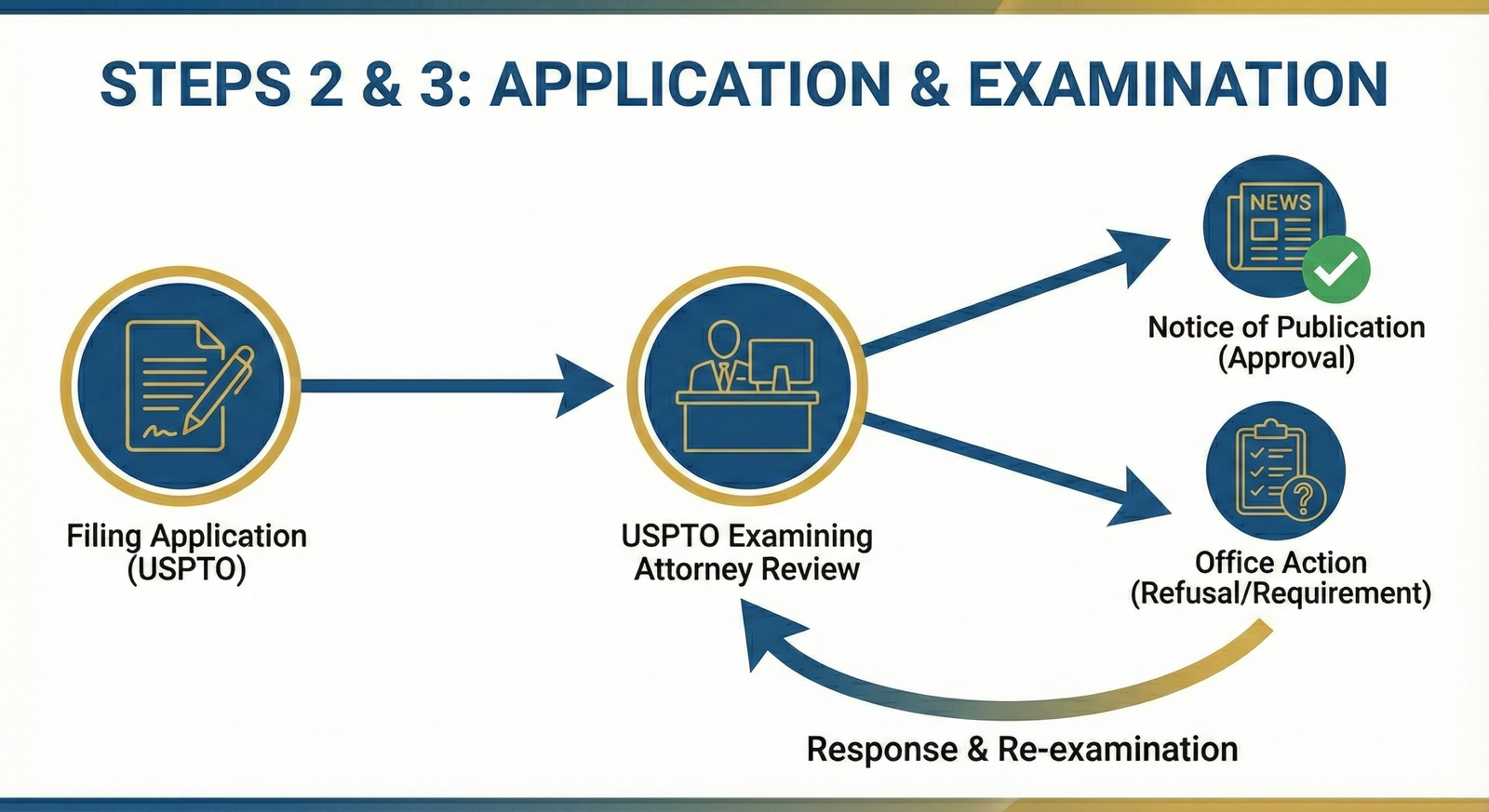
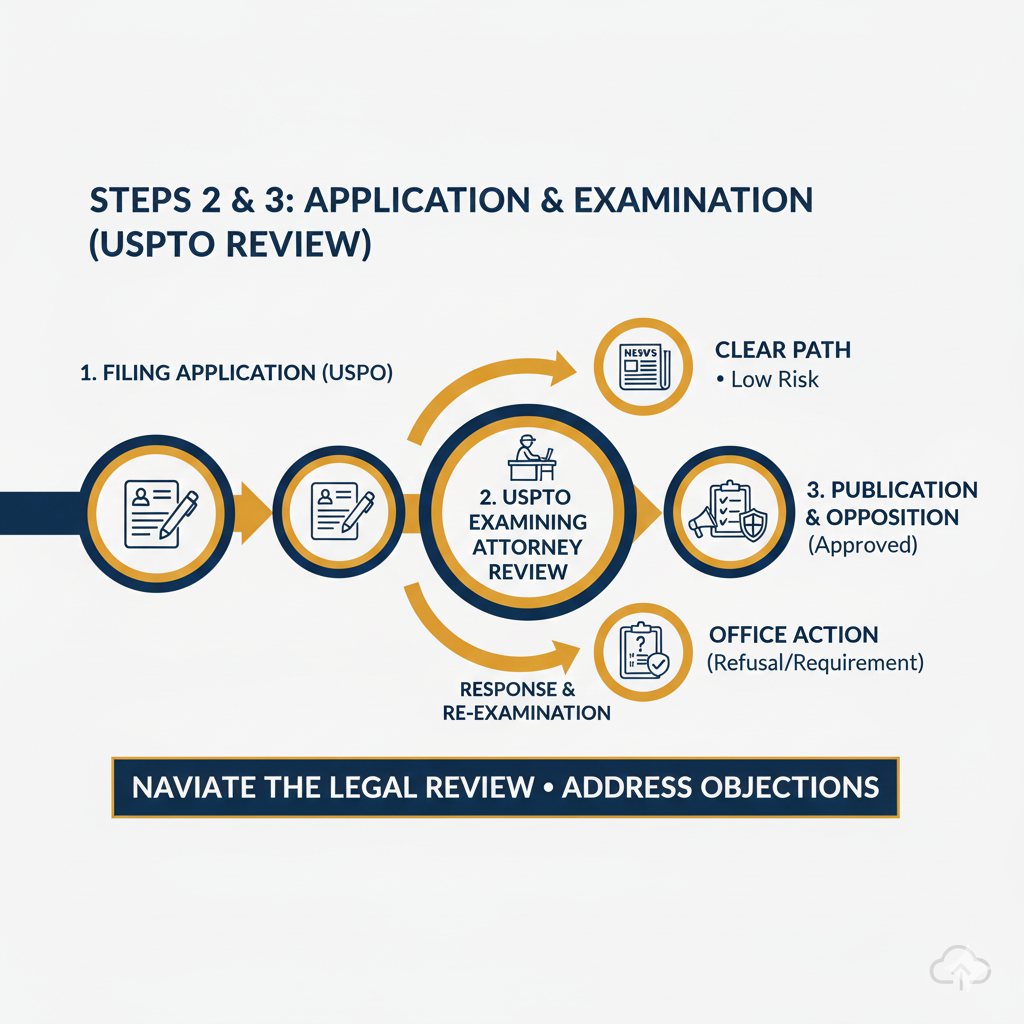
Step 3: Prepare and Submit the Application
The application is filed electronically through the USPTO’s Trademark Center.
You must accurately identify the goods or services associated with the mark using the Nice Classification system.
An inaccurate classification is a common reason for application delays.
The USPTO provides a direct portal for this process. Using the TEAS Plus option offers a lower filing fee but requires stricter adherence to pre-approved descriptions.
Step 4: Examination by an Attorney
Approximately three to six months after filing, a USPTO Examining Attorney reviews the application.
The attorney checks for compliance with all federal laws and conducts their own search for conflicting marks.
If issues are found, the attorney will issue an Office Action, which is a formal letter detailing the reasons for refusal or required corrections.
The applicant has a limited time (usually six months) to respond to the Office Action.
Step 5: Publication for Opposition
If the Examining Attorney approves the mark, it is published in the Official Gazette, a weekly publication of the USPTO.
This opens a 30-day window during which any third party who believes they would be damaged by the registration can file an opposition.
This is a quasi-judicial proceeding before the Trademark Trial and Appeal Board (TTAB).
Step 6: Issuance of Registration or Notice of Allowance
If no opposition is filed (or if an opposition is successfully overcome), the process moves to the final stage.
If the application was based on “use in commerce,” the USPTO issues the Certificate of Registration.
If it was based on “intent to use,” a Notice of Allowance is issued, and the applicant then has six months (with possible extensions) to file the Statement of Use, proving the mark is now in use.
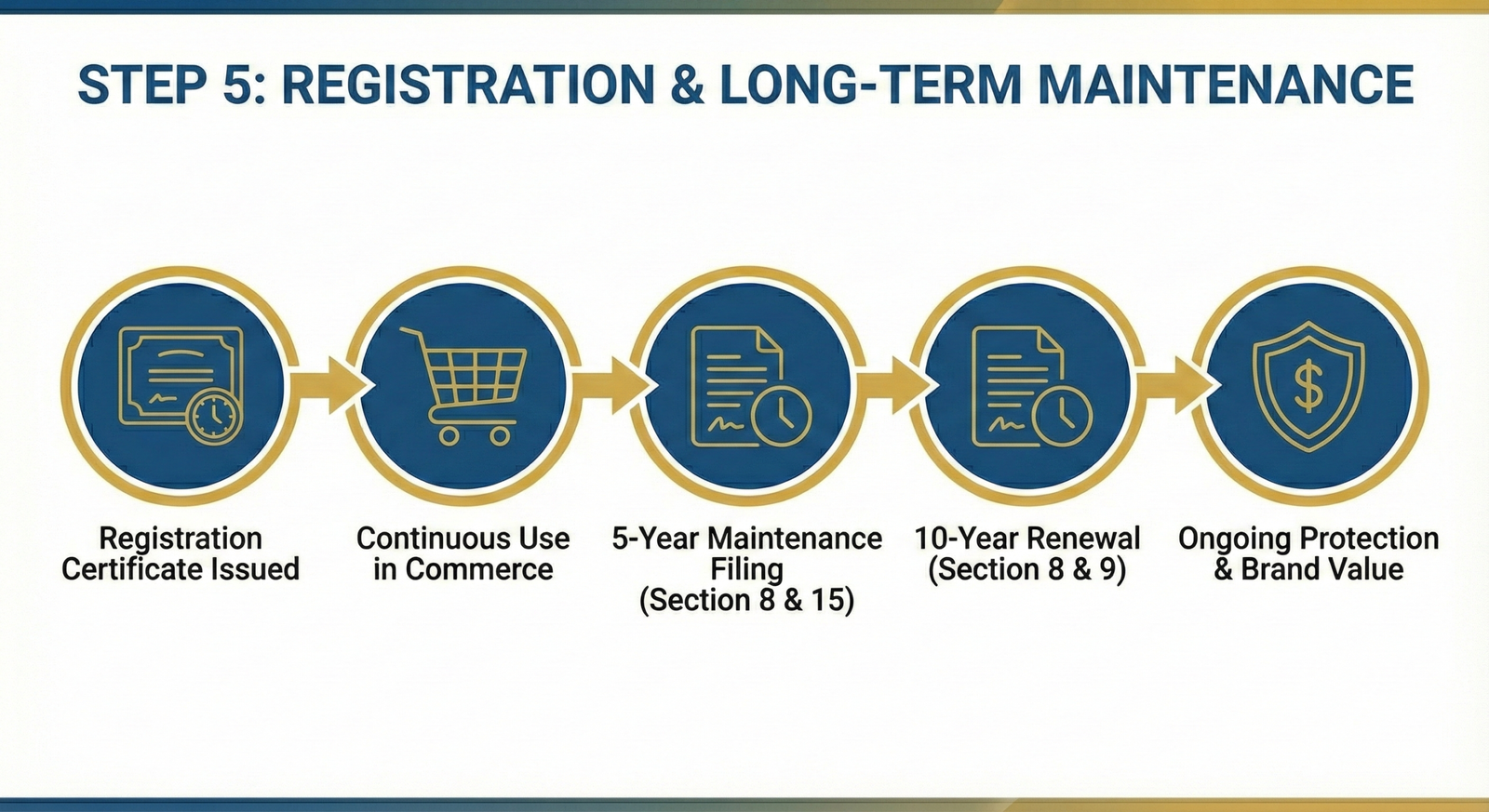
Step 7: Post-Registration Maintenance
A trademark registration is not permanent.
To keep the registration alive, the owner must file maintenance documents at specific intervals: between the 5th and 6th year, and then between the 9th and 10th year, and every 10 years thereafter.
Failure to file these documents results in the cancellation of the registration.
Deep Dive: The Critical Clearance Search 🔎
The clearance search is the most critical administrative step in the entire process.
A poor search can lead to a costly rejection or, worse, a lawsuit from an existing trademark owner after you have invested heavily in branding.
The goal is to find any mark that is “confusingly similar” to yours, not just identical.
| Search Component | Focus | Risk Mitigation |
|---|---|---|
| TESS Database | Federally registered and pending marks. | Avoids USPTO Office Actions based on likelihood of confusion. |
| State Registries | Marks registered only at the state level. | Avoids state-level infringement claims. |
| Common Law Sources | Business directories, domain names, social media, search engines. | Avoids common law infringement claims from unregistered users. |
The legal standard is “likelihood of confusion,” which considers the similarity of the marks and the similarity of the goods or services.
For example, “Apple” for computers and “Apple” for music are considered similar marks, but they are in different classes of goods.
However, “Apple” for computers and “iApple” for computer repair services would likely be confusingly similar.
International Protection: The Madrid Protocol 🌐
For businesses with global ambitions, registering a trademark in every country is a costly and time-consuming administrative nightmare.
The Madrid Protocol, administered by the World Intellectual Property Organization (WIPO), offers a streamlined solution.
It allows a trademark owner to file a single international application, based on their home country’s application or registration, to seek protection in up to 129 member countries.
WIPO explains that the Madrid Protocol is a convenient and efficient way for trademark owners to file one application to register their trademark in multiple countries. This single-application system is a massive administrative advantage.
Administrative Benefits of the Madrid System
The Madrid Protocol simplifies the administrative burden in several key ways.
- Single Filing and Language: The application is filed in one office (your home country’s IP office) and in one language (English, French, or Spanish).
- Centralized Management: Subsequent changes, such as a change of ownership or renewal, are recorded centrally with WIPO, rather than requiring separate filings in dozens of national offices.
- Cost-Effective: While not cheap, it is significantly less expensive than hiring local counsel in every country to file separate national applications.
For businesses with international aspirations, integrating the Madrid Protocol into the initial trademark strategy is a crucial step for long-term business growth.
Legal Distinction: Trademark, Copyright, and Patent 🧐
A common administrative confusion is the difference between the three main types of intellectual property (IP) protection.
Each protects a different aspect of your business and requires a separate registration process.
| IP Type | What It Protects | Duration |
|---|---|---|
| Trademark | Brand names, logos, slogans, and symbols used to identify goods/services. | Indefinite, provided it is continuously used and maintained. |
| Copyright | Original works of authorship (e.g., books, music, software code, photographs). | Life of the author plus 70 years (or 95 years for corporate works). |
| Patent | Inventions, processes, and designs (utility or design patents). | 20 years from filing date (utility) or 15 years from grant (design). |
A single product may involve all three: a patent for the technology, a copyright for the user manual, and a trademark for the brand name.
The U.S. Small Business Administration (SBA) provides excellent resources to help small businesses distinguish between these forms of protection. Understanding your IP portfolio is key to legal defense.
Avoiding Common Administrative and Legal Pitfalls 🚧
The trademark process is littered with administrative traps that can lead to rejection or loss of rights.
Being aware of these common pitfalls is essential for a smooth registration process.
Pitfall 1: Choosing a Weak Mark
Trademarks are categorized by their strength, from strongest to weakest: Fanciful (e.g., KODAK), Arbitrary (e.g., APPLE), Suggestive (e.g., MICROSOFT), Descriptive (e.g., SHARP TV), and Generic (e.g., SHOE STORE).
Descriptive and Generic marks are often refused registration because they do not distinguish the source of the goods.
Always aim for a Fanciful or Arbitrary mark to ensure the highest level of legal protection and brand distinctiveness.
Pitfall 2: Improper Identification of Goods/Services
The USPTO requires a precise description of the goods or services.
Overly broad or vague descriptions will result in an Office Action.
The administrative task here is to use the USPTO’s “Acceptable Identification of Goods and Services” manual to ensure your description is accurate and accepted.
Pitfall 3: Failure to Monitor and Enforce
Registration is only the beginning.
The administrative responsibility for monitoring and enforcing your trademark falls entirely on the owner.
If you allow others to use confusingly similar marks, you risk your mark becoming “generic” (like Aspirin or Escalator), which can lead to the loss of your exclusive rights.
This requires ongoing administrative effort, often through a watch service or regular searches.
LegalZoom emphasizes the importance of protecting your business name or product name through registration. The process is simple, but the maintenance is continuous.
The Role of Legal Counsel in the Process 🧑⚖️
While it is possible to file a trademark application yourself, the USPTO strongly recommends using a licensed attorney.
The legal complexities of the clearance search, responding to Office Actions, and navigating the TTAB process are significant.
An attorney can provide a more thorough clearance search, correctly classify your goods/services, and expertly handle any legal objections raised by the Examining Attorney.
The initial investment in legal counsel is often far less than the cost of correcting a flawed application or defending against an infringement lawsuit later.
The decision to hire an attorney is a critical administrative choice that directly impacts the success and longevity of your trademark protection.
Sterne Kessler provides a reminder on the benefits of a federal trademark registration, underscoring the legal protections that enhance a trademark’s reputation and value. This legal foundation is the bedrock of brand equity.
Video Guides to Trademark Registration 📚
To visualize the steps and concepts discussed, here are some helpful video resources.
Conclusion: Protect Your Brand, Secure Your Future 🌟
The trademark registration process is a necessary administrative and legal investment for any business serious about growth.
By diligently following the seven steps—from the critical clearance search to the final post-registration maintenance—you secure exclusive rights to your brand identity.
This protection is the foundation upon which you can build brand recognition, expand into new markets, and create valuable licensing opportunities.
Do not let your most valuable asset remain vulnerable; take the steps today to register and defend your trademark.
Your future business growth depends on it. 🥳