
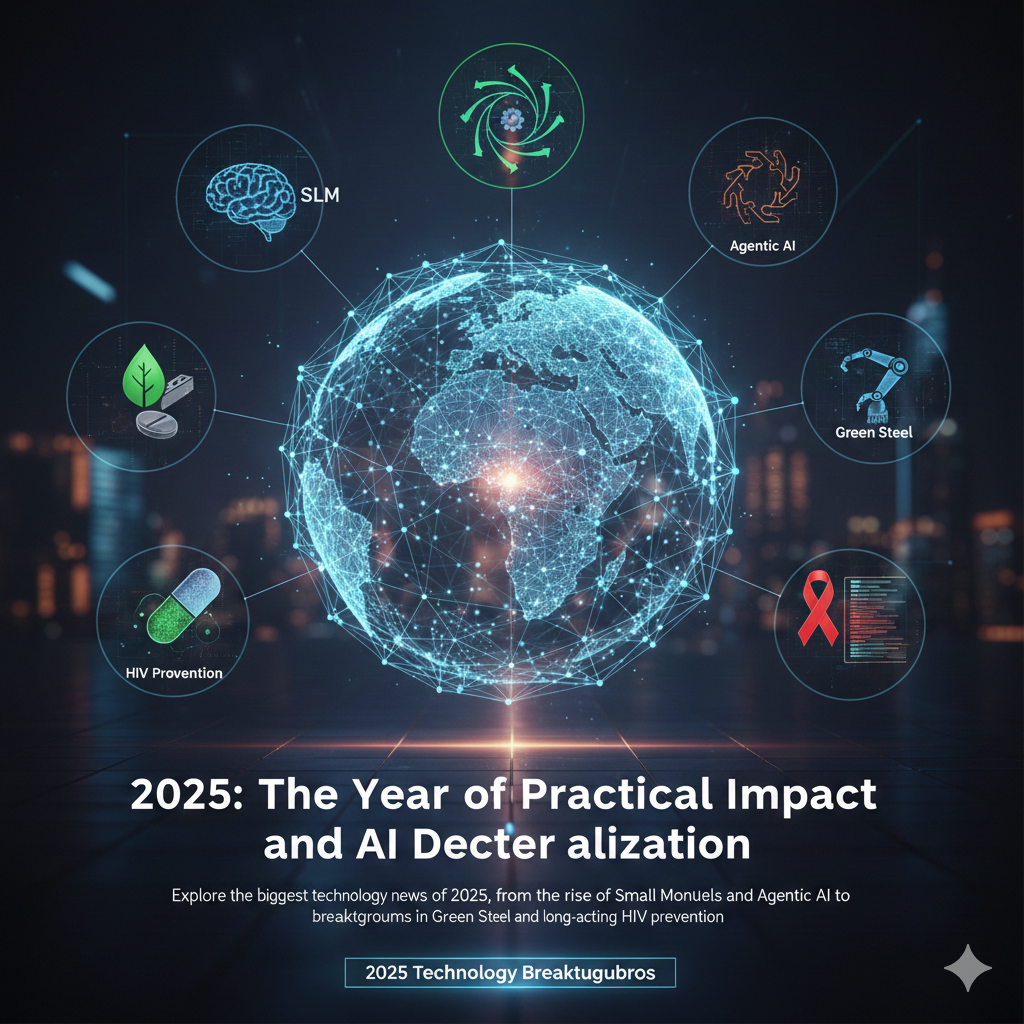
The year 2025 will be remembered not as the year of new technological promises, but as the year those promises finally began to deliver on a massive, global scale. 🚀
The technological landscape shifted profoundly, moving from the speculative excitement of the early 2020s to a period of tangible, scaled application. 💡
This transition was marked by three dominant themes: the maturation and decentralization of Artificial Intelligence, a critical tipping point in industrial sustainability technologies, and groundbreaking advances in human health and cosmic exploration. 🌌
The narrative of 2025 is one of practical impact. 📌
Technologies that were once confined to research labs or niche pilot programs—from AI agents to hydrogen-powered steel production—broke into the mainstream. 📈
This fundamentally reshaped industries, consumer behavior, and the global fight against climate change. 🌍
The AI Revolution’s Next Chapter: From LLMs to SLMs and Agentic Search 🤖
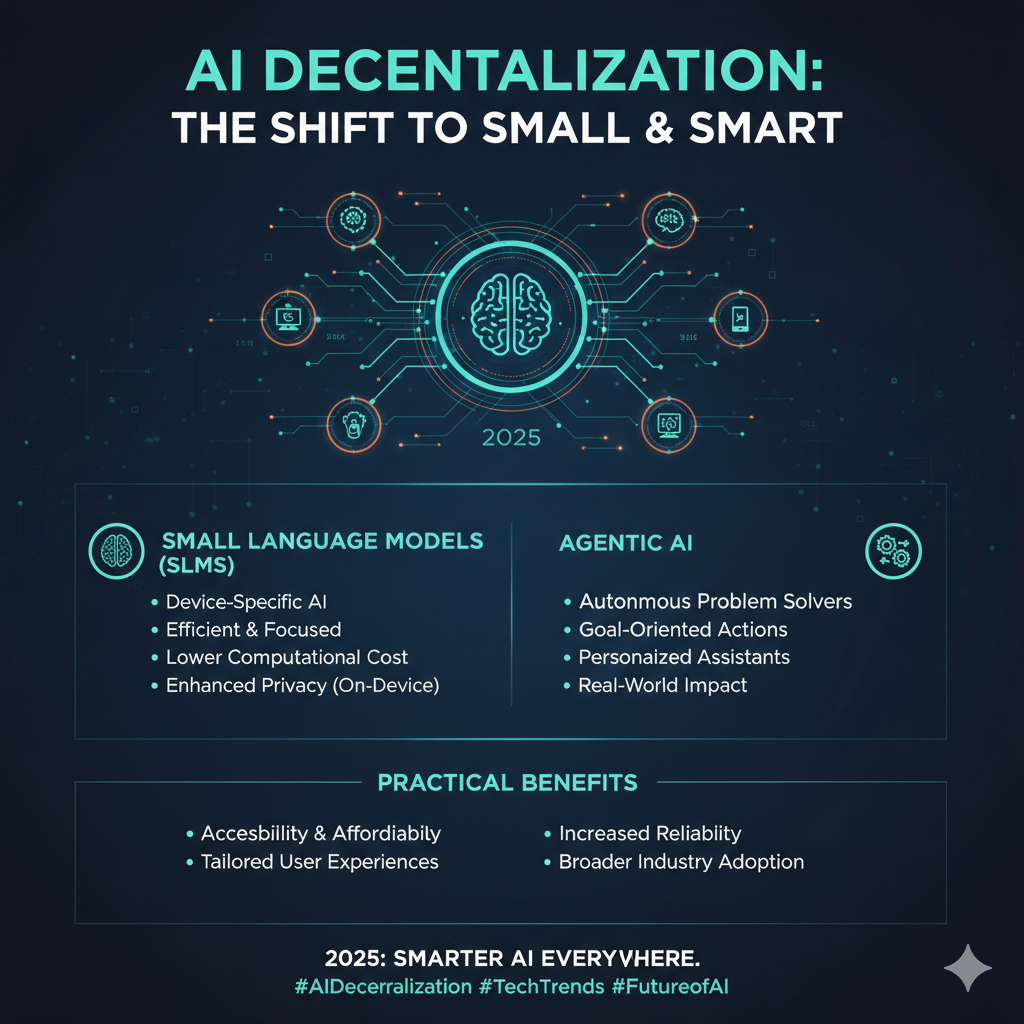
Artificial Intelligence, particularly the generative variety, dominated the headlines, but the story of 2025 was less about the raw power of Large Language Models (LLMs) and more about their evolution into more efficient, specialized, and agentic forms. 🧠
This shift is most visible in the transformation of how we access information. 🔎
The New Front Door: Generative AI Search
The traditional search engine, built on the paradigm of “ten blue links,” faced an existential challenge in 2025. 📉
Generative AI search, where an AI model synthesizes information from multiple online sources to provide a single, comprehensive answer, became the preferred method for a significant portion of the internet-using population. The MIT Technology Review highlighted this as a key breakthrough. [1]
Reports indicated that 44% of AI-powered search users now consider it their primary and preferred source of insight, surpassing traditional search methods. [2]
This change has profound implications for the digital economy. 💰
While AI search offers unparalleled convenience, it creates a “zero-click” problem for content creators and publishers. 📰
The data suggests a stark trade-off: while AI search conversions can be up to 23 times better than organic clicks, the overall traffic driven to external sites remains low, often under 1%. [3]
This dynamic has forced a rapid re-evaluation of Search Engine Optimization (SEO) strategies. 🛠️
Businesses are pivoting to focus on data quality, authority, and integration with AI models rather than simple keyword ranking. 🎯
The internet’s “front door” is no longer a list of links; it is an intelligent, conversational agent. 🗣️
Tiny Brains, Big Impact: The Rise of Small Language Models (SLMs)
The high cost, immense computational requirements, and latency of massive LLMs began to hit a wall in 2025. 🛑
This paved the way for their leaner, faster cousins: Small Language Models (SLMs). 🐇
These models, typically containing between 1 and 10 billion parameters, proved that they could match or even exceed the performance of their larger counterparts on specific, fine-tuned tasks. Forbes highlighted their business benefits. [4]
The advantages of SLMs are numerous and compelling: ✨
- Cost-Effectiveness: They require significantly less processing power and memory, leading to dramatically lower operational costs.
- Speed and Latency: Their smaller size allows for near-instantaneous responses, making them ideal for real-time applications.
- On-Device Deployment: SLMs can run locally on consumer devices, enhancing privacy and enabling functionality even without an internet connection. [5]
- Specialization: By being fine-tuned for specific enterprise or domain tasks, they offer higher accuracy and relevance than general-purpose LLMs.
This shift is not merely an optimization; it is the foundation for the next wave of AI: Agentic AI. 🏗️
Agentic AI: The Future of Automation
Agentic AI refers to systems capable of performing complex, multi-step tasks autonomously. 🤖
They make decisions and interact with the digital and physical world on a user’s behalf. 🌐
The efficiency and local deployability of SLMs are the critical enablers for these agents. Research from Arxiv confirms that SLMs are the future of agentic systems. [6]
Instead of relying on a single, massive, cloud-based brain, an agentic system in 2025 is often composed of multiple, specialized SLMs working in concert. 🤝
This architecture allows for unprecedented levels of automation in the workplace. 💼
Reports show that while adoption of generative AI is high (82% of companies using it at least weekly), only a small fraction (around 5%) have successfully integrated it into core workflows. [7]
The challenge for the remainder of the decade will be scaling these agentic systems from successful pilots to full enterprise transformation. 🚀
The Green Tech Tipping Point: Sustainability and Industrial Innovation ♻️
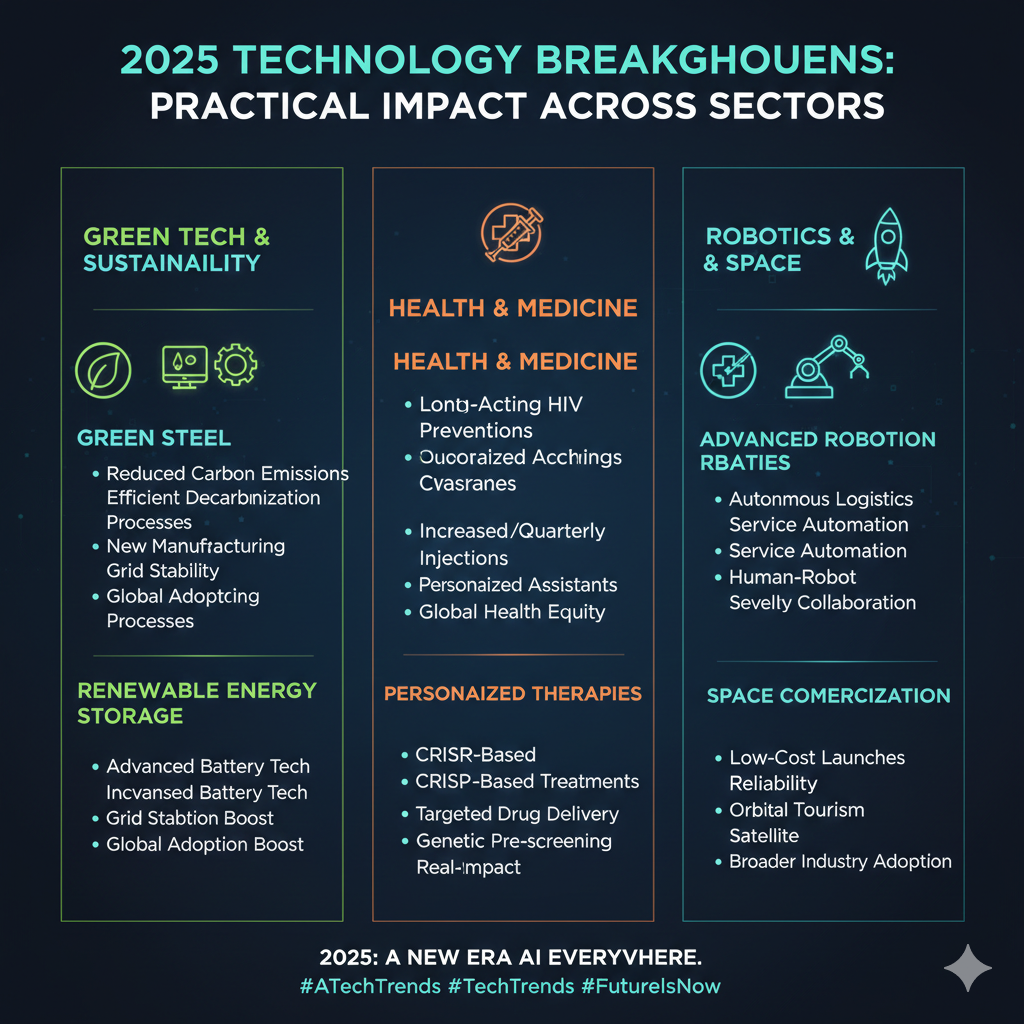
While AI captured the public imagination, some of the most consequential breakthroughs of 2025 occurred in the industrial and environmental sectors. 🏭
These were driven by a global mandate to decarbonize. 🎯
The year marked a decisive move toward commercializing technologies that tackle the hardest-to-abate emissions. 💨
Green Steel: Decarbonizing the Foundation of Industry
The steel industry is one of the world’s largest industrial sources of carbon dioxide, emitting more than all of India. [8]
In 2025, the concept of Green Steel—steel produced without using coking coal—moved from pilot to industrial reality. 🏗️
The construction of the first industrial-scale green-steel plant, utilizing hydrogen made with renewable power, began in earnest. [9]
This hydrogen-based process replaces the traditional, carbon-intensive blast furnace method. 🔥
It offers a pathway to dramatically reduce the carbon footprint of construction, infrastructure, and manufacturing globally. 🌎
The successful scaling of this technology is a crucial step in achieving net-zero targets for the entire industrial sector. ✅
Sustainable Aviation Fuel (SAF) Takes Flight
The aviation sector, another major emitter, saw a significant acceleration in the adoption and production of Sustainable Aviation Fuel (SAF). ✈️
New government mandates and corporate commitments fueled a massive investment wave in production facilities. [10]
SAF, which can be made from used cooking oil, agricultural waste, or even synthetic processes using captured carbon, became a major commodity. 🛢️
The infrastructure and regulatory framework established in 2025 set the stage for SAF to become a dominant fuel source within the next decade. ⏳
A Dietary Solution to Climate Change
Perhaps the most surprising environmental breakthrough came from the agricultural sector: a solution to cattle-related methane emissions. 🐄
Cow burps are a major source of agricultural greenhouse gases. 💨
But 2025 saw the widespread commercial availability of food supplements that significantly reduce the amount of methane cattle belch. [11]
This simple, scalable dietary intervention, now available in dozens of countries, offers an immediate and measurable impact. 💯
It demonstrates that not all climate solutions require complex, multi-billion-dollar infrastructure projects. 💰
Human Augmentation and Exploration: Health, Robotics, and the Cosmos 🧑🚀
Beyond AI and sustainability, 2025 delivered monumental progress in technologies that directly affect human life and our understanding of the universe. 🔭
Medical Milestones: Long-Acting Prevention and Stem-Cell Cures
The fight against global pandemics and chronic disease saw two major victories. 🏆
A new, long-acting medication for HIV prevention was hailed as a potential game-changer. 💉
Clinical trials demonstrated that a single injection administered once every six months offered 100% protection against acquiring HIV infections in treated women and girls. [12]
This breakthrough significantly simplifies adherence and could be the final, crucial tool needed to end the AIDS epidemic. 🙏
Simultaneously, the decades-long promise of stem-cell therapies began to materialize. 🌱
Experimental transplants of lab-made cells showed remarkable success in treating two very different, debilitating conditions: epilepsy and Type 1 diabetes. [13]
This progress signals a new era of regenerative medicine, moving beyond managing symptoms to offering potential cures. 🧬
The General-Purpose Robot and the Augmented Mind
In robotics, the integration of generative AI led to the emergence of fast-learning, general-purpose robots. 🦾
Unlike their predecessors, which were programmed for a single, repetitive task, these new automatons can be dropped into novel environments. 🗺️
They learn complex, multi-step tasks almost instantly through natural language instruction. [14]
This capability is rapidly accelerating the deployment of robots in logistics, manufacturing, and even domestic settings. 🏡
Meanwhile, the field of Brain-Computer Interfaces (BCIs) moved from the realm of science fiction to clinical reality. 🧠💻
With over 25 clinical trials underway, BCIs are being tested to restore motor function, treat neurological disorders, and even enhance cognitive abilities. [15]
The year 2025 was a critical testing ground, validating the safety and efficacy of these devices. 🛡️
Looking to the Stars: The Vera C. Rubin Observatory
Finally, our view of the cosmos was set to be revolutionized with the commissioning of the Vera C. Rubin Observatory in Chile. 🇨🇱
Equipped with the largest digital camera ever made for astronomy, the observatory began its decade-long survey of the southern sky. [16]
This project is expected to generate an unprecedented volume of data. 💾
It will help astronomers untangle cosmic unknowns, including the nature of dark matter and the structure of the Milky Way. 💫
This ensures that 2025 was a year of looking inward at human potential and outward at the universe’s mysteries. 🌠
Summary of 2025 Breakthroughs: The Practical Shift
The following table summarizes the key technological shifts that defined the year 2025. 📊
| Theme | Key Breakthrough | Impact in 2025 |
|---|---|---|
| AI & Information | Generative AI Search | Became the preferred source of insight for 44% of users, challenging traditional search. |
| AI & Information | Small Language Models (SLMs) | Enabled cost-effective, fast, and on-device AI, driving the next wave of Agentic AI. |
| Sustainability & Industry | Green Steel | First industrial-scale plants began construction, replacing carbon-intensive coking coal with hydrogen. |
| Sustainability & Industry | Cattle Burping Remedies | Simple, scalable dietary supplements offered an immediate, measurable reduction in agricultural methane emissions. |
| Health & Exploration | Long-Acting HIV Prevention | A single, six-month injection showed 100% protection in trials, simplifying adherence. |
| Health & Exploration | Fast-Learning Robots | Integration of Generative AI created general-purpose robots that learn complex tasks instantly. |
Conclusion: The Era of Scaled Impact 🌟
The technology news of 2025 paints a picture of a world where innovation is no longer a theoretical exercise. 🧐
The year was defined by the successful scaling of solutions to some of humanity’s most pressing challenges—from climate change and disease to the fundamental way we interact with information. 🤝
The decentralization of AI through SLMs, the industrial shift toward Green Steel, and the medical breakthroughs in HIV prevention and stem-cell therapy all underscore a single, powerful trend. 💪
That trend is: technology is now moving from the laboratory to the ledger, from the pilot program to the planet. 🌐
As these technologies converge, the impact will only amplify, promising a decade of transformation built on the hard-won, practical realities of 2025. 🥳
Stay tuned for what 2026 has in store! ⏭️
References and Further Reading 📚
The following sources were used to compile this report on the major technology news of 2025. 📝
[1] MIT Technology Review. (2025, January 3). 10 Breakthrough Technologies 2025.