

Dialogue is the lifeblood of fiction. 🩸
It is the most immediate, visceral way to reveal character, inject conflict, and propel your plot forward.
Poor dialogue, however, can flatten your characters, confuse your readers, and bring your story to a grinding halt. 🛑
The goal is not to write “realistic” dialogue—real-life conversations are often boring and repetitive—but to write effective dialogue.
Effective dialogue is a highly concentrated form of communication that serves multiple purposes at once.
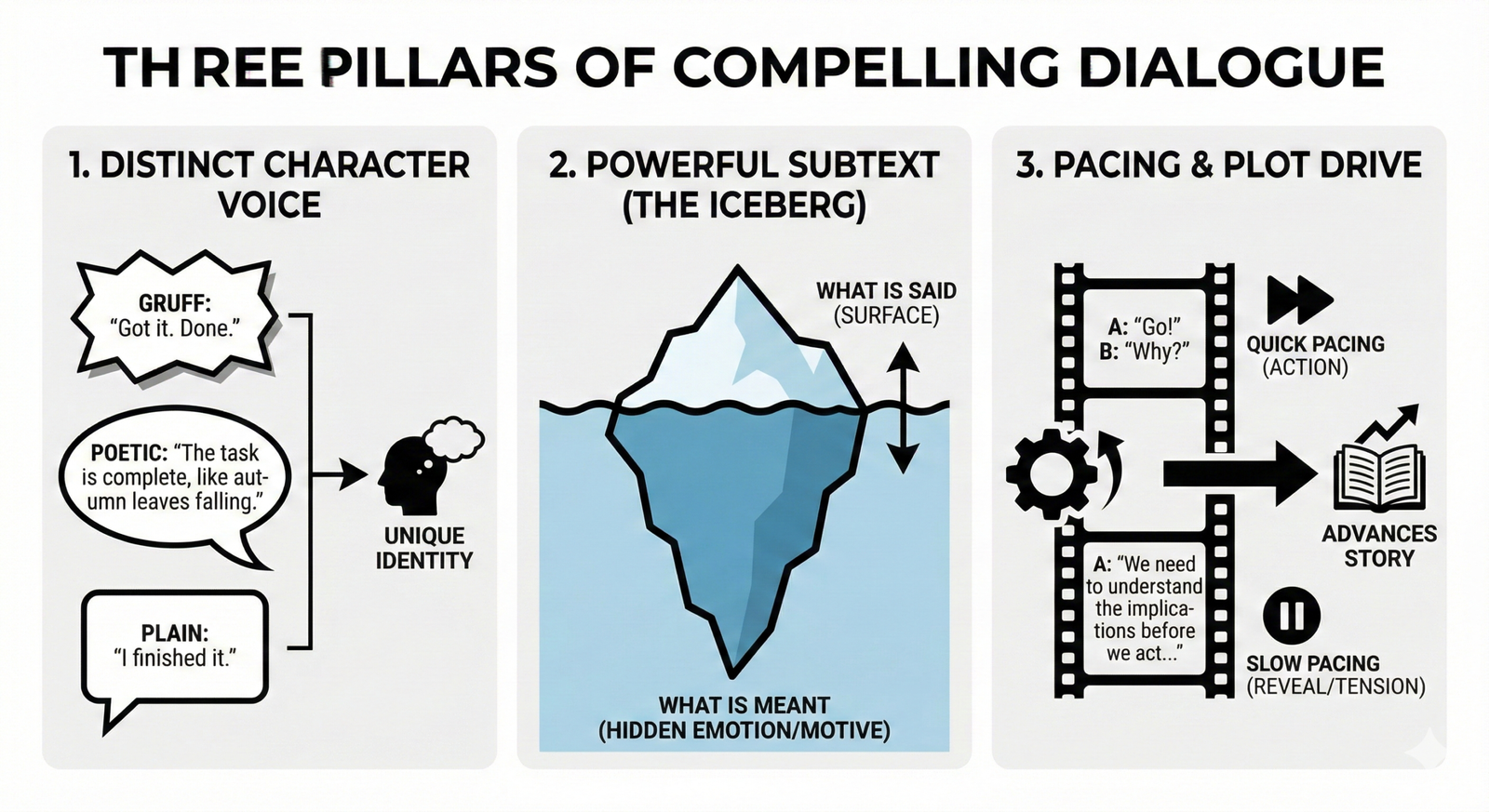
To master this essential craft, you must practice the three pillars of great dialogue: Voice, Subtext, and Pacing.
These Fiction Dialogue Writing Exercises are designed to sharpen your skills and ensure every word spoken in your novel earns its place.
Phase I: Hear Them Speak: Crafting Unique Character Voices 🗣️
In a well-written novel, you should be able to tell who is speaking even if the dialogue tag is removed.
If all your characters sound the same, you are missing a massive opportunity for characterization.
A unique voice is built on vocabulary, sentence structure, rhythm, and the specific things a character chooses to talk about—or avoid.
Exercise 1: The Monologue Swap 🎭
Write a one-page monologue for your most articulate, educated character (Character A).
The topic should be something they are passionate about.
Now, take the exact same content and rewrite the monologue for your least articulate, most guarded character (Character B).
Character B should use shorter sentences, more slang, more pauses, and perhaps avoid the core topic entirely.
This forces you to focus on the mechanics of voice, not just the content.
Exercise 2: The “Only Dialogue” Scene 💬
Write a short scene (about 300 words) with two characters talking about a mundane topic, like the weather or what they had for breakfast.
Do not use any dialogue tags (“he said,” “she replied”) or action beats.
The reader must be able to distinguish the speakers solely by their distinct voices.
If you cannot tell who is speaking, their voices are not unique enough.
This exercise is a brutal but effective test of your characterization skills.
For a deeper understanding of this technique, read about Creating Distinctive Character Voices.
Exercise 3: The Vocabulary Restriction 🚫
Choose a character and impose a strict vocabulary restriction on them.
For example, one character can only use words of one syllable.
Another can only speak in questions.
A third can only use metaphors and similes.
Write a short, high-stakes conversation between these characters.
The constraint will force you to be creative and will highlight the unique rhythm of each voice.
Phase II: The Meaning Beneath: Harnessing Subtext 🤫
Subtext is the meaning that is implied rather than stated.
It is the difference between a character saying “I love you” and a character saying “I made your favorite dinner.”
In real life, people rarely say exactly what they mean, especially in moments of high emotion or conflict.
Mastering subtext is the key to creating dialogue that feels rich, complex, and emotionally resonant.
Exercise 4: The Lie Detector 🤥
Write a scene where Character A is trying to convince Character B of something that Character A knows is a lie.
Character A must be utterly convincing, but their dialogue should be riddled with subtle tells—over-explaining, avoiding eye contact (shown through action beats), or using overly formal language.
Character B, who suspects the lie, should respond with questions that seem innocent but are designed to poke holes in the story.
This exercise is excellent for developing the tension that comes from the gap between what is said and what is true.
Exercise 5: The Unspoken Argument 😡
Write a scene where two characters are having a polite, seemingly harmless conversation about a neutral topic, like gardening or a recent movie.
However, the subtext is that they are furious with each other over a completely different, unmentioned issue.
The anger must leak out through their word choice, their tone (implied by action beats), and their inability to truly connect on the surface topic.
This is the essence of dramatic tension, as explained in resources on How to Write Subtext in Dialogue.
The conflict is what makes the scene compelling, even if the words themselves are mundane.
For more on this, explore the principles of Dramatic Tension in Fiction.
Phase III: Rhythm and Flow: Integrating Dialogue and Action 🥁
Dialogue should never exist in a vacuum.
It must be grounded in the physical world through action beats and dialogue tags.
This integration controls the pacing of your scene and prevents the dreaded “floating head” syndrome.
Exercise 6: The Action Beat Drill 🚶♀️
Take a scene from your current work that relies heavily on “he said” and “she said” tags.
Rewrite the scene, replacing every single dialogue tag with a meaningful action beat.
Instead of “He said, ‘I’m leaving,'” try: “He picked up his keys, the jangle a tiny, final sound in the quiet room. ‘I’m leaving.'”
The action beat should reveal character, set the mood, or advance the plot.
This practice forces you to think visually and physically about your characters’ interactions.
Exercise 7: The Interruption Game 💥
Write a high-stakes conversation where the characters are under extreme time pressure or emotional duress.
Use interruptions, incomplete sentences, and overlapping dialogue to create a sense of urgency and realism.
This is a great way to speed up the pacing of a scene.
Conversely, a scene with long, unbroken speeches will slow the pacing down.
Understanding this balance is key to Pacing with Dialogue.
Dialogue Tags vs. Action Beats: A Quick Comparison ⚖️
Knowing when to use a simple tag and when to use a descriptive beat is a mark of a skilled writer.
Use this table as a quick reference.
| Element | Purpose | Effect on Pacing |
|---|---|---|
| Dialogue Tag (e.g., said, asked) | To clearly identify the speaker with minimal distraction. | Fast and invisible; keeps the focus on the words. |
| Action Beat (e.g., He sighed, She looked away) | To reveal character, show emotion, or ground the scene physically. | Slower and more descriptive; controls the scene’s rhythm. |
| Adverbial Tag (e.g., angrily, quickly) | To tell the reader the emotion (generally discouraged). | Can slow pacing and feel redundant if the dialogue is strong. |
Conclusion: The Final Polish 🌟
Dialogue is not just a transcription of speech; it is a carefully constructed tool for revelation.
It should be a constant source of conflict, character, and forward momentum.
The final, non-negotiable step in mastering dialogue is to read your dialogue aloud.
This will immediately expose clunky phrasing, unnatural rhythms, and characters who sound too much alike.
Use these exercises as a regular part of your writing routine, and you will find your characters leaping off the page.
For more tips on refining your manuscript, consult resources on Fiction Editing Techniques.
Remember: every line of dialogue must serve a purpose—to reveal, to advance, or to entertain.
Embrace the unspoken truth; it is where the real drama lies.
Be ruthless in your editing; cut anything that doesn’t move the story forward.
Happy writing! 📝