
Welcome, author, to the powerful world of the personal essay. ✍️
This genre is more than just a writing exercise; it is a critical tool in your author marketing and promotion arsenal. 🚀
A well-crafted personal essay can connect you with readers on a deeply human level, transforming casual browsers into dedicated fans.
But how do you structure an experience, a memory, or a moment of profound realization into a compelling, publishable piece? 🤔
The secret lies in a template that balances two essential elements: narrative and reflection.
This guide will break down the Personal Essay Structure Template, ensuring your next piece is unforgettable.
Phase I: The Irresistible Hook and Introduction 🎣
Every great personal essay begins with an irresistible hook.
This is the single most important sentence or short paragraph that compels a reader to continue.
In the crowded digital landscape, you have mere seconds to capture attention. ⏱️
The hook must be specific, evocative, and immediately raise a question in the reader’s mind.
Consider opening in medias res—starting in the middle of the action—or with a startling, counter-intuitive statement.
The introductory paragraph then expands on the hook, setting the scene for the personal experience you are about to share.
It should hint at the larger theme without giving away the ultimate realization.
For a deeper dive into this crucial first step, explore Mastering the Essay Hook from a high-authority writing resource.
Phase II: The Dual Engine: Narrative and Reflection 💡
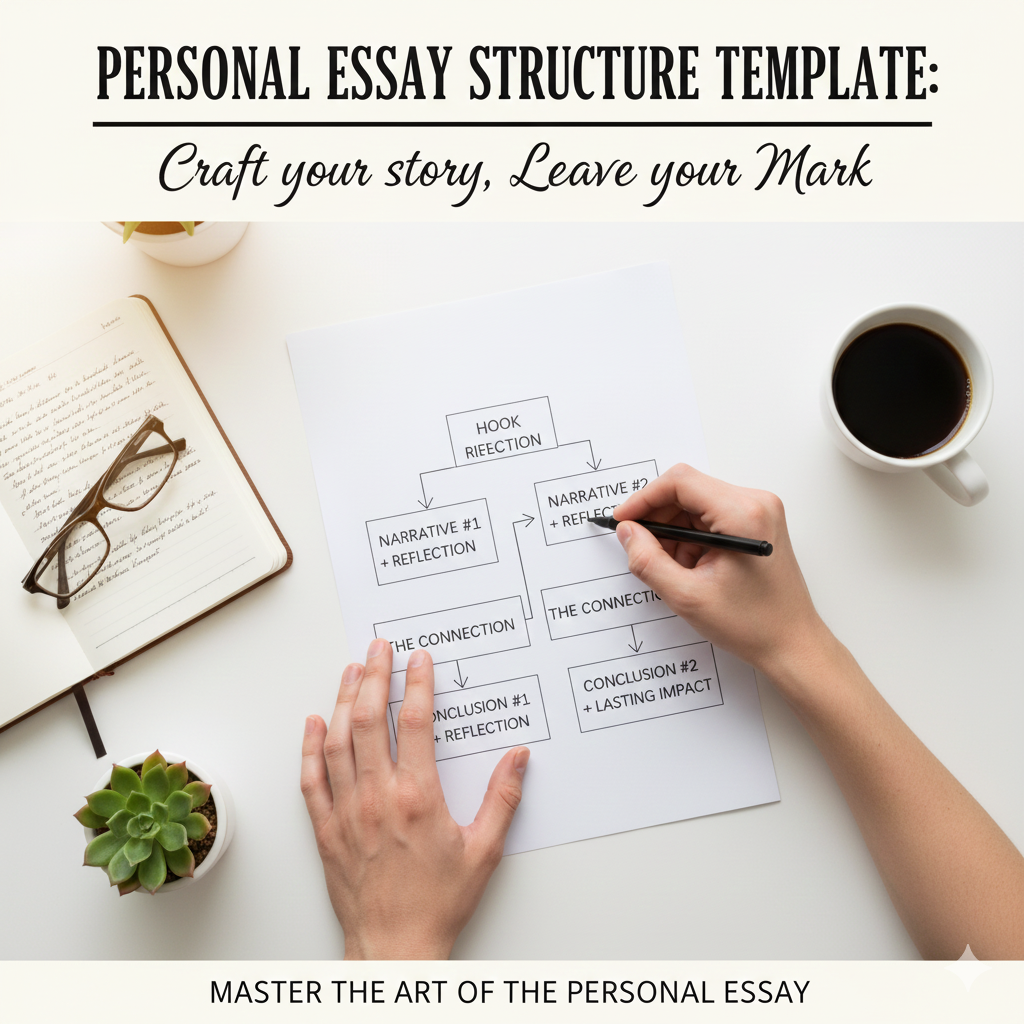
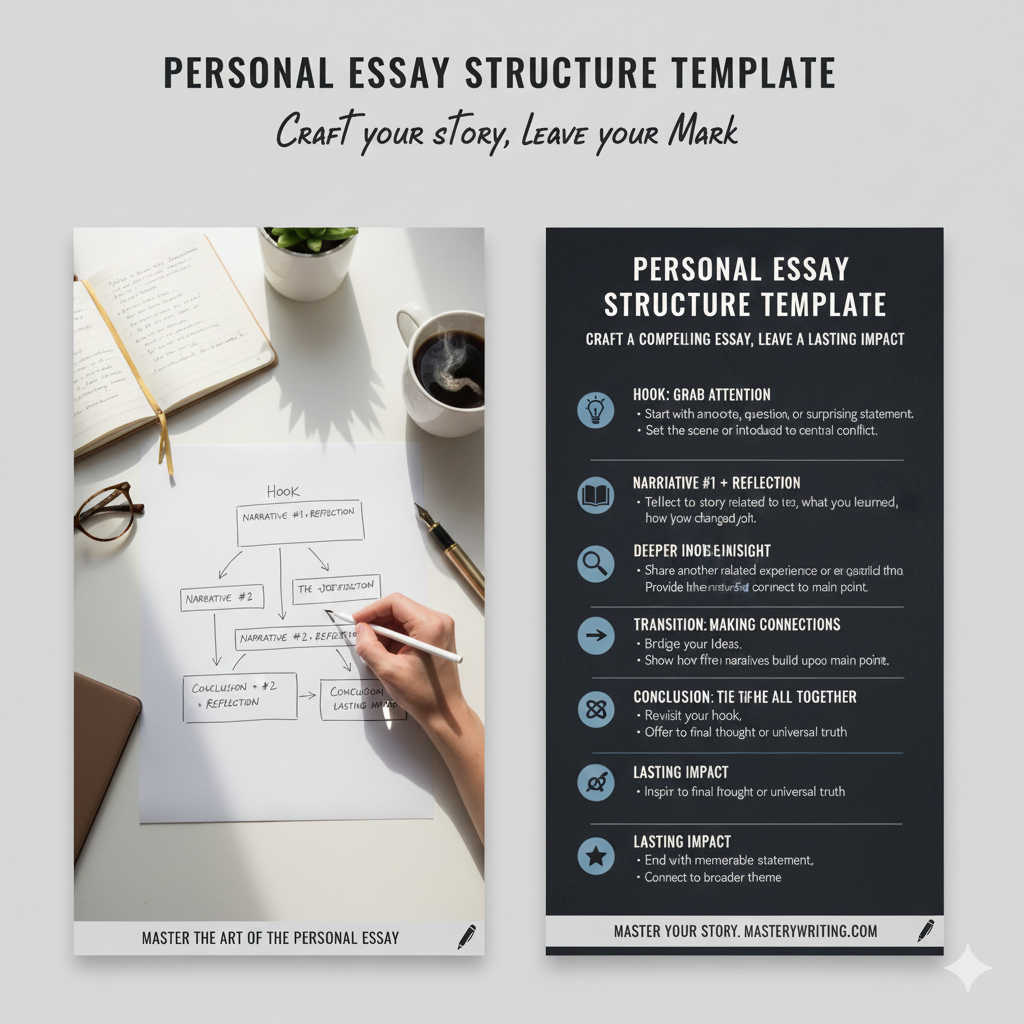
The body of the personal essay is powered by a dual engine: the narrative and the reflection.
Many new writers make the mistake of focusing solely on the story, resulting in a piece that feels like a diary entry.
Others focus only on the philosophical musings, which can feel abstract and ungrounded.
The magic happens when these two elements are seamlessly woven together. ✨
The Narrative is the “What Happened.”
It is the specific, sensory-rich story of a pivotal event or experience from your life.
The Reflection is the “What It Means.”
It is the universal truth, the insight, or the lesson you derived from that experience.
Think of the narrative as the fuel and the reflection as the engine that drives the essay forward.
Section A: Building the Narrative Arc 🗺️
Your narrative arc should be tight and focused.
Unlike a memoir, a personal essay typically focuses on a single, contained event or a short period of time.
Use vivid, active language to transport the reader into the moment.
Show, don’t tell, the emotional stakes of the situation.
The narrative section should build tension, leading to a moment of crisis or realization.
This is where the story peaks before the reflective turn.
Remember that every detail you include must serve the larger reflective purpose of the essay.
If a detail doesn’t contribute to the meaning, it should be cut. ✂️
Section B: The Reflective Pivot and Universal Truth 🌟
The reflective pivot is the moment you shift from recounting the story to analyzing its significance.
This is the most challenging, yet most rewarding, part of the essay.
It requires vulnerability and honesty, as you must expose your inner thoughts and the process of your own change.
The goal is to move from the “I” to the “we.”
How does your personal experience illuminate a shared human condition?
This is the key to making your essay resonate with a broad audience.
For more on this crucial element, read The Power of Vulnerability in Creative Nonfiction.
It is in this reflection that the essay transcends mere anecdote and becomes a piece of Visual Guide to Personal Essay Structure.
The reader should feel that your story has given them a new lens through which to view their own life.
Phase III: The Lasting Resonance and Conclusion 🎁
The conclusion of your personal essay should not simply summarize what you have already said.
Instead, it should return to the opening hook or image with a new, deeper understanding.
This circular structure provides a satisfying sense of closure and demonstrates the arc of your personal growth.
The final sentence should be powerful and memorable, leaving the reader with a final, resonant thought.
It is the last impression you make, so make it count. 💯
This final resonance is what makes the essay a powerful marketing tool, as readers will remember you and seek out your other work.
A strong portfolio of published personal essays is an essential part of your Essential Author Marketing Strategies.
Your Personal Essay Template Checklist ✅
To ensure your essay is ready for submission, use this checklist to review your draft.
Each point is a non-negotiable element of a successful personal essay.
- Did I start with a specific, compelling hook that immediately engages the reader?
- Is the narrative focused on a single, pivotal event with high emotional stakes?
- Have I successfully pivoted from the personal story to a universal, reflective insight?
- Is my conclusion a return to the opening, but with a new, profound understanding?
- Have I been vulnerable and honest, exposing a moment of personal growth or failure?
- Does every detail in the narrative serve the larger reflective theme?
- Have I checked the submission guidelines for the target publication?
Understanding the submission process is just as important as the writing itself.
Always consult resources like the Purdue OWL Guide to Submitting to Literary Magazines before sending your work out.
The personal essay is a marathon, not a sprint, requiring multiple revisions to perfect the balance between story and meaning.
Do not rush the reflection phase; it is the soul of the essay.
Embrace the discomfort of vulnerability, as it is the bridge to your reader’s heart.
Your unique voice is your greatest asset in this competitive landscape.
Comparing Narrative vs. Reflection: A Quick Guide 🤓
| Element | Focus (The “What”) | Purpose (The “Why”) |
|---|---|---|
| Narrative | A specific, contained event or experience. | To engage the reader and provide context for the insight. |
| Reflection | The writer’s analysis, insight, and emotional processing. | To reveal a universal truth and connect with the reader on a deeper level. |
| Pacing | Fast-paced, action-oriented, and scene-driven. | Slower, contemplative, and thought-provoking. |
By mastering this template, you are not just writing an essay.
You are crafting a piece of marketing that sells your most valuable product: your perspective.
Go forth and write your unforgettable arc! 🌟
Remember to always read your work aloud to catch any breaks in rhythm or flow.
Happy writing! 📝