
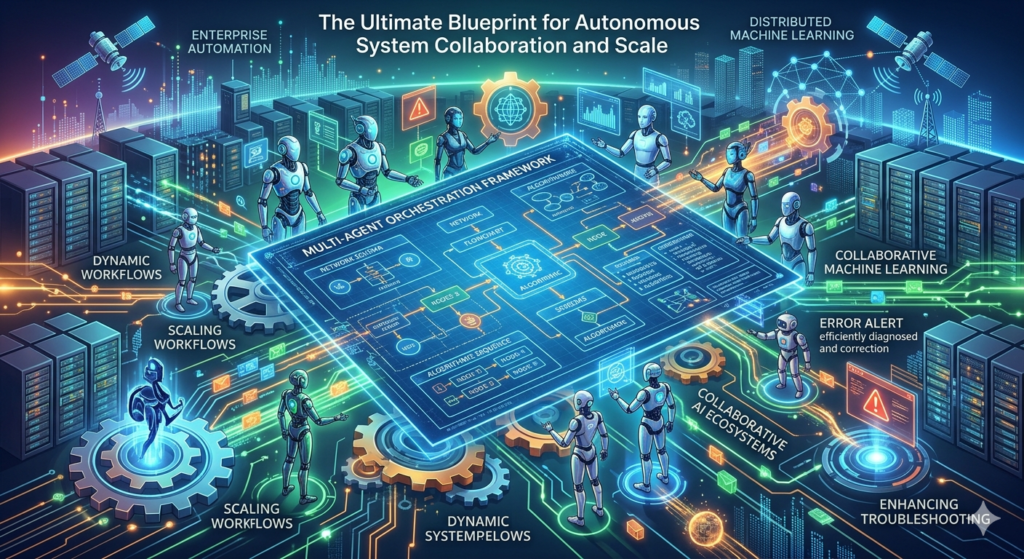
The Dawn of Multi Agent Orchestration
Welcome to the definitive guide on building resilient and autonomous artificial intelligence ecosystems Agentic AI multi-agent orchestration frameworks.
The landscape of enterprise automation has fundamentally shifted from simple text generation to dynamic action.
We are no longer just prompting systems for answers.
Today we deploy collaborative networks of intelligent agents that perceive, reason, and execute complex workflows autonomously.
This evolution is driven by advanced multi-agent orchestration frameworks.
These frameworks allow distributed machine learning models to coordinate seamlessly across self-hosted environments.
Organizations that master this collaboration unlock unprecedented scale and operational efficiency.
Those relying on legacy automation will quickly fall behind the innovation curve.
Generative artificial intelligence revolutionized how we interact with data.
However early implementations were severely limited by their inability to cross system boundaries.
A standard chatbot cannot autonomously troubleshoot a cloud server or negotiate application programming interface rate limits.
This is where the concept of agentic artificial intelligence changes everything.
Agentic AI refers to systems that take proactive steps to complete multi-stage goals without continuous human intervention.
Recent data underscores the massive acceleration of this technology.
According to a comprehensive 2026 report by Gartner, forty percent of enterprise applications now include task-specific AI agents.
This represents a staggering leap from less than five percent just one year prior in 2025.
The market for these autonomous technologies is expanding at a phenomenal rate.
Industry analysts project the agentic market will reach forty five billion dollars by 2030.
“The 2026 landscape will separate AI leaders who master multi-agent orchestration from organizations stuck in endless pilot programs,” notes technology researcher Michael Goldrich.
Overcoming the Execution Gap
Many executives find that initial efficiency gains from basic AI tools plateau rapidly.
Experts refer to this phenomenon as the execution gap.
Basic models lack the cognitive architecture to manage complex webhooks and looping logic safely.
They cannot reliably distinguish between a priority workflow and an archive task.
A multi-agent ecosystem solves this by distributing cognitive load across specialized nodes.
Instead of forcing one massive model to do everything, you orchestrate multiple lightweight models.
Each agent focuses entirely on one specific domain or tool.
One agent handles data extraction from a source database.
Another agent structures that data into a standardized JSON format.
A third agent handles the logic required to publish the content across hundreds of digital endpoints.
This modular approach drastically reduces error rates and token consumption.
It also prevents infinite loops that often crash single-agent systems.
Core Orchestration Patterns for Collaborative AI
Designing a scalable ecosystem requires selecting the right orchestration pattern.
The first essential pattern is concurrent orchestration.
This is often referred to as scatter and gather logic.
The system simultaneously deploys multiple agents to process independent data streams.
For example, a content automation pipeline might trigger five different specialized agents at once.
They independently gather statistics, write code snippets, format images, and analyze search intent.
A final synthesizer agent then aggregates these outputs into a cohesive final product.
This dramatically reduces total execution latency compared to sequential processing.
The second major pattern involves decentralized autonomous routing.
In this setup there is no single master controller bottlenecking the workflow.
Agents communicate directly with one another through peer-to-peer protocols.
They pass structured payloads back and forth to refine their outputs.
This decentralization is highly resilient against single points of failure.
A recent 2026 study published on arXiv demonstrated the power of this approach.
The researchers found that multi-agent orchestration achieved a one hundred percent actionable recommendation rate for incident response.
By contrast single-agent systems delivered usable results only one point seven percent of the time.
The architectural value clearly lies in deterministic quality rather than raw generation speed.
Infrastructure Strategies for Unstoppable Scale
Advanced automation requires a robust and self-managed infrastructure.
Shared hosting environments simply cannot handle the high concurrency demands of thousands of simultaneous agent interactions.

The most reliable blueprint involves deploying orchestration frameworks on dedicated virtual machines.
Platforms like Google Cloud Platform offer the scalable compute necessary for aggressive execution.
Assigning a static IP to your primary orchestration server ensures stable communication with external vendor systems.
Securing this infrastructure is equally critical.
Relying on modern web servers like Caddy allows for automatic HTTPS management.
This keeps your webhook payloads securely encrypted in transit.
Complete control over the server environment means you dictate the boundaries of your ecosystem.
You eliminate the risk of arbitrary rate limits imposed by shared hosting providers.
This self-hosted approach is foundational for managing high volume digital publishing networks.
When you are orchestrating workflows across five hundred separate web properties, network latency becomes a major factor.
A finely tuned cloud virtual machine minimizes the delay between an event trigger and the agentic response.
Integrating Advanced Automation Frameworks
The engine of any collaborative ecosystem is the workflow automation software.
Visual node-based platforms have become the industry standard for wiring agents together.
These platforms allow developers to map out complex logic flows without writing thousands of lines of boilerplate code.
You can visually drag a trigger node connected to a Google Sheet into your workspace.
From there the data flows seamlessly into an AI classification agent.
The logic can split based on custom conditions you define.
If the data requires deep analysis it routes to a high-capacity reasoning model.
If the task is simple formatting it routes to a faster and cost-effective model.
This dynamic model routing saves substantial operational costs.
It ensures you only pay for heavy compute when the task genuinely requires it.
Furthermore modern frameworks support advanced debugging interfaces.
You can inspect the exact payload moving between agents at every step of the journey.
This transparency is vital when troubleshooting API integrations or authentication errors.
Upgrading to modern integration standards ensures long-term stability for your automated projects.
The Role of Specialized Knowledge in Distributed Systems
One of the greatest advantages of a multi-agent ecosystem is the ability to integrate deep specialized knowledge bases.
You can equip individual agents with specific technical documentation and hardware manuals.
Imagine an agent dedicated solely to understanding the intricacies of advanced off-road vehicle suspension systems.
This agent could analyze real-time telemetry data against the theoretical limits of dynamic valve technologies.
Another agent might be specialized in low-level programming architectures and microprocessor scaling.
It could evaluate blockchain gas costs by simulating execution environments in Assembly or C.
When these two agents collaborate they can generate insights that neither could achieve independently.
This principle applies equally to areas of human performance and biomechanics.
An agent trained on the physics of traditional martial arts conditioning can collaborate with a physiological analytics agent.
Together they can map out the precise stresses applied during rigorous wooden dummy drills.
By siloing specific domain expertise into distinct AI personas the overall system becomes a vast library of interconnected intelligence.
The orchestration layer simply queries the right expert at the right time.
This completely eliminates the hallucination risks associated with asking a generalist model to perform highly technical analysis.
Economic Imperatives and Business Transformation
The transition to autonomous collaboration is not just a technical upgrade.
It is a fundamental shift in business economics.
A recent 2026 survey by PwC revealed that eighty eight percent of executives plan to increase their AI budgets specifically for agentic initiatives.
Organizations are realizing that human capital is better spent on strategic oversight rather than repetitive digital labor.
More than sixty six percent of companies utilizing these agents report highly measurable productivity gains.
In the realm of large-scale content generation the math is undeniable.
Managing a massive portfolio of targeted web assets manually requires an impossibly large editorial team.
An orchestrated army of AI agents can crawl priority targets, synthesize information, and publish updates continuously.
They never sleep, they never suffer from writer fatigue, and they execute with absolute consistency.
The profit-sharing models of the future will increasingly be built upon these automated foundations.
Partnerships will be defined by who controls the most efficient algorithmic infrastructure.
As agentic software revenue climbs toward projected hundreds of billions of dollars early adopters will secure insurmountable competitive moats.
Engineering the Human and Machine Interface
Despite the autonomous nature of these systems human supervision remains a critical component.
The goal is not to remove humans from the loop entirely.
Instead the objective is to elevate the human operator to the role of a systems architect.
You transition from doing the work to designing the machines that do the work.
This paradigm shift is often referred to as vibe coding.
The operator sets the intent, the guardrails, and the creative direction.
The multi-agent ecosystem then interprets this vibe and translates it into executable code and content.
This requires a deep understanding of how different cognitive frequencies influence productivity.
Just as human brain waves shift between analytical Beta states and creative Theta states agentic workflows must be tuned for optimal coherence.
You must design your logic flows to balance rapid data processing with deep analytical reasoning.
Creating digital personas to represent these different functional states can help operators visualize the system.
These synthetic faces act as intuitive dashboards for complex backend processes.
When an operator interacts with a specialized persona they intuitively understand the parameters of that interaction.
This human-centric approach to interface design drastically lowers the barrier to managing enterprise-grade automation.
Security Protocols in an Autonomous World
Granting artificial intelligence the authority to execute actions introduces significant security considerations.
An agent that can update databases and trigger external actions must be strictly governed.
Relying on third-party shared tools for sensitive workflows introduces unacceptable supply chain risks.
This is exactly why deploying your own custom virtual private servers is non-negotiable for serious applications.
You must implement strict identity and access management protocols within your orchestration layer.
Every API call made by an agent should be logged, authenticated, and auditable.
Furthermore data should never traverse the public internet without robust encryption.
Implementing reverse proxies to handle secure socket layers ensures that your internal system traffic remains opaque to external observers.
You must also design circuit breakers into your automation logic.
If an agent begins generating malformed payloads or exceeding API rate limits the system must automatically pause execution.
These failsafes prevent catastrophic cascading failures across your integrated platforms.
True autonomy requires true accountability.
The Future of Distributed Machine Learning
Looking ahead the boundaries between individual AI agents will continue to blur.
We are moving toward a future of continuous distributed machine learning.
Agents will not just execute tasks they will learn from the outcomes of those tasks and update their shared knowledge base.
If an agent discovers a more efficient way to format a specific data array it will broadcast that optimization to the entire network.
This collective intelligence will compound over time leading to exponentially faster workflow resolutions.
We will see the rise of highly specialized micro-agents deployed on edge devices.
Your personal smartphone will run localized models that coordinate seamlessly with your cloud-based enterprise systems.
This hybrid approach will minimize latency while maximizing privacy.
The technical challenges of maintaining such complex networks are substantial.
However the rewards for those who successfully architect these systems are limitless.
Preparing Your Infrastructure for Tomorrow
Building this blueprint starts with auditing your current workflows.
Identify the repetitive rule-based processes that currently drain your most valuable resources.
Map out the data flow from origin to final execution.
Select an orchestration framework that supports both visual node mapping and custom script execution.
Provision your dedicated cloud infrastructure to guarantee the compute power necessary for your goals.
Configure your security certificates and establish your static IP routing.
Begin by deploying a small isolated team of agents to tackle a single well-defined problem.
Measure their performance meticulously.
Refine their interaction loops and optimize their token consumption.
Once you have established a stable deterministic output you can begin to scale the operation horizontally.
Expand the network to cover hundreds of endpoints and thousands of daily interactions.
The path to enterprise scale is paved with meticulous planning and relentless optimization.
Final Thoughts on the Agentic Revolution
The era of isolated single-function software applications is officially drawing to a close.
We have entered an age defined by dynamic collaboration and autonomous problem-solving.
Multi-agent orchestration frameworks provide the architecture required to build truly intelligent ecosystems.
By combining specialized knowledge bases, robust self-hosted infrastructure, and advanced routing logic you can achieve unprecedented operational scale.
The organizations that embrace this ultimate blueprint today will dictate the pace of innovation tomorrow.
They will out-publish, out-analyze, and out-perform competitors still relying on manual processes.
The technology is no longer theoretical.
The tools are available, the cloud infrastructure is ready, and the economic benefits are proven.
The only remaining variable is your willingness to build the system.
Step into the future of automation and let your agentic ecosystem redefine what is possible for your enterprise.
🔍 Explore More: See all related guides for Agentic AI multi-agent orchestration frameworks on Z-A-D-A.