
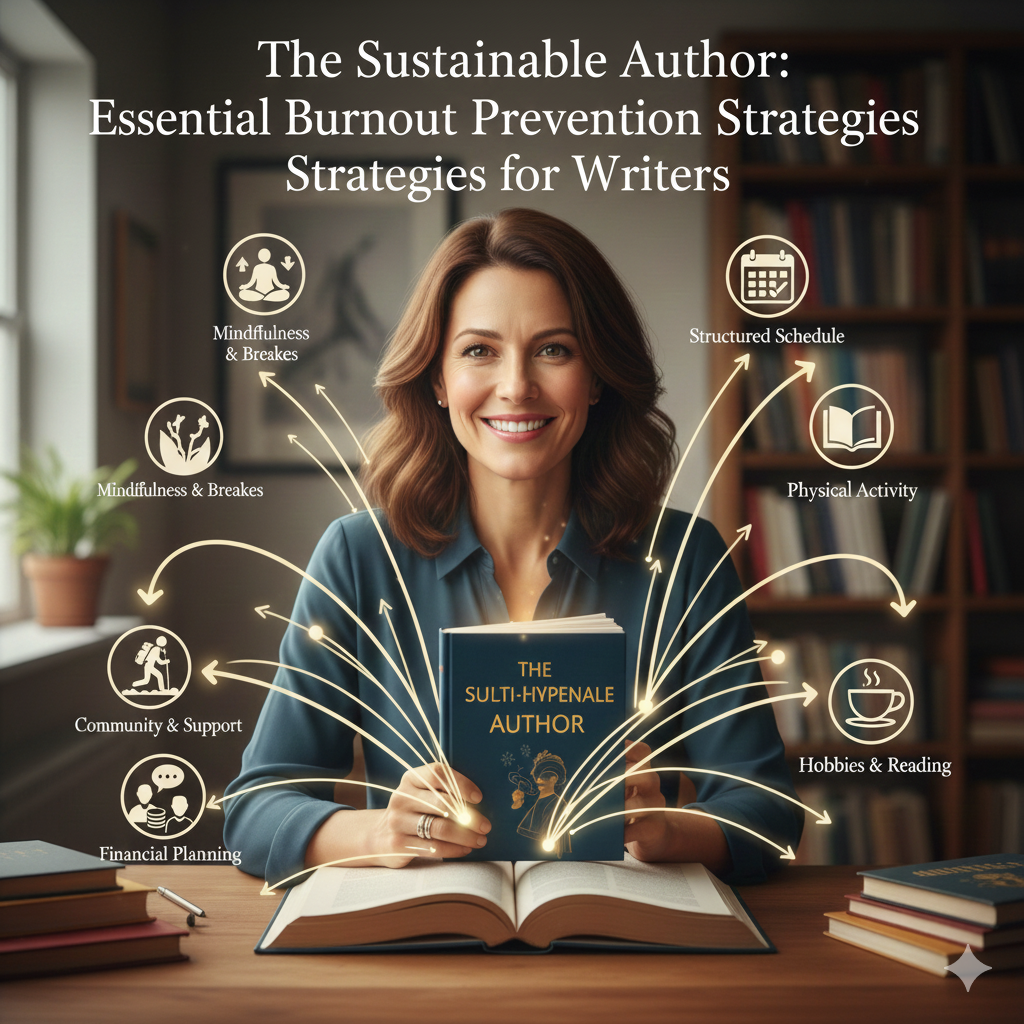
Burnout is the author’s silent epidemic. 🤫
It is not merely feeling tired; it is a state of emotional, physical, and mental exhaustion caused by prolonged or excessive stress.
For writers, the pressure is unique: the isolation of the craft, the emotional investment in the work, the relentless demands of self-promotion, and the constant cycle of deadlines.
This environment is a perfect breeding ground for creative collapse. 💥
The good news is that burnout is not a personal failure; it is a sign that your system is broken.
The solution is not to push harder, but to build a more resilient, sustainable writing life.
This guide provides essential Author Burnout Prevention Strategies to protect your creative energy and ensure the longevity of your career.
Phase I: The Fence Around Your Focus: Setting Unbreakable Boundaries 🚧
Boundaries are the invisible fences that protect your time, energy, and creative space.
For a writer, setting boundaries is not a luxury; it is the most important skill you will ever learn.
Boundary 1: Time Boundaries ⏰
Treat your writing time as a non-negotiable appointment with your career.
Establish dedicated writing blocks and communicate them clearly to everyone in your life.
Crucially, establish non-negotiable “off” hours where you are not thinking about writing, marketing, or publishing.
Use tools like the Pomodoro Technique to work in focused bursts, followed by mandatory breaks.
Boundary 2: Digital Boundaries 📵
The internet is the writer’s greatest tool and greatest distraction.
Limit your social media time, turn off all non-essential notifications, and consider implementing a “digital sabbath” where you unplug completely for a full day.
The constant influx of information and comparison is a major contributor to burnout.
Boundary 3: Interpersonal Boundaries 🗣️
Learn to say “no” to requests that do not serve your core goals.
This includes non-essential meetings, favors that drain your energy, and requests to read manuscripts that are not a priority.
Communicate your writing schedule to your family and friends so they understand that “writing” is not “free time.”
This is a critical step in taking your writing seriously, as detailed in guides on Setting Boundaries for Writers.
Phase II: The Marathon, Not the Sprint: Sustainable Writing Habits 🏃♀️
Burnout often results from an unsustainable pace—a sprint mentality applied to a marathon career.
The goal is to build habits that are consistent, not heroic.
Strategy 1: Realistic Goal Setting 🎯
Focus on consistency over word count spikes.
A “minimum viable output” of 250 words a day is far more valuable than 5,000 words one day followed by a week of recovery.
Set small, achievable goals that you can hit even on your worst days.
This focus on consistency is the core of a Sustainable Writing Practice.
Strategy 2: The Power of the Pause ⏸️
Scheduled breaks are not a reward; they are a necessary part of the creative process.
Step away from your work when you are stuck or frustrated.
Change your location, take a walk, or engage in a completely different activity.
Your subconscious mind will continue to work on the problem while you rest.
Strategy 3: Separating the Roles 🎭
The author wears many hats: the Writer, the Editor, the Marketer, the Business Manager.
Trying to wear them all at once is a recipe for creative paralysis.
Dedicate specific time blocks to each role.
When you are writing, you are only writing.
When you are marketing, you are only marketing.
This separation prevents the critical voice of the editor from stifling the creative voice of the writer.
Phase III: Marketing Without the Meltdown: Eco-Friendly Promotion 🌱
Marketing is often cited as the number one cause of author burnout.
It is a skill set that is fundamentally different from writing, and it often feels like a performance that drains the introverted writer.
Strategy 4: Calculated Social Media Decisions 🎯
Do not try to be everywhere at once.
Choose one or two platforms where your ideal reader spends the most time and focus your energy there.
Use a content calendar and batch your creation and scheduling, as discussed in the previous post.
This is the core of Eco-Friendly Book Marketing—promotion that is effective without being exhausting.
Strategy 5: Prioritizing the Email List 📧
Your email list is the only platform you truly own.
Reduce your reliance on volatile social media algorithms by directing your energy toward building and nurturing your list.
Email marketing is a quieter, more personal, and ultimately more sustainable form of promotion.
Strategy 6: Non-Negotiable Self-Care 🧘♀️
Self-care is not a bubble bath; it is a strategic necessity.
Prioritize sleep, nutrition, and exercise.
Ensure you are consuming creative input outside of your own work—read for pleasure, watch movies, visit museums.
You cannot pour from an empty cup, and your creative well must be constantly replenished.
Burnout Symptoms vs. Prevention Strategies ⚖️
Recognizing the early signs of burnout is the first step toward prevention.
Use this table to connect common symptoms with the corresponding prevention strategy.
| Common Symptom | Underlying Cause | Prevention Strategy |
|---|---|---|
| Inability to start writing. | Overwhelm from unrealistic goals. | Realistic Goal Setting (Strategy 1). |
| Resentment toward family/friends. | Lack of clear Interpersonal Boundaries. | Interpersonal Boundaries (Boundary 3). |
| Constant distraction by social media. | Lack of Digital Boundaries. | Digital Boundaries (Boundary 2). |
Conclusion: The Long-Term View 🏆
Burnout is a serious threat to your career, but it is entirely preventable.
By implementing these strategies, you are not just avoiding a breakdown; you are building a foundation for a long, productive, and joyful writing life.
If you are already experiencing symptoms, remember that recovery is possible.
Resources on Creative Burnout Recovery emphasize the need for rest, connection, and a temporary shift in focus.
Your well-being is your most important asset; treat it as such.
Be kind to yourself; the creative process is inherently demanding.
Write for the marathon, not the sprint.
Protect your peace, and the words will follow. 📝