
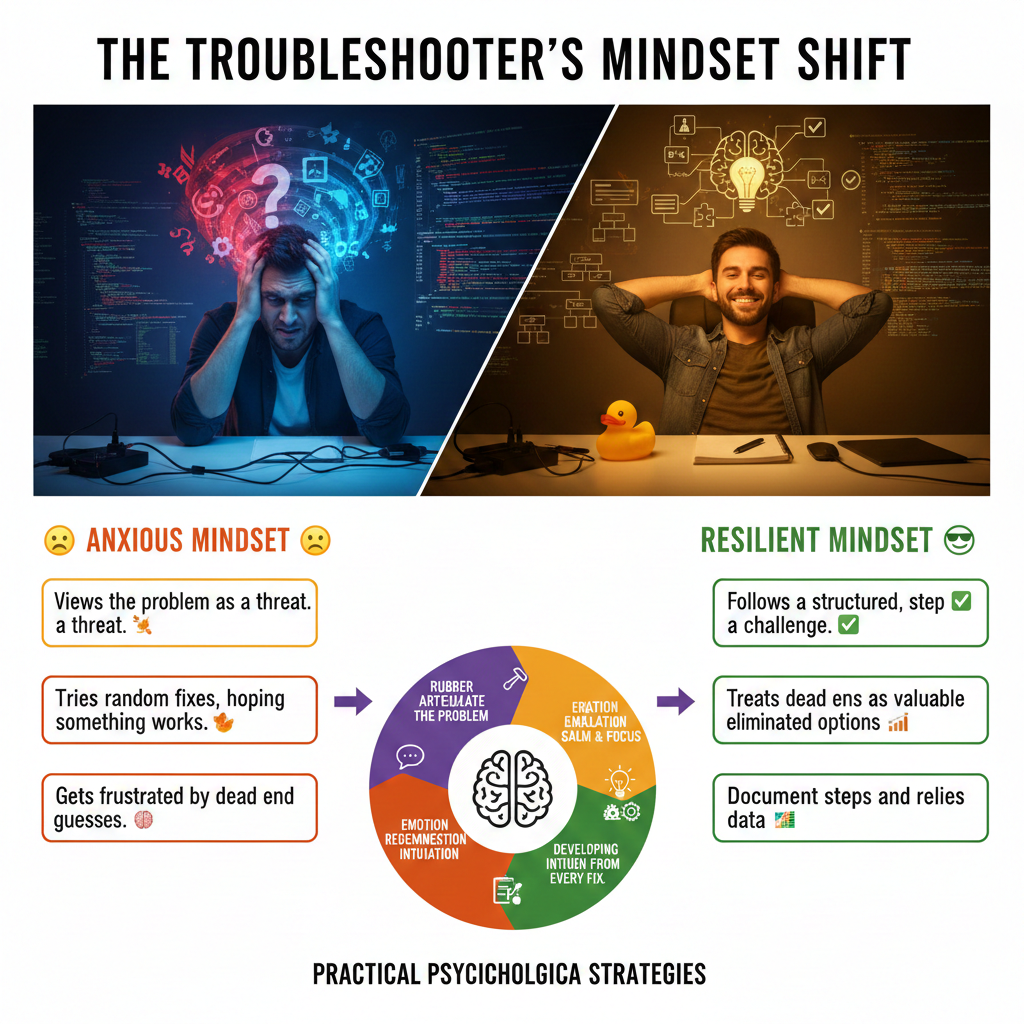
Troubleshooting is often viewed as a purely technical skill, dependent on your knowledge of systems, code, or machinery. 🛠️
However, true experts know that effective problem-solving is 80% psychology and 20% technical know-how.
When faced with a critical failure, your technical knowledge can completely vanish if panic takes over. 🧠
Building troubleshooting confidence is less about memorizing every error code and more about mastering your mental state under pressure.
This guide explores the psychological aspects of troubleshooting to help you move from anxiety to mastery. 🚀
By understanding how your brain reacts to novel problems, you can train yourself to approach breakdowns with curiosity rather than fear.
Let’s dive into the mental toolkit required for unshakable confidence. 💼
The Troubleshooting Mindset: Reframing “Failure”
The biggest barrier to troubleshooting confidence is the fear of being wrong. 😨
Many of us operate under the assumption that if something breaks while we are in charge, it is a personal reflection of our competence.
This is a crippling mindset that leads to hesitation and “analysis paralysis.”
To build confidence, you must fundamentally reframe what a “broken” state means. 💡
A broken system is not an accusation; it is a puzzle waiting to be solved.
Every failed attempt to fix it is not a personal failure; it is simply elimination of one possibility. 🧐
Psychologists refer to this as adopting a “learning orientation” rather than a “performance orientation.”
When you focus on learning, mistakes become valuable data points rather than sources of shame. 📈
The most confident troubleshooters are those who are most comfortable with being temporarily wrong.
They understand that the path to the right answer is almost always paved with incorrect hypotheses. 🛣️
Quote –
“I have not failed. I’ve just found 10,000 ways that won’t work.” – Thomas A. Edison
Embracing this Edison-like mentality is crucial for psychological resilience in technical fields.
For more on the psychology of how we perceive success and failure, examine these insights from Psychology Today on the definitions of success.
When you stop fearing the error message, you gain the mental bandwidth needed to actually read it. 🤓
Psychological Barriers to Effective Problem Solving
Even equipped with the right mindset, our brains often work against us during a crisis. 🚫
Evolution has wired us for quick decisions in dangerous situations, which is terrible for complex technical troubleshooting.
Understanding these cognitive biases is the first step toward mitigating them. 🛡️
- Confirmation Bias: This is the tendency to favor information that confirms your pre-existing beliefs or initial guess. If you decide immediately that “it must be the network,” your brain will actively ignore evidence suggesting it’s a software issue. You end up wasting hours chasing a ghost because you decided on the answer before asking the right questions. 👻
- Cognitive Tunneling: Under stress, our focus narrows dramatically. You might become obsessed with one specific error log or one piece of hardware, completely losing sight of the bigger picture. 🕵️♂️ This hyper-focus prevents you from seeing obvious, high-level connections that are causing the issue.
- The Imposter Phenomenon: When things break badly, it’s common to feel like a fraud waiting to be exposed. This anxiety cripples your ability to think logically because a portion of your brain is dedicated to worrying about what others think of you. 😰
These psychological traps are universal; they affect junior staff and seasoned veterans alike.
The difference is that confident troubleshooters recognize when they are falling into a trap and consciously step back. 🧘♀️
Awareness of these cognitive distortions is key to better decision-making.
You can learn more about how these mental shortcuts affect our judgment by reading about cognitive biases at Verywell Mind.
Combatting these barriers requires deliberate practice and self-awareness.
As the video above highlights, even highly accomplished individuals struggle with feelings of inadequacy when faced with new challenges.
Recognizing that this is a shared human experience can significantly lower your anxiety levels. 🤝
Practical Strategies to Build Mental Resilience
Confidence doesn’t just appear; it is built through action. 🏗️
We need concrete strategies to bridge the gap between knowing we should be calm and actually being calm.
Here are psychological techniques translated into practical troubleshooting steps.
The Power of “Rubber Ducking” 🦆
This is a classic technique in software engineering that applies to almost any troubleshooting scenario.
The idea is to explain your problem, line by line, to an inanimate object like a rubber duck. 🗣️
Psychologically, this forces you to engage different parts of your brain. 🧠
When you articulate a problem verbally, you must organize your thoughts coherently, which often reveals the solution without you even trying.
It moves the problem from abstract worry to concrete language.
You can read about the origins of this fascinating psychological trick on Wikipedia’s entry for Rubber Duck Debugging.
If you don’t have a duck, explaining it to a colleague—or even out loud to yourself—works just as well.
Systematic Decomposition (Breaking it Down) 🔨
A massive, undefined problem is terrifying to the human brain. 😱
It triggers an overwhelm response that shuts down higher-order thinking.
The antidote is systematic decomposition: breaking the big, scary problem into tiny, manageable chunks.
Don’t try to “fix the server”; try to “verify the power cable is plugged in.”
By achieving small wins on these tiny sub-tasks, you generate dopamine, which improves your mood and cognitive function. ✨
This builds a “confidence snowball” that carries you through the harder parts of the diagnosis.
| Anxious Mindset (Low Confidence) 😟 | Resilient Mindset (High Confidence) 😎 |
|---|---|
| Views the problem as a threat. | Views the problem as a challenge. |
| Tries random fixes hoping something works. | Follows a structured, step-by-step process. |
| Gets frustrated by dead ends. | Treats dead ends as valuable eliminated options. |
| Rilies on memory and guesses. | Documents steps and relies on data. |
Shifting from the left column to the right column is a conscious psychological effort. 🏋️♀️
The video above provides excellent context on computational thinking, which is essentially the art of breaking down complex problems psychologically. 🧩
The Role of Emotion Regulation in Diagnostics
You cannot troubleshoot effectively when your amygdala (the brain’s fear center) is hijacking your prefrontal cortex (the logic center). 🧠💥
When a critical system goes down, the physiological response is identical to being chased by a predator.
Your heart rate increases, your palms sweat, and your ability to think abstractly vanishes. 🏃♂️
The first step in any high-pressure troubleshooting scenario is not technical; it is physical.
You must manually override your fight-or-flight response through controlled breathing.
Taking three deep, slow breaths signals to your parasympathetic nervous system that you are not in immediate physical danger. 🌬️
Only once your physical panic has subsided can your logical brain come back online.
If you feel yourself spiraling, literally step away from the keyboard or the machine for two minutes. 🚶♂️
The problem will still be there when you get back, but your capacity to solve it will have improved significantly.
Learning to manage workplace stress is vital for long-term career health; consider these stress relief tips from the Mayo Clinic.
Emotion regulation is the foundation upon which technical skills rest. 🧘♂️
Developing Your “Troubleshooter’s Intuition”
We often look at senior experts and marvel at how they seem to “just know” where the problem lies. 🧙♂️
This isn’t magic; it’s highly developed pattern recognition resulting from years of psychological exposure to problems.
Confidence comes from knowing that you have seen something similar before, or at least knowing that you have the methodology to figure it out.
You can accelerate the development of this intuition through deliberate reflection. 🤔
After you solve a difficult problem, don’t just close the ticket and move on.
Take five minutes to write down a “post-mortem.” 📝
What were the initial symptoms? What was your initial wrong hypothesis? What was the breakthrough moment?
By documenting your wins, you reinforce the neural pathways associated with successful problem-solving.
Over time, this builds a subconscious library of solutions that manifests as “intuition.” 📚
Understanding how expertise is developed can help you be more patient with your own learning curve; Harvard Business Review offers deep insights into the making of an expert.
Quote –
“It’s not that I’m so smart, it’s just that I stay with problems longer.” – Albert Einstein
Einstein’s quote reminds us that persistence, a psychological trait, is often more valuable than raw intelligence. 🐢
As discussed in the video above, intuition is unreliable when you are a novice, but becomes a powerful tool as you gain experience. 🧰
Trust your process now so you can trust your intuition later.
Conclusion: Embracing the Chaos
Building troubleshooting confidence is a journey, not a destination. 🗺️
There will always be new systems, bizarre errors, and high-pressure situations that threaten to shake your composure.
By focusing on the psychological aspects—reframing failure, managing emotions, and breaking down complex problems—you insulate yourself against panic. 🧥
Remember that every great troubleshooter started exactly where you are right now: looking at a broken system and feeling unsure. 🤷♀️
The goal isn’t to know everything instantly; the goal is to know that you can eventually figure anything out.
Take a deep breath, trust your methodology, and embrace the next challenge as an opportunity to grow your mental resilience. 🌱