

The technical interview process for software engineers is a gauntlet. ⚔️
It demands not only proficiency in complex data structures and algorithms but also the ability to perform under pressure and communicate your thought process clearly.
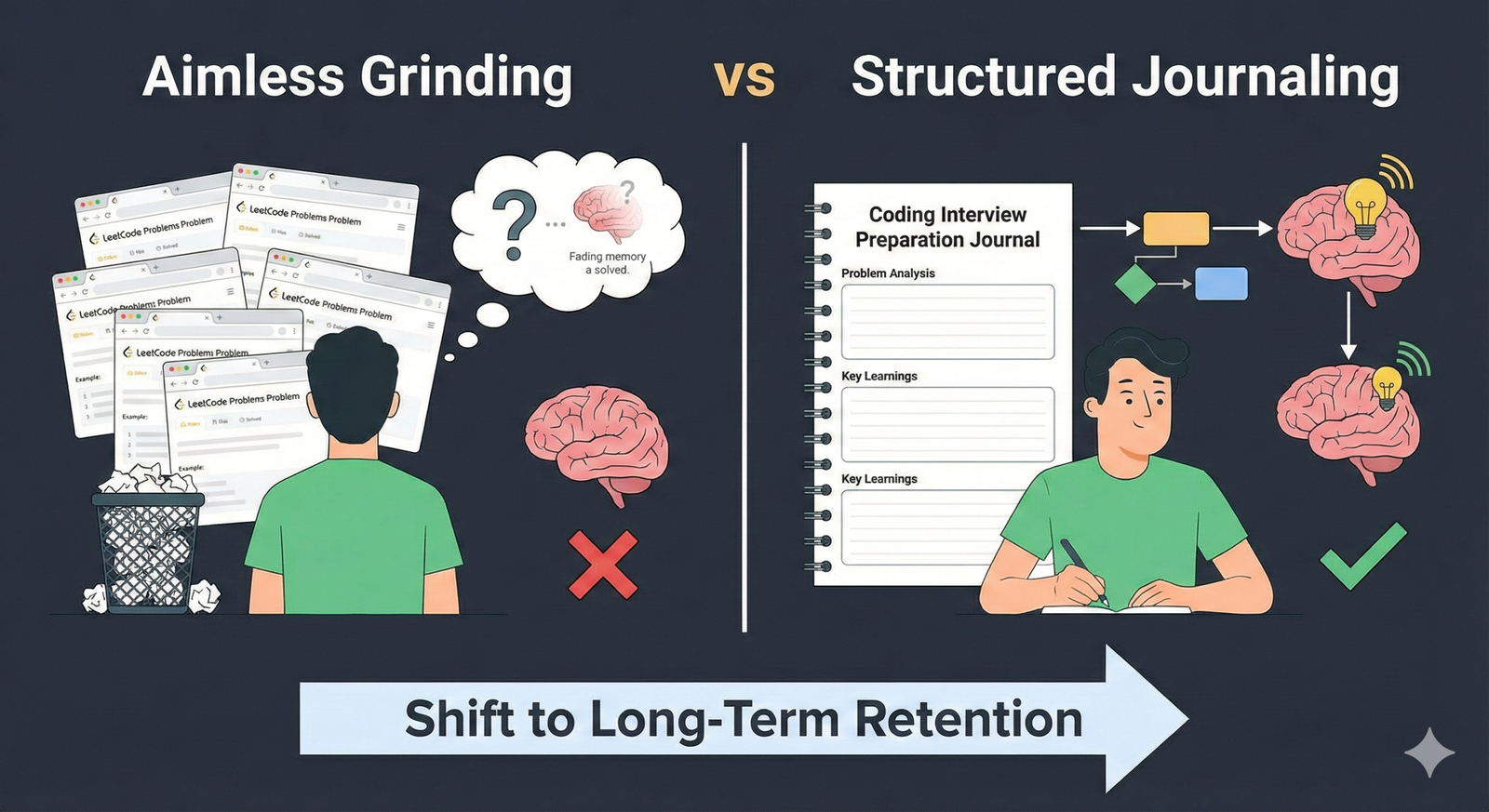
Many aspiring engineers fall into the “LeetCode Grind” fallacy: solving hundreds of problems without truly retaining the core concepts.
This high-volume, low-retention approach leads to burnout and a frustrating cycle of relearning the same patterns. 🔄
The solution is to shift your focus from mere practice to metacognition—thinking about your own thinking.
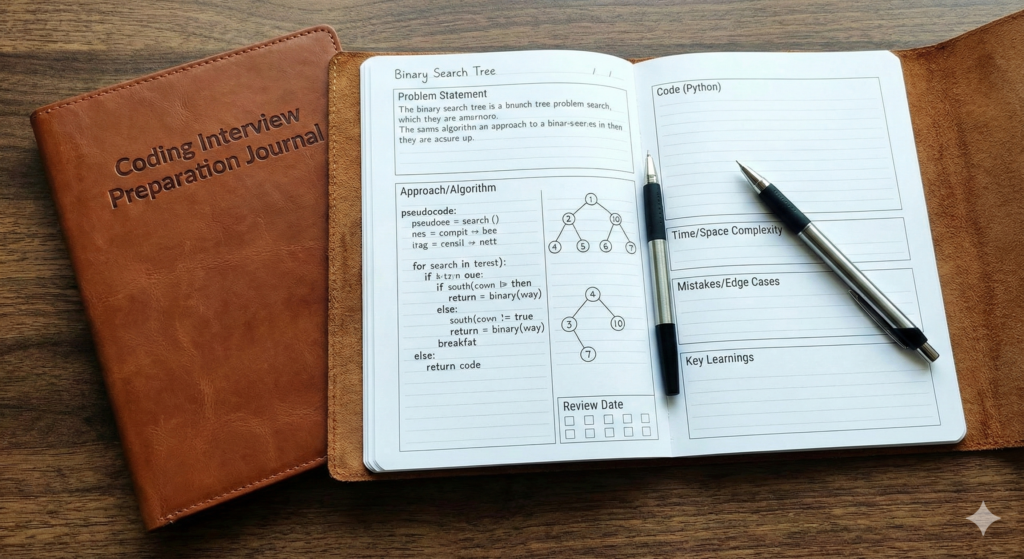
The most effective tool for this is the Coding Interview Preparation Journal, a structured system that transforms aimless practice into a measurable, strategic learning process.
This guide will show you how to build a high-retention journal that turns you into an Interview Architect.
Phase I: The Anatomy of a Journal Entry: Deep Learning in Action 📝
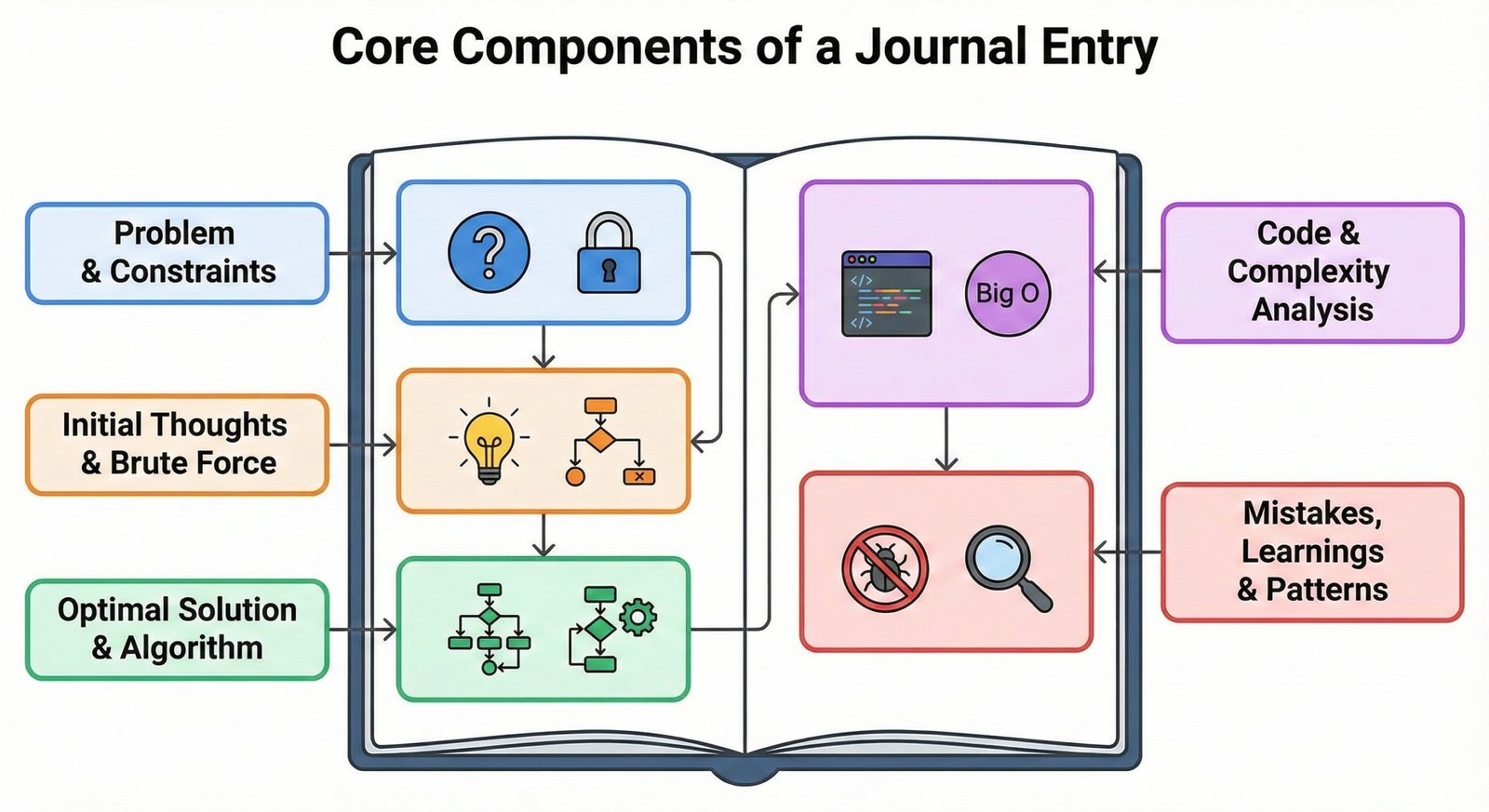
A journal entry is not just a link to a problem; it is a structured analysis of your performance and the underlying concept.
Each entry should force you to confront your mistakes and distill the problem down to its core insight.
Section 1: Problem Statement and Initial Thoughts 🧠
Start by clearly stating the problem and your initial approach.
Document the brute-force solution, its time and space complexity, and the first few edge cases you considered (e.g., empty input, negative numbers, overflow).
This section captures your raw, unoptimized thinking, which is crucial for later review.
Section 2: The Optimal Solution and Key Insight ✨
After solving the problem, document the optimal solution.
The most important part here is the Key Insight—the “Aha!” moment that unlocks the efficient solution.
Was it realizing you needed a Hash Map instead of an Array?
Was it the specific dynamic programming state transition?
Write this insight down in a single, memorable sentence.
Also, document the final, optimized time and space complexity.
Section 3: Mistakes, Review Date, and Metacognition 🧐
This is the most valuable section.
What specific mistake did you make?
Did you forget to handle a null case?
Did you get stuck on the loop invariant?
Finally, assign a review date based on the difficulty and your performance.
This process of self-reflection is the essence of Metacognition in Learning, which is proven to increase retention.
Phase II: Beyond the Problem: Tracking Progress and Identifying Weaknesses 📊
The journal’s power comes from the data you collect over time.
This data allows you to move from random practice to strategic, targeted study.
Tracking Metrics for Strategic Study 📈
For every problem, track the following metrics:
- Date Solved: For tracking progress over time.
- Topic/Pattern: E.g., Two Pointers, Sliding Window, Graph Traversal (BFS/DFS).
- Difficulty: Easy, Medium, Hard.
- Time Taken: How long did it take to reach the optimal solution?
- Success/Failure: Did I solve it on my own, or did I need a hint?
By filtering this data, you can instantly identify your weakest areas (e.g., “I consistently fail Medium-level Dynamic Programming problems”) and focus your efforts where they matter most.
The Spaced Repetition System (SRS) 🔁
The journal is the perfect tool for implementing Spaced Repetition, a technique that schedules review sessions at increasing intervals to maximize long-term retention.
If you struggled with a problem, review it in 3 days.
If you solved it easily, review it in 3 weeks.
This prevents the knowledge from fading, ensuring that the patterns are instantly accessible during the high-pressure interview.
This is a proven method for technical learning, as highlighted in articles on Spaced Repetition for Technical Learning.
Phase III: The Full Picture: Behavioral and System Design Logs 🗣️
A technical interview is more than just coding; it includes behavioral questions and, for senior roles, system design.
Your journal should be comprehensive enough to cover these areas as well.
The Behavioral Log: Storytelling Practice 🎭
Behavioral questions (e.g., “Tell me about a time you had a conflict with a teammate”) are best answered using the STAR method (Situation, Task, Action, Result).
Your log should contain a list of 10-15 core stories, each mapped to 3-4 common behavioral questions.
After each mock interview, log the question asked, the story you told, and the interviewer’s feedback.
This practice transforms your answers from rambling anecdotes into polished, results-oriented narratives.
The System Design Log: Conceptual Clarity 🏗️
For system design, your log should focus on conceptual clarity and trade-offs.
Document core components (Load Balancers, Caching Layers, Databases) and the trade-offs between different architectural choices (e.g., SQL vs. NoSQL, Monolith vs. Microservices).
Draw and save diagrams for common systems (e.g., URL Shortener, Twitter Feed) to internalize the patterns.
This is a critical skill for senior roles, as outlined in guides on System Design Interview Preparation.
Journal Entry Template: Key Fields 🔑
Use this table as a template for structuring your journal entries, whether you use a physical notebook, a spreadsheet, or a Notion database.
| Field | Purpose | Example Value |
|---|---|---|
| Problem Link/Title | Identification and Source. | LeetCode #1: Two Sum |
| Key Insight | The core concept that unlocks the optimal solution. | Use a Hash Map to store (value, index) to achieve O(n) time complexity. |
| Mistake/Stuck Point | What went wrong during the attempt. | Forgot to check if the complement existed before inserting the current number. |
| Next Review Date | SRS-driven review schedule. | 2025-12-25 (3 weeks from now) |
Conclusion: The Journal as Your Competitive Edge 🏆
The Coding Interview Preparation Journal is more than a study log; it is a personalized textbook of your weaknesses and breakthroughs.
It transforms the overwhelming task of interview prep into a focused, data-driven, and highly effective process.
By embracing this structured approach, you move beyond simply solving problems to truly mastering the underlying concepts, which is the key to long-term career growth.
This systematic approach is a core tenet of Technical Interview Best Practices.
Be honest in your entries; the journal is for you, not for show.
Prioritize quality over quantity; one well-analyzed problem is better than ten rushed ones.
Review consistently; the SRS is the engine of retention.
Start building your Interview Architecture today! 🏗️