



In today’s hyper-connected world, every second of system downtime costs businesses dearly. 💸
From lost revenue to damaged customer trust, the implications of system failures are more severe than ever. 📉
For far too long, IT and operations teams have been trapped in a reactive cycle, constantly battling fires after they’ve already ignited. 🔥
This traditional approach is no longer sustainable in environments characterized by complex microservices, cloud-native architectures, and continuous delivery.
Enter Predictive Troubleshooting Methodologies (PTrS) – a revolutionary shift from reacting to predicting and preventing issues. 🚀
PTrS leverages advanced analytics, machine learning, and real-time data to identify potential problems before they escalate into full-blown incidents. 💡
It’s about transforming IT from a cost center focused on repairs to a strategic enabler of business continuity and innovation. 🌟</p\p>
This blog post will delve into the core principles, essential technologies, and practical steps for implementing predictive troubleshooting, empowering your organization to stay ahead of the curve. 📌
The Imperative for Change: From Reactive to Predictive IT
The reactive model of IT operations is inherently inefficient and costly. 😫</p\p>
It relies on alerts triggered after a threshold has been breached or, worse, on user complaints once an outage is already in progress. 🚨
The mean time to recovery (MTTR) can be extensive, leading to prolonged service disruptions and significant financial impact. Gartner consistently highlights MTTR as a critical metric for IT operations teams.
In contrast, predictive troubleshooting proactively seeks out anomalies and patterns that indicate an impending failure. 🕵️
It’s about detecting the subtle shifts in system behavior that precede a crash, allowing teams to intervene gracefully and often imperceptibly to end-users. 🤫
“The best way to predict the future is to create it.”
This quote by Peter Drucker perfectly encapsulates the spirit of PTrS – actively shaping a more reliable operational future. 🛠️
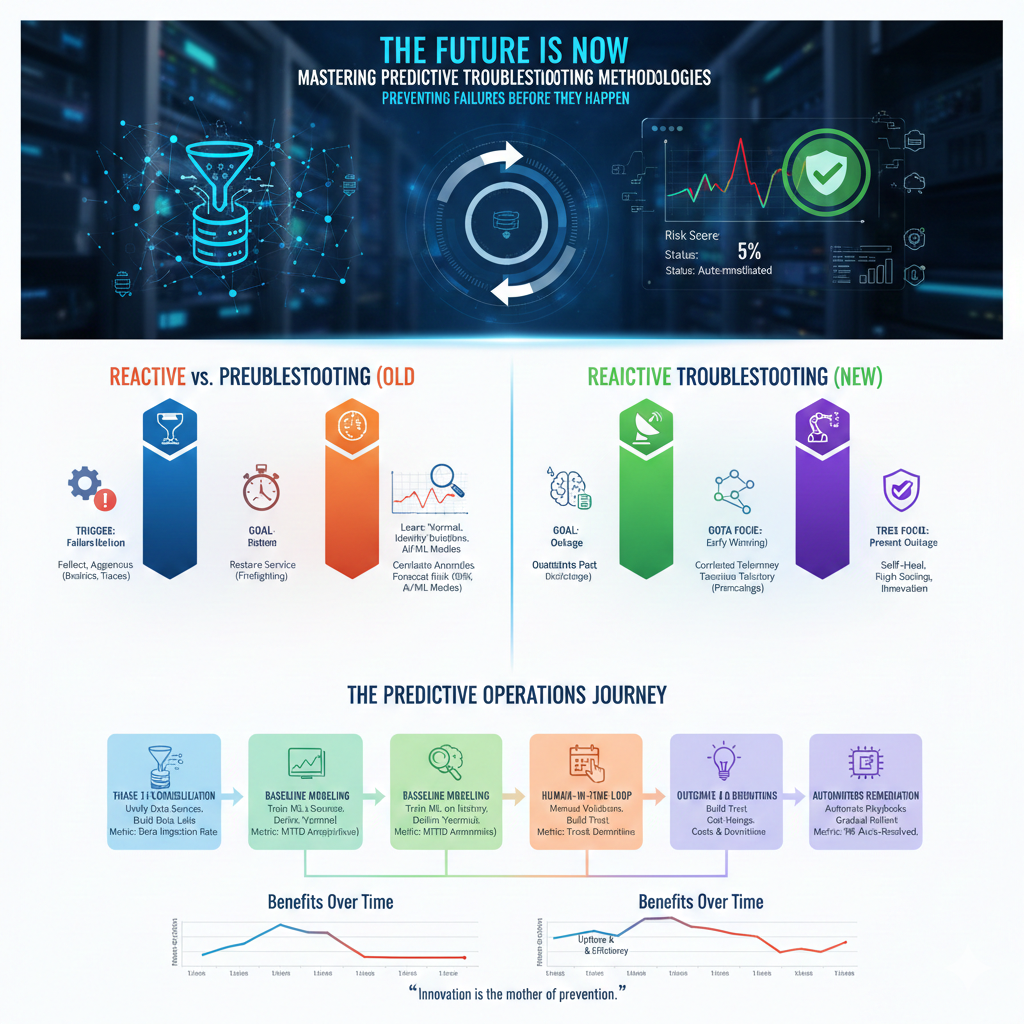
Reactive vs. Predictive: A Fundamental Shift
Understanding the core differences between these two operational philosophies is crucial for adoption.
| Aspect | Reactive Approach | Predictive Approach |
|---|---|---|
| Trigger | System outage, error alert, user report. | Anomaly detection, risk score, predictive alert. |
| Goal | Restore service; minimize current damage. | Prevent failure; ensure continuous service. |
| Focus | Symptoms and immediate root cause. | Behavioral patterns, subtle deviations, future impact. |
| Outcomes | Downtime, manual fixes, increased operational costs. | Higher uptime, automated remediation, cost savings, improved morale. |
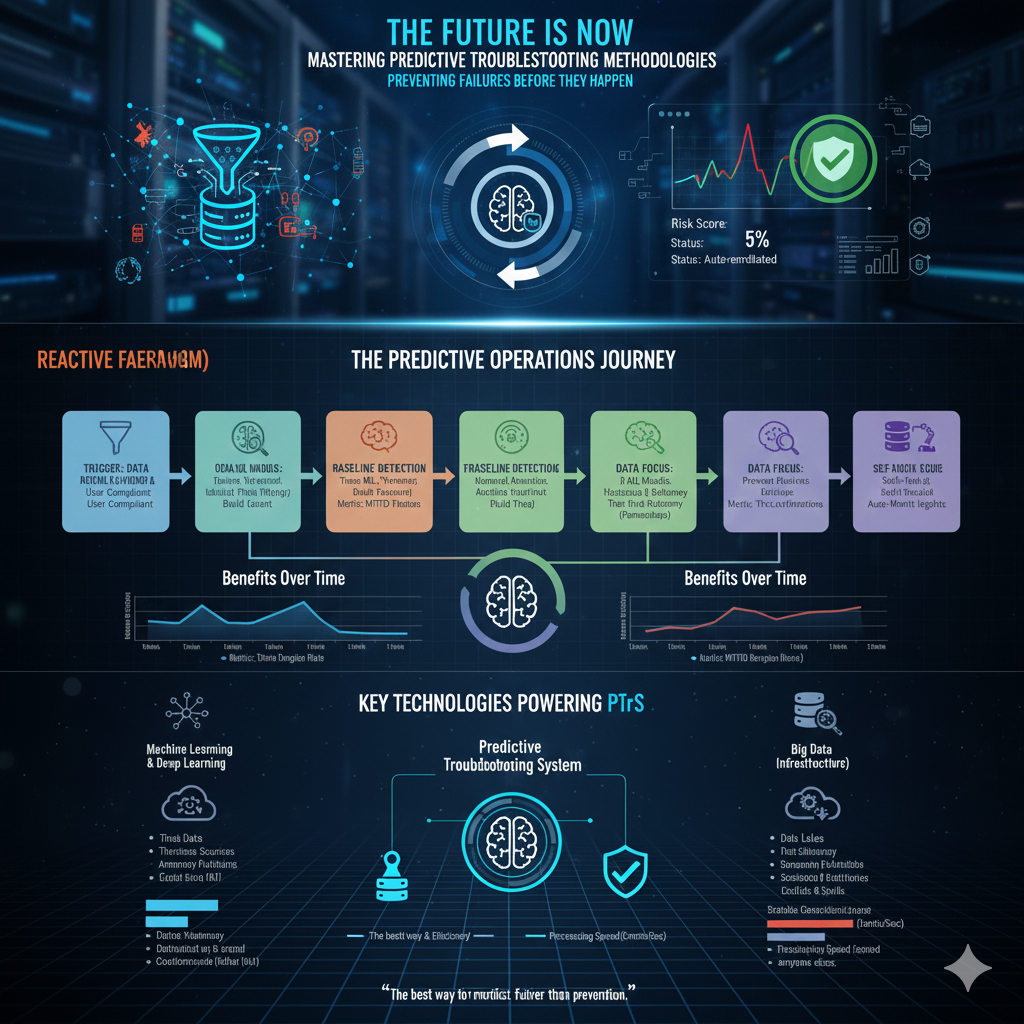
The Four Pillars of Predictive Troubleshooting
Implementing PTrS involves a structured, multi-faceted approach built upon four interconnected pillars. 🏗️
These pillars form a continuous feedback loop, constantly refining the accuracy and effectiveness of the predictive system.
Pillar 1: Comprehensive Data Ingestion & Normalization
The cornerstone of any effective predictive model is high-quality, relevant data. 🧱
Modern IT environments generate vast quantities of telemetry – logs, metrics, traces, events – from every component of the infrastructure, applications, and network. 📡
This data must be collected in real-time, aggregated, and then meticulously normalized.
Normalization involves standardizing diverse data formats, harmonizing timestamps, mapping unique identifiers, and enriching raw data with critical contextual information like service names, deployment versions, and organizational units. 🧹
Without proper normalization, even the most sophisticated machine learning algorithms will struggle to identify meaningful patterns. 🤖
Investing in robust data pipelines and schema management is paramount for the success of any PTrS initiative.
Pillar 2: Dynamic Baseline Modeling & Anomaly Detection
Once data is flowing cleanly, the system must learn what constitutes “normal” behavior for every monitored entity. 🧠
This goes beyond static thresholds (e.g., “CPU > 80%”).
Modern systems exhibit dynamic behavior, with normal performance patterns fluctuating based on time of day, week, month, or even external events like marketing campaigns. 📊
Machine learning models (e.g., time-series forecasting, statistical process control) are trained on historical data to establish a dynamic baseline, understanding the acceptable range of behavior under various conditions.
Anomaly detection algorithms then continuously compare incoming real-time data against this learned baseline, flagging any statistically significant deviations. 🕵️♀️
The challenge here is distinguishing between true pre-failure signals and benign “noise” or expected fluctuations. 👂
Pillar 3: Predictive Modeling & Risk Scoring
This pillar is where the true “prediction” happens. 🔮
It’s not enough to simply detect an anomaly; the system must correlate multiple anomalies across different layers and services to forecast the likelihood and potential impact of a future failure. 🔗
For instance, a minor increase in database query latency, combined with a sudden drop in available memory on an application server and an uptick in error logs, might collectively predict an imminent service outage. 📉⬆️🔥
Advanced ML techniques, including recurrent neural networks (RNNs) or graph neural networks, are deployed to recognize these complex, multi-dimensional failure patterns. IBM Research is at the forefront of developing such predictive AI for IT operations.
The output is a Risk Score or a probability estimate, indicating how likely a specific component or service is to fail within a defined timeframe (e.g., “75% chance of Payment Gateway degradation in the next 45 minutes”). 🎯
Pillar 4: Automated Action & Intelligent Remediation
Prediction without action is merely observation. 🚀
The final, most impactful pillar involves triggering automated remediation steps based on the calculated risk. ⚙️</p\p>
For low-risk, well-understood predictions, the system can automatically execute pre-defined runbooks, such as restarting a service, clearing a cache, or scaling out a microservice. 🤖
For higher-risk or novel scenarios, the system might escalate to human operators with enriched context, recommended actions, and clear diagnostic paths. 🧑💻
This proactive self-healing capability significantly reduces Mean Time To Repair (MTTR), often preventing user impact entirely.
It allows operations teams to shift from heroic firefighting to strategic engineering. 🦸
Key Technologies Fueling PTrS Excellence
Predictive troubleshooting isn’t a single tool but an integrated strategy powered by a sophisticated technology stack. 💻
Artificial Intelligence & Machine Learning (AI/ML)
AI and ML are the brains behind PTrS. 🧠
Algorithms handle everything from time-series anomaly detection to pattern recognition in complex log data and causal inference. 📊
Techniques like clustering, classification, regression, and deep learning are all employed to learn from historical incidents and predict future ones. 💡
Big Data & Stream Processing
The sheer volume and velocity of operational data demand robust Big Data infrastructure. 🌊
Technologies like Apache Kafka for real-time data streaming, and platforms like Elasticsearch or cloud data lakes for storage and analysis, are fundamental. 💾
The ability to process millions of events per second and store petabytes of historical data is critical for training accurate models and making real-time predictions. Cloud providers like AWS offer comprehensive big data services essential for PTrS.
Observability Platforms
PTrS thrives on comprehensive observability. 👁️🗨️
An observability platform unifies logs, metrics, and traces, providing deep insights into the internal state of a system. 🔗
This rich, contextualized data feeds the predictive models, enabling them to identify subtle signals and provide actionable insights. 📈
Without a solid foundation of observability, predictive models are starved of the necessary information to perform effectively.
Implementing Your Predictive Troubleshooting Strategy
Adopting PTrS is a strategic journey that requires careful planning, organizational alignment, and a phased technical rollout. 🗺️
| Phase | Description | Key Outcome |
|---|---|---|
| Phase 1: Data Foundation | Consolidate monitoring tools, establish robust data ingestion pipelines, ensure data normalization. | Unified, clean, and accessible operational data. |
| Phase 2: Baseline & Anomaly Detection | Train ML models on historical data to establish dynamic baselines; deploy initial anomaly detectors. | Accurate detection of deviations from normal behavior. |
| Phase 3: Human-in-the-Loop Prediction | Generate predictive alerts and risk scores; require human validation and action to build trust. | Validated predictive accuracy and growing team confidence. |
| Phase 4: Autonomous Remediation | Implement automated playbooks for low-risk, well-understood predictions; gradually increase automation. | Reduced MTTR, increased system resilience, optimized human effort. |
The Importance of an MLOps Culture
Predictive troubleshooting models are not “set it and forget it.” 🔄
System behavior evolves, new code is deployed, and user patterns shift, leading to model drift.
A robust MLOps (Machine Learning Operations) practice is essential for continuous monitoring, re-training, and deployment of predictive models. Google Cloud provides excellent resources on establishing effective MLOps pipelines.
This ensures the predictive system remains accurate and relevant over time. ⏰
“Continuous improvement is better than delayed perfection.”
This quote from Mark Twain perfectly illustrates the iterative nature of PTrS.
The Transformative Benefits of Predictive Operations
The adoption of PTrS yields profound benefits across the entire organization. 🌟
Unprecedented System Uptime & Resilience
This is the most direct and impactful benefit. ✅
By preventing outages rather than reacting to them, organizations can achieve significantly higher availability targets, often reaching “four nines” (99.99%) or even “five nines” (99.999%) of uptime. 📈
This directly translates to uninterrupted service delivery, enhanced customer satisfaction, and maximum revenue generation. 💰
Significant Cost Reduction
While PTrS requires an initial investment, the ROI is substantial. 🤑
It reduces the direct costs of downtime (lost sales, SLA penalties) and the indirect costs associated with frantic, emergency troubleshooting. 💸
Furthermore, proactive maintenance allows for efficient resource planning, reducing wasteful over-provisioning and optimizing cloud spending. ☁️
By identifying and addressing inefficiencies before they become critical, PTrS helps streamline operational budgets significantly.
Empowered and Innovative Teams
Reactive operations lead to stress, burnout, and high turnover among engineers. 😩
PTrS automates the mundane and predictable aspects of troubleshooting, freeing up highly skilled personnel to focus on innovation, strategic projects, and enhancing system architecture. 🧘♀️
This shift fosters a culture of engineering excellence and significantly boosts team morale and productivity. 🚀
Enhanced Customer Experience
Ultimately, stable and reliable systems lead to happier customers. 😊
Predictive troubleshooting ensures that services are consistently available and performant, leading to higher customer satisfaction, loyalty, and brand reputation. ⭐
Overcoming Challenges & Glimpsing the Future
The path to full PTrS implementation isn’t without its challenges, but the rewards far outweigh them. 🚧
Data Quality and Trust
“Garbage in, garbage out” remains a universal truth. 🗑️
The accuracy of predictive models is directly tied to the quality and completeness of the ingested data.
Building trust in automated remediation also takes time, requiring clear explainability (XAI) for why a prediction was made or an action was taken. 🤝
The Evolution Towards Cognitive Operations
The future of PTrS lies in increasingly sophisticated Cognitive Operations or AIOps. 🧠
This involves more advanced causal inference, predicting not just that something will fail, but exactly why, where, and what the precise impact will be.
Deep learning will enable systems to understand the semantic meaning of log entries, correlate seemingly unrelated events, and even suggest preventative architectural changes. Organizations like IEEE are actively researching and publishing advancements in this field.
Hyper-personalization of predictions – for specific user cohorts or business transactions – will also become standard. 👤
Conclusion: Embracing the Proactive Paradigm
Predictive Troubleshooting Methodologies are no longer a futuristic concept; they are a present-day necessity for any organization striving for operational excellence and digital resilience. 🎯
By strategically leveraging AI, Big Data, and a robust observability fo