

Code review is arguably the most critical process in modern software development.
It is the gatekeeper of code quality, the primary mechanism for knowledge sharing, and a powerful tool for mentorship.
However, a poorly executed code review can become a bottleneck, a source of friction, and a drain on team morale.
For high-performing teams, especially those operating in a distributed or remote environment, mastering the art of the code review is essential for maintaining velocity, reducing technical debt, and fostering a culture of continuous improvement.
This comprehensive guide outlines the best practices for both the author and the reviewer to transform your code review process from a necessary chore into a powerful engine for team excellence.
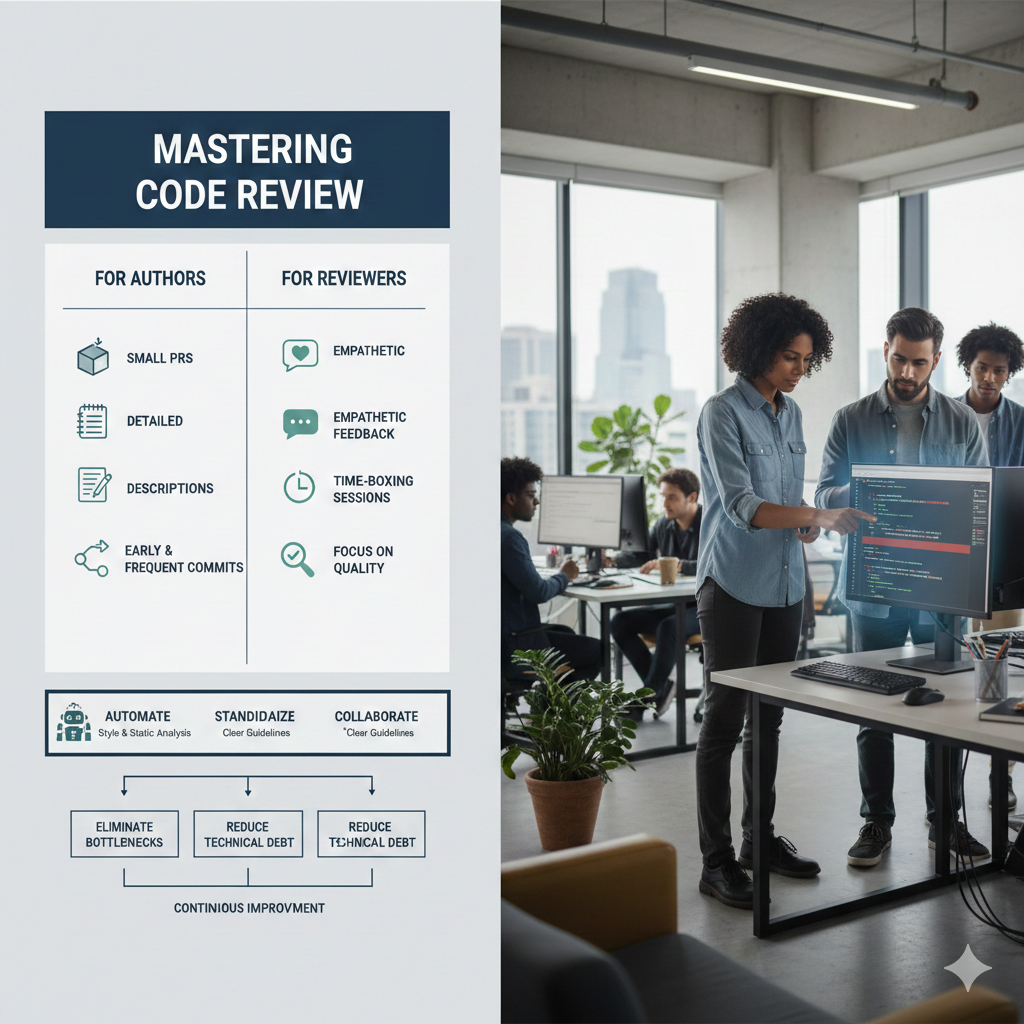
Phase 1: Best Practices for the Code Author
The quality of a code review begins with the quality of the Pull Request (PR) submitted by the author.
A well-prepared PR sets the stage for a fast, effective, and positive review experience.
1. Keep Pull Requests Small and Focused
The single most important rule for a code author is to submit small, single-purpose PRs.
Research consistently shows that the human brain’s capacity for effective review drops sharply after a certain number of lines of code.
The 250-400 Line Rule
- Aim for PRs that are no more than 250-400 lines of code changed.
- Large PRs are intimidating, lead to reviewer fatigue, and result in a significantly lower defect detection rate.
- If a change is larger, break it down into smaller, logically independent commits or feature flags.
Single Concern
- Each PR should address only one logical concern: a single bug fix, a single feature implementation, or a single refactoring task.
- Avoid mixing refactoring with feature work, as this makes it impossible for the reviewer to separate the two concerns.
2. Write a Detailed and Contextual Description
The PR description is the reviewer’s map.
It should provide all the necessary context to understand the “why” and the “what” of the changes.
A great description drastically reduces the back-and-forth communication.
The “Why”
- Explain the problem being solved or the feature being implemented.
- Link to the relevant ticket (Jira, GitHub Issue, etc.).
- Include screenshots or short video clips of the feature in action if it involves a UI change.
The “What”
- Summarize the changes.
- Highlight the key files and the most important architectural decisions made.
- If you had to make a trade-off, explain the decision-making process.
Testing Instructions
- Provide clear, step-by-step instructions on how to test the changes locally.
- Include any necessary setup steps, environment variables, or test data.
- The easier it is to test, the faster the review will be.
3. Self-Review Before Submitting
A thorough self-review is a sign of professionalism and respect for the reviewer’s time.
It catches the low-hanging fruit and ensures the PR is ready for external scrutiny.
Checklist
- Before submitting, check for: unused variables, commented-out code, proper formatting, passing tests, and adherence to team style guides.
- Run your linter and formatter one last time.
Read the Diff
- Read the code line-by-line in the diff view, as if you were the reviewer.
- This often reveals logical errors or confusing code paths that were missed in the IDE.
- Fix all obvious errors before assigning a reviewer.
Phase 2: Best Practices for the Code Reviewer
The reviewer’s role is to act as a constructive gatekeeper, focusing on quality, maintainability, and knowledge transfer, not just finding bugs.
The reviewer is a collaborator, not a critic.
4. Prioritize and Allocate Time for Reviews
Code reviews should be treated as a high-priority task, not something to be done only when all other work is finished.
Delays in review are the primary cause of development bottlenecks.
Time-Box Reviews
- Dedicate specific, short blocks of time (e.g., 30 minutes, twice a day) solely for code review.
- This helps maintain focus and prevents context switching.
- Studies show that reviewing for more than 60-90 minutes at a time leads to a significant drop in defect detection rate.
The 24-Hour SLA
- Establish a Service Level Agreement (SLA) for reviews, such as a maximum of 24 hours for the first pass.
- This keeps the development pipeline moving and respects the author’s need for fast feedback.
5. Focus on the Big Picture First
Before diving into line-by-line comments, the reviewer should first understand the overall approach and architecture of the change.
This is where the most critical feedback is given.
High-Level Questions
- Ask questions about the design, the architectural impact, and whether the solution is the simplest possible one.
- Is this the right place for this logic?
- Does it introduce unnecessary complexity?
- Is the change solving the right problem?
Avoid Nitpicks Early
- Save minor style or formatting comments for the end, or better yet, automate them with a linter.
- Focus the initial feedback on substantive issues like logic errors, security vulnerabilities, and performance concerns.
6. Provide Constructive and Empathetic Feedback
The goal of a review is to improve the code and the author, not to criticize.
Feedback should be a teaching moment, not a judgment.
Be Kind to the Human, Strict to the Code
- Frame comments as suggestions or questions, not commands.
- Use phrases like “What if we tried…” or “I’m concerned about X because…”
- Never use accusatory language.
Explain the “Why”
- Don’t just point out a problem; explain the consequence of the current code and the benefit of your suggested change.
- This is crucial for knowledge sharing and mentorship.
- The reviewer should aim to teach the author how to avoid the issue in the future.
Praise Good Work
- Always acknowledge well-written code, clever solutions, or thorough testing.
- Positive reinforcement is vital for team morale and encourages the author to maintain high standards.
Phase 3: Team-Wide Process and Culture
The most effective code review is one that is supported by a healthy team culture and clear, automated processes.
This phase is about scaling the practice across the entire organization.
7. Automate Everything Possible
Any feedback that can be automated should be automated.
This frees up human reviewers to focus on the complex, subjective aspects of the code.
Linters and Formatters
- Use tools like Prettier, ESLint, or Black to enforce style and formatting automatically.
- These tools should run on commit or push, preventing style discussions from ever reaching the PR.
Static Analysis
- Integrate static analysis tools (e.g., SonarQube, Bandit) into the CI pipeline to catch common security vulnerabilities, complexity issues, and potential bugs before the review even starts.
Automated Tests
- Require 100% passing unit and integration tests before a PR can be merged.
- The CI pipeline should be the first reviewer.
8. Establish Clear Review Standards and Guidelines
Ambiguity is the enemy of an efficient review process.
The team must agree on what constitutes “good code” and what the review process entails.
Review Checklist
- Create a simple, shared checklist for both authors and reviewers.
- This ensures consistency and reduces the chance of critical steps being missed.
- The checklist should cover functional requirements, testing, documentation, and adherence to security standards.
Code Style Guide
- Maintain a living document that defines the team’s coding standards.
- This should be the source of truth for all style-related discussions.
- Reviewers should reference the guide rather than stating personal preferences.
9. Make Reviews a Collaborative Event
Code reviews should not be a silent, asynchronous exchange of text comments.
For complex changes, a synchronous review can be far more efficient and less prone to miscommunication.
Pair Reviewing
- For large or complex PRs, the author and reviewer can sit together (physically or virtually) and walk through the code.
- This resolves confusion instantly and accelerates the process.
- This is especially effective for onboarding new team members.
Review Meetings
- Schedule a short, dedicated meeting to discuss contentious or complex comments that are difficult to resolve asynchronously.
- A 15-minute conversation can often save hours of back-and-forth text comments.
Phase 4: Advanced Techniques for Code Review Mastery
For teams looking to elevate their code review process to a truly world-class level, these advanced techniques can provide significant benefits.
10. The “Ship It” Culture
The goal of a code review is not perfection, but continuous improvement and the prevention of major defects.
Reviewers should be encouraged to approve a PR once it is “good enough” and meets the defined standards.
Avoid Analysis Paralysis
- Resist the urge to make a PR perfect.
- If the code is correct, safe, and adheres to standards, approve it.
- Minor improvements can be addressed in follow-up PRs.
Focus on Risk
- The depth of the review should be proportional to the risk of the change.
- A change to a critical payment processing module requires a deeper review than a change to a static text file.
11. Rotating Reviewers and Ownership
To prevent knowledge silos and “bus factor” risks, implement a system for rotating reviewers.
Cross-Pollination
- Ensure that engineers review code outside of their immediate area of expertise.
- This spreads knowledge across the team and encourages the author to write clearer, more self-documenting code.
Mandatory Reviewers
- For critical components, require at least one senior engineer or component owner to sign off, but still encourage a junior engineer to review for learning purposes.
12. Measuring and Iterating on the Process
A process that is not measured cannot be improved.
Collect metrics on your code review process to identify bottlenecks and areas for optimization.
Key Metrics
- Track Time to Review (TTR), Review Coverage (percentage of code reviewed), and Defect Escape Rate (bugs found in production that should have been caught in review).
Retrospectives
- Use these metrics in team retrospectives to discuss what is working and what is causing friction.
- Continuously iterate on your process based on data, not just anecdotes.
Conclusion: The Culture of Code Quality
Code review is more than just a quality assurance step; it is a fundamental cultural practice.
When done correctly, it transforms individual contributions into collective knowledge, elevates the skill level of every team member, and ensures the long-term health of the codebase.
By adopting these best practices—keeping PRs small, providing empathetic feedback, and automating the mundane—your team can turn the code review process into a powerful, positive force that drives high performance and sustainable software development.
The most successful teams view code review as a collaborative, educational, and essential part of their daily workflow, fostering a culture where every line of code is an opportunity to learn and improve.
| Role | Key Best Practice | Primary Benefit |
|---|---|---|
| Author | Keep PRs Small (250-400 LOC) | Reduces reviewer fatigue and increases defect detection. |
| Author | Write Detailed PR Descriptions | Provides context and reduces back-and-forth communication. |
| Reviewer | Time-Box Reviews (e.g., 30 mins) | Maintains focus and prevents context switching. |
| Reviewer | Provide Empathetic Feedback | Fosters a positive culture and encourages mentorship. |
| Team | Automate Style and Static Analysis | Frees up human reviewers for complex, subjective issues. |
| Team | Establish a 24-Hour SLA | Eliminates review bottlenecks and maintains velocity. |