


Soldering SMD Components Troubleshooting: Diagnosing and Fixing Common Issues
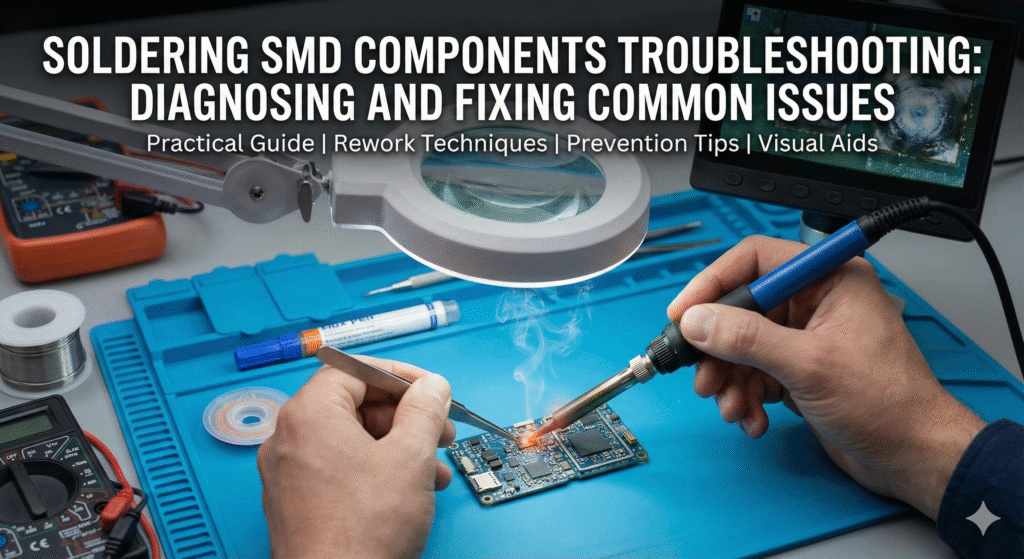
Hand-soldering Surface Mount Device (SMD) components requires precision and the right technique. 🤓
Even experienced technicians encounter defects that can compromise circuit function. 💡
This guide explains common SMD soldering defects, their causes, and reliable repair methods. 📌
The post also covers prevention, tooling, and process controls to minimize rework. 🤓
I. Common SMD Soldering Defects and Causes
Most soldering issues stem from incorrect temperature, insufficient flux, or poor placement. 🤓
Understanding root causes helps you choose the correct rework action. 💡
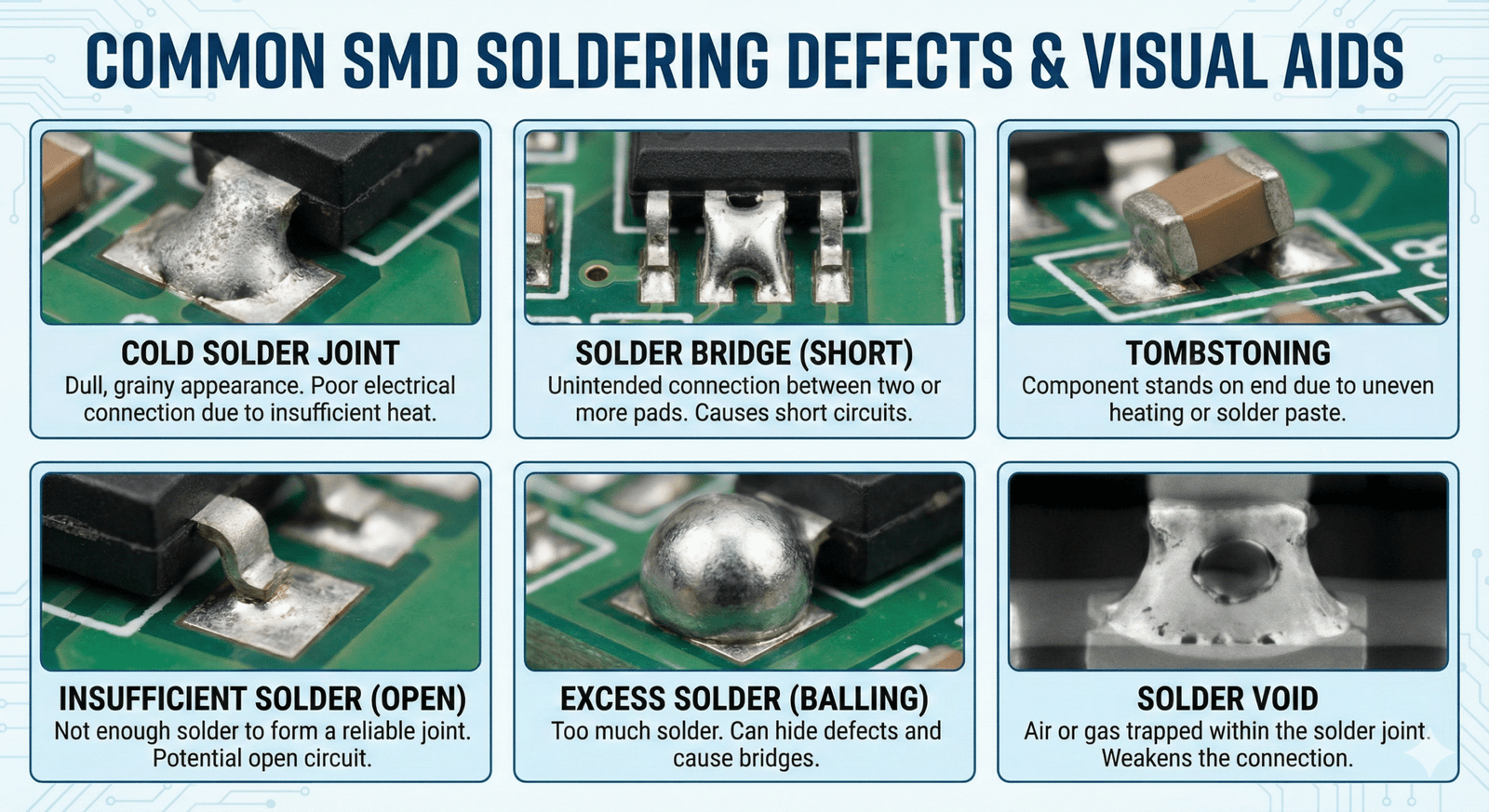
| Defect | Description | Primary Causes |
|---|---|---|
| Tombstoning | A two-terminal component lifts on one end, standing vertically on the board. | Uneven heating, unbalanced solder paste volume, or poor pad wetting. |
| Solder Bridging | Solder connects adjacent pads, creating a short circuit. | Excess solder paste, incorrect stencil design, or misaligned components. |
| Cold Joint / Insufficient Solder | Dull, grainy joint that lacks proper wetting and mechanical strength. | Iron too cool, insufficient flux, or too-brief heat application. |
| Solder Balls / Splatter | Small spheres of solder scattered across the PCB surface. | Contaminated paste, inappropriate reflow profile, or rapid solder spatter. |
| Component Misalignment | Component is off-center or shifted from its pad. | Poor pick-and-place accuracy or movement during reflow or manual placement. |
II. Tools and Materials That Make Troubleshooting Easier
Successful rework starts with the right tools. 🤓
Choose a temperature-controlled soldering iron for repeatable heat. 💡
Use quality flux, solder wire, and solder wick for efficient repairs. 📌
Magnification and proper lighting are non-negotiable for tiny SMDs. 🤓
A hot-air rework station is ideal for multi-pin components and reflow rework. 💡
- Temperature-controlled iron: Essential for consistent, safe rework.
- Good flux: Promotes wetting and reduces oxidation during soldering.
- Solder wick and solder braid: Remove bridges and clean pads efficiently.
- Hot-air station: Reflows solder uniformly for multi-lead parts.
III. Visual Inspection and Diagnostics
Always start with a careful visual inspection under magnification. 🤓
Look for dull joints, bridges, misalignment, and solder balls. 💡
Use a multimeter to check for shorts and opens after inspection. 📌
When possible, use a thermal camera or thermal-sensitive film to identify hotspots during reflow. 🤓
IV. Targeted Rework Procedures
Below are practical step-by-step repair techniques for the common defects. 💡
A. Fixing Tombstoning
Tombstoning often happens with small passive two-terminal parts. 🤓
Begin by applying a small amount of fresh flux to both pads. 💡
Use hot air or a soldering iron to reheat the properly soldered pad so the component can be flattened. 📌
Gently press the component down with non-marring tweezers while heating the opposite pad. 🤓
When the molten solder on both pads flows, the surface tension will pull the component flat. 💡
Allow the solder to solidify and inspect the fillets for good wetting. 📌
B. Resolving Solder Bridging
Solder bridges are common on fine-pitch ICs and passives. 🤓
First, apply liquid flux generously over the bridged area. 💡
Place a copper braid over the bridge and press the tinned iron tip onto it. 📌
The wick will absorb the excess solder when heated. 🤓
For stubborn bridges, remove most solder with braid and then use a tiny amount of fresh solder and flux to reflow each pad cleanly. 💡
Use magnification to confirm separation between pins and pads. 📌
C. Correcting Cold Joints (Insufficient Solder)
Cold joints are brittle and unreliable. 🤓
Apply fresh flux to the dull-looking joint. 💡
Heat the pad and component lead simultaneously with the iron tip. 📌
Add a small amount of fresh solder wire while maintaining heat to ensure proper wetting. 🤓
The joint should appear shiny with a smooth concave fillet when done correctly. 💡
D. Removing Solder Balls and Splatter
Solder balls pose risk of shorts and should be cleaned. 🤓
Use flux to gather balls together for easier removal. 💡
Wipe them away with solder wick or desolder braid under careful heat application. 📌
For reflow-related splatter, review reflow profile and paste handling to prevent recurrence. 🤓
E. Correcting Component Misalignment
Misaligned parts can usually be repositioned prior to solder solidification. 🤓
Reapply flux and reheat the component until solder is molten. 💡
Use vacuum pick-up or fine tweezers to nudge the part into place. 📌
Allow the solder to reflow and solidify with the component correctly seated. 🤓
V. Best Practices to Prevent Recurring Defects
Prevention is always better than repeated rework. 💡
Implementing process controls reduces defect rates significantly. 🤓
- Stencil & Paste Control: Use correct aperture sizes and high-quality paste to ensure proper solder volume.
- Profile Management: Validate and tune reflow profiles for your board and paste alloy.
- Component Placement: Ensure reliable pick-and-place accuracy and stable board fixturing.
- Cleanliness: Keep boards and paste free from contaminants and moisture to avoid solder balls and poor wetting.
VI. Advanced Techniques and Tips from the Field
Experienced technicians develop small workflow habits that reduce rework time. 🤓
Always pre-tin tips for faster heat transfer when using a soldering iron. 💡
Use temperature-controlled stations and verify tip temperature regularly. 📌
When replacing ICs, remove pins of the old device carefully and clean pads before laying the new one. 🤓
Use flux pens to apply flux precisely to small areas without flooding the board. 💡
When possible, reflow suspicious sections in a local oven or hot-air system to avoid disturbing nearby components. 📌
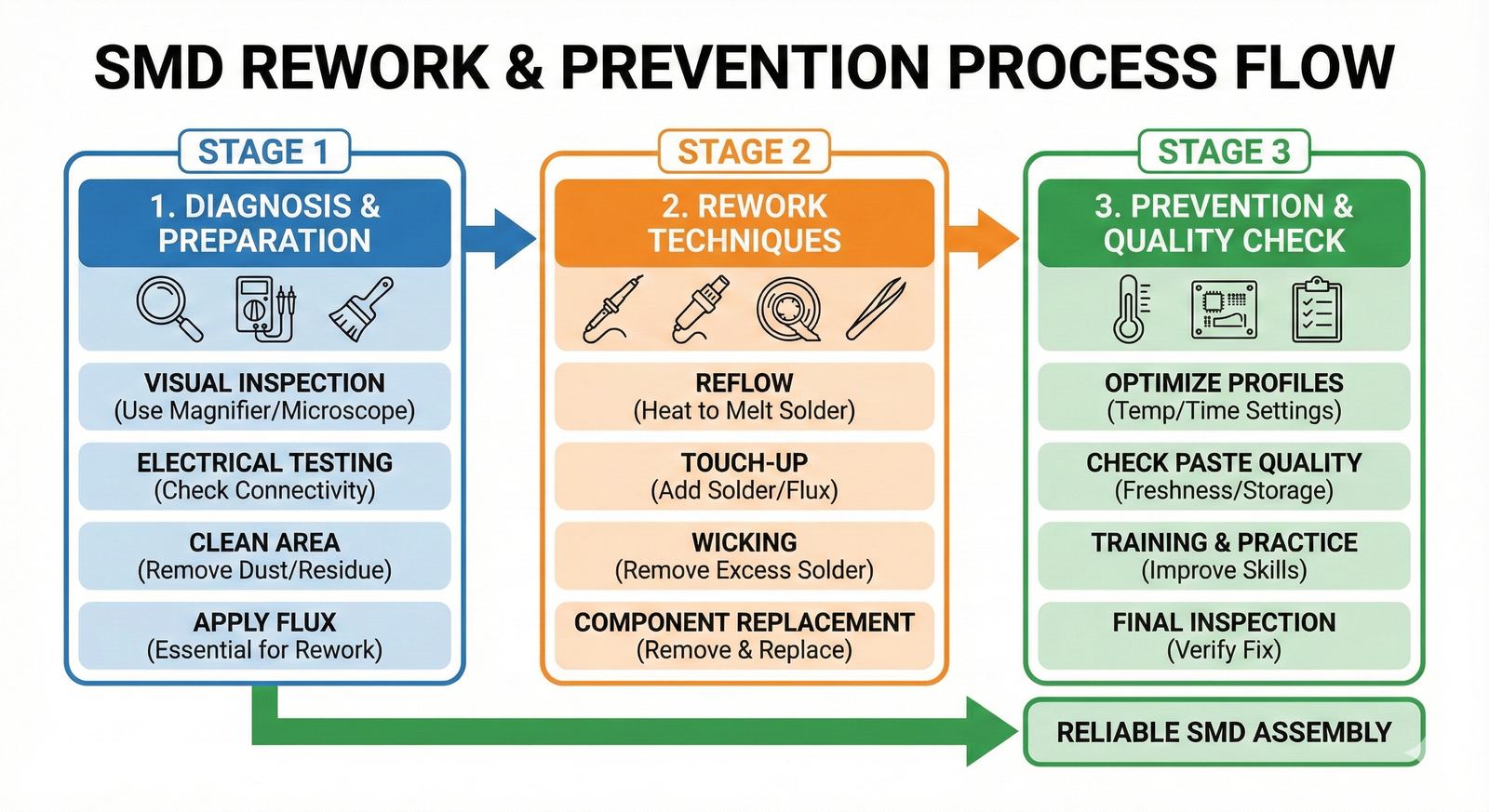
VII. Rework Process Flow: A Quick Checklist
| Step | Action |
|---|---|
| Inspect | Magnify and identify defect type and scope. |
| Document | Photograph and record PCB ID, lot, and defect location. |
| Choose Method | Select hot-air, iron, or wick based on component and defect. |
| Execute | Apply flux, reflow or wick, reposition parts, and re-solder as needed. |
| Verify | Electrical test and visual confirmation under magnification. |
VIII. When to Replace Instead of Repair
Sometimes replacement is faster and more reliable than rework. 🤓
Replace a component if the pads are damaged or if repeated rework fails electrical tests. 💡
For BGA and fine-pitch ICs, consider full site rework with proper tooling to avoid collateral damage. 📌
IX. Training and Continuous Improvement
Ongoing training reduces operator-induced defects. 🤓
Use first-article inspections and process capability analysis to catch issues early. 💡
Maintain a defect log to track root causes and elimination trends. 📌
Encourage technicians to share lessons learned and standardize successful rework steps. 🤓
X. Resources and Further Reading
These authoritative resources help deepen your understanding and validate best practices. 📚
Cadence — SMT Soldering Defects: Examples & Causes
DDM Novastar — Selective Solder Troubleshooting Guide
ProtoExpress — Common Errors in SMT
IPC — Standards for Assembly and Soldering
IEEE Xplore — Technical Papers on Reflow and Soldering
XI. Video Tutorials
https://youtu.be/6g4Z0q2QpQw
https://youtu.be/ZK3K6K2E8pY
https://youtu.be/1dF1b7Az6Qw
XIII. Final Thoughts
Mastering SMD soldering and rework is a combination of good tools, practiced technique, and robust process control. 🤓
Systematic diagnosis and methodical rework restore functionality and extend PCB life. 💡
Prioritize prevention through stencil control, reflow profiling, and operator training to reduce repair cycles. 📌
When in doubt, document, test, and consult standards like IPC to guide corrective actions. 🤓
Good soldering practices save time, money, and product reputation. 💡