



In the rapidly evolving landscape of technology, the integration of microcontrollers into everyday objects has revolutionized how we interact with the world.
From smart thermostats adjusting our home temperature to complex industrial control systems managing power grids, embedded systems are the silent workhorses of modern civilization.
However, this ubiquity comes with a significant price that many developers overlook until it is too late.
The connectivity that makes these devices so useful also opens the door to malicious actors seeking to exploit vulnerabilities for data theft, service disruption, or even physical damage.
Security considerations in embedded systems design are no longer optional features to be added at the end of the development cycle.
They are fundamental requirements that must be woven into the very fabric of the hardware and software architecture from day one.
Failure to prioritize security can lead to catastrophic brand damage, legal liabilities, and compromised user safety.
This comprehensive guide will explore the critical layers of protection required to secure your microcontroller-based products against sophisticated cyber threats.
We will delve into hardware defenses, firmware integrity, and the best practices that every embedded engineer must know.
Understanding the Threat Landscape 🕵️♂️
Before we can build effective defenses, we must first understand the nature of the threats targeting embedded systems.
Unlike traditional IT infrastructure, embedded devices often operate in physically accessible environments, making them susceptible to a wider range of attacks.
Hackers can employ non-invasive techniques like network sniffing or invasive methods that involve decapping chips to read memory contents directly.
One of the most dangerous misconceptions is “security by obscurity,” the belief that because a device uses a proprietary protocol or a custom architecture, it is immune to attack.
History has proven time and again that determined attackers will reverse-engineer any system given enough time and motivation.
Common attack vectors include buffer overflows, injection attacks, and the exploitation of weak authentication mechanisms.
Furthermore, side-channel attacks, which analyze power consumption or electromagnetic emissions to extract cryptographic keys, are becoming increasingly accessible to hobbyist hackers.
Understanding these diverse threats is the first step toward creating a robust security posture for your product.
It is crucial to perform a thorough threat modeling exercise early in the design phase to identify potential assets, threats, and vulnerabilities.
This proactive approach allows you to allocate security resources effectively where they are needed most.
“Security is a process, not a product.” – Bruce Schneier
Common Vulnerabilities in Embedded Systems ⚠️
Identifying specific vulnerabilities is key to hardening your system against potential exploits.
Many of these issues stem from legacy coding practices or cost-cutting measures that prioritize functionality over safety.
Below is a detailed breakdown of frequent security gaps found in microcontroller environments.
| Vulnerability Type | Description & Impact |
|---|---|
| Buffer Overflows | Occurs when data exceeds the memory buffer’s capacity, overwriting adjacent memory and potentially allowing code execution. |
| Insecure Debug Ports | Leaving JTAG or SWD interfaces open in production units allows attackers to dump firmware and manipulate device state easily. |
| Weak Cryptography | Using outdated algorithms (like DES or MD5) or hardcoded keys makes it trivial for attackers to decrypt sensitive communications. |
| Lack of Secure Boot | Without secure boot, an attacker can replace the legitimate firmware with a malicious version that grants them full control. |
| Default Passwords | Shipping devices with identical default credentials is a massive risk that has led to some of the largest botnets in history. |
Addressing these vulnerabilities requires a disciplined approach to coding and system architecture.
Developers should utilize static analysis tools to catch buffer overflows and other logic errors during the build process.
For more insights on vulnerability trends, you can review the Top 8 Cyber Security Vulnerabilities by Check Point Software.
The Foundation: Hardware Root of Trust 🏗️
Software security controls are essential, but they are ultimately only as strong as the hardware they run on.
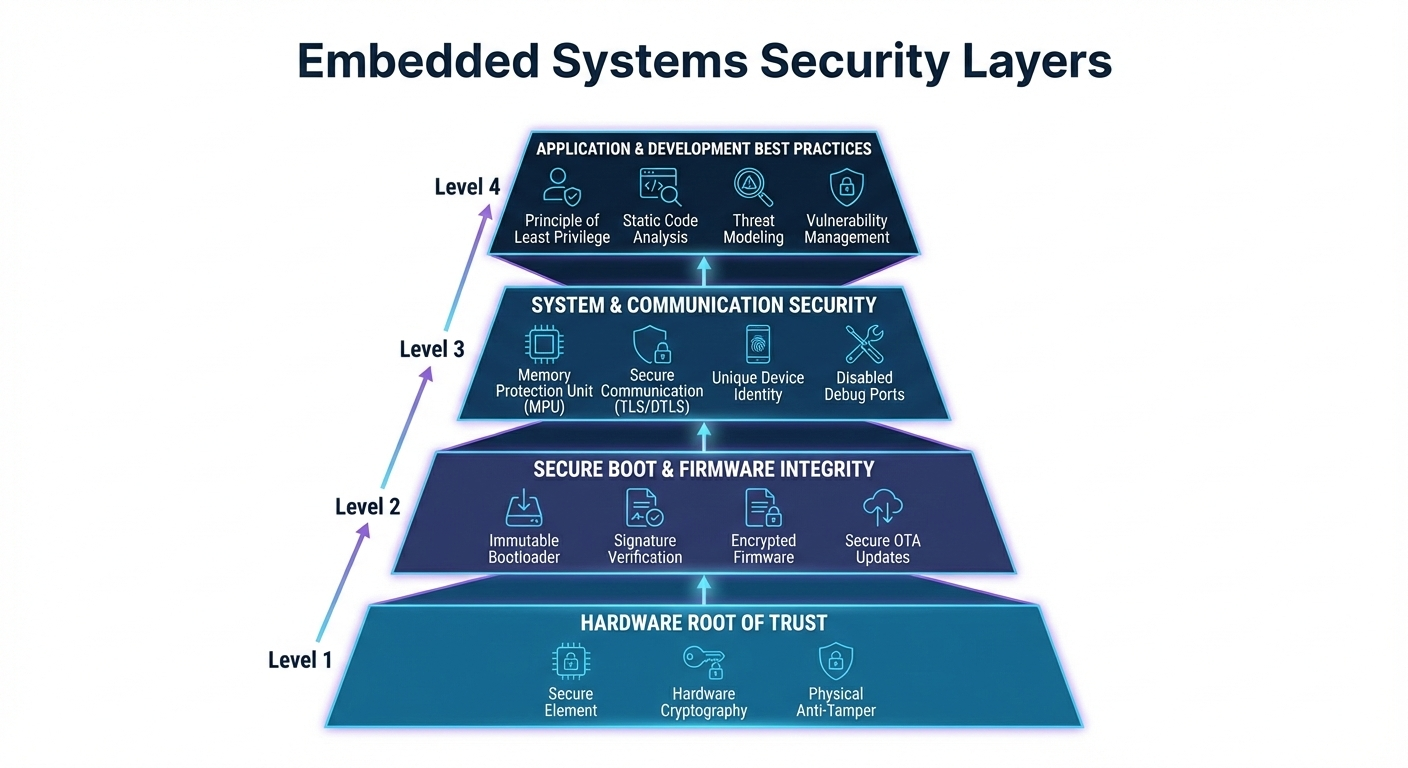
This is where the concept of a Hardware Root of Trust (RoT) becomes indispensable for modern embedded designs.
A Root of Trust is a set of functions that is always trusted by the computer’s operating system.
It typically serves as a separate computing engine that controls the trusted computing platform cryptographic processor.
By implementing a hardware RoT, you ensure that the device’s identity cannot be cloned and that its keys are protected from extraction.
Modern microcontrollers often come with built-in security modules such as TrustZone or dedicated secure elements.
These components provide a safe haven for storing private keys, certificates, and performing sensitive cryptographic operations.
Leveraging these hardware features allows you to establish a chain of trust that extends from the moment the device powers on.
If the hardware foundation is compromised, no amount of software patching can fully restore the integrity of the system.
Therefore, selecting a microcontroller with robust security features is one of the most critical design decisions you will make.
For a deeper dive into hardware security implementations, Microchip provides excellent resources on Platform Root of Trust and Secure Boot technology.
Secure Boot and Firmware Integrity 🛡️
Once the hardware is secured, the next critical defense layer is ensuring that only authorized software runs on the device.
Secure Boot is the mechanism that verifies the authenticity and integrity of the firmware before execution begins.
When the device starts, the immutable bootloader checks the digital signature of the application firmware against a trusted public key stored in the hardware.
If the signature is valid, the processor allows the application to run; if not, the system halts or enters a recovery mode.
This process effectively prevents attackers from installing persistent malware or modified firmware versions.
However, secure boot is just the beginning of the firmware lifecycle management.
You must also consider how updates will be delivered securely to devices in the field.
Over-the-Air (OTA) updates are convenient but introduce significant risk if not implemented with encryption and authentication.
Updates should always be signed by the developer and encrypted to protect proprietary algorithms from reverse engineering.
A robust update mechanism is your primary tool for fixing vulnerabilities that are discovered after the product has shipped.
Failing to plan for secure updates is planning for obsolescence and insecurity.
“If you think technology can solve your security problems, then you don’t understand the problems and you don’t understand the technology.” – Bruce Schneier
Communication and Network Security 🌐
In the era of the Internet of Things (IoT), few embedded devices operate in isolation.
Whether communicating via Wi-Fi, Bluetooth, Zigbee, or LoRaWAN, protecting data in transit is paramount.
All communication channels should be encrypted using industry-standard protocols like TLS 1.3 or DTLS.
Rolling your own crypto is a recipe for disaster and should be avoided at all costs.
Furthermore, each device should have a unique identity and unique credentials.
Using a shared key across all devices in a product line means that compromising one device compromises them all.
Mutual authentication between the device and the server ensures that the device is talking to the legitimate cloud service and vice versa.
It is also vital to minimize the network attack surface by closing unused ports and disabling unnecessary services.
Read more about securing communication and other strategies in Octavo Systems’ guide on Developing Secure Embedded Systems.
Best Practices for Embedded Developers 💡
Achieving a high level of security requires a shift in mindset and adherence to rigorous engineering discipline.
It involves a combination of coding standards, architectural choices, and process management.
Here is a list of actionable best practices to guide your development process.
- Implement the Principle of Least Privilege: Ensure that every task and process operates with the minimum level of access rights necessary to function.
- Disable Hardware Debug Interfaces: Physically blow fuses or use cryptographic locks to disable JTAG/SWD ports on production units to prevent physical tampering.
- Use Memory Protection Units (MPU): Configure the MPU to separate critical system code from user applications and to prevent code execution from data segments (NX bit).
- Regularly Perform Code Reviews and Audits: Utilize static code analysis tools and conduct peer reviews to identify potential flaws before they reach production.
- Plan for End-of-Life: Have a clear strategy for how user data will be securely wiped when the device is decommissioned or factory reset.
Following these guidelines can significantly reduce the likelihood of a successful cyber attack.
For a broader perspective on development standards, the Qt Blog on Embedded Security offers valuable insights into framework-level protection.
Regulatory Compliance and Standards 📜
The regulatory landscape for embedded security is tightening rapidly across the globe.
Governments are realizing the critical risk posed by insecure IoT devices and are mandating minimum security standards.
In the United States, the NIST cybersecurity framework provides a gold standard for managing information security risk.
Europe has the ETSI EN 303 645 standard, which outlines baseline security requirements for consumer IoT devices.
Compliance with these standards is not just about avoiding fines; it is about demonstrating a commitment to customer safety.
Ignorance of these regulations is no longer a valid defense in the event of a breach.
You can reference the NIST Computer Security Resource Center for the latest guidelines and special publications related to system security engineering.
Conclusion and Future Outlook 🚀
Securing embedded systems is a complex, continuous challenge that demands vigilance, expertise, and a proactive mindset.
As microcontrollers become more powerful and interconnected, the sophistication of attacks will only increase.
By implementing a hardware root of trust, enforcing secure boot, and adhering to strict coding standards, you can build a resilient defense.
Remember that security is an enabler of trust, and trust is the most valuable currency in the digital economy.
Your users rely on your devices to be safe, reliable, and private; do not let them down.
Start integrating these security considerations into your design process today to future-proof your products against tomorrow’s threats.
For ongoing updates on critical vulnerabilities that could affect your systems, always monitor the CISA Known Exploited Vulnerabilities Catalog.
Stay curious, stay secure, and keep innovating responsibly. 🤓