
Embedded systems are ubiquitous in modern life, from automotive control units and medical devices to industrial controllers and IoT devices. 💡
These systems often operate in resource-constrained environments, manage critical functionality, and interact with sensitive data.
Unlike traditional software applications that can be patched and updated remotely, embedded systems often have limited update capabilities, making security vulnerabilities particularly dangerous.
A vulnerability in an embedded system can have far-reaching consequences: a compromised automotive system could endanger lives, a breached medical device could harm patients, and a vulnerable IoT device could become part of a botnet attacking critical infrastructure.
The challenge of securing embedded systems is compounded by the use of low-level languages like C and Assembly.
While these languages offer unparalleled control and efficiency, they also provide ample opportunities for security mistakes.
Buffer overflows, integer overflows, use-after-free errors, and race conditions are common vulnerabilities in C/Assembly code, and they can be exploited to compromise system integrity.
The traditional approach of adding security as an afterthought—conducting penetration testing after development is complete—is insufficient for embedded systems.
Instead, security must be integrated into every phase of development, from initial design through post-market monitoring.
This is where a Security Development Lifecycle (SDL) becomes essential.
An SDL is a structured framework that embeds security best practices into every stage of software development.
For embedded systems projects using C and Assembly, a well-designed SDL can significantly reduce the attack surface, catch vulnerabilities early, and ensure that security is not compromised for the sake of performance or convenience.
This article explores the key phases of an SDL tailored for embedded systems, discusses practical tools and techniques, and provides guidance on implementing a robust security culture in C/Assembly development teams.
Section 1: Understanding the Security Development Lifecycle 🤓
The Security Development Lifecycle is not a new concept; it has been refined over decades through the work of security researchers, software engineers, and organizations like Microsoft and the Open Web Application Security Project (OWASP).
The Core Principles of SDL
At its heart, the SDL is built on several core principles.
First, security is a shared responsibility.
It is not the domain of a single security team but rather a concern that every developer, architect, and project manager must embrace.
Second, security must be integrated early and continuously.
Attempting to bolt on security at the end of development is ineffective and expensive.
Third, security requires a combination of people, processes, and tools.
No single tool can guarantee security; instead, a holistic approach combining secure coding practices, rigorous testing, and appropriate tooling is necessary.
The SDL typically consists of several phases, each with specific security activities and deliverables.
While different organizations may structure their SDL differently, the fundamental phases are consistent: requirements and planning, design, implementation, verification, and post-release.
SDL for Embedded Systems: Unique Challenges
Embedded systems present unique challenges for SDL implementation.
First, embedded systems often have strict resource constraints.
A security tool that works well on a desktop application might be too resource-intensive for an embedded device with limited RAM and CPU.
Second, embedded systems often have long lifespans and limited update mechanisms.
A vulnerability discovered years after deployment might be impossible to patch, making prevention all the more critical.
Third, embedded systems often interact with hardware at a low level, requiring developers to understand not just software security but also hardware security considerations.
An effective SDL for embedded systems must account for these challenges.
It must prioritize prevention over remediation, provide tools that work within resource constraints, and integrate hardware security considerations into the development process.
For a detailed look at the SDL process, consult the Microsoft Security Development Lifecycle (SDL) documentation, which provides a comprehensive framework.
Section 2: Phases of a Robust Embedded Systems SDL 📌
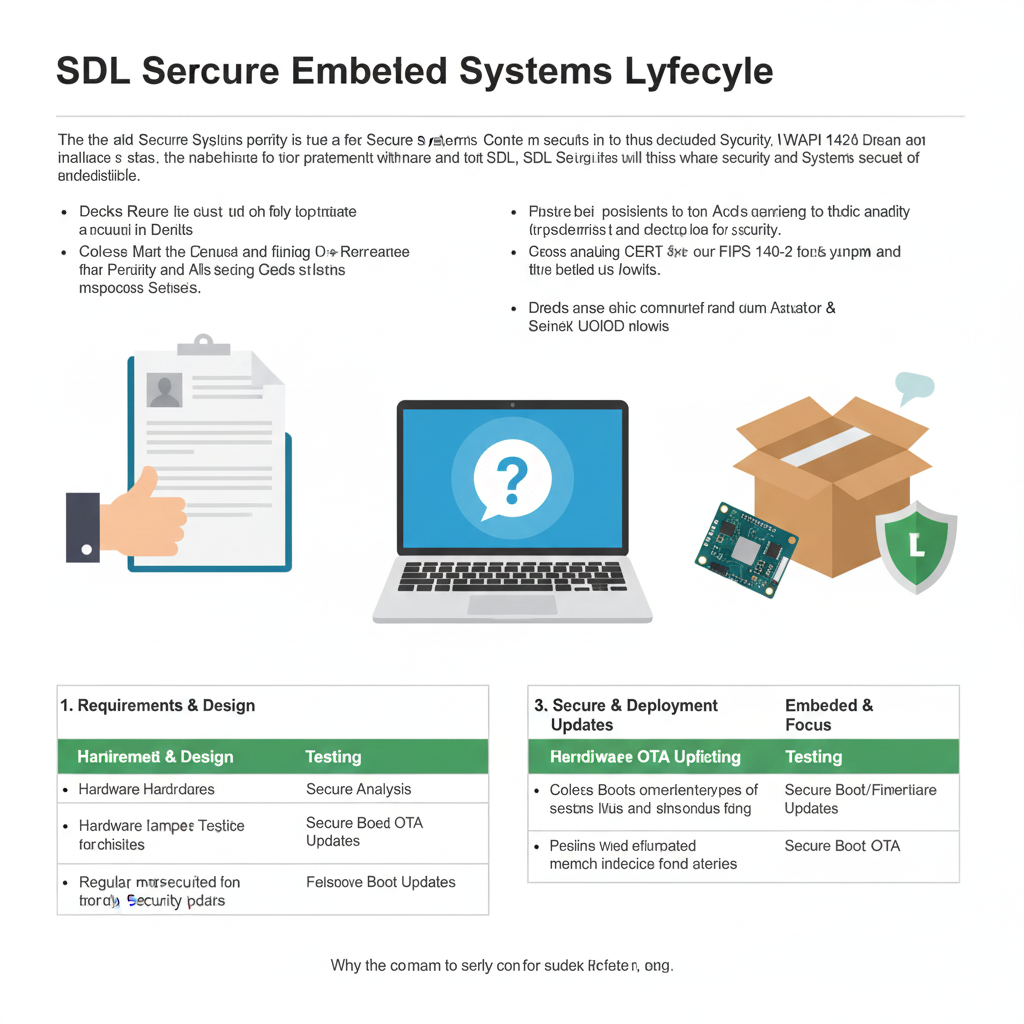
A comprehensive SDL for embedded systems typically consists of five main phases, each with specific security activities.
Phase 1: Requirements and Planning
The first phase of the SDL is where security requirements are defined and a security plan is established.
This phase involves threat modeling, where potential threats to the system are identified and analyzed.
For an embedded system, threat modeling should consider not just software attacks but also physical attacks, side-channel attacks, and supply chain vulnerabilities.
During this phase, security requirements are derived from the threat model.
These requirements specify what the system must do to protect against identified threats.
For example, if the threat model identifies that an attacker could attempt to modify firmware in transit, a security requirement might specify that all firmware updates must be cryptographically signed and verified before installation.
Additionally, a security plan is created that outlines the SDL activities that will be performed, the tools that will be used, the roles and responsibilities of team members, and the metrics that will be used to measure the effectiveness of the SDL.
Phase 2: Design and Architecture
In the design phase, the system architecture is developed with security as a primary consideration.
This involves designing secure interfaces, identifying trust boundaries, and planning for secure communication between components.
For embedded systems, this phase should include hardware-software co-design considerations.
For example, if the system uses a secure enclave or trusted execution environment (TEE), the design should specify how the software will interact with these hardware security features.
Additionally, the design should consider secure boot mechanisms, ensuring that only authorized firmware can execute on the device.
The design phase should also include a security design review, where the architecture is examined by security experts to identify potential vulnerabilities or design flaws.
This review can catch security issues early, before implementation begins, when they are cheaper and easier to fix.
Phase 3: Implementation and Secure Coding
The implementation phase is where developers write the actual code.
A robust SDL for this phase includes secure coding guidelines, code review processes, and automated analysis tools.
Secure coding guidelines specific to C and Assembly should be established.
These guidelines should address common vulnerabilities such as buffer overflows, integer overflows, format string vulnerabilities, and use-after-free errors.
Guidelines should also specify best practices for memory management, input validation, and cryptographic operations.
Code review is a critical activity in this phase.
Peer review of code, particularly for security-sensitive components, can catch vulnerabilities that automated tools might miss.
Code reviews should be mandatory for all code changes, and reviewers should be trained in security considerations.
Automated analysis tools, such as static analysis tools, can scan code for potential vulnerabilities.
Tools like Clang Static Analyzer, Coverity, and Infer can identify common programming errors and potential security issues.
These tools should be integrated into the development workflow, ideally running on every code commit.
Adopting a standard like the Barr Group’s Embedded C Coding Standard is a strong starting point for establishing secure coding practices.
Phase 4: Verification and Testing
The verification phase involves testing the system to ensure that it meets security requirements and is free of known vulnerabilities.
This phase includes multiple types of testing: unit testing, integration testing, system testing, and security testing.
Security testing is particularly important for embedded systems.
This includes fuzzing, where malformed or unexpected inputs are fed to the system to identify crashes or unexpected behavior.
Dynamic analysis tools can monitor the running system for security issues.
Additionally, penetration testing, where security experts attempt to break into the system, can identify vulnerabilities that other testing methods might miss.
For embedded systems, this phase should also include testing on actual hardware, not just in simulation.
Hardware-specific vulnerabilities, such as side-channel attacks or fault injection attacks, can only be identified through testing on real hardware.
Phase 5: Post-Release and Monitoring
The SDL does not end when the product is released.
Post-release activities include monitoring for security issues, responding to vulnerability reports, and planning for updates and patches.
For embedded systems, a post-release security plan should specify how security updates will be delivered to devices in the field.
This might involve over-the-air (OTA) updates, secure boot mechanisms that verify the authenticity of updates, and rollback mechanisms in case an update introduces problems.
Additionally, a vulnerability disclosure policy should be established, specifying how security researchers can report vulnerabilities responsibly and how the organization will respond to vulnerability reports.
Section 3: Tools and Techniques for Embedded Systems Security 🛠️
A robust SDL requires appropriate tools and techniques to be effective.
For embedded systems development in C and Assembly, several categories of tools are particularly important.
Static Analysis Tools
Static analysis tools examine source code without executing it, identifying potential vulnerabilities and programming errors.
For C code, tools like Clang Static Analyzer, Coverity, and Infer can identify buffer overflows, use-after-free errors, null pointer dereferences, and other common vulnerabilities.
These tools should be integrated into the build process, running automatically on every code commit.
The use of static analysis is a non-negotiable step in securing C/Assembly code, as it catches many memory-related errors that are difficult to find manually.
Dynamic Analysis and Fuzzing
Dynamic analysis tools monitor the running system for security issues.
Fuzzing tools like AFL (American Fuzzy Lop) and libFuzzer can automatically generate malformed inputs to test the robustness of the system.
These tools are particularly effective at finding edge cases and unexpected behavior.
For embedded systems, dynamic analysis often involves specialized hardware probes and debuggers to monitor the system’s behavior in real-time.
Cryptographic Libraries and Hardware Security
For systems that require cryptographic operations, using well-vetted cryptographic libraries is essential.
Libraries like OpenSSL, mbedTLS, and libsodium have been extensively reviewed and tested.
Additionally, if the hardware supports cryptographic acceleration or a secure enclave, the system design should leverage these features.
Hardware-based security is the strongest defense against many physical and side-channel attacks.
Secure Boot and Firmware Integrity
Secure boot mechanisms ensure that only authorized firmware can execute on the device.
This involves cryptographic verification of the bootloader and kernel before execution.
For embedded systems, secure boot is a critical security feature that prevents attackers from replacing the firmware with malicious code.
| SDL Phase | Key Activities | Primary Tools/Techniques | Security Outcome |
|---|---|---|---|
| Requirements & Planning | Threat modeling, Security requirements definition | STRIDE, Attack trees | Clear security objectives |
| Design & Architecture | Secure design review, Hardware-software co-design | Architecture review, TEE integration | Secure-by-design system |
| Implementation | Secure coding, Code review, Static analysis | Coding standards, Peer review, Clang SA | Vulnerability prevention |
| Verification & Testing | Fuzzing, Dynamic analysis, Penetration testing | AFL, Valgrind, Manual testing | Vulnerability detection |
| Post-Release | Vulnerability monitoring, OTA updates | Security monitoring, Update mechanisms | Rapid vulnerability response |
Section 4: Best Practices for Embedded Systems Security 🛡️
Beyond the formal SDL phases, several best practices can significantly enhance the security of embedded systems.
Principle of Least Privilege
The principle of least privilege dictates that each component of the system should have only the minimum permissions necessary to perform its function.
In embedded systems, this might mean running different components with different privilege levels, using memory protection to isolate components, and restricting access to hardware resources.
For Assembly code, this often translates to carefully managing register access and memory permissions.
Defense in Depth
Defense in depth is the practice of implementing multiple layers of security controls.
If one layer is compromised, others remain to protect the system.
For embedded systems, this might involve secure boot, signed firmware updates, runtime integrity checking, and anomaly detection.
This multi-layered approach is essential because no single security mechanism is foolproof.
The SAFECode Fundamental Practices for Secure Software Development guide offers excellent advice on this topic.
Regular Security Training
Developers must be trained in secure coding practices and security considerations.
Regular security training ensures that the team stays up-to-date with emerging threats and best practices.
Security awareness is not a one-time event but an ongoing commitment to continuous improvement.
This is particularly true for C/Assembly developers, who must be intimately familiar with the memory-safety pitfalls of their chosen languages.
Secure Supply Chain
The security of an embedded system is only as strong as its supply chain.
This includes the security of development tools, build systems, and third-party libraries.
Organizations should implement controls to verify the integrity of tools and libraries, use secure build systems, and monitor for supply chain attacks.
Incident Response Planning
Despite best efforts, security incidents may occur.
An incident response plan specifies how the organization will respond to security incidents, including reporting, analysis, remediation, and communication.
For embedded systems, this plan should address how to deliver security updates to devices in the field and how to communicate with users about security issues.
Section 5: Implementing SDL in Your Organization 🚀
Implementing a robust SDL is not a trivial undertaking.
It requires organizational commitment, resource allocation, and cultural change.
Start with a Security Audit
Before implementing an SDL, conduct a security audit of your current development practices.
Identify existing vulnerabilities, assess the maturity of your security practices, and determine what improvements are needed.
Prioritize and Phase Implementation
Implementing all SDL activities at once is overwhelming.
Instead, prioritize the most critical activities and implement them in phases.
Start with threat modelin