
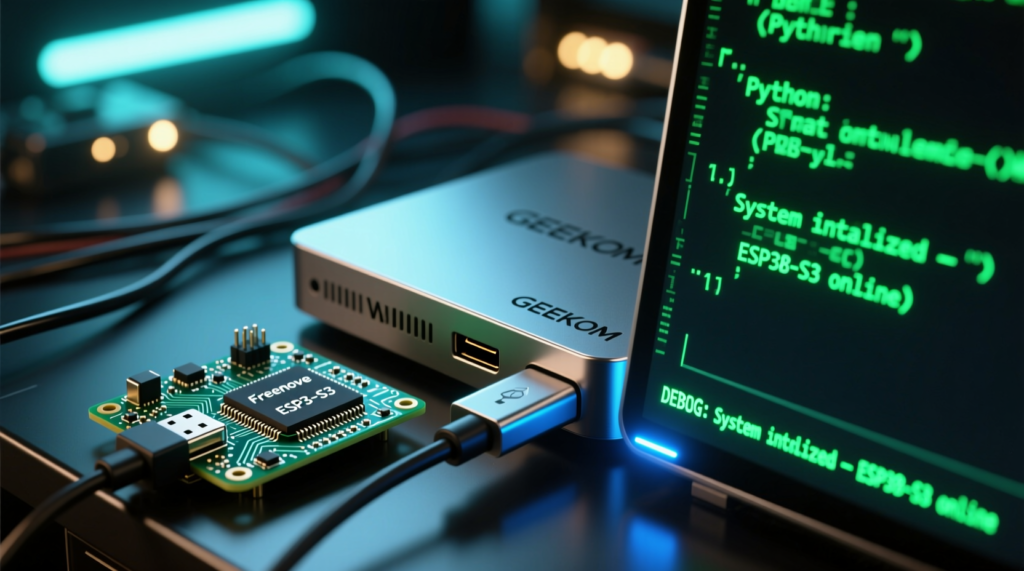


When it comes to Freenove ESP32-S3 kit tutorial compiling C vs Rust binaries for microcontrollers, getting the right details matters. Freenove Ultimate Starter Kit for ESP32-S3
GEEKOM A9 Max Mini PC
GEEKOM A8 Mini PC
Freenove ESP32-S3 Kit Tutorial: Compiling C vs Rust Binaries for Microcontrollers Without the Production Pitfalls
You have the Freenove Ultimate Starter Kit for ESP32-S3 on your bench. You have read the debates on r/esp32 and r/rust. You know C gives you mature drivers and fast incremental builds, but you also know it ships buffer overflows and hard-fault reboots. Rust promises memory safety, yet the first clean build takes forever, the binary swells toward the 8 MB flash ceiling, and a mismatched partitions.csv leaves you staring at a boot loop.
This guide is the no-fluff path through that mess. You will learn why C binaries fail in production, why Rust binaries bloat, how to set up both toolchains on the exact Freenove ESP32-S3 hardware, and which build host makes Rust iteration tolerable. By the end, you will have a production-safe stack instead of a pile of cryptic linker errors.
The Technical Reality — Why C Binaries Fail and Rust Binaries Bloat on the ESP32-S3
Memory-Safety Failure Modes in Production C Firmware
Legacy C code compiled for the ESP32-S3-WROOM-1 has no compile-time memory guarantees. That gap becomes expensive once the device leaves the bench.
| Failure Mode | Technical Data | Real-World Consequence | Stack/Heap Buffer Overflow | 64-byte payload copied into 32-byte buffer silently overruns adjacent memory in legacy C compiled for ESP32-S3-WROOM-1. | Corrupted state, unexpected reboots, or bricked remote sensor nodes in the field. | Use-After-Free Conditions | Task releases a block, another task reuses the same address, and heap metadata becomes garbage in FreeRTOS task heaps. | Crash that only appears under load, making debugging nearly impossible. | Integer Overflow Paths | Sensor counter wraps around, array index goes negative, and CPU throws an exception. | Hard-fault reboots that look like power glitches in deployed systems. | Remote Code Execution | Attacker controls payload length to redirect execution via malformed sensor payloads or MQTT messages. | Exploitable vectors that Rust eliminates at compile time. |
|---|
Undefined Behavior Surface in GCC/Clang for Xtensa
The Xtensa GCC/Clang toolchain for the Xtensa LX7 dual-core @ 240 MHz does not stop data races or aliasing violations. It compiles what you wrote, not what you meant.
| Issue | Technical Cause | Rust Mitigation | Data Races and Aliasing | Two FreeRTOS tasks touch the same register without a lock, compiling cleanly in C. | Borrow checker refuses compilation until synchronization is proven. | Malformed Payload Overwrite | Oversized MQTT message writes past buffer into next task’s stack frame without bounds checking. | Bounds checking prevents memory overwrite. | Heap Corruption | Unguarded C pointer arithmetic walks off heap into TCB, corrupting the scheduler. | Pointer math is restricted or abstracted safely. |
|---|
The Rust Compile-Time Enforcement Cost
Rust trades runtime safety for upfront discipline. The trade-off is real.
| Factor | Impact | Mitigation | Ownership and Borrowing | Stops entire bug classes but prevents writing global mutable state without thought. | Adopt ownership patterns early in design. | Binary Size Increase | Default binary drags in core::fmt, panic infrastructure, and allocator code. | Use panic = “abort” and size optimization profiles. | Compile Cycles | cargo build pulls cross-compiler, ESP-IDF headers, and bindgen; first build takes minutes. | Use high-performance build host with ample RAM. |
|---|
Binary-Size Bloat in Rust no_std/std on the 8 MB Flash Limit
The Freenove kit ships with 8 MB external flash. Rust can fit, but only if you fight for every kilobyte.
| Optimization Setting | Configuration | Result | opt-level | “s” or “z” | Aggressive size reduction; “z” favors size over speed. | lto | true | Link-time optimization removes dead code across crate boundaries. | codegen-units | 1 | Slower compile but smaller binary by merging translation units. | panic | “abort” | Strips panic unwinding machinery to reclaim kilobytes. |
|---|
A C blink/sensor demo may sit at 180–220 KB. A naive Rust build can hit 600 KB. With panic = “abort” and aggressive LTO, the gap closes to roughly 1.5×.
Toolchain and ABI Friction When Mixing C and Rust
Hybrid projects are where the pain lives.
| Friction Point | Technical Detail | Resolution | bindgen Integration | Expose C headers to Rust and ensure HAL crate matches ESP-IDF commit. | Pin ESP-IDF and esp-idf-sys versions in lockstep. | Partition Mismatches | Rust binary flashed with wrong partitions.csv boots into loop due to factory partition offset. | Use correct 8 MB partition table and verify factory size. | ABI Drift | Struct layout or calling-convention mismatch causes .elf to link but crash on interrupt. | Keep toolchain and HAL versions synchronized. |
|---|
Iteration Latency and Real-Time Determinism Erosion
Rust on a low-end laptop is a productivity trap.
Check out TECH Collection Amazon Products
| Constraint | Technical Cause | Operational Impact | Incremental Build Latency | Xtensa LLVM backend, bindgen, and ESP-IDF build compete for RAM on 8 GB/16 GB laptops. | Swapping kills tight edit-flash-test loop; developer velocity drops. | Interrupt Latency | Poorly placed critical_section or heap allocation inside ISR. | 240 MHz dual-core chip misses real-time deadlines. | Timing Transparency | C lets you see every cycle; Rust hides them behind zero-cost abstractions. | Requires learning abstraction boundaries to verify timing. |
|---|
The Core Gear Architecture — Validated Hardware Stack for C and Rust ESP32-S3 Builds
Primary Development Platform — Freenove Ultimate Starter Kit for ESP32-S3
The Freenove Ultimate Starter Kit for ESP32-S3 is the unified learning and prototyping platform. It directly addresses the failure mode of not having a consistent, well-documented target to test C and Rust binaries against.
| Specification | Detail | Core Module | ESP32-S3-WROOM-1 with Xtensa LX7 dual-core @ 240 MHz | Wireless | Wi-Fi 4 (802.11 b/g/n) + Bluetooth 5 LE | Memory | 512 KB SRAM, 384 KB ROM, 8 MB external flash, optional 8 MB PSRAM | Security | Secure Boot, AES-256-XTS Flash Encryption, HMAC, Digital Signature | Interfaces | USB-C/micro-USB, UART, SPI, I2C, I2S, PWM, ADC, DAC |
|---|
Kit Contents and Tutorial Ecosystem
The kit removes the “where do I plug this in” friction.
| Component | Value | Hardware | Solderless breadboard, jumper wires, resistors, LEDs, pushbuttons, sensors, USB cable | Documentation | ~368-page PDF tutorial with Python/C/Rust compatibility | Migration Benefit | Provides known-good C baseline; if C works and Rust fails, bug is in Rust code, not hardware. |
|---|
Build Host — GEEKOM A9 Max Mini PC for Rust Cross-Compilation
Rust cross-compilation for Xtensa is the failure point that kills projects. The GEEKOM A9 Max Mini PC is the insurance policy.
| Feature | Specification | Benefit | CPU | AMD Ryzen AI 9 HX 370, 12 cores / 24 threads | Parallel execution of bindgen, LLVM, and ESP-IDF steps. | RAM | Up to 128 GB DDR5 SODIMM | Eliminates swap thrashing; keeps target directory and crate index in RAM. | Storage/Network | M.2 PCIe Gen4 x4 NVMe, Dual 2.5G RJ45 | High throughput for CI build-node and artifact storage. | Virtualization | Proxmox VE/Kubernetes compatible | Isolated build containers prevent crate version drift between teams. |
|---|
Alternative Budget Build Hosts
You do not need the flagship to start, but you do need a floor.
| Model | Specs | Use Case | GEEKOM A8 Mini PC | Ryzen 9 8945HS, up to 64 GB DDR5 | Mid-tier host; strong performance for Rust cross-compilation. | GEEKOM A6 | Ryzen 7 6800H, up to 64 GB DDR5 | Budget entry point; acceptable for single-project builds. | Minimum Viable | 32 GB DDR5 + fast NVMe | Below 32 GB, wait time exceeds coding time. |
|---|
The Technical Setup Blueprint — Compiling, Flashing, and Debugging C vs Rust on the Freenove ESP32-S3
C/ESP-IDF Build Pipeline
Recommended Insights From Our Guide Library:
- C vs. Rust for Embedded Security: A Deep Dive into Memory Safety » Z A D A
- IoT Device Optimization: Why C and Assembly Still Reign Supreme in 2026 » Z A D A
- Choosing the Right Microcontroller for Your Next Project: A Comprehensive Guide » Z A D A
- Microcontrollers: Understanding, Choosing, and Programming
- C vs. Assembly: When Hand-Tuning Beats the Compiler for Peak Performance
| Step | Action | Key Detail | Setup | ESP-IDF v5.x and Xtensa GCC toolchain | Pin ESP-IDF version; use install.sh and export.sh scripts. | Build | Classic blink and sensor-read binaries | Use gpio and i2c examples; verify with idf.py size. | Partition | 8 MB external flash layout | Use partitions_8M.csv; ensure factory app partition is sufficient. | Flash | esptool.py parameters | Match –flash_mode, –flash_freq, –flash_size to avoid boot loops. |
|---|
Rust esp-rs Build Pipeline
| Step | Action | Key Detail | Setup | rustup + espup installation | Installs Xtensa Rust toolchain and required LLVM fork. | Target | Select target triple | xtensa-esp32s3-espidf for std/Wi-Fi; xtensa-esp32s3-none-elf for bare-metal. | Flash | cargo-espflash workflow | cargo espflash flash –release builds and flashes; verify partition table. | Integration | ldproxy and bindgen | Resolve linker scripts and generate FFI; lock ESP-IDF and esp-idf-sys versions. |
|---|
Size-Optimized Release Profile for 8 MB Flash
Add this to your Cargo.toml:
“`toml
[profile.release]
opt-level = “s” # or “z” for even smaller code
lto = true # link-time optimization across crates
codegen-units = 1 # slower compile, smaller binary
panic = “abort” # strip panic unwinding machinery
“`
Benchmarking C vs Rust binary size on the same peripheral demo reveals the real cost. Measure both with the same LED + I2C sensor code and document the delta for stakeholders.
Flashing and Partition-Table Matching
| Rule | Implementation | Failure Symptom | Partition Table | Use 8 MB table; ensure factory/ota_0 partition fits Rust binary. | Boot loop due to partition mismatch. | Bootloader | Flash bootloader matching ESP-IDF or esp-hal revision. | Boot loop from version mismatch. | Tool Alignment | cargo-espflash and esptool.py must use same flash mode/freq/size. | Inconsistent flashing results. |
|---|
HAL Crate Version Pinning
Compatible esp-hal, esp-wifi, and esp-println combinations must be verified against release notes. Do not assume latest-always-works.
Resolving cryptic compile errors often reveals crate version drift. If you see esp_hal::peripherals::Peripherals mismatches, your HAL and PAC crates are out of sync.
Pin exact versions in Cargo.toml and use a Cargo.lock in version control. Treat HAL updates like toolchain updates.
Debugging C vs Rust Behavior
| Tool | Usage | Constraint | JTAG/OpenOCD | Hardware debugging | probe-rs support improving but sensitive to probe firmware versions. | Breakpoints | Stack trace analysis | Outdated CMSIS-DAP firmware can cause silent breakpoint failures. | Logic Analyzer | Timing verification | Identifies whether bug is in driver or protocol during timing regressions. |
|---|
Cybersecurity and Network Perimeter Architecture
Enable RSA-3072/ECDSA secure boot and AES-256-XTS flash encryption in menuconfig or sdkconfig. These prevent attackers from running modified firmware or reading secrets from flash.
Store device certificates in NVS and sign OTA images with a private key kept offline. Route traffic through a perimeter firewall and segment IoT devices into their own VLAN with deny-by-default rules.
Micro-Electronics and PCB Diagnostic Rules
Check out TECH Collection Amazon Products
| Parameter | Specification | Warning | GPIO Logic | 3.3 V | Not 5 V tolerant; use level shifter for 5 V peripherals. | Current Limit | ~20 mA per GPIO | Sufficient for LED with resistor; insufficient for relay coil. | ADC/DAC | 12-bit SAR ADC, 8-bit DAC @ 3.3 V | ADC counts map to 3.3 V; use divider for 5 V readings. | Download Mode | Hold BOOT, press EN, release BOOT | Flashing failure usually due to incorrect button sequence. |
|---|
DevOps Homelab and CI/CD Integration
Containerized Rust builds on Proxmox VE/Kubernetes nodes lock the Rust toolchain, ESP-IDF version, and crate manifest. Reproducible builds prevent “works on my laptop” issues.
Tune OpenZFS ARC for build-artifact and crate-cache storage to avoid re-downloads. Separate control-plane API and node-to-node traffic across dual 2.5G LAN interfaces to mirror enterprise build-farm topology.
Field Verdict & Operational ROI — Why the Right Gear Stack Prevents Costly Firmware Failures
When C Still Wins on the ESP32-S3
| Advantage | Detail | Ecosystem Maturity | Mature ESP-IDF ecosystem and peripheral coverage; drivers exist first in ESP-IDF. | Timing Transparency | Transparent real-time timing for interrupt-critical applications; inspect assembly easily. | Build Speed | Faster incremental builds on modest hardware; cheap laptop is sufficient. |
|---|
When Rust Becomes Non-Negotiable
| Advantage | Detail | Memory Safety | Eliminates memory-safety classes in connected/OTA IoT devices; avoids CVEs from untrusted payloads. | Maintainability | Long-term maintainability with compile-time guarantees; refactoring is mechanical. | Security Posture | Borrow checker acts as security review on every build for network-exposed devices. |
|---|
The Investment Case
The Freenove Ultimate Starter Kit for ESP32-S3 serves as the unified C/Rust learning and prototyping platform. One board, one tutorial, one known-good baseline for both languages.
The GEEKOM A9 Max Mini PC acts as the build-host insurance policy against Rust iteration latency. The cost of the host is smaller than the cost of a developer waiting for builds.
Total cost of ownership favors a faster build host and well-tested kit, reducing recalls, OTA failures, and security incidents.
Recommended Action Stack
| Priority | Action | 1 | Start with the Freenove Ultimate Starter Kit for ESP32-S3. | 2 | Pair with a 32 GB+ DDR5/NVMe build host (GEEKOM A9 Max Mini PC preferred). | 3 | Maintain pinned esp-rs crate manifests and size-optimized release profiles. |
|---|
Conclusion
You now have a complete map for compiling C and Rust binaries on the Freenove Ultimate Starter Kit for ESP32-S3 without walking into common production pitfalls. You understand why C firmware fails at memory safety, why Rust firmware can bloat, and exactly how to size-optimize, flash, and debug both.
Community Reference & Authority Resources:
You also have a validated hardware stack: the Freenove kit for the target and the GEEKOM A9 Max Mini PC as the build host that keeps Rust iteration from grinding to a halt.
The real benefit is confidence. Whether you ship C or Rust, the right board, the right toolchain pins, and the right build host turn firmware from a source of late-night debug sessions into a repeatable, auditable, deployable system. Pick your language, pin your versions, size-optimize your release profile, and let the hardware do the heavy lifting.
🔍 Explore More: See all tech guides and tutorials for Freenove ESP32-S3 kit tutorial compiling C vs Rust binaries for microcontrollers.
Check out TECH Collection Amazon Products