


The Modern Traveler’s Dilemma: Why Your Laptop Needs a Power Bank
The dreaded low-battery warning – it always seems to flash at the worst possible moment. красная
For digital nomads, remote workers, and avid travelers, a dead laptop isn’t just an inconvenience; it’s a productivity killer. 🛑
In our hyper-connected world, staying powered up is no longer a luxury but an absolute necessity.
The days of tethering yourself to a wall outlet are over, thanks to the evolution of the external laptop battery power bank.
These are not the small pocket chargers for your phone; we’re talking about high-capacity, high-wattage beasts capable of reviving a fully drained MacBook Pro.
Recent data shows that the demand for high-capacity portable power solutions is expected to grow significantly through 2026, as more professionals embrace a location-independent lifestyle.
The reality is, that reliance on public charging stations is a risky game of chance.
A dedicated power bank for your laptop is your personal, reliable energy grid, no matter where you are. ✈️
https://youtube.com/watch?v=5iS6de5p_sU
Decoding the Tech: Not All Power Banks Are Created Equal
Choosing the right power bank can feel like navigating a sea of technical jargon. 🤯
Let’s break down the essential specifications you need to understand to make an informed decision.
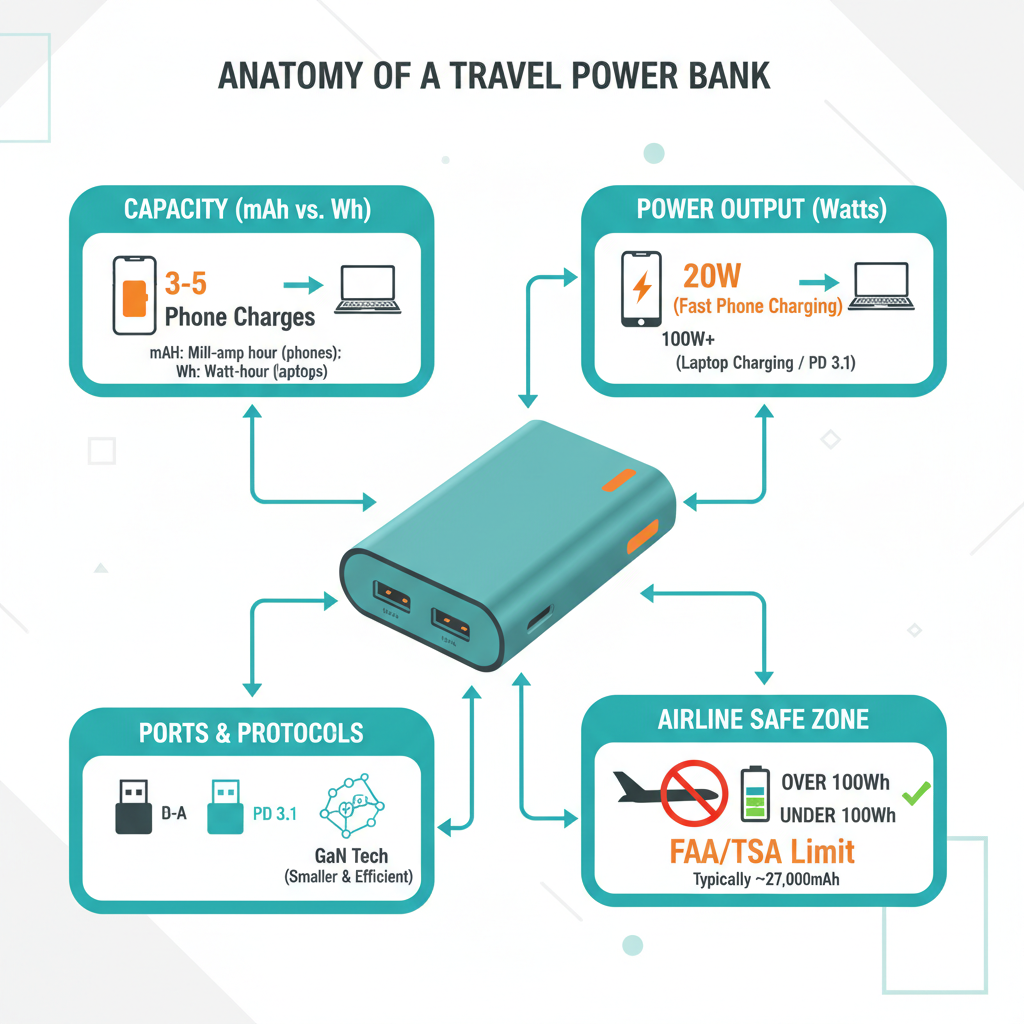
First and foremost is understanding the difference between milliamp-hours (mAh) and Watt-hours (Wh).
While mAh is the most common marketing term, Wh is the universal standard for air travel safety and a more accurate measure of actual energy capacity.
For travel, you should always look for a power bank that is under the 100Wh limit imposed by the TSA and FAA to ensure it can be carried on a plane.
This typically corresponds to a capacity of around 27,000mAh, which is more than enough to provide a full charge to most modern laptops.
Next up is Power Output, measured in Watts (W).
This is arguably the most critical factor for laptop charging.
A standard phone charger might offer 20W, but a laptop requires significantly more, typically in the range of 65W to 140W for effective charging.
Using an underpowered charger will result in slow charging or, in some cases, no charging at all, especially while the laptop is in use.
Always check your laptop’s original charger to see its wattage rating and choose a power bank that can match or exceed it.
Finally, consider the ports and protocols.
The gold standard today is USB-C with Power Delivery (PD). 📌
This technology allows for high-speed, two-way charging, enabling the same port to charge your laptop or recharge the power bank itself at high speed.
Look for models that specify PD 3.0 or even the newer PD 3.1 for the most future-proof performance.
Feature Comparison of Top Travel Power Banks
Infographic: Never Run Out of Juice: The Ultimate Guide to Laptop Power Banks for Digital Nomads & Travelers
| Model | Capacity (mAh/Wh) | Max Output (Watts) | Key Feature | Best For |
|---|---|---|---|---|
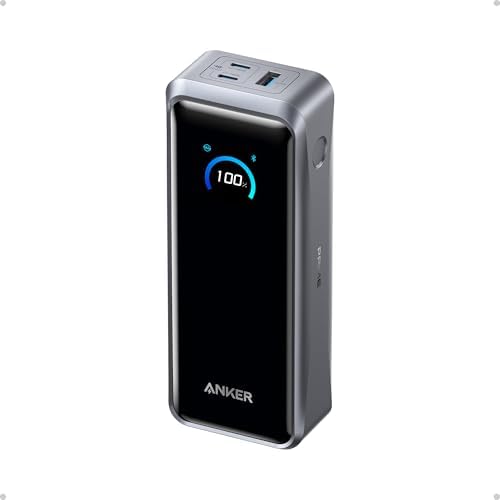
| Anker Prime 26K | 26,250mAh / 99.7Wh | 140W | Digital Status Display | Long-Haul Flights |
| INIU 140W | 25,000mAh / 92.5Wh | 140W | High-Speed Laptop Charging | Business Travelers |
| UGREEN Nexode 100W | 20,000mAh / 72Wh | 100W | Versatile & Compact | Digital Nomads |
| Mophie Powerstation AC | ~22,000mAh / 99Wh | 100W (AC Outlet) | Built-in AC Outlet | Charging Multiple Device Types |
“In the age of remote work, your office is wherever your laptop is. A power bank ensures your office is always open.”
Navigating the Skies: TSA and Airline Rules for Power Banks ✈️
Carrying a high-capacity battery onto a plane can be intimidating, but the rules are actually quite straightforward. 💡
The key regulation from both the Federal Aviation Administration (FAA) and the TSA is that all spare lithium-ion batteries, which includes power banks, must be transported in your carry-on luggage only.
They are strictly forbidden in checked baggage due to fire risk.
Power banks with a capacity of 100 Watt-hours (Wh) or less are permitted without any special approval.
This is the golden number to look for when shopping for a travel power bank.
Most reputable manufacturers, like those mentioned by Anker, design their high-capacity models to fall just under this limit, specifically for hassle-free travel.
If your power bank is between 101Wh and 160Wh, you may be able to bring it, but you will need approval from the airline beforehand.
Anything over 160Wh is generally not allowed on commercial flights.
https://youtube.com/watch?v=g2aBq4-p97g
The Future is Fast: GaN Technology and Smart Charging
The technology inside these devices is advancing at a blistering pace. 🚀
One of the biggest recent innovations is the widespread adoption of Gallium Nitride (GaN) technology.
As detailed by tech publications like The Verge, GaN components are more efficient than traditional silicon, allowing chargers to be built smaller, lighter, and run cooler, all while handling more power.
This means you no longer have to carry a massive, heavy brick to charge your laptop.
Modern GaN power banks pack immense power into a travel-friendly form factor.
Many 2026 models now incorporate multiple smart-charging ports that can intelligently distribute power based on the needs of the connected devices.
You can plug in your laptop, phone, and headphones all at once, and the power bank will automatically allocate the fastest possible charge to each one.
This level of intelligence and efficiency is a game-changer for travelers who need to power an entire ecosystem of tech gear.
For more in-depth reviews on the latest models, resources like CNET provide excellent, up-to-date buying guides.
“The right piece of technology feels like a superpower. A laptop power bank is the superpower of infinite productivity.”
Essential Travel Tips for Your Power Bank
Owning a great power bank is only half the battle; using it effectively and safely is just as important. Here are some pro tips:
- Always Fully Charge Before You Leave: This seems obvious, but it’s easy to forget. Make it part of your pre-travel checklist to charge your power bank to 100% the night before you fly.
- Use High-Quality Cables: The cable is just as important as the power bank. To get the maximum charging speed, use a cable that is rated for the wattage your power bank provides. A 100W-rated USB-C cable is a must-have accessory.
- Avoid Extreme Temperatures: Lithium-ion batteries do not like extreme heat or cold. Don’t leave your power bank in a hot car or out in the freezing cold, as it can permanently damage the battery’s capacity. For guidance on battery care, check out resources from established tech sites like Wired.
- Store it Partially Charged: If you’re not going to use your power bank for an extended period, store it with a charge of around 50%. This helps prolong the long-term health of the battery cells.
https://youtube.com/watch?v=V6y58CHA1ys
🔍 Explore More: See all Related Blog Posts for External laptop battery power bank for travel.