
Welcome, cloud enthusiasts and network architects! 🤓
In today’s dynamic digital landscape, understanding and implementing robust cloud networking is paramount for any organization leveraging cloud services.
At the heart of this lies the concept of a Virtual Private Cloud (VPC).
A VPC isn’t just a buzzword; it’s the foundational building block for creating a secure, isolated, and highly customizable network environment within a public cloud.
Think of it as your own private data center, but within the vast infrastructure of a cloud provider. 💡
This comprehensive guide will delve into the intricacies of VPC architecture, exploring its core components, design principles, and best practices for building scalable and secure cloud networks.
“The cloud is not just a place to store your data; it’s a platform to transform your business.”
What Exactly Is a Virtual Private Cloud (VPC)?
A Virtual Private Cloud (VPC) is a logically isolated section of a public cloud where you can launch AWS resources in a virtual network that you define.
While this definition is specific to AWS, the concept applies broadly across all major cloud providers like Azure (Virtual Network or VNet) and Google Cloud (VPC).
It allows you to provision a private, isolated network segment within a public cloud provider’s infrastructure.

This isolation ensures that your resources are separate from other customers’ resources, providing a higher level of security and control.
Within your VPC, you have complete control over your virtual networking environment.
This includes selecting your own IP address range, creating subnets, configuring route tables, and setting up network gateways.
It’s like having your own dedicated piece of the internet, but managed by a cloud provider. 🌐
Key Components of VPC Architecture
To truly master VPC architecture, it’s essential to understand its fundamental building blocks.
Each component plays a crucial role in defining the network’s behavior, security, and connectivity.
IP Addressing and CIDR Blocks
Every VPC must be associated with an IPv4 CIDR block, for example, 10.0.0.0/16.
This CIDR block defines the private IP address range for all instances and resources within your VPC.
Choosing the right CIDR block is a critical initial step, as it dictates the maximum number of private IP addresses available for your resources.
Planning for future growth and potential network peering with other VPCs or on-premises networks is vital here.
Subnets
Within your VPC, you divide your CIDR block into smaller ranges called subnets.
Subnets are essential for organizing your resources and segmenting your network.
There are two main types:
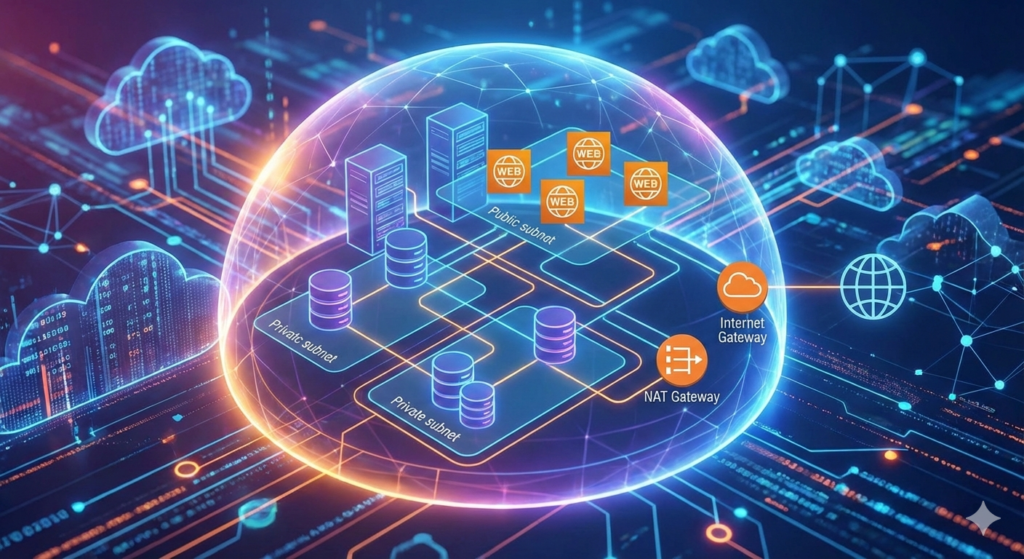
- Public Subnets: These subnets are directly connected to an Internet Gateway (IGW), allowing resources within them to communicate directly with the internet. Web servers and public-facing load balancers typically reside here.
- Private Subnets: Resources in private subnets cannot directly access the internet. They typically house databases, application servers, and other sensitive resources that should only be accessible from within the VPC or via a controlled NAT Gateway.
Route Tables
Route tables determine where network traffic from your subnets is directed.
Each subnet must be associated with a route table.
The route table contains a set of rules, called routes, that specify where network packets should be sent.
For example, a public subnet’s route table will have a route sending internet-bound traffic to an Internet Gateway.
Internet Gateways (IGW) and NAT Gateways (NGW)
An Internet Gateway (IGW) enables communication between your VPC and the internet.
It serves as the entry and exit point for internet-bound traffic for public subnets.
A NAT Gateway (NGW) allows instances in a private subnet to connect to the internet or other AWS services, but prevents the internet from initiating a connection with those instances.
It provides a managed, highly available way for private instances to access external resources without exposing them directly.
Network Access Control Lists (NACLs) and Security Groups
These are your primary tools for network security within a VPC.
Network Access Control Lists (NACLs) act as a firewall for subnets.
They are stateless, meaning they apply rules to both inbound and outbound traffic independently.
NACLs provide a coarse-grained level of security at the subnet level.
Security Groups act as a virtual firewall for individual instances.
They are stateful, remembering outgoing connections and automatically allowing return traffic.
Security groups offer a fine-grained level of security at the instance level.
It’s crucial to use both NACLs and Security Groups in a layered security approach. 🛡️
Designing Your VPC Architecture: Best Practices
A well-designed VPC is the cornerstone of a resilient and secure cloud infrastructure.
Here are some best practices to consider:
Multi-AZ Deployment for High Availability
Always distribute your subnets across multiple Availability Zones (AZs) within a region.
This ensures that if one AZ experiences an outage, your application can continue to run in another AZ, providing high availability and disaster recovery capabilities.
It’s a fundamental principle for building resilient cloud applications.
CIDR Block Planning
Carefully plan your CIDR block allocations.
Choose a CIDR range that is large enough to accommodate future growth but also avoids overlapping with your on-premises networks or other VPCs you might peer with.
Non-overlapping CIDRs simplify future network integrations.
Layered Security with NACLs and Security Groups
Implement a defense-in-depth strategy using both NACLs and Security Groups.
NACLs can provide a broad brush of security at the subnet level, while Security Groups offer granular control over individual instances.
Always follow the principle of least privilege, allowing only necessary traffic.
Dedicated Subnets for Different Tiers
Segment your applications into different tiers (e.g., web, application, database) and place each tier in its own dedicated subnet.
This enhances security by allowing you to apply specific NACLs and routing rules to each tier.
For example, your database subnet should only allow traffic from your application subnet, not directly from the internet.
Monitoring and Logging
Implement robust monitoring and logging for your VPC.
Tools like VPC Flow Logs (AWS), Network Watcher (Azure), or Flow Logs (Google Cloud) provide valuable insights into network traffic, helping you detect anomalies, troubleshoot connectivity issues, and meet compliance requirements.
Regularly review these logs. 📊
Advanced VPC Concepts and Connectivity
Beyond the basics, VPCs offer advanced features for complex networking scenarios.
VPC Peering
VPC peering allows you to connect two VPCs securely and privately, routing traffic between them using private IP addresses.
This is ideal for scenarios where different teams or applications need to communicate across separate VPCs within the same account or even different accounts.
It’s a hub-and-spoke model for networking.
AWS Transit Gateway / Azure Virtual WAN / Google Cloud Network Connectivity Center
For complex network topologies involving many VPCs, on-premises networks, and remote users, services like AWS Transit Gateway, Azure Virtual WAN, and Google Cloud Network Connectivity Center provide a centralized hub for managing all network connections.
These services simplify routing and network management at scale.
VPN and Direct Connect / ExpressRoute / Cloud Interconnect
To establish hybrid cloud connectivity between your on-premises data centers and your VPC, you have a few options:
- VPN (Virtual Private Network): Establishes a secure, encrypted connection over the public internet. It’s cost-effective but can have varying performance.
- Direct Connect / ExpressRoute / Cloud Interconnect: Provides a dedicated, private network connection between your on-premises network and the cloud provider. Offers consistent, high-bandwidth, and low-latency connectivity, ideal for mission-critical applications and large data transfers.
VPC Architecture Across Major Cloud Providers
While the core concepts remain consistent, each major cloud provider has its own nomenclature and subtle differences.
| Feature | AWS VPC | Azure VNet | Google Cloud VPC |
|---|---|---|---|
| Core Network Service | VPC | Virtual Network (VNet) | VPC Network |
| Network Isolation | Region-based | Region-based | Global (subnets are regional) |
| Subdivision | Subnets (tied to AZs) | Subnets (tied to VNets) | Subnets (tied to regions) |
| Network ACL Equivalent | Network ACL | Network Security Group (NSG) at subnet/NIC level | Firewall Rules (can apply to network/tags) |
| Instance Firewall | Security Groups | Network Security Group (NSG) at NIC level | Firewall Rules (can apply to network/tags) |
Security Considerations in VPC Architecture
Security is not an afterthought; it’s an integral part of VPC design.
Here are some key security considerations:
- Principle of Least Privilege: Only allow the minimum necessary network access. Restrict ingress and egress traffic as much as possible using Security Groups and NACLs.
- Private IP Addresses for Internal Communication: Whenever possible, use private IP addresses for communication between instances within your VPC. Only expose what’s absolutely necessary to the internet.
- Regular Security Audits: Periodically review your VPC configuration, including route tables, security groups, and NACLs, to ensure they align with your security policies and best practices.
- DDoS Protection: Leverage cloud provider’s DDoS protection services (e.g., AWS Shield, Azure DDoS Protection, Google Cloud Armor) to safeguard your public-facing resources.
- Compliance Requirements: Design your VPC with compliance regulations (e.g., GDPR, HIPAA, PCI DSS) in mind. Ensure your network segmentation and data flow adhere to these standards.
“Security is a journey, not a destination.”
Conclusion
Mastering Virtual Private Cloud architecture is a fundamental skill for anyone working with cloud computing.
By understanding its core components, applying best practices, and leveraging advanced features, you can design and implement secure, scalable, and highly available cloud networks that meet the demands of modern applications.
Remember, a well-architected VPC provides the robust foundation upon which your entire cloud infrastructure rests.
It’s an investment in the stability and security of your digital future. 🚀
Continuously learn and adapt, as cloud networking is an ever-evolving field.
Your journey to becoming a VPC expert starts now!
“The only way to do great work is to love what you do.”
Further Reading and Resources
For a deeper dive into specific cloud provider documentation and additional learning, explore these high-authority resources: