
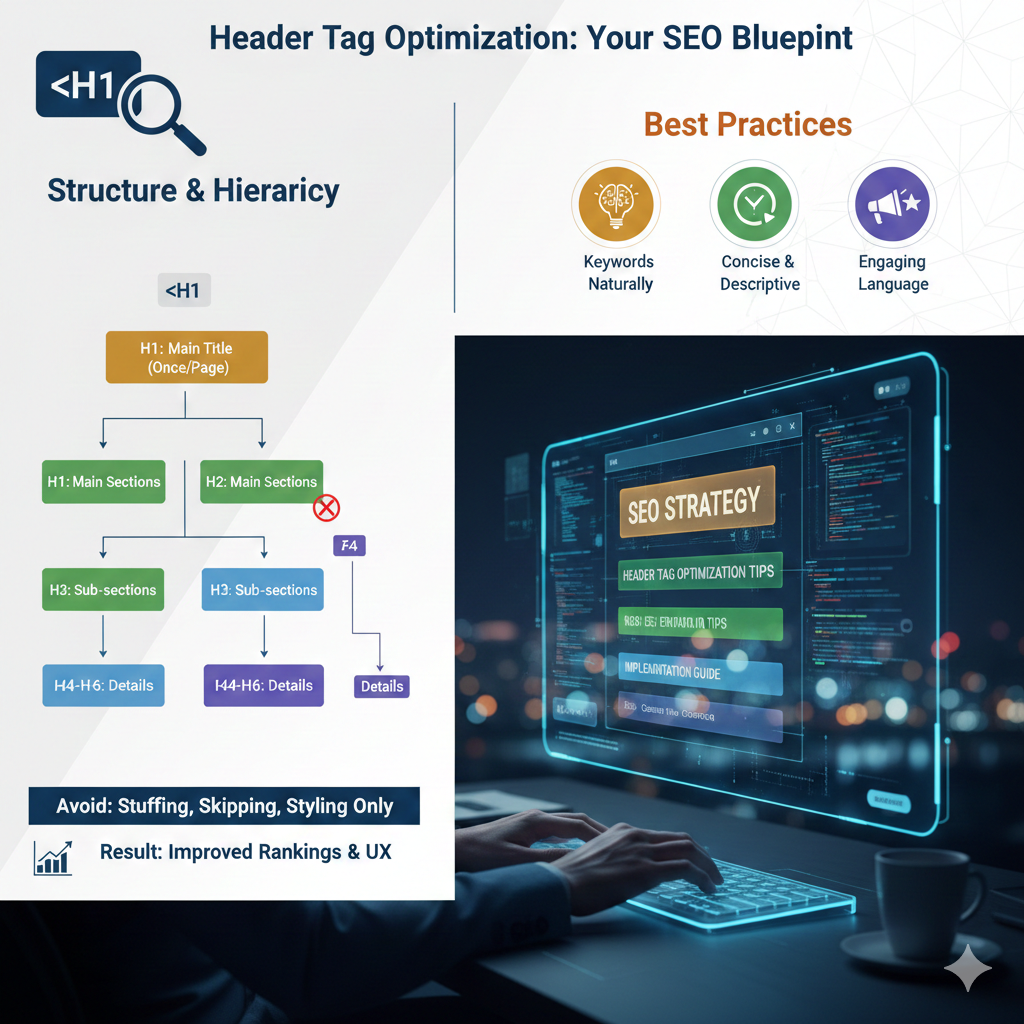



Welcome to the definitive guide on mastering one of the most overlooked aspects of a successful SEO strategy. 🤓
We are diving deep into the world of HTML header tags.
You might think these are just simple formatting tools to make text bigger.
However, thinking that way is a major mistake for your search rankings. 🛑
Header tags are actually critical signals to search engine crawlers.
They provide structure, context, and hierarchy to your content.
If you ignore them, you are essentially handing your competitors an advantage on a silver platter. 🍽️
In this post, we will explore actionable header tag optimization tips that you can implement immediately.
Let’s turn your messy content into a structured powerhouse that Google loves.
Are you ready to boost your on-page SEO? 🚀
Why Header Tags Are Crucial for Your SEO Strategy
Before we get into the “how,” we need to understand the “why.” 💡
Header tags (H1 through H6) act as the skeleton of your blog post or webpage.
Imagine trying to read a 2,000-word academic paper that has no paragraphs, no sections, and no titles.
It would be an absolute nightmare for a human user.
Now, imagine you are a search engine bot, like Googlebot. 🤖
Googlebot needs clear signals to understand what your content is actually about.
Headers provide those signals by breaking down complex information into digestible chunks.
According to SEO authorities like Moz on on-page factors, proper page structure improves both crawlability and user experience.
When users can easily scan your content and find what they need, they stay on your page longer.
This sends positive dwell-time signals back to search engines. 📈
Furthermore, well-optimized headers increase your chances of winning Featured Snippets.
Google often pulls content directly below an H2 or H3 tag to answer a user’s specific query directly on the search results page.
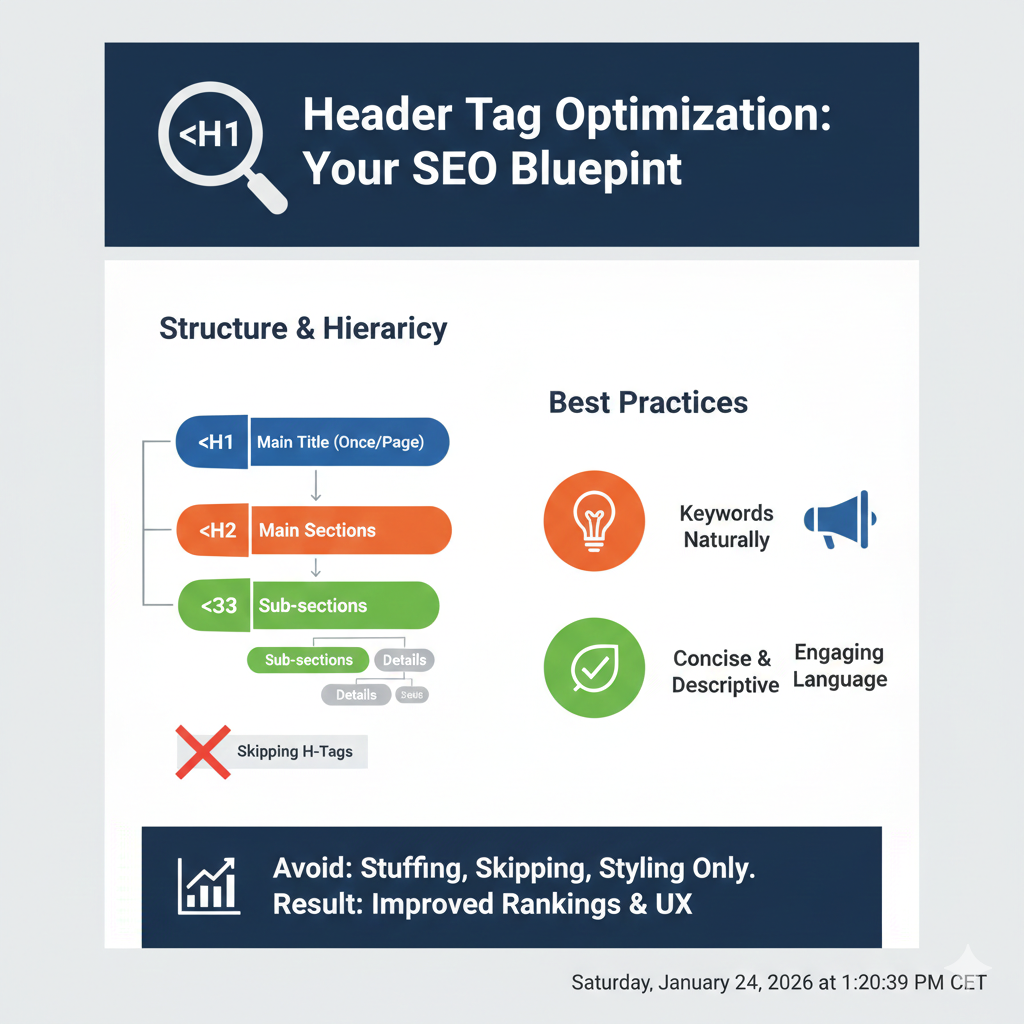
The Hierarchy of Headings: H1 to H6 Explained
Understanding header hierarchy is fundamental to a solid SEO strategy. 🏛️
Think of it like writing an outline for a book.
You cannot have three different titles for the same book.
Similarly, you need to use headings in their proper logical order.
Below is a breakdown of how each tag should be utilized within your content structure.
| Header Tag | Purpose and Best Practice |
|---|---|
| <h1> | This is the main title of the page. It should be unique and used only once per page. |
| <h2> | These are the main sections or chapters of your content. They break the H1 topic into major sub-points. |
| <h3> | These represent subsections within your H2s. They provide supporting details for the main sections. |
| <h4> – <h6> | Used for very granular details or nested lists. These are rarely used in standard blog posts but are useful for complex technical documentation. |
Sticking to this hierarchy is crucial. 📌
Do not skip levels randomly.
For instance, do not jump straight from an H2 to an H4 just because you like the font size better.
Essential Header Tag Optimization Tips
Now that we understand the structure, let’s move into the actionable header tag optimization tips. ✨
Applying these rules consistently will significantly improve your on-page SEO.
Remember that SEO is often about getting many small details right.
- Inject Keywords Naturally: Your primary and secondary keywords should appear in your headers. However, avoid “keyword stuffing” at all costs. The headers must still read naturally to a human being.
- Keep Them Concise but Descriptive: A header acts as a promise of what the following paragraphs will contain. Ensure your headers accurately summarize the section content in a few punchy words. Long, rambling headers are ineffective.
- Focus on User Intent: When crafting an H2, ask yourself what the user is looking for in that section. Are they looking for a definition, a “how-to” step, or a list of benefits? Frame the header as an answer to their implicit question. 🧐
- Make Them Interesting: While SEO is important, boring headers will cause users to bounce. Use engaging language that entices the reader to continue down the page.
You can verify the importance of structure by checking Google’s own documentation.
Read what Google Search Central says about headings and content structure to confirm these best practices.
📣 Informational Quote 📣
Structure is not just about aesthetics; it is the foundation upon which relevance is built. Without clear signals, search engines are left guessing, and guessing rarely leads to number one rankings.
The H1 Tag Rule: One to Rule Them All
The H1 tag is arguably the most important header on your entire page. 👑
It is usually the first thing both users and search engines see.
There is a golden rule in SEO strategy regarding H1s: Use only one per page.
While HTML5 technically allows multiple H1s in different <article> sections, it is widely considered best practice for SEO to stick to a single H1 representing the main topic.
Your H1 should almost always contain your primary target keyword for that page.
It needs to clearly and immediately communicate what the entire page is about.
Think of it as the headline on a newspaper front page. 📰
It must be compelling and accurate.
For more on keyword placement, check out resources on keyword research from experts like Ahrefs.
Structuring Content with H2s and H3s
Once your H1 is set, you need to use H2s and H3s to create a logical flow. 🌊
Your H2s are the major pillars of your argument or guide.
Every major point you want to make needs its own H2 section.
If one of those H2 sections becomes very long or complex, you need to break it down further.
This is where H3 tags come into play.
Using H3s under an H2 helps organized detailed steps or supporting evidence without cluttering the main structure.
This “nesting” creates a clear outline that is easy to navigate.
Scannability is key in the modern digital age.
Most users do not read word-for-word; they scan headers to find the information relevant to them. 👀
Common Header Tag Mistakes to Avoid
Even experienced marketers sometimes mess up their header tags. 😓
Avoiding these common pitfalls is just as important as following the best practices.
Here are the mistakes that can derail your SEO strategy.
- Using Headers for Styling Only: Never use an H2 tag just because you want bold, large text in the middle of a paragraph. This confuses crawlers. Use CSS for styling and header tags for structure only. 🎨
- Keyword Stuffing: We mentioned this before, but it bears repeating. A header like “<h2>Best SEO Strategy Tips for SEO Strategy Lovers</h2>” looks terrible and spammy to Google.
- Inconsistent Formatting: Ensure your capitalization and punctuation standards are the same across all headers of the same level. This looks professional and trustworthy.
- Breaking Hierarchy: Skipping from H2 to H5 ruins the logical outline of your content. Always follow the proper sequence.
It is always good to refer to web standards to ensure your HTML is compliant.
The W3C guidelines on headings provide the technical baseline for correct usage.
Measuring the Impact of Optimized Headers
How do you know if your header tag optimization tips are actually working? 🤔
You need to track performance over time.
You likely won’t see an overnight miracle just by changing an H2 tag.
However, over several weeks, you should notice trends.
Keep an eye on your organic traffic in Google Analytics.
Monitor the average time on page; better structure usually leads to longer reading times.
Check Google Search Console to see if your rankings for specific keywords used in headers are improving. 📈
A noticeable increase in Featured Snippet capture rate is a strong indicator that your header structure is excellent.
You can also use SEO auditing tools like SEMrush or Screaming Frog to crawl your site and identify missing or poorly formatted headers across all pages.
Staying updated with the latest industry trends is vital, so regularly check reputable sources like Search Engine Journal.
💡 Motivation for Implementation 💡
The best time to optimize your site structure was yesterday. The second best time is right now. Don’t let perfect be the enemy of good; start structuring your content today.
In conclusion, header tags are not merely cosmetic elements.
They are vital components of a robust SEO strategy.
By following the hierarchy, injecting keywords naturally, and focusing on user experience, you can significantly improve your site’s visibility.
Take the time to audit your existing content today.
Implement these header tag optimization tips and watch your rankings climb! 🎉