



Welcome, aspiring authors and seasoned wordsmiths! 🤓
Have you ever dreamt of crafting a story that captivates readers, a narrative so enthralling it stays with them long after the final page?
The journey from a flickering idea to a published book is a marathon, not a sprint, filled with creative challenges and industry intricacies.
This post is your ultimate guide, delving deep into effective fiction writing techniques and demystifying the often-complex book production timeline.
Let’s embark on this exciting literary adventure together! 💡
The Art of Storytelling: Essential Fiction Writing Techniques
Fiction writing is a delicate dance between imagination and craft.
It’s about building worlds, breathing life into characters, and weaving plots that keep readers on the edge of their seats.
Here are some fundamental techniques every fiction writer should master.
Crafting Compelling Characters
Characters are the heart and soul of any story.
Readers connect with well-developed characters, empathize with their struggles, and cheer for their triumphs.
A compelling character isn’t just a name on a page; they’re a living, breathing entity with desires, flaws, and a unique voice.
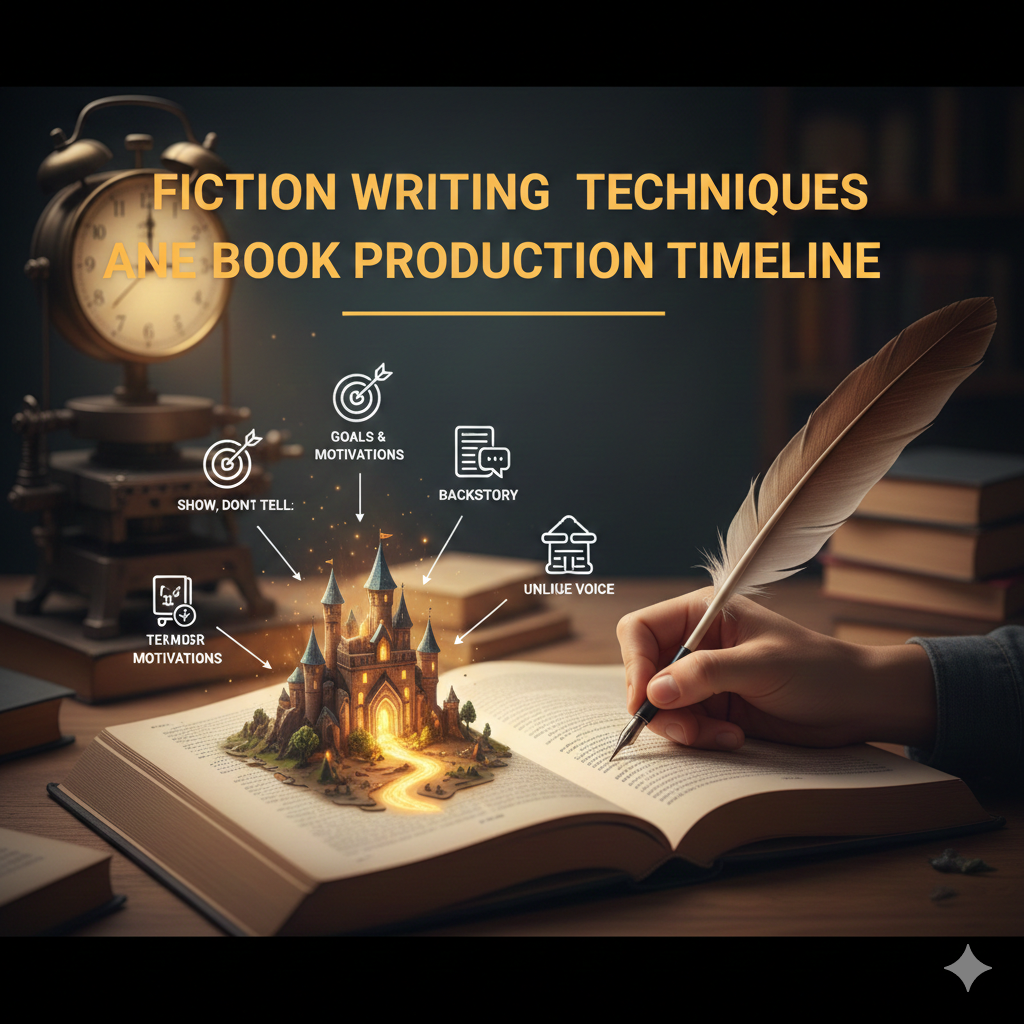
- Show, Don’t Tell: Instead of saying your character is brave, describe them facing a terrifying challenge. Let their actions speak louder than adjectives.
- Give Them Goals and Motivations: What does your character want? Why do they want it? These internal drivers propel the plot forward.
- Introduce Flaws: Perfection is boring. Flaws make characters relatable and provide opportunities for growth and conflict.
- Create a Backstory: Even if not explicitly revealed, understanding your character’s past informs their present actions and personality.
- Unique Voice: Each character should sound distinct. Pay attention to their dialogue patterns, vocabulary, and mannerisms.
As the renowned author Stephen King wisely stated, “The scariest moment is always just before you start.”
Building Believable Worlds and Settings
Whether you’re writing fantasy, sci-fi, or contemporary fiction, your setting plays a crucial role.
It’s more than just a backdrop; it influences your characters and the story itself.
- Sensory Details: Engage all five senses. What does your world look like, sound like, smell like, taste like, and feel like?
- Consistency: If you establish rules for your world, stick to them. Inconsistencies break the reader’s immersion.
- Show, Don’t Infodump: Integrate world-building details naturally into the narrative rather than presenting them as lengthy explanations.
- Atmosphere and Mood: Use your setting to evoke specific emotions and contribute to the overall tone of your story.
Mastering Plot and Structure
A strong plot provides the backbone of your narrative, guiding readers through the story’s events.
Understanding common story structures can help you organize your ideas effectively.
- Inciting Incident: The event that kicks off the main conflict of the story.
- Rising Action: A series of events that build tension and lead to the climax.
- Climax: The turning point of the story, where the main conflict comes to a head.
- Falling Action: The events that occur after the climax, leading to the resolution.
- Resolution: The conclusion of the story, where loose ends are tied up.
“Plot is no more than footprints in the snow after the story has stomped by.” – Ray Bradbury
The Power of Dialogue
Dialogue breathes life into your characters and advances the plot.
Effective dialogue sounds natural, reveals character, and avoids unnecessary exposition.
- Authenticity: Does the dialogue sound like something real people would say? Read it aloud to test its flow.
- Purposeful: Every line of dialogue should serve a purpose – revealing character, moving the plot, or building tension.
- Subtext: What isn’t being said can be just as powerful as what is. Explore the unspoken meanings behind conversations.
- Varying Pacing: Mix short, snappy exchanges with longer, more reflective speeches to maintain reader interest.
Refining Your Prose: Style and Voice
Your unique voice is what sets your writing apart.
It encompasses your sentence structure, word choice, and overall tone.
Developing a strong authorial voice is a continuous process of reading, writing, and self-reflection.
- Word Choice: Choose strong, specific verbs and nouns. Avoid clichés and vague language.
- Sentence Variety: Mix short, impactful sentences with longer, more complex ones to create rhythm and interest.
- Figurative Language: Metaphors, similes, and personification can add depth and imagery to your writing.
- Show, Don’t Tell (again!): This principle applies to your prose style as well. Immerse the reader in the experience.
The Road to Publication: Navigating the Book Production Timeline
Once your manuscript is complete, a new journey begins: the path to publication.
This timeline can vary significantly depending on whether you choose traditional publishing or self-publishing.
Let’s break down the typical stages.
Stage 1: The Writing and Rewriting Phase
This is where the magic happens – and often, the most grueling work.
It’s not just about getting words on the page; it’s about refining them until they shine.
- First Draft: Get the story down. Don’t worry about perfection. The goal is to complete the narrative arc.
- Self-Editing: Review your manuscript for plot holes, character inconsistencies, pacing issues, and overall readability.
- Critique Partners/Beta Readers: Get fresh eyes on your work. Constructive feedback is invaluable for identifying areas for improvement.
- Revisions: Implement feedback and continue to polish your manuscript. This stage can involve multiple passes.
| Phase | Description | Estimated Time |
|---|---|---|
| First Draft | Writing the initial version of your story. | 3-12 months |
| Self-Editing & Revisions | Refining plot, characters, pacing, and prose. | 2-6 months |
| Beta Readers/Critique | Receiving feedback from trusted readers. | 1-3 months |
Stage 2: Professional Editing
Before submitting to agents or self-publishing, professional editing is non-negotiable.
An objective, expert eye will elevate your manuscript significantly.
Investing in good editing is one of the best decisions an author can make.
- Developmental Edit: Focuses on the big picture – plot, pacing, character arcs, and overall story structure.
- Line Edit: Improves the prose on a sentence-by-sentence level, focusing on style, clarity, and impact.
- Copy Edit: Corrects grammar, spelling, punctuation, and ensures consistency in style.
- Proofread: The final check for any remaining errors before publication.
Stage 3: The Publishing Path
Here, your journey diverges. Will you seek a traditional publishing deal or embark on the self-publishing adventure?
Traditional Publishing
This path involves finding a literary agent who will then pitch your book to publishing houses.
- Querying Agents: Crafting a compelling query letter, synopsis, and sample pages to send to literary agents. This can be a lengthy process.
- Agent Representation: If an agent offers representation, they will guide you through the submission process to publishers.
- Submission to Publishers: The agent submits your manuscript to editors at various publishing houses.
- Book Deal: If a publisher makes an offer, contracts are negotiated.
- Pre-production with Publisher: This involves more editing (developmental, copy, proofreading by the publisher), cover design, interior layout, and marketing strategy discussions.
- Publication: Your book is released to the world! This typically happens 12-18 months after signing a book deal.
“You don’t start out writing good stuff. You start out writing crap and thinking it’s good stuff, and then gradually you get better at it. That’s why I say one of the most important things is to read a lot, write a lot.” – Octavia E. Butler
Self-Publishing
With self-publishing, you take on all the roles of a traditional publisher, giving you complete control but also more responsibility.
- Professional Editing: You hire freelance editors for developmental, line, copy, and proofreading services.
- Cover Design: Commissioning a professional cover designer. A good cover is paramount for attracting readers.
- Interior Formatting: Preparing your manuscript for e-book and print formats.
- Platform Selection: Choosing platforms like Amazon KDP, Apple Books, Kobo, etc., for distribution.
- Upload and Publish: Uploading your formatted manuscript and cover to your chosen platforms.
- Marketing and Promotion: This is ongoing and crucial. You are responsible for marketing your book.
Stage 4: Post-Publication and Marketing
Publishing your book isn’t the finish line; it’s the start of another exciting phase.
Whether traditionally or self-published, marketing is key to reaching readers.
- Author Platform: Building your online presence through a website, blog, and social media.
- Book Launches and Events: Virtual or in-person events to celebrate and promote your book.
- Reviews: Encouraging readers to leave reviews on Goodreads and retail sites.
- Advertising: Utilizing paid advertising on platforms like Amazon, Facebook, or Google.
- Nurturing Your Readership: Engaging with your readers and building a loyal fan base.
The journey of a book doesn’t end when it’s published; it begins its true life in the hands of its readers.
“You don’t write because you want to say something, you write because you have something to say.” – F. Scott Fitzgerald
Mastering fiction writing techniques requires dedication, practice, and a willingness to learn.
Understanding the book production timeline, whether you choose traditional or self-publishing, empowers you to navigate the industry with confidence.
Remember, every acclaimed author started exactly where you are now – with an idea and the courage to put words on a page.
So, keep writing, keep learning, and most importantly, keep telling your unique stories! ✍️
For further insights into the publishing world, check out resources from Publishers Weekly or dive into the craft with advice from SFWA’s writing resources.
Happy writing! 📖