
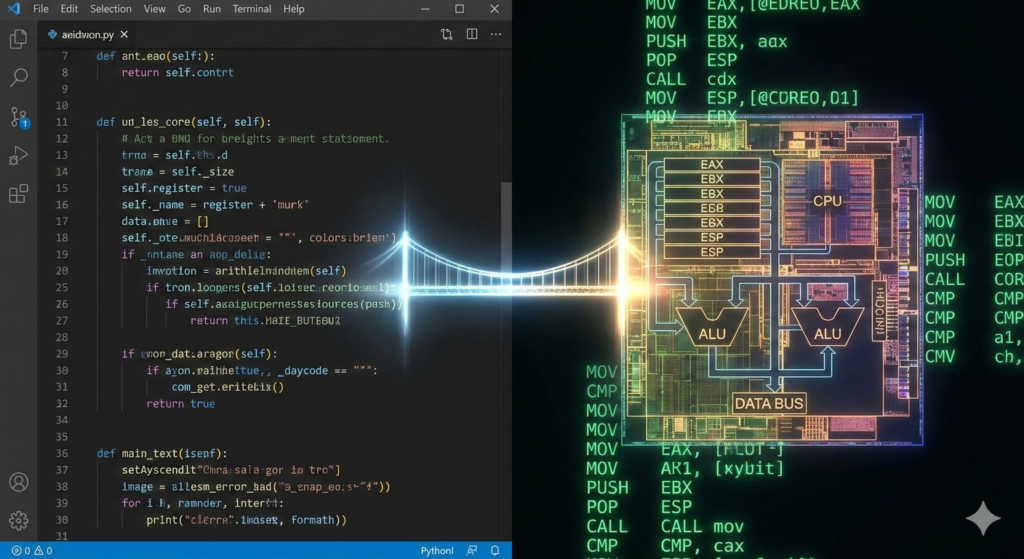

In today’s world of high-level abstraction, programmers often operate far removed from the actual hardware.
We write elegant code in Python, JavaScript, or C#, trusting compilers and interpreters to handle the heavy lifting. 🧙♂️
But what happens when you need to squeeze every ounce of performance out of a system?
Or when you need to understand exactly why a bizarre bug is crashing your application? 🐛
This is where stepping down the abstraction ladder becomes crucial.
Mastering Assembly is not just about learning an old language; it is truly your gateway to deep computer architecture understanding.
De-mystifying the Machine: What is Assembly?
At its core, computer hardware only understands one thing: electrical signals, represented as binary (zeros and ones). 0️⃣1️⃣
Writing raw binary is impossible for humans.
Assembly language acts as the most direct interface between human thought and machine execution.
It is a low-level programming language where there is a strong correspondence between the language’s instructions and the architecture’s machine code instructions.
Unlike compiled languages that might turn one statement into fifty machine instructions, Assembly is almost a one-to-one mapping.
For a deeper dive into standard definitions, you can check out this overview on Wikipedia’s Assembly Language page.
The “Gateway”: Connecting Code to Silicon
This is the heart of why mastering Assembly is transformative. 💡
When you write high-level code, variables are abstract concepts.
When you write Assembly, variables are specific memory addresses or CPU registers.
You are no longer asking the computer to “add X and Y.”
You are manually instructing the Central Processing Unit to move data from RAM into Register A, move other data into Register B, execute an ALU operation, and store the result back in memory. 🤯
“People who are more than casually interested in computers should have at least some idea of what the underlying hardware is like. Otherwise the programs they write will be pretty weird.” — Donald Knuth
By forcing you to micromanage these resources, Assembly imbues you with an intuitive understanding of the Von Neumann architecture.
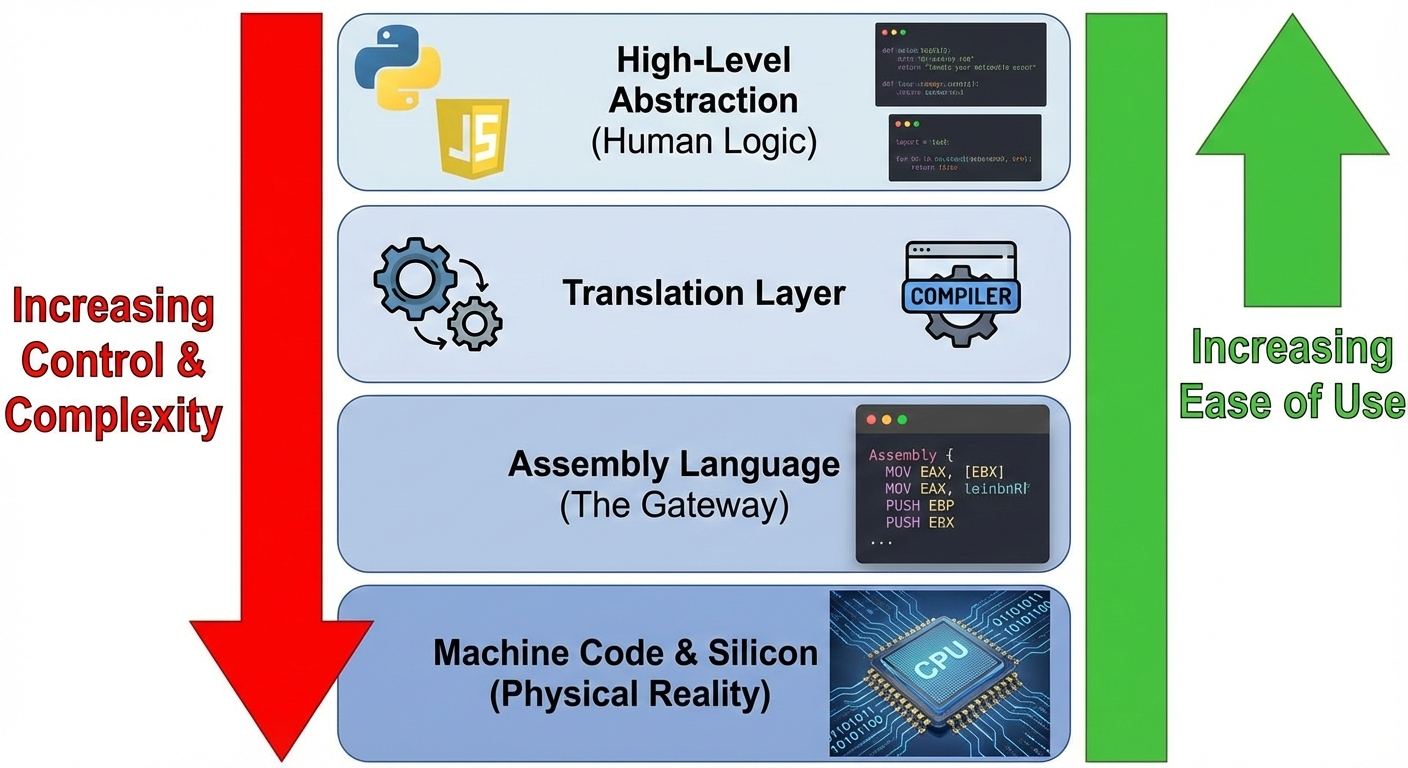
You begin to think like the processor.
You stop seeing code as magic spells and start seeing it as a sequence of precise mechanical operations.
| High-Level Concept (e.g., C++) | Assembly Reality (e.g., x86) |
|---|---|
| int x = 10; | MOV EAX, 10 (Moving value into a register) |
| if (x > 5) { … } | CMP EAX, 5 followed by JG label (Compare and Jump if Greater) |
| Function Call myFunc(); | Manually pushing arguments to the stack, CALL address, managing the stack frame pointer (EBP/ESP). |
Key Benefits of Going Low-Level
Why endure the steep learning curve of Assembly? 📈
The payoff is substantial for serious technologists.
- Unparalleled Performance Optimization: While modern compilers are amazing, sometimes you need to hand-tune a critical loop using SIMD instructions or specific CPU features that compilers miss. 🏎️
- Reverse Engineering and Security: Malware analysts and security researchers spend their lives looking at disassembled code. 🛡️If you want to understand how an exploit really works at the memory level, Assembly is mandatory.
- Embedded Systems and IoT: When working with microcontrollers with extremely limited resources (like a few kilobytes of RAM), the overhead of high-level languages is sometimes unaffordable. 🤖
- Superior Debugging Skills: When your C++ program crashes with a segmentation fault, looking at the disassembly view in your debugger shows you exactly which instruction tried to access invalid memory. 🕵️♀️
For an example of where low-level understanding aids performance, read about Intel’s intrinsic functions for performance.
Core Concepts You Will Master
When you dive into Assembly, you aren’t learning libraries; you are learning the raw components of the computer.
Here are the fundamental concepts that will transition from abstract ideas to concrete realities.
1. Registers: The CPU’s Workbench
Registers are super-fast, tiny storage locations directly inside the CPU core.
Unlike RAM which is vast but relatively slow, registers are where the immediate action happens. ⚡
In x86, you become intimate friends with registers like EAX (Accumulator), EBX (Base), and ESP (Stack Pointer).
Understanding how limited these resources are changes how you write code forever.
You can learn more about the x64 register architecture here.
2. The Stack and Memory Management
High-level languages hide the stack from you.
In Assembly, you are responsible for it. 🏗️
You must manually “push” data onto the stack before a function call and “pop” it off afterward.
If you mess up the stack pointer, your program crashes immediately.
This teaches you exactly how local variables are stored and why buffer overflows are such a critical security vulnerability.
“A good programmer understands what the machine is doing, even if they are writing in Python.” — Unknown
Getting Started on Your Assembly Journey
Ready to take the plunge? 🏊♂️
The first step is choosing an architecture.
The two giants today are x86-64 (desktop/laptop) and ARM (mobile/Mac M1/M2).
- The x86 path: This is great for traditional PC software reverse engineering and high-performance desktop computing.We recommend starting with an assembler like NASM (Netwide Assembler) on Linux for a pure experience. 🐧You can download it from the official NASM website.
- The ARM path: If you are interested in mobile devices or newer Macs, ARM64 is the future.It is a Reduced Instruction Set Computing (RISC) architecture, which some find cleaner than the complex x86.Check out ARM’s own documentation to get started.
The Ultimate Perspective Shift
Mastering Assembly is not about abandoning Python or C++ to write entire applications in machine code. 🛑
That would be impractical today.
It is about gaining the “X-ray vision” that allows you to see through the high-level abstractions down to the silicon traces beneath.
Once you understand how a CPU actually executes a MOV instruction, you will never look at code the same way again.
It is the ultimate gateway to truly grokking computer architecture. 🎓
Embrace the challenge, dive into the registers, and unlock a deeper level of computing mastery. ✨