
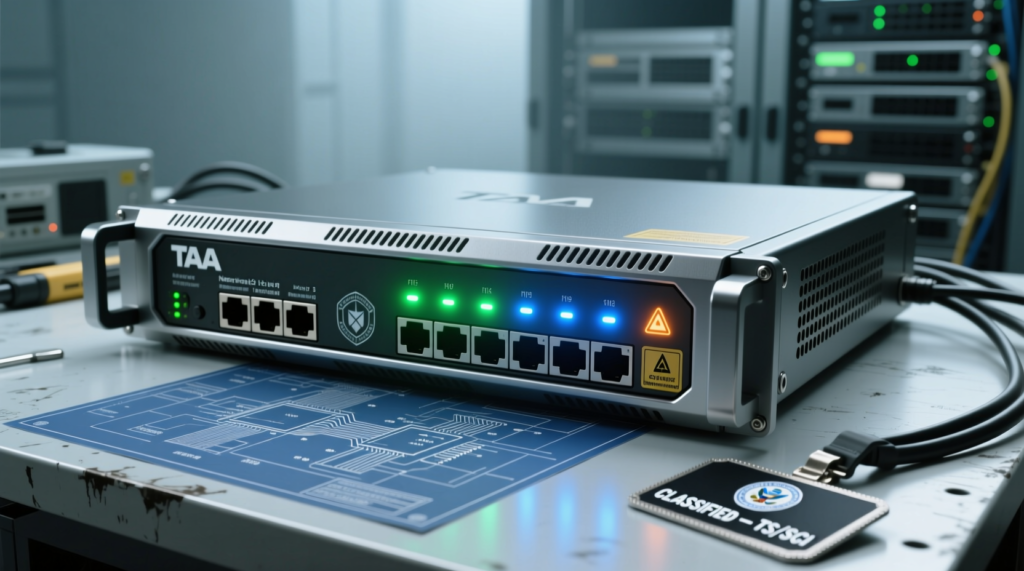






When it comes to how to design taa compliant network perimeters for government contractors, getting the right details matters. Fortinet FortiGate 40F
Fortinet FortiGate 60F
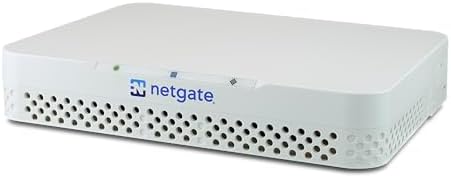
Netgate 1100 pfSense Plus
The Technical Reality / The Failure Point
Government contractors lose contracts at the perimeter. Not because they lack security awareness, but because they install the wrong gateway, miss a cryptographic validation detail, or fail to document scope. Every audit finding traces back to one of six failure sequences. Map them correctly and the architecture writes itself.
Regulatory Failure: DFARS 252.204-7012 and the NIST SP 800-171 “Moderate Confidentiality” Baseline
Non-federal systems that process, store, or transmit Controlled Unclassified Information must implement the NIST SP 800-171 “moderate confidentiality” baseline. DFARS clause 252.204-7012 enforces this directly on defense contractors.
If your perimeter gateway is not TAA-compliant and FIPS-validated, you do not meet the baseline. That is not a gray area.
A CMMC 2.0 Level 2 assessor will write it as a finding, and the contract goes to a competitor. The root cause is procurement: buying a firewall on throughput alone without checking validation and country of origin.
Cryptographic Validation Failure: CMMC SC.L2-3.13.11 and the CMVP FIPS Gap
CMMC control SC.L2-3.13.11 requires FIPS 140-2 or FIPS 140-3 validated cryptography for VPNs and external boundary protection. Standard firewalls, including most pfSense community builds and uncertified appliances, lack active CMVP validation.
This is the gap that burns sysadmins during pre-audit reviews. They assume OpenVPN or IPsec running on generic hardware satisfies the control. It does not. The module must be on the CMVP validated products list. Without that listing, SC.L2-3.13.11 fails.
CMVP Transition Risk: September 21, 2026 FIPS 140-2 → Historical Status Deadline
On September 21, 2026, CMVP moves all remaining active FIPS 140-2 certificates to Historical status. Federal procurement guidance already discourages Historical modules in new procurements.
If you are designing a perimeter today for a future contract bid, FIPS 140-3 validation is the only safe target. FIPS 140-2 is still valid for existing deployments, but new procurements need a 140-3 upgrade path. Miss this and your hardware ages out before the contract does.
TAA Procurement Failure: Country-of-Origin Disqualification
The Trade Agreements Act requires products to be manufactured or substantially transformed in TAA-designated countries. Non-TAA network hardware violates federal procurement policy.
This failure mode is not technical; it is supply chain. A contractor can configure a firewall perfectly and still be disqualified because the appliance was built in a non-designated country. The fix is documentation before purchase, not after.
Architectural Scope Failure: Misplaced Cryptographic Responsibility at the Perimeter
Contractors often assume the firewall must perform all CUI cryptography. That assumption is expensive and often wrong. If CUI is encrypted at the endpoint using FIPS-validated TLS, application encryption, or a compliant Secure Web Gateway, the boundary device can be architecturally removed from the cryptographic scope.
The catch is documentation. You cannot imply the scope exclusion. You must write it down, justify it, and make it auditable. Without that paper trail, the assessor defaults to treating the perimeter as in-scope.
Monitoring Gap Failure: Missing SIEM/Wazuh Continuous Monitoring for SC.L1-3.13.1
Lack of centralized log management breaks SC.L1-3.13.1. Configuration changes, authentication events, and security alerts scatter across devices and disappear. When the assessor asks for evidence of continuous monitoring, you have nothing.
A perimeter without SIEM correlation is a blind perimeter. Wazuh or an equivalent platform is not optional if you want to pass.
The Core Gear Architecture
The perimeter stack must answer three questions: Is it TAA-compliant? Is the cryptography CMVP-validated? Can you prove it? The following hardware meets those requirements with exact port counts, throughput figures, and validation levels.
Fortinet FortiGate 40F: 5-Port GE RJ45, 5 Gbps Firewall, 800 Mbps NGFW, FIPS 140-2 Level 2
| Specification | Details |
|---|---|
| Ports | 5 x GE RJ45 |
| Firewall Throughput | 5 Gbps |
| NGFW Throughput | 800 Mbps |
| Cryptographic Validation | FIPS 140-2 Level 2 |
| Required Tamper-Evident Kit | FIPS-SEAL-RED |
| Compliance Alignment | TAA-compliant; NIST SP 800-171 / CMMC Level 2 / DFARS 252.204-7012 |
| Future Readiness | Upgrade path to FIPS 140-3 for post-September 2026 procurements |
The FortiGate 40F is the entry point for small contractors who need a defensible perimeter without overbuilding. Five GE RJ45 ports give you WAN, LAN, and a couple of isolated zones. The 800 Mbps NGFW throughput handles most small-office CUI flows, and the FIPS 140-2 Level 2 validation covers SC.L2-3.13.11 directly.
The FIPS-SEAL-RED kit is not optional. Install it or the tamper-evident requirement fails.
For future bids, confirm the FIPS 140-3 upgrade path with your reseller before you commit.
Fortinet FortiGate 60F: 10-Port GE RJ45, 10 Gbps Firewall, 1 Gbps NGFW, Mid-Sized Contractor Standard
| Specification | Details |
|---|---|
| Ports | 10 x GE RJ45 |
| Firewall Throughput | 10 Gbps |
| NGFW Throughput | 1 Gbps |
| Cryptographic Validation | FIPS 140-2 Level 2 |
| Required Tamper-Evident Kit | FIPS-SEAL-RED |
| Compliance Alignment | TAA-compliant; standard mid-sized contractor compliance gateway |
| Future Readiness | FIPS 140-3 upgrade path for new procurements |
The FortiGate 60F doubles the port count and roughly doubles the throughput. Ten GE RJ45 ports let you segment CUI, corporate, guest, and VoIP networks without extra switches. The 1 Gbps NGFW throughput supports heavier inspection loads.
This is the appliance you buy when the assessor is coming, the prime is asking for evidence, and you need a single box that answers every question. Same seal requirement. Same validation watch.
Netgate 1100 (pfSense Plus): ARM64 Cortex-A53, 3×1 Gbps, TAA/NDAA-Compliant Budget Path
| Specification | Details |
|---|---|
| Ports | 3 x 1 Gbps switched ports |
| CPU | Dual-Core ARM64 Cortex-A53 |
| Compliance | TAA-compliant, NDAA-compliant |
| Validation | No active CMVP FIPS validation |
| Use Case | Budget-conscious alternative only when CUI is encrypted end-to-end before reaching the perimeter |
The Netgate 1100 is a legitimate appliance, but it is not a cryptographic boundary for CUI. It is TAA-compliant and NDAA-compliant, which solves the country-of-origin problem. It does not solve SC.L2-3.13.11.
Use it only when CUI is encrypted at the endpoint before it touches the perimeter. In that architecture, the Netgate handles routing, access control, and logging. The cryptography happens elsewhere. Document that scope exclusion in writing.
Freshness Mandates for Perimeter Hardware
New procurements must prioritize FIPS 140-3 validated modules. Network perimeter hardware should support 2.5G/10G interfaces as baseline. Wi-Fi 7 and DDR5 are current standards for integrated gateway and management platforms.
These mandates are not about future-proofing for fun. They reflect the reality that federal procurement moves slowly but penalizes outdated gear. Buy once, buy right.
Micro-Electronics & PCB Diagnostic Reference Stack
| Tool | Key Specifications |
|---|---|
| 40 AWG Micro-Thin Jumper Wire | Severed copper trace repair on multi-layer PCBs |
| FNIRSI LCR-ST1 Smart LCR Tweezers | Test frequencies: 100 Hz, 1 kHz, 10 kHz | Test voltages: 0.3V / 0.6V | Weight: 41g | Display: 1.14-inch color |
| Andonstar AD246S-M Digital Microscope | 7-inch LCD | 30cm high bracket working clearance | 2160P video, dual-screen HDMI output | Three interchangeable lenses |
This stack supports the bench side of a compliance operation. The 40 AWG jumper wire lets you repair traces on compact appliances without replacing entire boards. The FNIRSI LCR-ST1 covers 100 Hz to 10 kHz with 0.3V low-voltage mode, which protects sensitive SMD components during in-circuit testing. The Andonstar AD246S-M gives you 2160P video and a 30cm working clearance for detailed inspection work.
DevOps Homelab & Compute Cluster Reference Stack
| Model | CPU | RAM | Storage | Networking | Special Features |
|---|---|---|---|---|---|
| GEEKOM A9 Max | AMD Ryzen AI 9 HX 370 (12C/24T) | Up to 128 GB DDR5 SODIMM | 2 x M.2 PCIe Gen4 x4 NVMe (Up to 8 TB) | Dual 2.5G RJ45 LAN | AMD XDNA 2 NPU, up to 55 TOPS |
| GEEKOM A8 | AMD Ryzen 9 8945HS (8C/16T) | Up to 64 GB DDR5 SODIMM | 1 x M.2 2280 NVMe PCIe Gen4 x4 (Up to 4 TB) | Single 2.5G RJ45 LAN, Wi-Fi 6E | Worker node / Lab scale |
| GEEKOM A6 | AMD Ryzen 7 6800H (8C/16T) | Up to 64 GB DDR5 SODIMM | 1 x M.2 2280 PCIe Gen4 x4 + 1 x M.2 2242 SATA | Single 2.5G RJ45 LAN, Wi-Fi 6E | Entry compute / Lab scale |
These mini-PCs serve as the compute layer behind the perimeter. The GEEKOM A9 Max with 128 GB DDR5 and dual 2.5G RJ45 LAN is ideal for a Proxmox VE or Kubernetes control plane that needs memory headroom and network separation. The A8 and A6 scale down for worker nodes or lab environments. DDR5 and 2.5G networking are the baseline, not the premium option.
The Technical Setup Blueprint
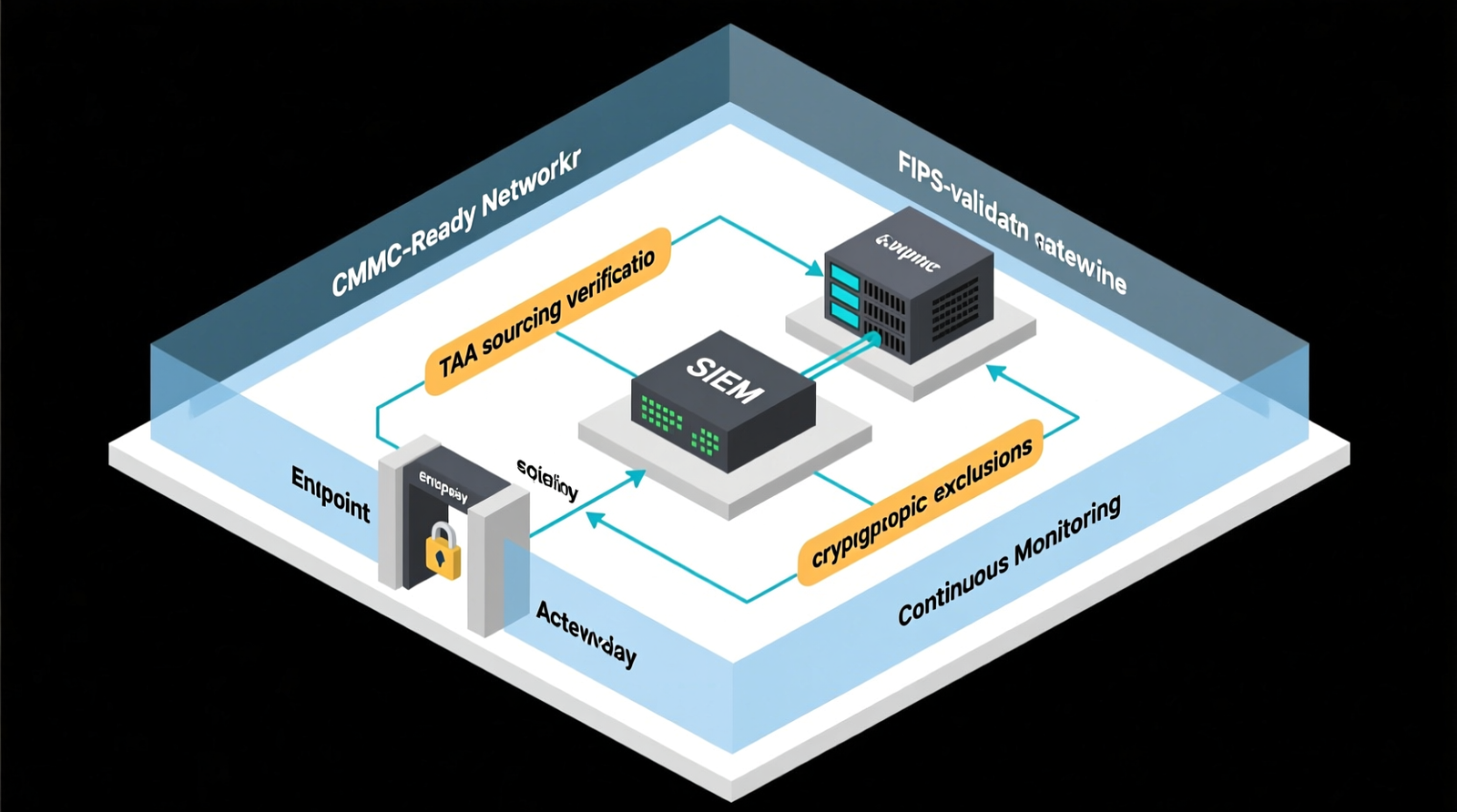
Perimeter Zoning and CUI Scope Documentation
Define the external boundary where CUI enters and exits your non-federal environment. Document every device that processes, stores, or transmits CUI. Then establish architectural scope exclusions with written justification.
If a device never sees unencrypted CUI, say so. If it does, mark it. The assessor will ask you to draw the line. Have the drawing ready.
FIPS-Validated Cryptographic Deployment and Tamper-Evident Seal Installation
Enable FIPS mode on the FortiGate 40F or FortiGate 60F. Install the FIPS-SEAL-RED tamper-evident seal kit on the appliance chassis. Verify the CMVP certificate status before procurement, either FIPS 140-2 active or FIPS 140-3 for post-September 21, 2026 procurements.
The seal is a physical control. A missing seal is an audit finding even if the cryptography is perfect. Treat it as part of the installation, not an afterthought.
Check out TECH Collection Amazon Products
Endpoint Encryption Bypass Architecture for Non-FIPS Perimeter Devices
Encrypt CUI at the endpoint using FIPS-validated end-to-end TLS. Implement local application encryption or a compliant Secure Web Gateway. Configure pfSense or Netgate 1100 for routing, access control, and logging only. Do not let it process CUI cryptography.
Then document the architectural scope exclusion for auditors. Explain where the cryptography happens, why the perimeter is out of scope, and how you verify that no unencrypted CUI reaches the boundary device.
Wazuh SIEM Integration and Audit-Ready Log Correlation
Deploy Wazuh agentless log aggregation from the firewall. Correlate network traffic logs with endpoint file integrity monitoring. Generate compliance reporting for SC.L1-3.13.1 continuous monitoring.
The value is not just log collection. It is the ability to show an assessor that a configuration change on the firewall correlates with a user login, a file change, and a policy update in the same timeline.
TAA Sourcing Verification and Procurement Documentation Workflow
Verify country-of-origin documentation before you purchase network equipment. Reject low-cost marketplace alternatives that lack TAA certification. Maintain procurement records for prime contractor and DoD supply chain audits.
Keep the certificate, invoice, and vendor attestation in the same folder. When the prime asks, you answer in one email.
Field Verdict & Operational ROI
Audit Survival and Contract Eligibility Protection
FIPS 140-2/140-3 plus TAA-compliant gateways eliminate CMMC Level 2 findings at the perimeter. Proper scope documentation prevents auditor pushback on endpoint-encryption architectures. You stop guessing and start passing.
Avoiding Last-Minute Hardware Replacement Costs
Forum threads are full of sysadmins discovering the pfSense FIPS gap during pre-audit reviews. They replace appliances under pressure, pay rush shipping, and reschedule assessments. Upfront investment in validated hardware avoids that entire cycle.
Prime Contractor Readiness and Supply Chain Audit Defense
Upstream primes increasingly require demonstrated NIST SP 800-171 / CMMC 2.0 compliance before you can bid. Tamper-evident seals, SIEM logs, and TAA documentation form a defensible evidence package. You become easier to work with than the next subcontractor.
Total Cost of Ownership vs. Compliance Risk
Small-to-mid-sized contractors feel the budget tension. A turnkey FIPS gateway costs more upfront. A risky endpoint-only architecture costs less until it fails an audit.
The rule is simple: only deploy Netgate 1100 or pfSense at the perimeter if end-to-end endpoint encryption is documented and audited. Otherwise, default to the FortiGate FIPS-validated stack. The cost of the appliance is smaller than the cost of a lost contract.
Conclusion
Designing a TAA-compliant network perimeter is not about buying the most expensive firewall. It is about matching the right hardware to the right scope and proving it. The failure modes are clear: regulatory gaps, cryptographic validation misses, the FIPS 140-2 historical transition, country-of-origin disqualification, misplaced cryptographic responsibility, and blind monitoring.
Community Reference & Authority Resources:
The solution is equally clear. For most contractors, the FortiGate 40F or FortiGate 60F with FIPS-SEAL-RED provides a defensible, TAA-compliant, CMMC-ready perimeter. For tightly budgeted shops with documented endpoint encryption, the Netgate 1100 can play a supporting role. In every case, Wazuh or equivalent SIEM logging and written scope documentation are non-negotiable.
Build the perimeter once. Validate it. Seal it. Log it. Document it. Then bid with confidence.
🔍 Explore More: See all tech guides and tutorials for how to design taa compliant network perimeters for government contractors.
Check out TECH Collection Amazon Products