
“In the world of IoT, efficiency isn’t just a metric; it’s the difference between a device that lasts a year and one that dies in a week.”
– Embedded Systems Axiom
Welcome back to the lab, tech innovators and firmware wizards! 🔌
We are living in a hyper-connected era where everything from your toaster to your industrial sensors is talking to the cloud.
However, despite the explosion of high-level languages like Python and JavaScript making waves in the software world, the gritty reality of the Internet of Things (IoT) tells a different story.
When you peel back the plastic casing of a smart thermostat or a wearable health tracker, you aren’t likely to find a Python interpreter running the show.
You will find the bedrock of computing: C and Assembly language.
In 2026, one might assume these “ancient” languages would be obsolete, gathered dust in the museum of computer history.
Yet, they are more relevant than ever before.
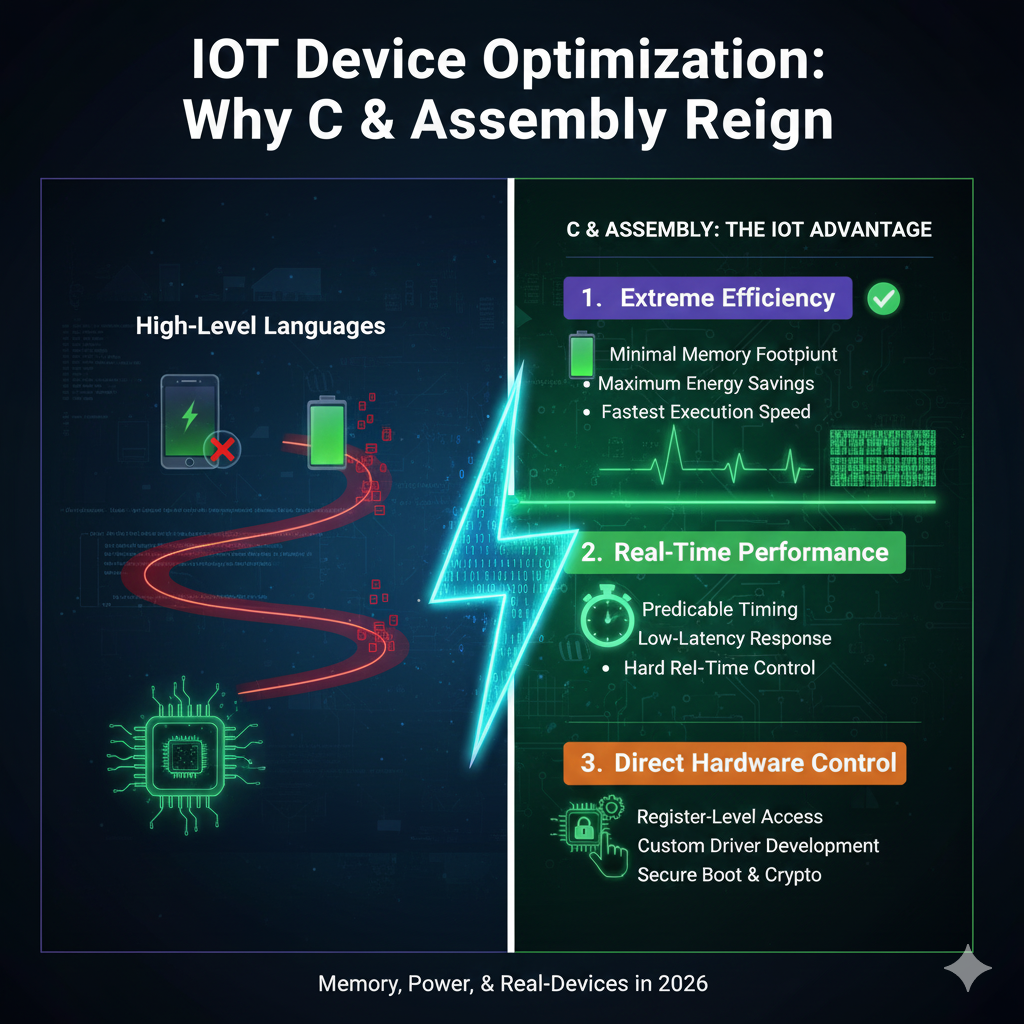
The constraints of modern IoT devices—battery life, processing power, and memory size—demand a level of optimization that only low-level languages can provide.
Today, we are going to explore exactly why C and Assembly still hold the crown in the realm of embedded systems and IoT optimization. 👑
The Harsh Reality of Hardware Constraints 📉
To understand the dominance of C and Assembly, you first have to understand the battlefield.
Unlike a cloud server with terabytes of RAM and limitless power from the grid, an IoT node is often starving.
We are talking about microcontrollers (MCUs) that might have as little as 2KB of RAM and 32KB of Flash memory.
These devices often run on coin-cell batteries and are expected to last for years without maintenance.
Every processor cycle consumes energy.
Every byte of memory used is a byte that can’t be used for data buffering or encryption keys.
High-level languages come with “baggage”—garbage collectors, virtual machines, and heavy runtime environments—that these tiny chips simply cannot carry.
Optimization in this context is not about making code run milliseconds faster; it is about making the device viable at all.
C: The “Portable Assembly” 🛡️
The C programming language strikes the perfect balance for embedded development.
It offers high-level constructs like loops, functions, and structures, which makes code readable and maintainable.
Yet, it maps very directly to the underlying machine instructions.
This allows developers to reason about the performance cost of every line of code they write.
Pointers in C allow for direct memory addressing, which is essential when you are mapping hardware peripherals to software structures.
If you need to flip a specific bit in a hardware register to turn on an LED or read a sensor, C lets you do that with surgical precision.
This language standard, maintained by ISO, ensures that code written for one architecture can often be ported to another with minimal changes.
For more on the standardization that keeps C relevant, check out the ISO/IEC 9899 (C Standard).
When C Isn’t Enough: The Assembly Edge ⚔️
Sometimes, even the efficiency of C isn’t quite enough.
This is where Assembly language enters the chat.
Assembly is the human-readable representation of the machine code that the processor actually executes.
Writing in Assembly gives you total control over the CPU’s resources, including registers, the stack, and specific instruction sets.
In IoT, Assembly is often used for:
- Startup Code: The very first instructions that run when a chip wakes up, setting up the stack pointer and initializing memory before the C environment loads.
- Interrupt Service Routines (ISRs): Critical sections of code that must execute immediately when a hardware event occurs; saving even a few cycles here reduces latency.
- DSP Operations: Many modern microcontrollers have specialized Digital Signal Processing instructions that can process sensor data efficiently, but C compilers might not always utilize them optimally.
By hand-tuning these critical paths in Assembly, developers can squeeze out maximum performance and minimize power consumption.
You can dive deeper into architecture-specifics with the ARM Assembly Language Guide.
Comparing the Titans: High vs. Low Level 📊
Let’s break down why high-level languages struggle to compete in the deep embedded space.
The following table illustrates the trade-offs involved in selecting a language for IoT firmware.
| Feature | Python / Java | C / C++ | Assembly |
|---|---|---|---|
| Memory Footprint | High (Requires VM/Interpreter) | Low (Compiled directly) | Minimal (Exact control) |
| Execution Speed | Slower (Interpreted) | Fast (Native machine code) | Fastest (Optimized) |
| Power Efficiency | Poor (More cycles per task) | Excellent | Maximum |
| Hardware Access | Abstracted / Limited | Direct (Pointers) | Full (Registers) |
Energy Efficiency: The Ultimate Currency 🔋
In the IoT world, we often say that “cycles equal joules.”
The longer your CPU is awake processing data, the more battery it drains.
Efficiency isn’t just about speed; it’s about “race-to-sleep.”
The goal is to wake up, perform the necessary calculation or transmission as fast as physically possible, and then return to a deep sleep mode.
C and Assembly facilitate this by generating compact code that executes in fewer clock cycles.
Furthermore, managing power states often requires writing directly to power management registers, a task perfectly suited for C.
If your code is bloated, your device stays awake longer, and your 5-year battery life claim quickly drops to 6 months.
This direct correlation between code quality and battery longevity is why low-level languages remain non-negotiable for edge devices.
Real-Time Determinism ⏱️
Many IoT devices operate in “hard real-time” environments.
Think of an airbag sensor in a car or a robotic arm in a factory.
These devices must respond to an input within a strict time deadline.
If the response is late, the system fails, potentially causing injury or damage.
High-level languages with garbage collection introduce “jitter,” or unpredictable pauses in execution.
You cannot afford for your airbag to pause for garbage collection right when it needs to deploy! 💥
C allows developers to control exactly when memory is allocated and freed, ensuring predictable timing.
Assembly allows for cycle-counting, where you know exactly how many nanoseconds a routine will take.
This predictability is essential for Real-Time Operating Systems (RTOS).
For insights into real-time kernels, the FreeRTOS documentation is a great place to start.
The “Rust” Factor and Future Trends 🦀
We cannot talk about modern embedded development without mentioning Rust.
Rust is gaining traction as a memory-safe alternative to C, offering similar performance without the risk of buffer overflows.
However, the C ecosystem is massive, with decades of legacy code, drivers, and libraries.
Most microcontroller manufacturers provide their Software Development Kits (SDKs) in C.
Porting this entire ecosystem to Rust is a monumental task that will take years.
Additionally, for the absolute smallest 8-bit microcontrollers, C and Assembly are still often the only viable options.
While new contenders arise, the inertia and sheer utility of C ensure it will remain the industry standard for the foreseeable future.
Industry portals like Embedded.com frequently discuss this shifting landscape.
Security Through Low-Level Control 🔒
Security in IoT is a hot topic, often cited as the industry’s Achilles’ heel.
While C is often criticized for memory safety vulnerabilities (like buffer overflows), it also provides the tools to build secure roots of trust.
Secure bootloaders, which verify the digital signature of the firmware before loading it, are almost exclusively written in C and Assembly.
This is because they need to run in a highly constrained environment before the main OS exists.
Implementing cryptographic primitives (AES, SHA) often requires Assembly optimization to run efficiently on small chips without draining the battery.
Check out Microchip Technology for examples of secure hardware elements that rely on optimized driver code.
“Hardware makes it possible; Software makes it fast; Assembly makes it happen.”
– Anonymous
Conclusion: The Backbone of the Connected World 🌐
As we navigate 2026 and beyond, the Internet of Things will continue to expand into every corner of our lives.
While the cloud applications processing the data may be written in Python or Go, the edge devices collecting that data rely on the efficiency of C and Assembly.
These languages provide the necessary control over hardware, memory, and power that constrained devices demand.
They are the invisible pillars holding up the massive structure of the IoT.
For developers looking to enter this space, mastering these low-level languages is not just a nod to the past; it is a critical skill for the future.
The ability to write code that is close to the metal is what separates a functional prototype from a market-ready product.
So, embrace the pointer, respect the register, and optimize for the future!
Would you like me to create a specific study plan for mastering Embedded C for IoT development?