
Network congestion is an inevitable challenge in the modern digital landscape. 🌐
This bottleneck can cripple business operations and degrade user experience significantly.
The sheer volume of data traffic has rendered traditional manual troubleshooting methods obsolete.
Today’s solution lies in leveraging the power of Artificial Intelligence (AI) for proactive traffic management. 🤖
The Anatomy of Network Congestion 🔍
Understanding common causes of network congestion is crucial before exploring AI solutions.
Congestion occurs when demand for network resources exceeds available capacity.
This leads to increased latency, packet loss, and significantly reduced throughput.
Primary culprits include insufficient bandwidth and faulty network devices.
Misconfigured Quality of Service (QoS) policies also contribute significantly.
Sudden, unexpected traffic spikes can overwhelm even well-provisioned networks.
Manual root cause identification involves sifting through mountains of log data.
This is where AI’s scale and speed transform raw data into actionable intelligence.
AI: The New Engine for Network Diagnostics 🚀
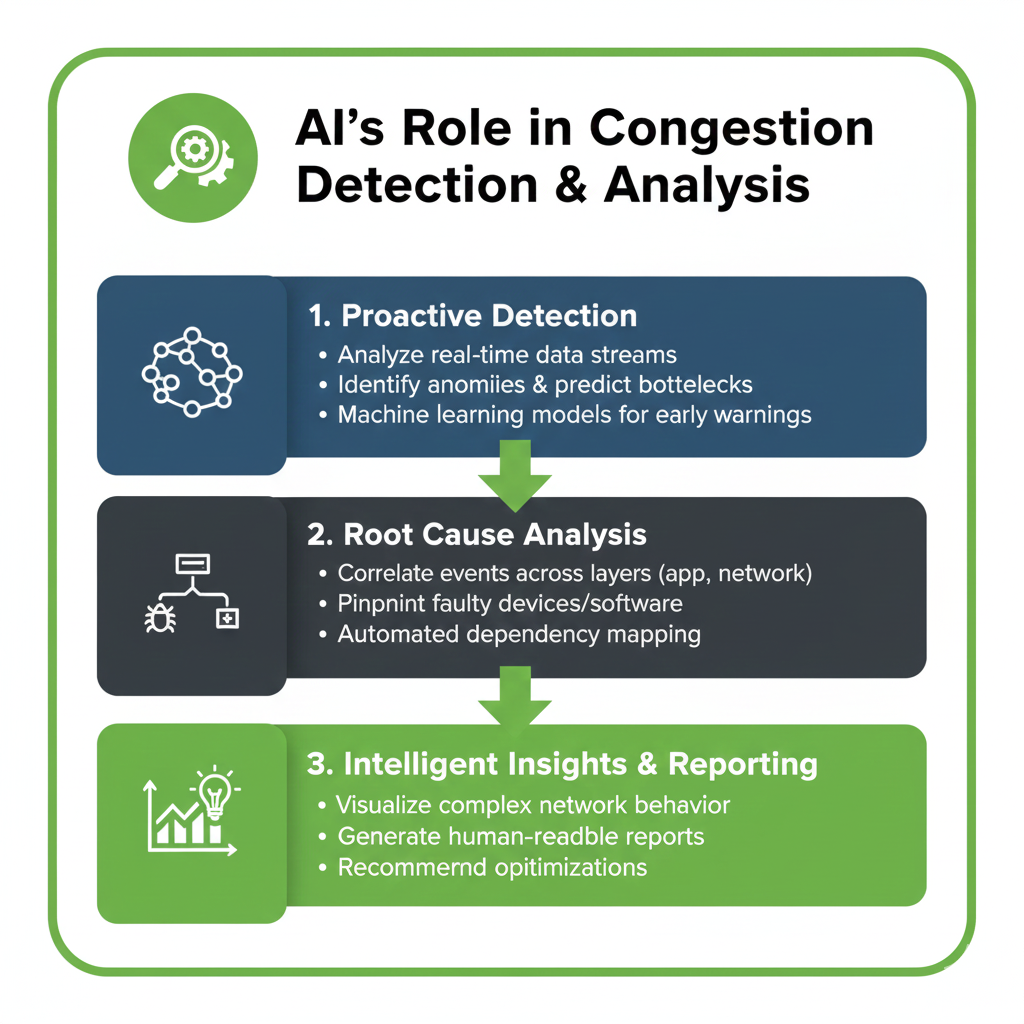
AI-driven systems utilize Machine Learning to analyze network data in real-time.
They establish a dynamic baseline of normal network behavior for comparison.
This foundation enables anomaly detection long before issues impact service.
The process breaks down into three critical phases of operation.
Phase 1: Comprehensive Data Ingestion 📊
AI systems ingest vast telemetry data from every network corner.
This includes routers, switches, firewalls, servers, and endpoint devices.
Data encompasses flow records, SNMP metrics, and configuration changes.
AI correlates data across disparate sources for a holistic view.
This comprehensive approach provides insights human operators often miss.
For deeper understanding, see this resource on AI Network Monitoring.
Phase 2: Intelligent Diagnosis and Root Cause Analysis 🎯
ML models identify patterns and anomalies in the ingested data.
AI performs Root Cause Analysis (RCA) by tracing anomalies to their source.
It distinguishes between legitimate traffic surges and device malfunctions.
This precision drastically reduces Mean Time To Resolution (MTTR).
Engineers get directed to exact problem areas for faster fixes.
Phase 3: Autonomous and Proactive Resolution ⚡
The ultimate goal is autonomous resolution without human intervention.
AI can dynamically adjust QoS settings during congestion events.
It reroutes traffic around congested links for optimal flow.
Non-critical applications may get temporarily throttled when necessary.
This Intent-Based Networking (IBN) approach ensures continuous alignment with business objectives.
The system learns from every resolution, refining its models constantly.
Key AI Techniques for Traffic Management 🛠️
Specific AI and ML techniques revolutionize network traffic management.
These provide predictive and prescriptive capabilities beyond simple analysis.
- Time-Series Forecasting: Predicts future traffic loads using advanced models for preemptive resource allocation. 📈
- Reinforcement Learning (RL): Makes real-time routing decisions optimizing for latency and throughput. 🔄
- Deep Learning for Anomaly Detection: Detects subtle anomalies traditional systems miss, including sophisticated DDoS attacks. 🛡️
These models process massive datasets effectively in high-speed environments.
Practical Steps for AI-Driven Troubleshooting 🎯
Implementing AI-driven strategy requires a structured, methodical approach.
This involves both cultural and operational shifts within organizations.
1. Establish a Data Lake 🗄️
Centralize all network telemetry data into a single, accessible repository.
This data lake provides necessary fuel for the AI engine’s operations.
Ensure proper data tagging, cleaning, and normalization for model integrity.
2. Define Clear Performance Metrics 📏
Clearly define what constitutes congestion and optimal performance.
Establish acceptable latency for VoIP and minimum throughput for critical apps.
These metrics serve as objective functions for AI optimization algorithms.
3. Start with Assisted Automation 🤝
Begin with AI-assisted troubleshooting where systems recommend fixes.
Human engineers execute changes initially to build system trust.
Transition to full autonomy as confidence in AI recommendations grows.
Learn more in this article on AI in Network Troubleshooting.
4. Implement Dynamic QoS 🎛️
Use AI to implement dynamic Quality of Service policies.
These automatically adjust traffic priority based on real-time conditions.
Mission-critical traffic remains prioritized during high congestion periods.
The Financial and Operational Impact 💰
AI-driven traffic management yields significant returns beyond faster fixes.
Preventing outages and optimizing resources brings substantial benefits.
| Metric | Traditional Troubleshooting | AI-Driven Management |
|---|---|---|
| Mean Time To Detect (MTTD) | Hours to Days | Seconds to Minutes |
| Operational Cost | High (Manual Labor) | Reduced (Automation) |
| Network Uptime | Reactive Maintenance | Proactive Prevention |
| Capacity Planning | Historical Trends | Predictive Modeling |
The shift to proactive operations represents the most significant benefit.
IT teams focus on strategic initiatives while AI maintains network health.
This strategic focus maintains competitive edge in digital economy.
The Future is Autonomous 🔮
AI in network management evolves toward fully Self-Driving Networks.
Future networks will self-heal, self-optimize, and self-configure based on business intent.
AI will manage entire traffic lifecycle from prediction to dynamic provisioning.
Complex congestion scenarios will resolve in milliseconds automatically.
This automation already deploys in large-scale data centers globally.
Explore technical implementation in this paper on Machine Learning in Network Traffic.
AI-driven management is essential architecture for resilient, high-performance networks.
Embracing these technologies ensures networks drive innovation rather than frustration.
The journey begins with commitment to intelligent automation and data utilization.
Learn foundational principles in this guide on Network Congestion.
AI integration is fundamental necessity for robust digital backbone.
Modern network complexity demands solutions operating at machine speed.
AI ensures networks learn, adapt, and perform at peak efficiency continuously.
This intelligent adaptation finally conquers persistent congestion challenges.
Proactive AI addresses potential issues before service impacts occur.
The result is faster, more reliable, and cost-effective network operations.
Embrace the AI revolution to secure your digital future with optimal network performance.