

The dream of founding a tech startup has captivated a new generation of innovators. 💡
But how do you transform a simple idea into a thriving business? 🤔
This comprehensive guide will walk you through the essential steps to found a tech startup, from the initial spark of an idea to scaling your company for long-term success. 🚀
The Foundation: Simple Ideas with Big Potential
Every successful tech startup begins with a solid idea. 💡
But it doesn’t have to be a groundbreaking invention that changes the world overnight.
Often, the most successful startups are built on simple ideas that solve a common problem in a new and innovative way. 📌
Think about the everyday challenges you face, or the inefficiencies you observe in a particular industry.
Therein lies a wealth of untapped opportunities.
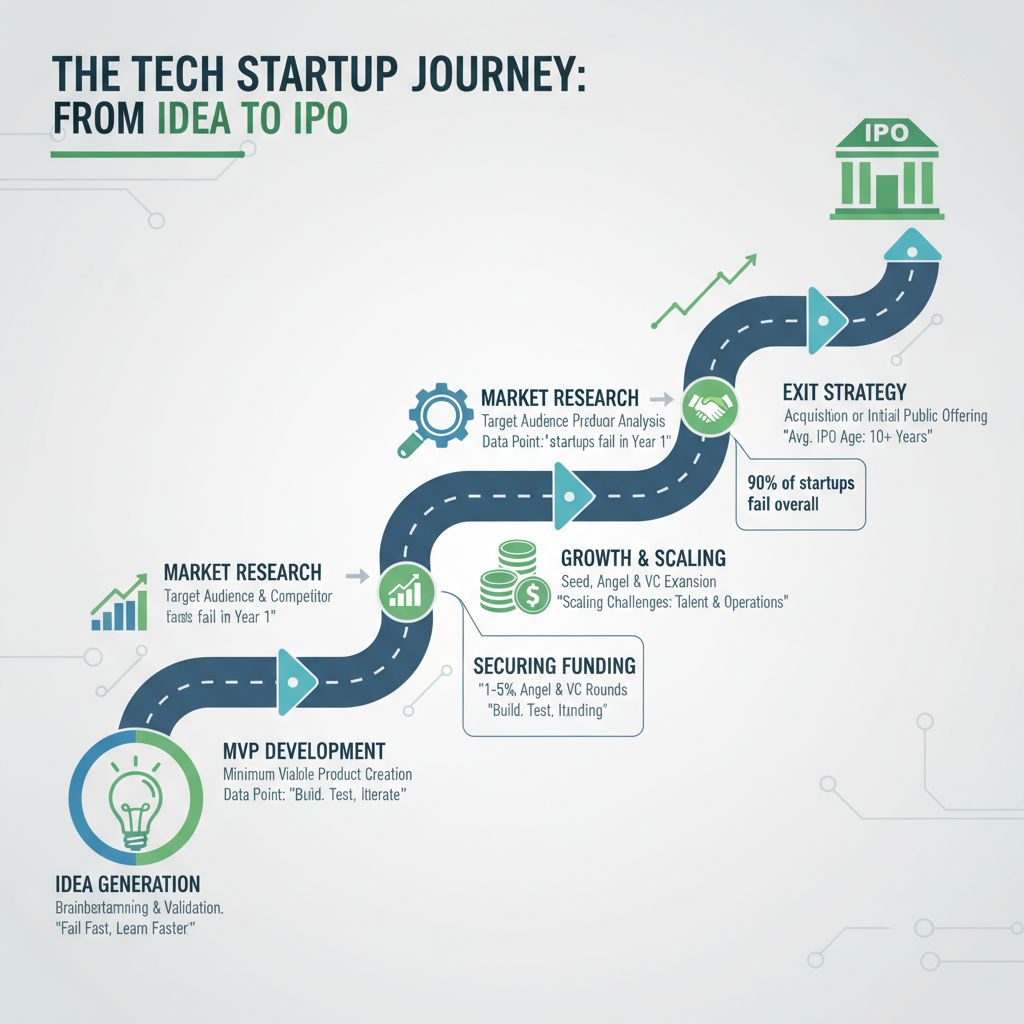
The latest data shows that the average startup failure rate is a staggering 90%, making it crucial to start with a validated concept.
Here are a few simple startup ideas with immense potential in 2026 and beyond:
- AI-Powered Knowledge Product Studios: With the rise of AI, you can create a one-person media startup that transforms complex topics into digestible content like YouTube explainers, mini-courses, and newsletters.
- Industry-Specific AI Automation Agencies: Businesses are eager to adopt AI but often lack the expertise. You can bridge this gap by offering tailored AI automation services for specific industries like real estate, law, or healthcare.
- Hyper-Personalized Learning Platforms: Leverage AI to create adaptive learning experiences that cater to individual learning styles and paces, a significant improvement over the traditional one-size-fits-all approach to education.
- Sustainable Tech Solutions: As consumers and investors become more environmentally conscious, startups focused on sustainability, such as developing eco-friendly products or promoting a circular economy, are gaining traction.
Market Research: Your Compass to Success
Once you have an idea, it’s time to put it to the test.
Thorough market research is non-negotiable for any aspiring tech entrepreneur.
It’s your compass, guiding you toward product-market fit and helping you avoid common pitfalls. 🧭
Start by defining your target audience and understanding their needs, pain points, and desires.
Conduct surveys, interviews, and focus groups to gather direct feedback from potential customers.
Analyze your competitors to identify their strengths, weaknesses, and the gaps in the market that your startup can fill.
The goal is to gain valuable insights that will inform your product development and business strategy.
Remember, you’re not just building a product; you’re solving a problem for a specific group of people.
https://youtube.com/watch?v=55L6-1sItoo
“Your most unhappy customers are your greatest source of learning.” – Bill Gates
Building Your Minimum Viable Product (MVP)
With a validated idea and a deep understanding of your target market, it’s time to build your Minimum Viable Product (MVP).
An MVP is a version of your product with just enough features to be usable by early customers, who can then provide feedback for future product development.
The key is to focus on the core functionality that solves the most significant problem for your users.
Avoid the temptation of “feature creep,” which can lead to a bloated and overly complex product.
The rise of no-code and low-code platforms has made it easier than ever for non-technical founders to build an MVP without writing a single line of code.
This allows you to test your assumptions, gather user feedback, and iterate quickly without a significant upfront investment.
| Stage | Description | Key Activities |
|---|---|---|
| Ideation | Brainstorming and refining your startup idea. | – Identify a problem to solve – Brainstorm potential solutions – Conduct initial feasibility analysis |
| Market Research | Validating your idea and understanding the market landscape. | – Define target audience – Analyze competitors – Conduct surveys and interviews |
| MVP Development | Building a basic version of your product to test with early adopters. | – Prioritize core features – Choose a tech stack or no-code platform – Gather user feedback for iteration |
Securing Funding: Fueling Your Growth
While some startups can be bootstrapped, most tech companies will require external funding to scale.
From angel investors and venture capitalists to crowdfunding and government grants, there are numerous avenues for securing the capital you need to grow your business.
Before you start pitching to investors, you need a solid business plan that outlines your vision, mission, target market, financial projections, and go-to-market strategy.
A well-crafted business plan not only serves as a roadmap for your company but also demonstrates to potential investors that you have a clear and viable path to success.
Be prepared to answer tough questions about your business model, competitive landscape, and long-term vision.
https://youtube.com/watch?v=CjB_o9_Jgcs
For more insights on securing funding, check out this article on how to get funding for a startup by Forbes.
Marketing and Scaling: Reaching Your Full Potential
With a product in hand and funding in the bank, it’s time to focus on marketing and scaling your startup.
A successful launch is crucial for building momentum and acquiring your first customers.
Develop a comprehensive go-to-market strategy that leverages a mix of digital marketing tactics, such as SEO, content marketing, paid advertising, and social media.
Engage with startup communities, attend industry events, and build relationships with influencers to generate buzz and drive brand awareness.
As your user base grows, it’s essential to have a scalable infrastructure in place to support your expansion.
This includes everything from your technology stack and customer support systems to your internal processes and team structure.
Don’t be afraid to experiment with different marketing channels and growth strategies to find what works best for your business.
For a deep dive into growth hacking techniques, I recommend checking out Neil Patel’s guide to growth hacking.
https://youtube.com/watch?v=Re5sUEMc3sY
“The secret to successful hiring is this: look for the people who want to change the world.” – Marc Benioff
The Road Ahead: Challenges and Opportunities
Founding a tech startup is a challenging yet rewarding journey.
There will be ups and downs, successes and failures, but with passion, perseverance, and a willingness to learn, you can turn your simple idea into a market-leading company.
The tech landscape is constantly evolving, with new trends and technologies emerging all the time.
Stay curious, stay agile, and never stop innovating.
For more on the latest tech trends, visit TechCrunch.
You can also explore resources from the U.S. Small Business Administration for guidance on starting and growing your business.
For a global perspective on innovation and technology, check out the World Economic Forum.
🔍 Explore More: See all related guides for how to found a tech startup – Deep Down simple Ideas on Z-A-D-A.