

📉
Entrepreneurship is often romanticized.
We see the gleaming success stories, the IPOs, the unicorns.
But beneath the surface, there’s a less glamorous, yet equally critical, reality: business failure.
It’s a subject many shy away from, yet it’s an almost inevitable part of the journey for countless entrepreneurs.
Think about it: for every triumph, there are numerous ventures that didn’t quite make it.
This isn’t a sign of personal inadequacy.
Instead, it’s a crucible for growth, a forge where true entrepreneurial spirit is tested and refined.
In this comprehensive guide, we’re not just going to talk about failure.
We’re going to dive deep into it, exploring its nuances, understanding its lessons, and most importantly, discovering how an entrepreneurial mindset can transform what seems like an end into a powerful new beginning.
We’ll look at inspiring stories, practical strategies, and the psychological shifts needed to bounce back stronger than ever.
Are you ready to redefine your relationship with failure? 🚀
The Stigma of Failure: Why We Fear It 😨
In many cultures, failure is synonymous with defeat, a mark of shame.
This perception can be paralyzing for entrepreneurs.
The fear of failure often prevents individuals from even starting, or leads them to abandon ventures at the first sign of trouble.
Society often celebrates the “overnight success” without acknowledging the years of struggle, setbacks, and indeed, failures that preceded it.
This narrative creates immense pressure.
Entrepreneurs feel they must constantly project an image of success, even when facing significant challenges.
This can lead to isolation, burnout, and a missed opportunity to learn from mistakes openly.
However, the most successful entrepreneurs view failure not as a final destination, but as a critical stepping stone.
It’s a feedback mechanism, a teacher, a detour, not a dead end.
Understanding and dismantling this stigma is the first step towards truly embracing an entrepreneurial mindset.
We need to shift our collective perception and start seeing business failure as a valuable data point, not a personal indictment.
It’s about separating the outcome of a business from the worth of the individual. 🧠
Stories of Resilience: When Businesses Crumbled, but Entrepreneurs Didn’t 🌟
The best way to understand the power of an entrepreneurial mindset in the face of failure is through real-life examples.
These stories are not about avoiding failure, but about how individuals responded to it.
Story 1: Steve Jobs and NeXT 🍎
After being ousted from Apple, the company he co-founded, Steve Jobs embarked on a new venture: NeXT Inc.
NeXT computers were technologically advanced but commercially unsuccessful.
The company burned through hundreds of millions of dollars and failed to gain significant market share.
It was, by many accounts, a business failure.
However, Jobs’s experience at NeXT, though financially disappointing, was crucial.
It allowed him to hone his leadership skills, experiment with new ideas, and build a team that would later become instrumental in Pixar’s success.
When Apple acquired NeXT, it brought Jobs back to the company, leading to one of the greatest corporate comebacks in history.
Without the “failure” of NeXT, the triumphant return to Apple might never have happened.
This illustrates a profound point: sometimes, what looks like a failure is actually preparation for a much larger success.
Story 2: Arianna Huffington’s Early Ventures 📰
Before the massive success of The Huffington Post, Arianna Huffington experienced several political and business setbacks.
Her first online venture, Resignation.com, a site dedicated to bringing down President Clinton, failed to gain traction.
Her political campaigns were also unsuccessful.
However, Huffington consistently demonstrated an unshakeable belief in her vision and an ability to pivot.
She learned from each attempt, refining her approach to media and content.
These earlier experiences, though not successful in themselves, provided her with invaluable insights into the digital landscape and public engagement.
The Huffington Post, launched in 2005, became a monumental success, transforming online journalism.
Her journey underscores the importance of persistence and the willingness to iterate even after multiple failures.
Story 3: Henry Ford’s First Two Automobile Companies 🚗
Before the Ford Motor Company, Henry Ford founded the Detroit Automobile Company in 1899.
It quickly failed due to high production costs and low quality.
He then started the Henry Ford Company, from which he was eventually forced out due to disagreements with his investors.
These were significant early failures.
Yet, Ford didn’t give up.
He meticulously analyzed what went wrong, especially the production inefficiencies and the challenges of investor relations.
Armed with these hard-won lessons, he founded the Ford Motor Company in 1903.
His third attempt revolutionized the automobile industry with the Model T and the assembly line.
Ford’s story is a powerful testament to the idea that failure can be the ultimate teacher, paving the way for groundbreaking innovation.
“Success is not final, failure is not fatal: it is the courage to continue that counts.” – Winston Churchill
The Entrepreneurial Mindset: A Blueprint for Resilience 🛠️
What sets these individuals apart is not that they avoided failure, but how they approached it.
This approach is encapsulated in what we call the entrepreneurial mindset.
1. Growth Mindset vs. Fixed Mindset 🌱
One of the most fundamental shifts is adopting a growth mindset.
Developed by Carol Dweck, this concept posits that individuals with a growth mindset believe their abilities and intelligence can be developed through dedication and hard work.
In contrast, those with a fixed mindset believe their qualities are static.
When faced with failure, a fixed mindset leads to feelings of inadequacy and a desire to avoid challenges.
A growth mindset, however, sees challenges as opportunities to learn and grow.
It encourages perseverance and a belief that effort will eventually lead to mastery.
This is crucial for entrepreneurs.
Embracing the idea that every setback is a chance to improve is the cornerstone of resilience.
2. Learning Agility and Adaptability 🌪️
The business landscape is constantly changing.
Market conditions shift, technologies evolve, and customer needs transform.
An entrepreneurial mindset thrives on learning agility – the ability to rapidly learn from experience, adapt to new situations, and apply those learnings to future challenges.
When a business fails, it’s a rich source of data.
What assumptions were wrong? What market signals were missed? Where did the strategy falter?
Instead of dwelling on the negative, resilient entrepreneurs dissect the failure, extract key lessons, and adapt their strategies for future ventures.
This often involves pivoting – changing direction based on new insights.
Consider companies like Slack, which started as a gaming company (Tiny Speck) before pivoting to become a wildly successful communication platform.
Their initial product, Glitch, was a failure, but the internal communication tool they built for themselves became their next big hit.
3. Embracing Experimentation and Risk-Taking 🧪
Entrepreneurship is inherently about venturing into the unknown.
This means taking calculated risks and being comfortable with experimentation.
Not every experiment will succeed.
In fact, many will fail.
But each failure provides valuable information, narrowing down the path to success.
An entrepreneurial mindset doesn’t just tolerate risk; it embraces it as a necessary component of innovation.
It’s about prototyping quickly, testing assumptions, and being prepared for the possibility that an idea won’t work.
This iterative process, often called “fail fast, learn faster,” is fundamental to navigating uncertainty and ultimately achieving breakthrough results.
As Thomas Edison famously said, “I have not failed. I’ve just found 10,000 ways that won’t work.”
4. Emotional Intelligence and Self-Compassion ❤️🩹
Facing business failure can be emotionally devastating.
It’s easy to fall into a spiral of self-blame, regret, and anxiety.
An entrepreneurial mindset, while focused on learning, also recognizes the importance of emotional intelligence and self-compassion.
This means acknowledging the pain and disappointment without letting it consume you.
It involves understanding your emotions, managing stress, and seeking support when needed.
Self-compassion is crucial here.
Treating yourself with the same kindness and understanding you would offer a friend who has failed is vital for recovery and moving forward.
Without addressing the emotional toll, the intellectual lessons from failure can be overshadowed by psychological barriers.
Actionable Strategies for Navigating Business Failure 🗺️
Beyond mindset, there are concrete steps entrepreneurs can take when faced with business failure.
1. Conduct a Post-Mortem Analysis 🔎
Once the initial shock subsides, perform a thorough, objective post-mortem.
This isn’t about assigning blame, but about understanding causality.
- What were the initial assumptions? Were they validated?
- What market research was conducted? Was it accurate and comprehensive?
- Where did the financial projections go wrong?
- How effective was the team? Were there skill gaps or communication breakdowns?
- What external factors contributed? Economic downturns, new competitors, regulatory changes.
Document these findings meticulously.
This analysis is your most valuable asset for future ventures.
2. Prioritize Self-Care and Mental Health 🧘♀️
Business failure can take a significant toll on mental and physical health.
It’s essential to prioritize self-care during this period.
- Seek support from friends, family, or a therapist. Don’t try to go it alone.
- Maintain healthy habits: regular exercise, balanced nutrition, sufficient sleep.
- Engage in hobbies or activities that bring you joy and a sense of accomplishment, even small ones.
Rebuilding your mental and emotional reserves is crucial before embarking on a new venture.
3. Network and Seek Mentorship 🤝
You are not alone in this experience.
Many successful entrepreneurs have faced multiple failures.
Reach out to your network.
Talk to mentors, fellow entrepreneurs, and industry veterans.
Their insights can provide invaluable perspectives and guidance.
Sharing your experience can also be incredibly therapeutic and help you realize that failure is a shared part of the entrepreneurial journey.
It can also open doors to new opportunities, partnerships, or even investment.
A strong support system is a cornerstone of resilience.
4. Re-evaluate Your Passions and Skills 🤔
A period of failure can be an ideal time for introspection.
What truly excites you? What problems are you passionate about solving?
What skills did you develop during your last venture that you can leverage in a new direction?
Sometimes, a business fails not because of a lack of effort, but because it wasn’t aligned with your core strengths or market needs.
Use this opportunity to recalibrate your compass.
Perhaps your next venture will be in a completely different industry, or address a long-standing passion you previously put aside.
5. Financial Recovery and Planning 💰
Business failure often comes with financial implications.
It’s important to address these head-on.
- Assess your personal financial situation: Create a budget, cut unnecessary expenses, and explore temporary income sources.
- Deal with debts responsibly: Communicate with creditors, explore repayment plans, or seek financial counseling.
- Learn about legal implications: Understand any liabilities, contractual obligations, or bankruptcy procedures if applicable.
A clear financial plan provides a solid foundation for rebuilding and preparing for future ventures.
You can find valuable resources on financial planning after business closure from reputable sources like The U.S. Small Business Administration.
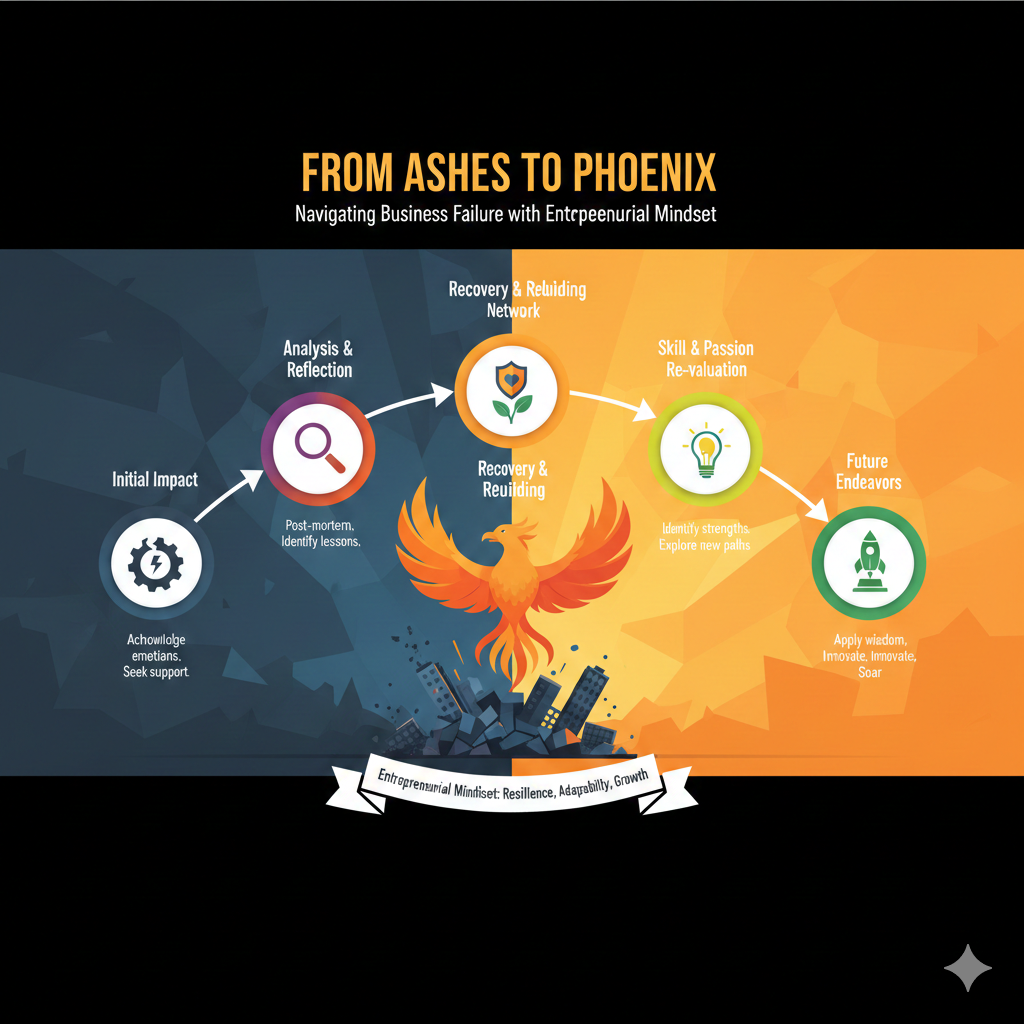
The Infographic: The Journey from Failure to Future 📊
| Stage | Entrepreneurial Action | Mindset Shift |
|---|---|---|
| 1. Initial Impact 💥 | Acknowledge emotions, seek immediate support. | From “It’s over” to “This is a setback.” |
| 2. Analysis & Reflection 🤔 | Conduct post-mortem, identify root causes. | From “I failed” to “The business failed, now I learn.” |
| 3. Recovery & Rebuilding 💪 | Prioritize self-care, address finances, network. | From “Burdened” to “Empowered to recover.” |
| 4. Skill & Passion Re-evaluation 💡 | Identify strengths, explore new opportunities. | From “Lost” to “Re-aligned with purpose.” |
| 5. Future Endeavors ✨ | Apply lessons learned, pivot or start anew. | From “Fearful” to “Confident and experienced.” |
Transforming Failure into Fuel: The Long-Term Perspective ⏳
The lessons learned from business failure are often more profound and lasting than those gained from uninterrupted success.
Failure builds character, sharpens judgment, and instills a deep appreciation for resilience.
It can lead to a stronger understanding of market dynamics, better decision-making capabilities, and a more robust business strategy in the future.
Many venture capitalists actually prefer to invest in entrepreneurs who have experienced and recovered from failure.
Why?
Because these individuals have proven their grit, their ability to learn under pressure, and their capacity to adapt.
They bring a level of wisdom and caution that often translates into more sustainable and well-managed ventures.
So, instead of viewing failure as a definitive end, see it as a critical chapter in your entrepreneurial autobiography.
It’s a testament to your courage to try, your willingness to take risks, and your unwavering commitment to your vision.
Embrace the scars, for they tell stories of battles fought and wisdom gained. 💪
Key Takeaways for a Resilient Entrepreneurial Journey 🔑
To summarize, navigating business failure with an entrepreneurial mindset involves several core principles:
-
- Reframe failure: See it as a learning opportunity, not a personal defeat.
- Embrace a growth mindset: Believe in your ability to develop and improve.
- Practice learning agility: Extract lessons and adapt swiftly.
- Cultivate resilience: Build emotional strength and seek support.
- Practice learning agility: Extract lessons and adapt swiftly.
- Cultivate resilience: Build emotional strength and seek support.
- Plan for recovery: Address financial and emotional well-being.
For further reading on building resilience, check out articles from organizations like Harvard Business Review and Forbes.
Consider also exploring the concept of “antifragility” from thinkers like Nassim Nicholas Taleb, which goes beyond resilience to suggest that some systems actually benefit from shocks and adversity.
Conclusion: The Path Forward 🚀
Business failure is not the end of your entrepreneurial journey; it is often a powerful catalyst.
It forces introspection, sharpens your skills, and deepens your understanding of yourself and the market.
By adopting an entrepreneurial mindset that prioritizes learning, adaptability, and resilience, you can transform what initially feels like a devastating setback into an invaluable foundation for future success.
Remember the stories of Jobs, Huffington, and Ford.
Their failures weren’t endpoints, but crucial detours on their path to greatness.
Your journey is no different.
Embrace the lessons, heal, and prepare to rise again, stronger and wiser than before. The next chapter of your entrepreneurial story awaits. ✨