
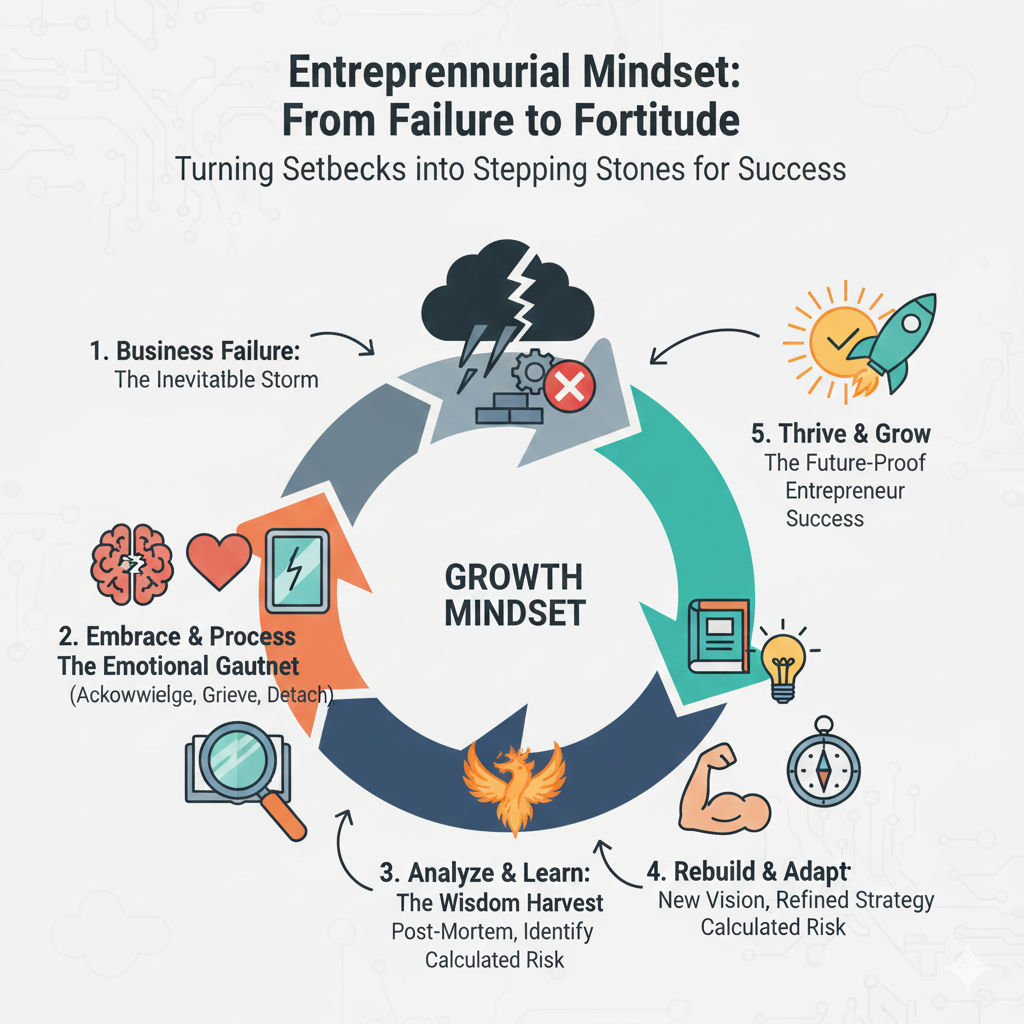
The narrative of entrepreneurship is often painted with broad strokes of success: the IPO, the acquisition, the overnight sensation. 🌟
Yet, beneath this glossy surface lies a far more common, and arguably more instructive, reality: the story of failure.
For every triumphant venture, countless others stumble, pivot, or simply cease to exist.
Dealing with business failure is perhaps the most profound test of the entrepreneurial mindset. 🧠
It is a moment of intense personal and professional reckoning, a crucible where true resilience is forged.
This comprehensive exploration delves into the psychology of business failure, dissects the common narratives, and provides a strategic framework for cultivating the mindset that transforms a devastating setback into an invaluable stepping stone for future success.
The Taboo of Failure: Shifting the Narrative 🗣️
In many cultures, failure is viewed as a final, definitive judgment.
This perception creates a “fear of failure” that Forbes notes is a silent saboteur, stifling growth and impairing judgment, which paradoxically increases the likelihood of failure. Overcoming this fear is the first step in building resilience.
The entrepreneurial mindset, by contrast, embraces failure as an inevitable, even necessary, component of the innovation cycle.
It is a data point, a feedback mechanism, not a personal indictment.
Failure as a Prerequisite for Success 💡
The most successful entrepreneurs often have a long list of failed ventures.
These failures are not deviations from the path to success but rather the very lessons that make success possible.
Each failed attempt refines the founder’s understanding of the market, the product, and their own capabilities.
- Refined Market Understanding: Failure often reveals that the market was not ready, the problem was not painful enough, or the timing was wrong. This knowledge is priceless for the next venture.
- Improved Self-Awareness: The trauma of failure forces an entrepreneur to confront their weaknesses, leading to better hiring decisions and a more realistic assessment of personal limitations.
- Increased Resilience: Surviving a business failure proves that the entrepreneur can endure hardship, making them mentally tougher and more prepared for the inevitable challenges of the next startup.
The key is to reframe the failure story, viewing it not as an ending, but as a chapter in a much larger, ongoing journey.
The Anatomy of Business Failure: Common Causes 📉
While every failure story is unique, they often share common, identifiable root causes.
Understanding these systemic issues is crucial for future risk mitigation.
1. Cash Flow and Financial Mismanagement
The most common reason for startup failure is running out of cash.
This is often due to poor financial planning, underestimating operational costs, or failing to secure adequate funding.
A lack of financial discipline is a fatal flaw in any business model.
2. Product-Market Mismatch
This occurs when a business builds a product that nobody wants or needs.
It is a failure to listen to the market, a reliance on assumptions, or a stubborn refusal to pivot when the data suggests a change is necessary.
The lesson here is the necessity of continuous, honest customer feedback.
3. Team and Leadership Issues
Internal conflicts, a lack of clear vision, or the inability of the founding team to work together are significant contributors to failure.
A strong team with a weak idea often outperforms a weak team with a strong idea.
Leadership failure, particularly the inability to make tough decisions or delegate effectively, can sink a venture quickly.
| Failure Category | Mindset Shift Required | Actionable Lesson |
|---|---|---|
| Financial | From Optimism to Realism | Build a 12-month runway and track burn rate religiously. |
| Market | From Assumption to Validation | Prioritize Minimum Viable Product (MVP) and continuous customer interviews. |
| Team | From Ego to Humility | Define roles clearly and hire for complementary skills, not just friendship. |
The honest, objective analysis of the cause of failure is the most valuable administrative task an entrepreneur can perform post-mortem.
The Psychology of Bouncing Back: Resilience and Grit 💪
The immediate aftermath of a business failure is often characterized by grief, shame, and self-doubt.
The entrepreneurial mindset must actively engage in a process of psychological recovery to prevent the trauma from becoming a permanent barrier.
1. Separating Self from the Venture
Entrepreneurs often tie their personal identity to their business.
When the business fails, they feel they have failed as a person.
The first step in recovery is a conscious, deliberate separation: the business failed, the entrepreneur learned.
This mindset shift is crucial for emotional survival and future risk-taking.
2. The Power of the Post-Mortem
A formal, objective post-mortem analysis is not about assigning blame; it is about extracting knowledge.
Document every decision, every assumption, and every outcome.
This process transforms the emotional pain of failure into a tangible, intellectual asset—a playbook of what not to do next time.
Foundr notes that if we can learn from our entrepreneurial failures, they can become building blocks for something greater. The lesson is the true return on investment.
3. Embracing the Growth Mindset
The concept of a growth mindset, popularized by Carol Dweck, is central to dealing with failure.
It is the belief that abilities and intelligence can be developed through dedication and hard work.
In the context of entrepreneurship, this means viewing the failure as a temporary setback that provides necessary data for improvement, rather than a reflection of a fixed lack of talent.
This mindset fuels the perseverance required to start again.
Lessons from the Legends: Famous Failure Stories 👑
It is comforting and instructive to remember that many of the world’s most successful entrepreneurs faced catastrophic failures before their breakthroughs.
These stories serve as powerful reminders that failure is a common denominator among innovators.
| Entrepreneur | Failure Story | Lesson Learned |
|---|---|---|
| Steve Jobs | Fired from Apple, the company he co-founded, in 1985. | The importance of vision, and the necessity of building NeXT and Pixar before his triumphant return. |
| Walt Disney | Fired from a newspaper for “lack of imagination” and his first animation company, Laugh-O-Gram Studio, went bankrupt. | Perseverance and the power of owning intellectual property (Mickey Mouse was created after the failure). |
| Oprah Winfrey | Fired from her job as a news anchor for being “too emotional” and unable to separate her emotions from the story. | The value of authenticity and turning a perceived weakness into a unique strength (empathy). |
Business.com details how many famous entrepreneurs failed before they succeeded, reinforcing the idea that failure is a part of the journey. These stories normalize the experience of failure.
The common thread is not the failure itself, but the refusal to let the failure be the final word.
The Practical Steps to Move Forward 🧭
Moving past failure requires a structured, deliberate process, not just a change in attitude.
This is the administrative and psychological cleanup that prepares the ground for the next venture.
Step 1: The Formal Shutdown and Legal Cleanup
This is the hardest but most necessary step.
Formally close the business entity, settle debts, and handle all legal and tax obligations.
Consulting with a lawyer and accountant is crucial to ensure a clean slate and protect personal assets.
Step 2: Document the Lessons Learned
Write down the post-mortem.
What were the three biggest mistakes?
What were the three things that actually worked?
This document is your most valuable takeaway from the entire experience.
Step 3: The Sabbatical and Skill Refinement
Do not immediately jump into the next venture.
Take a planned sabbatical to decompress, regain perspective, and process the emotional toll.
Use this time to refine the skills that were lacking, whether it is financial modeling, marketing, or team management.
Inc.com highlights that you learn more from your failures than your successes, making this period of reflection essential. The time spent healing is an investment in future success.
Step 4: Network and Share Your Story
Sharing your failure story is an act of vulnerability that builds trust and provides invaluable feedback.
It connects you with other entrepreneurs who have been through similar experiences.
This community support is a powerful antidote to the isolation that often accompanies business failure.
The Reddit entrepreneur community often shares stories of failure, demonstrating the power of communal learning.
Your failure story, when told correctly, becomes a testament to your resilience and a magnet for future partners and investors.
Video Guides to Entrepreneurial Resilience 📚
To see these concepts in action, here are some helpful video resources.
Conclusion: The Mindset of the Phoenix 🔥
Business failure is not the end of the entrepreneurial journey; it is a painful, but essential, rite of passage.
The true measure of an entrepreneur is not whether they fail, but how they deal with that failure.
By cultivating a mindset of resilience, engaging in honest post-mortems, and embracing the lessons learned, you transform a devastating loss into a powerful competitive advantage.
The ability to fail, learn, and start again is the ultimate hallmark of the successful entrepreneurial spirit.
Embrace the lessons, rise from the ashes, and build your next venture on a foundation of hard-won wisdom. 🚀