





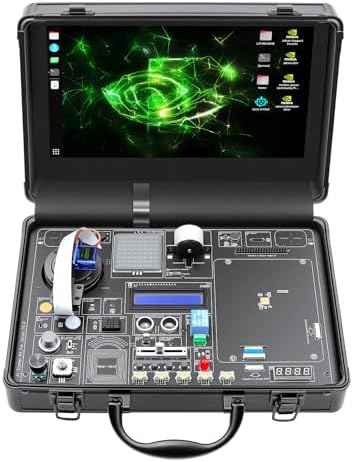


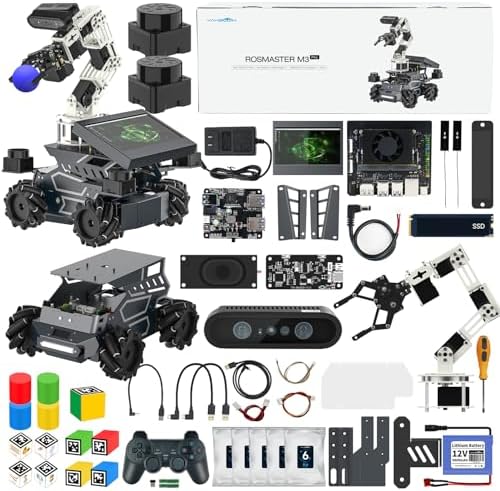

When it comes to Self-hosted SLM (Small Language Model) deployment on edge, getting the right details matters. Before we architect the system, equip your lab with top-tier hardware to accelerate your Self-hosted SLM (Small Language Model) deployment on edge: NVIDIA Jetson Orin Nano, Raspberry Pi 5 AI Kit, and Crucial Pro DDR5 RAM.
The paradigm of cloud-dependent artificial intelligence is fracturing under the weight of latency and bandwidth costs.
Architects are now shifting computational gravity toward the network perimeter to achieve deterministic response times.
This structural migration demands rigorous optimization of neural weights directly on localized silicon.
The Hardware Imperative for Localized Inference 💡
Selecting the correct silicon is the foundational bedrock of any localized neural network.
You cannot simply port massive parameter models to constrained microcontrollers without severe performance degradation.
Modern edge architectures require specialized tensor cores to handle matrix multiplications efficiently.
The NVIDIA Jetson Orin Nano provides up to 40 TOPS of AI performance, making it the undisputed champion for localized tensor operations.
Alternatively, the Apple Silicon M-series chips leverage unified memory architectures to eliminate data copying bottlenecks.
For ultra-low-power scenarios, the Raspberry Pi 5 paired with an AI kit offers a surprisingly capable baseline.
“Hardware without optimized software is just expensive silicon waiting to overheat.”
Quantization and Weight Compression Mechanics 📌
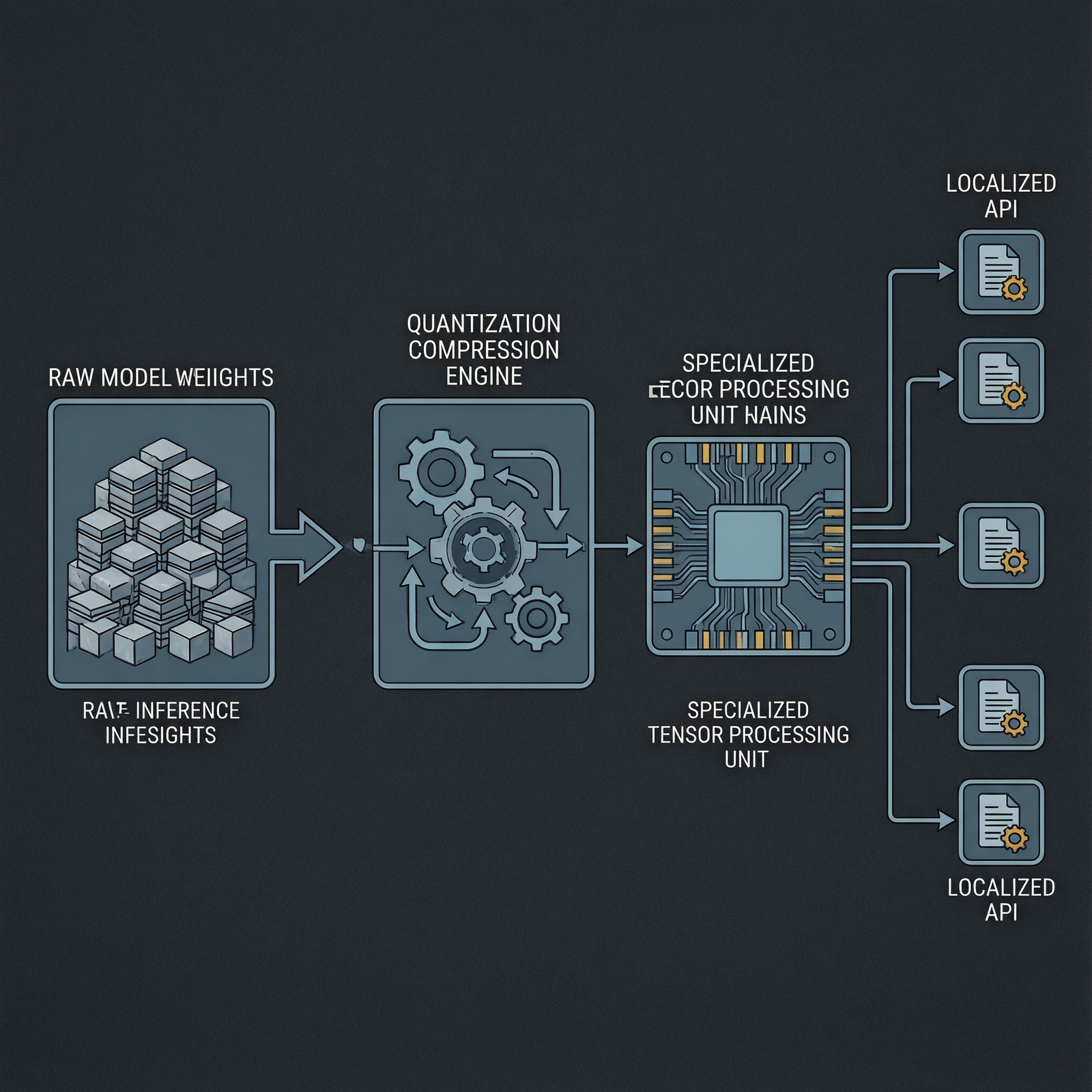
Raw floating-point weights are a luxury that edge environments simply cannot afford.
We must aggressively compress these models using advanced quantization techniques like GGUF and AWQ.
Reducing precision from 16-bit to 4-bit or even 2-bit drastically shrinks the memory footprint.
Int8 quantization typically reduces model size by 75 percent while retaining over 95 percent of the original accuracy metrics.
This compression allows a 7-billion parameter model to run comfortably within 8 gigabytes of VRAM.
Tools like llama.cpp have revolutionized this space by providing highly optimized C++ inference engines.
These engines utilize SIMD instructions to maximize throughput on consumer-grade CPUs and NPUs.
Memory Bandwidth and Cache Optimization 💡
Inference speed is rarely compute-bound at the edge; it is almost always memory-bound.
The physical distance between the compute cores and the memory banks dictates token generation speed.
This is why unified memory architectures currently dominate the localized inference benchmark charts.
Unified memory eliminates the PCIe transfer bottleneck, allowing the GPU and CPU to access the exact same weight tensors simultaneously.
< div style=”text-align: center; margin: 4em 0; background: #fdf8f8; padding: 30px; border: 2px solid #6c0000; border-radius: 10px;”>Check out My Teach collection Amazon productsSHOP THE COLLECTION
| Hardware Platform | Memory Architecture | Max Supported Parameters |
|---|---|---|
| Jetson Orin Nano | LPDDR5 | 8B (4-bit) |
Apple M2 Max
Unified
70B (4-bit)
Raspberry Pi 5
LPDDR4X
3B (4-bit)
Software Stack and Inference Engines 📌
The software stack must be as ruthlessly optimized as the underlying hardware.
Python is excellent for prototyping but entirely unsuitable for production edge inference.
You need compiled, low-level execution environments to squeeze out every drop of performance.
Ollama has emerged as a dominant force for local model management and deployment.
It abstracts the complex CUDA and Metal API calls into a simple, RESTful interface.
Ollama automatically detects the underlying hardware and selects the optimal execution backend, whether it is CUDA, Metal, or ROCm.
For deeper integration, vLLM provides continuous batching and PagedAttention for multi-user edge servers.
These advanced memory management techniques prevent out-of-memory errors during concurrent request processing.
KV Cache Management and Speculative Decoding 💡
The Key-Value cache is the primary memory hog during autoregressive generation.
As the context window expands, the KV cache grows linearly and eventually exhausts available VRAM.
Edge deployments must implement aggressive cache eviction policies to maintain system stability.
Speculative decoding offers a brilliant workaround by using a smaller draft model to predict tokens.
The larger target model then verifies these predictions in parallel, drastically reducing latency.
This technique effectively bypasses the memory bandwidth bottleneck of the primary inference engine.
Containerization and Orchestration 📌
Deploying these models in bare-metal environments is a recipe for dependency hell.
Containerization via Docker ensures that your inference engine runs identically across all edge nodes.
You can encapsulate the model weights, the quantization engine, and the API server into a single image.
Kubernetes or K3s can then orchestrate these containers across a fleet of distributed edge devices.
“A model is only as reliable as the infrastructure that serves it to the end user.”
- Utilize multi-stage Docker builds to keep the final inference image under two gigabytes.
- Implement health checks and readiness probes to ensure the model is fully loaded before routing traffic.
- Mount model weights as read-only volumes to prevent accidental corruption during runtime.
- Use GPU resource limits in your orchestration manifests to prevent noisy neighbor issues.
Security and Data Sovereignty 💡
The primary strategic advantage of localized inference is absolute data sovereignty.
When data never leaves the premises, you eliminate the attack surface associated with API transit.
This is non-negotiable for healthcare, finance, and defense applications handling sensitive telemetry.
< div style=”text-align: center; margin: 4em 0; background: #fdf8f8; padding: 30px; border: 2px solid #6c0000; border-radius: 10px;”>
Check out My Teach collection Amazon products
You must still secure the edge node itself against physical and network-based intrusions.
Implement strict iptables rules to ensure the inference API is only accessible via your internal VLAN.
For foundational research on quantization, refer to the papers published on arxiv.org.
The open-source community continuously pushes the boundaries of edge inference on github.com.
Hardware specifications and developer kits are detailed on nvidia.com.
Model repositories and community fine-tunes are hosted on huggingface.co.
For rigorous benchmarking standards, consult the guidelines from ieee.org.
Network Topologies for Distributed Edge Inference 📌
Single-node inference will eventually hit a physical ceiling regarding context length and throughput.
Distributed tensor parallelism allows you to split model layers across multiple edge devices.
This requires a high-speed, low-latency interconnect like InfiniBand or specialized RDMA over Converged Ethernet.
Pipeline parallelism is often more effective for edge networks with slightly higher latency tolerances.
By partitioning the model sequentially, each node processes a specific layer and passes the activation forward.
This approach maximizes hardware utilization without requiring expensive, specialized networking gear.
Future-Proofing the Edge Architecture 💡
The landscape of localized artificial intelligence is evolving at a breakneck pace.
Tomorrow’s edge nodes will feature dedicated neural processing units with tera-op capabilities.
We will see the rise of mixture-of-experts models specifically designed for constrained environments.
Architects must design their systems with modular upgrade paths to accommodate these silicon leaps.
Continuous integration pipelines should automatically test new quantization formats against your specific hardware.
Staying ahead of this curve requires a deep understanding of both silicon physics and algorithmic efficiency.
“True technological leadership requires building systems that anticipate the hardware of tomorrow.”
The transition to decentralized intelligence is not merely a trend; it is an architectural inevitability.
By mastering the mechanics of localized inference, you secure a massive competitive advantage in the data-driven economy.
Execute these principles with precision, and your edge network will operate as a flawless, autonomous entity.
🔍 Explore More: See all guides for Self-hosted SLM (Small Language Model) deployment on edge.
Check out My Tech collection Amazon products