
“The only truly secure system is one that is powered off, cast in a block of concrete, and sealed in a lead-lined room with armed guards – and even then, I have my doubts.”
– Gene Spafford
In the digital age, software is at the heart of nearly every business operation and personal interaction. 💻
From banking apps to social media platforms, the code we use daily needs to be robust, reliable, and, most importantly, secure.
Waiting until the end of the development process to address security is like building a house and only then thinking about its foundation – a recipe for disaster. 😬
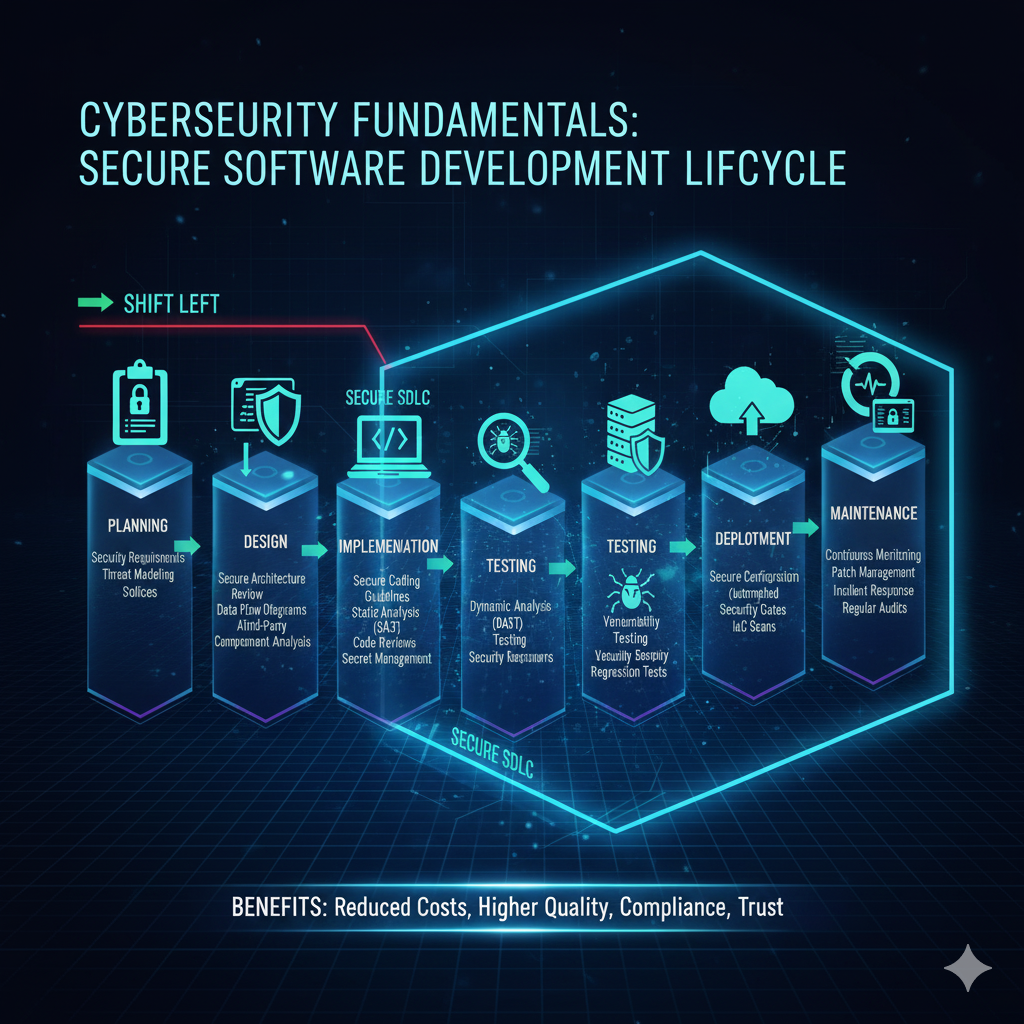
This is where the concept of a Secure Software Development Lifecycle (SSDLC) comes into play, fundamentally shifting security from an afterthought to an integrated core component of the entire development process. 🚀
This blog post will delve into the critical aspects of the SSDLC, outlining its phases, key practices, and why it’s indispensable for building resilient and trustworthy software. 🛡️
What is the Software Development Lifecycle (SDLC)?
Before we talk about security, let’s quickly review the traditional Software Development Lifecycle (SDLC).
The SDLC is a structured process that outlines the stages involved in developing and maintaining software applications. 🗺️</p\G
It typically includes phases such as:
- Planning: Defining requirements and scope.
- Analysis: Detailing functional and non-functional requirements.</p\G
- Design: Architecting the software solution.
- Implementation (Coding): Writing the actual code.
- Testing: Verifying functionality and quality.
- Deployment: Releasing the software to users.
- Maintenance: Ongoing support, updates, and bug fixes.
The problem with traditional SDLCs is that security has often been relegated to the testing phase, leading to costly fixes and increased vulnerabilities. 😩
The Evolution to a Secure SDLC (SSDLC)
The SSDLC integrates security practices into every phase of the SDLC, transforming it from a “check-the-box” activity to an ongoing, proactive approach. ✅
The goal is to identify and mitigate security risks early, when they are less expensive and easier to fix.
This philosophy aligns perfectly with the DevOps principle of “shifting left,” where quality and security are pushed earlier into the development pipeline. ⬅️
Key Phases and Practices of the SSDLC
Let’s break down how security is woven into each stage of the software development process.
1. Planning and Requirements
This phase is about defining security goals and incorporating them into the project’s requirements.
- Security Requirements Gathering: Explicitly define security requirements alongside functional ones. These might include data encryption needs, access control policies, audit logging, and compliance mandates (e.g., GDPR, HIPAA).
- Security Training: Ensure all team members, especially developers, receive regular security awareness and secure coding training. 🎓
- Establish Security Policies and Standards: Define coding standards, acceptable use policies, and security best practices that will govern the project.
2. Design and Architecture
Security considerations are paramount when designing the application’s architecture.
- Threat Modeling: A crucial activity where potential threats and vulnerabilities are identified, analyzed, and prioritized based on the application’s design.
This helps developers understand where attacks might occur and how to mitigate them proactively. Learn more about Threat Modeling from OWASP.
- Security Architecture Review: Review the proposed architecture for security flaws, insecure design patterns, and adherence to security principles (e.g., least privilege, defense in depth).
- Third-Party Component Analysis: Evaluate the security posture of any open-source or commercial libraries and frameworks planned for use. Supply chain security is a growing concern. 📦
3. Implementation (Coding)
This is where secure coding practices are actively applied.
- Secure Coding Guidelines: Developers follow established secure coding guidelines to prevent common vulnerabilities like SQL injection, cross-site scripting (XSS), and buffer overflows.
The OWASP Top 10 is an excellent resource for this. Explore the OWASP Top 10.
- Static Application Security Testing (SAST): Integrate SAST tools into the CI/CD pipeline to automatically scan source code for security vulnerabilities during development, providing immediate feedback to developers. 🔍
- Code Review: Peer code reviews should include a security component, with experienced developers or security experts checking for potential vulnerabilities.
- Secret Management: Implement secure practices for managing API keys, passwords, and other sensitive credentials, preventing them from being hardcoded or exposed. 🤫
4. Testing and Verification
Beyond functional testing, this phase rigorously evaluates the application’s security posture.
- Dynamic Application Security Testing (DAST): DAST tools analyze the running application from the outside, simulating attacks to find vulnerabilities that might not be visible in the source code (e.g., configuration errors, runtime issues). 📊
- Penetration Testing (Pen Testing): Conduct manual penetration tests by ethical hackers who attempt to exploit vulnerabilities in the application, much like a real attacker would. 🕵️
This often uncovers complex logical flaws that automated tools might miss. NIST provides guidelines for information security testing.
- Security Regression Testing: Ensure that new features or bug fixes don’t introduce new vulnerabilities or reintroduce old ones. ↩️
- Interactive Application Security Testing (IAST): IAST combines aspects of SAST and DAST, monitoring the application from within during runtime to identify vulnerabilities with greater accuracy.
- Vulnerability Scanners: Use automated vulnerability scanners to check for known vulnerabilities in third-party libraries and infrastructure components.
5. Deployment
Ensuring a secure deployment environment is critical to maintaining the integrity of the application.
- Secure Configuration Management: Deploy applications with hardened configurations, adhering to security baselines and removing unnecessary services or default credentials.
- Automated Deployment Security Checks: Integrate security checks into automated deployment pipelines to ensure that only secure, tested code is released.
- Infrastructure as Code (IaC) Security: If using IaC, ensure that your infrastructure templates are scanned for security misconfigurations before deployment.
6. Maintenance and Monitoring
Security doesn’t stop after deployment; it’s an ongoing process.
- Continuous Monitoring: Implement robust logging, monitoring, and alerting systems to detect and respond to security incidents in real-time. 🚨
- Vulnerability Management: Regularly scan for new vulnerabilities, apply security patches, and update dependencies.
- Incident Response Planning: Have a well-defined incident response plan in place to handle security breaches effectively and minimize damage.
- Regular Audits and Reviews: Conduct periodic security audits and reviews to ensure ongoing compliance and identify areas for improvement.
“Security is not a product, but a process.”
– Bruce Schneier
Benefits of an SSDLC
Adopting an SSDLC brings a multitude of advantages to organizations:
| Benefit Category | Description |
|---|---|
| Reduced Costs | Finding and fixing vulnerabilities early is significantly cheaper than post-deployment. 💰 |
| Improved Security Posture | Results in inherently more secure applications with fewer vulnerabilities. 🔒 |
| Enhanced Compliance | Easier to meet regulatory requirements (e.g., GDPR, HIPAA, PCI DSS) by embedding security throughout. ✔️ |
| Increased Customer Trust | Secure products build confidence and protect reputation. ❤️ |
| Faster Time to Market | Fewer security defects mean fewer delays in release cycles. ⏱️ |
| Better Risk Management | Proactive identification and mitigation of risks. 📊 |
https://www.google.com/search?q=https://youtu.be/kUaQjF7m7nU
Integrating SSDLC into DevOps
The principles of SSDLC align seamlessly with DevOps methodologies, leading to what is often called “DevSecOps.” 🤝</p\G
DevSecOps emphasizes automating security checks and integrating security tools directly into the CI/CD pipeline.
This ensures that security becomes an automated, continuous process rather than a manual bottleneck.
Key integrations include:
- Automated SAST and DAST: Running security scans as part of every code commit or build.
- Security Gates: Implementing automated gates in the pipeline that prevent deployment if critical vulnerabilities are detected.
- Infrastructure as Code (IaC) Security Scans: Scanning configuration files for security misconfigurations before provisioning infrastructure. Google Cloud provides a good overview of DevSecOps.
Conclusion
The Secure Software Development Lifecycle (SSDLC) is not just a best practice; it is an absolute necessity in today’s threat landscape. 🌟
By embedding security activities into every stage of the development process – from initial planning to ongoing maintenance – organizations can build applications that are inherently more resilient to cyberattacks.
This proactive approach not only reduces the cost and effort of fixing vulnerabilities but also safeguards sensitive data, maintains compliance, and builds invaluable trust with users.
Embracing the SSDLC is a commitment to quality, security, and the future success of your software. 💡