
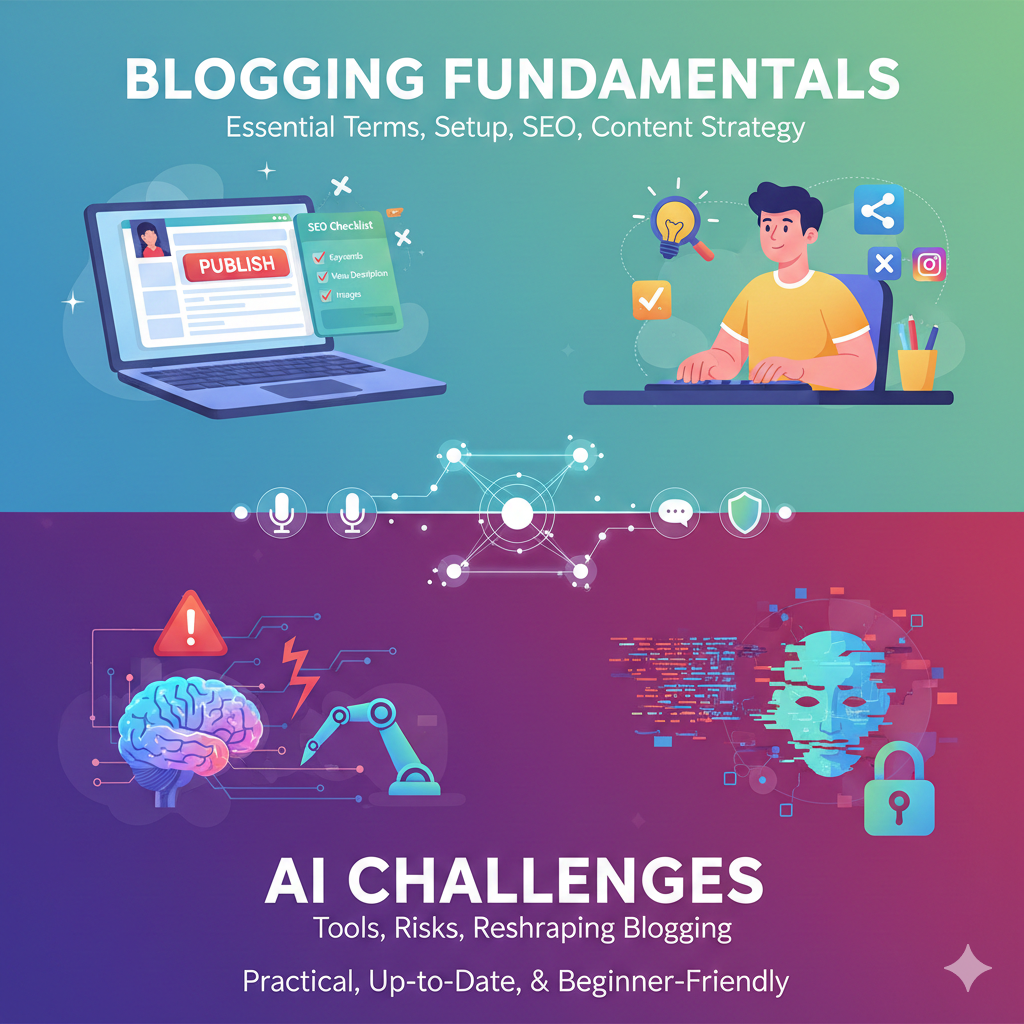
🤓 Blogging Fundamentals: A friendly guide to core terms and the new AI-era challenges.
This article explains essential blogging terminology for beginners in plain language.
This article also covers practical setup, SEO basics, content strategy, growth, monetization, and the latest AI-related issues bloggers face today.
Every sentence is short and separate so you can copy fragments easily.
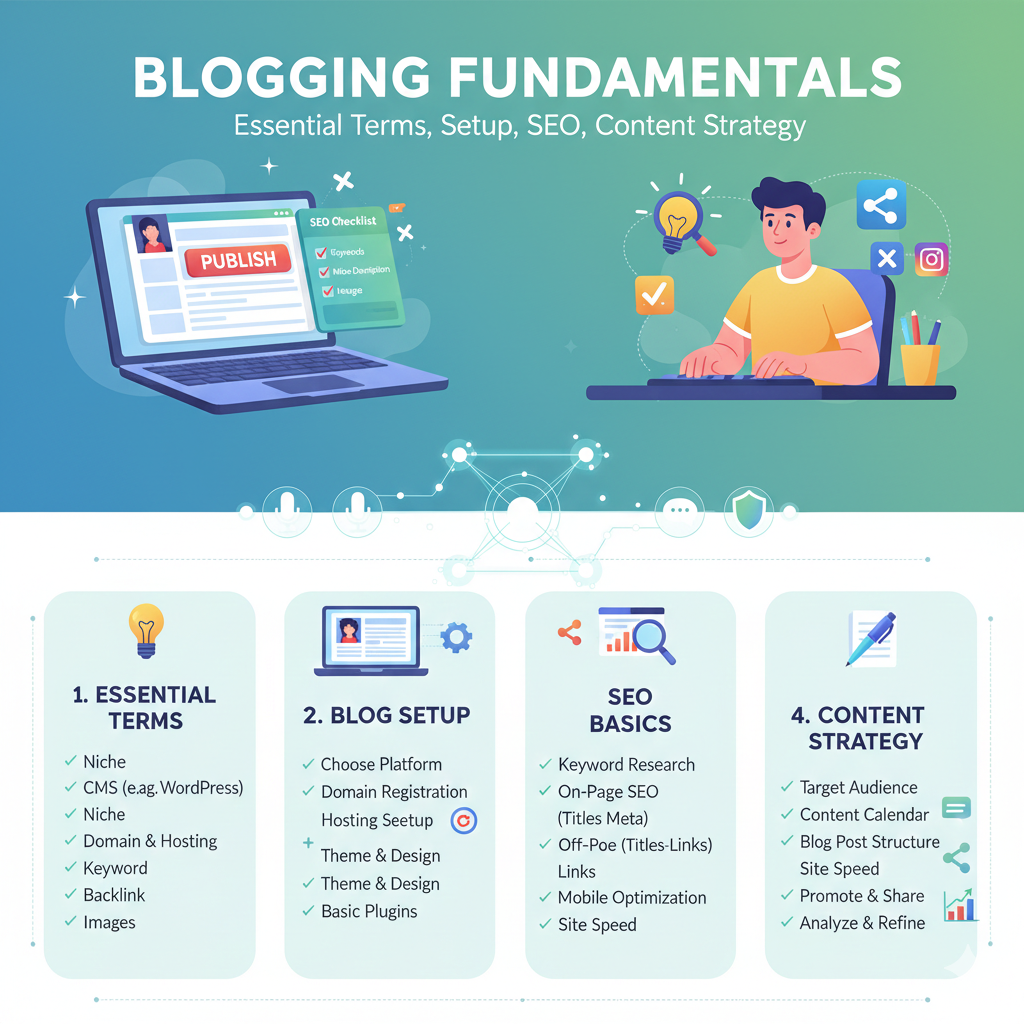
Why Blogging Still Matters in 2025
Blogs remain a top channel for long-form content, authority building, and organic search traffic.
High-quality blog content still drives sustained organic visitors and conversions when optimized correctly.
Google’s official SEO guidance emphasizes user-first content and technical correctness as core priorities.
Essential Blogging Terminology (Beginner-Friendly)
Domain: The website address people type or click to reach your blog.
Hosting: The service that stores your website files and serves them to visitors.
CMS (Content Management System): Software that makes publishing posts easy.
Theme: The visual template that controls your blog’s design and layout.
Plugin/Extension: Small add-ons that add features like SEO, caching, and contact forms.
Post vs Page: Posts are dated entries (blog posts); pages are static (about, contact).
Permalink: The permanent URL for a blog post, formatted for readability and SEO.
Meta Title & Meta Description: The title and snippet shown in search results — essential for clicks.
Canonical URL: The authoritative version of a page used to prevent duplicate-content issues.
Sitemap: A file that lists your site pages to help search engines crawl your blog.
Backlink: A link from another website to your post — still a strong SEO signal when from high-quality sites.
Organic Traffic: Visitors who find your blog via search engines rather than paid ads.
Quick Setup Checklist for New Bloggers
Choose a short, brandable domain that matches your niche.
Pick a reliable host and install a CMS like WordPress or a hosted platform like Ghost.
Install an SEO plugin, set clear permalink structure, and create essential pages (About, Contact, Privacy).
Install analytics to measure traffic and behavior.
Set up Google Search Console and submit your sitemap so Google can index your blog.
Basic SEO & Content Strategy (Actionable)
Pick one primary keyword phrase per article that reflects user intent.
Research related queries and questions to answer comprehensively in your post.
Use headings, short paragraphs, and media to make content scannable.
Optimize images and ensure fast page load times for better search performance.
Focus on Expertise, Authoritativeness, and Trustworthiness in topics that affect people’s health, finance or safety.
Reference reputable sources and link to them naturally to boost credibility.
Monetization Routes for Bloggers
Advertising networks like Google AdSense or alternative ad partners deliver display ads.
Affiliate marketing pays commissions when readers buy through your links.
Sponsored posts involve brands paying you to feature products or services.
Digital products like ebooks, courses, or templates create higher-margin revenue streams.
Memberships and paid newsletters offer recurring income from loyal readers.
Practical Content Calendar and Workflow
| Week | Task |
|---|---|
| Week 1 | Brainstorm topics, keyword research, outline 4 posts |
| Week 2 | Write drafts, add images, optimize headlines and meta descriptions |
| Week 3 | Publish 1–2 posts, promote on social, start outreach for backlinks |
| Week 4 | Analyze metrics, iterate topics, plan next month |
The New-Day AI Challenges Bloggers Must Know
AI writing tools are now ubiquitous and can speed writing, ideation, and research.
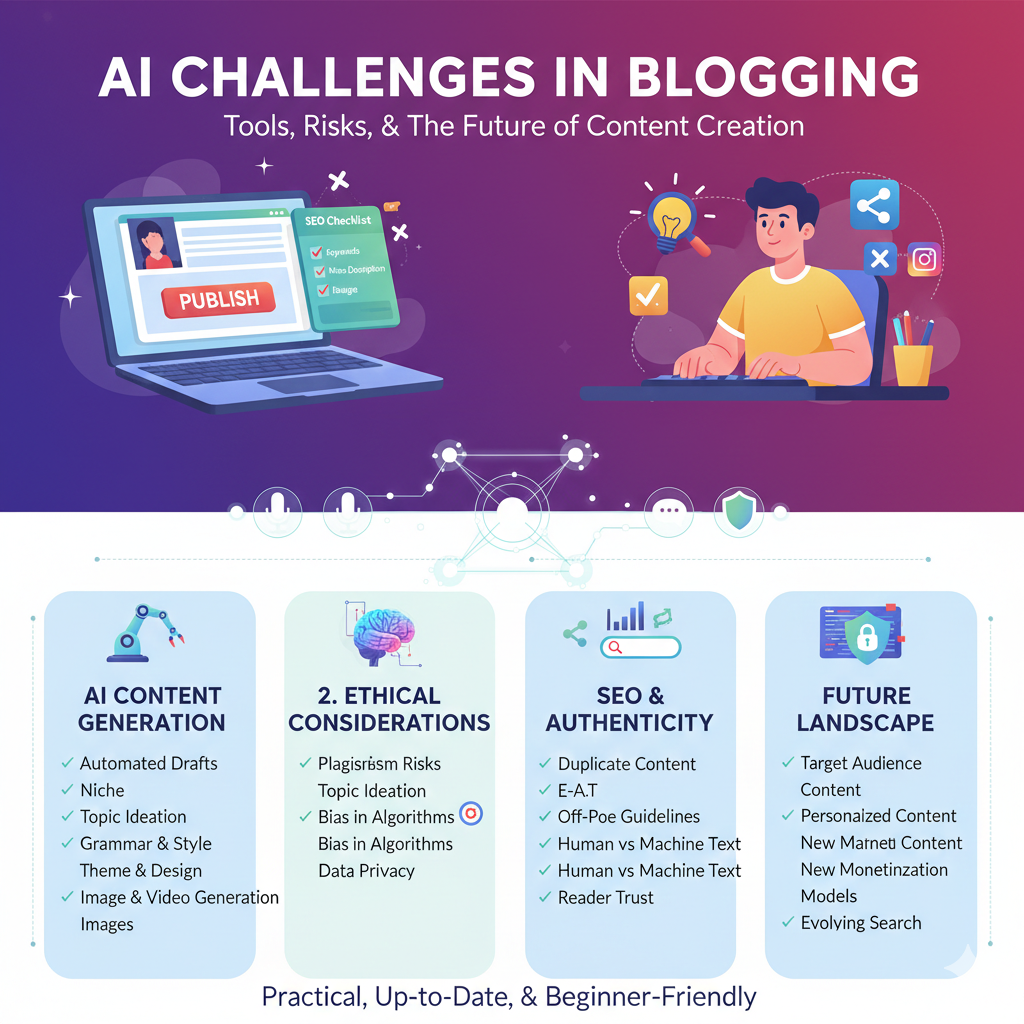
AI also brings fresh challenges: detectability, originality concerns, and search-quality expectations.
Search engines and brands increasingly prioritize human expertise and unique insights over mass-produced AI text.
AI-detection tools exist but are imperfect and should not be the sole quality gate.
Practical Rules for Using AI Safely in Blogging
- Use AI for research and first-draft generation, not as the final published text.
- Always fact-check and add original analysis, examples, or case studies a reader cannot find elsewhere.
- Disclose when AI significantly contributed to content if required by platform or contractual obligations.
- Train your internal style/voice: edit AI outputs to match your tone and add personal perspective.
Risks: Misinformation, Policy, and Detection
AI can produce plausible-sounding but false statements if prompts are not precise.
Publishers who use AI at scale without quality controls risk reputational harm and search penalties.
Staying ahead means combining human expertise, editorial review, and transparent sourcing.
Tools & Resources (High-Authority Links)
Google Search Central — SEO Starter Guide
Learn WordPress — Official Tutorials
HubSpot — How to Start a Blog & Strategy
OpenAI — Research & Safety Insights
Video Guides (non-clickable YouTube URLs)
Advanced Tips: Standing Out When AI is Everywhere
Double down on original reporting, interviews, and data-driven posts that AI cannot replicate easily.
Create content formats that require human touch such as tutorials with photos and videos of your actual process.
Build an email list and community channels where trust and relationship replace algorithm dependency.
Use schema (structured data) to help search engines understand specialized content like recipes and how-tos.
Monitor search trends and algorithm updates because SEO rules evolve and Google publishes guidance on major changes.
Quick Troubleshooting & Growth Hacks
- If traffic stalls, audit your top-performing posts and refresh them with current data and better internal links.
- Repurpose long posts into short social posts, videos, and infographics to capture multi-channel audiences.
- Run small experiments with headlines and featured images to improve CTR from Search and social platforms.
- Outreach to relevant sites for a backlink exchange only when you have genuinely useful, link-worthy content.
Conclusion: Build With Human Value, Use AI Wisely
💡 Blogging in 2025 blends timeless craft — clarity, research, and audience focus — with new AI tools and safety challenges.
Use AI to accelerate research and drafts, but not as a replacement for expertise and original thought.
Follow SEO fundamentals, measure results, and iterate consistently for sustainable growth.
Protect your brand by prioritizing accuracy, transparency, and reader trust in an AI-saturated landscape.
Good luck — and enjoy building something useful and original for your readers! 📌