
In the realm of modern technology, the “easy” problems are increasingly rare. 🤖
Automated scripts, self-healing infrastructure, and managed services handle the routine failures that used to occupy an IT professional’s day.
What remains are the complex, novel, and often baffling issues that defy standard operating procedures.
When a distributed microservices architecture starts exhibiting intermittent latency, or a cloud-native application fails silently, following a linear runbook will not save you. 📉
This is where technical knowledge must be augmented by a more fundamental skill: critical thinking.
Critical thinking for technical troubleshooting is the ability to analyze information objectively, question assumptions, and synthesize data from disparate sources to form a coherent view of reality. 🧠
It is the difference between a technician who swaps parts until something works, and an engineer who diagnoses the root cause with surgical precision.
This deep dive explores how to cultivate and apply critical thinking to become an elite troubleshooter in today’s complex technical landscape. 🚀
The Scientific Method as a Troubleshooting Framework
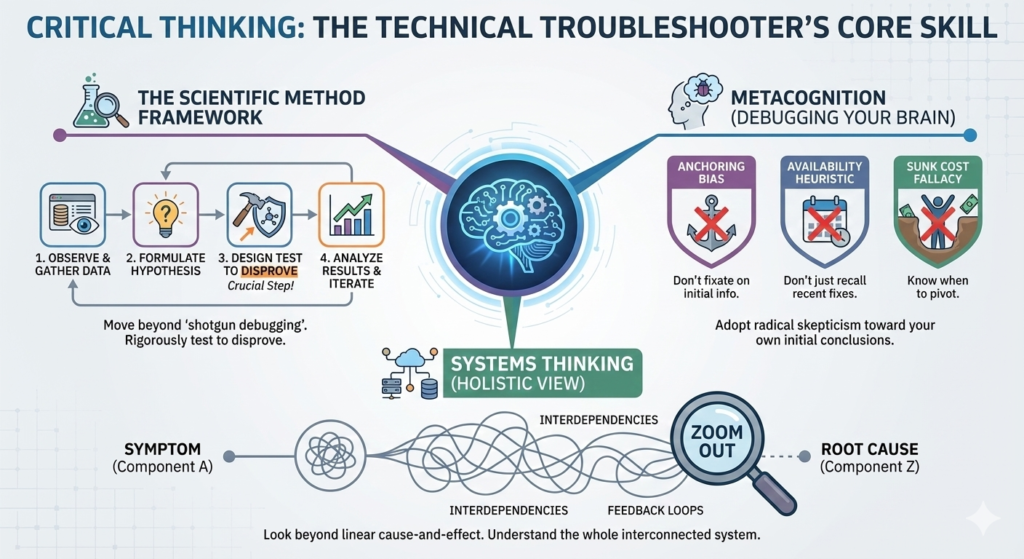
At its core, effective critical thinking in tech is the application of the scientific method to operational problems. 🧪
Too often, troubleshooters fall into the trap of “shotgun debugging”—trying every conceivable fix in rapid succession, hoping one sticks.
While this might occasionally work for simple issues, it is disastrous for complex ones; it muddies the water, introduces new variables, and rarely reveals the true root cause.
A critical thinker approaches a broken system like a scientist approaches an unknown phenomenon. 🔬
They do not immediately jump to solutions; they start with rigorous observation.
The goal is not to prove that your initial hunch is correct, but to aggressively try to disprove it.
If you believe a firewall rule is blocking traffic, your first step shouldn’t be to change the rule.
Your first step should be to perform a test that would definitively prove the firewall is not the issue (e.g., a packet capture on both sides of the barrier). 🕵️♀️
If the test fails to disprove your hypothesis, your confidence in that hypothesis increases.
For a deeper understanding of applying rigorous methodologies to software, examine IEEE Software’s insights on evidence-based software engineering.
Quote –
“The important thing is not to stop questioning. Curiosity has its own reason for existing.” – Albert Einstein
This relentless questioning is the fuel for the scientific approach to diagnostics.
The video above, while focused on physics, perfectly illustrates the mindset required: the discipline to design experiments that try to break your own theories. 🔨
Let’s contrast the impulsive approach with the critical approach.
| Impulsive Troubleshooting (Low Critical Thinking) 🐇 | Structured Troubleshooting (High Critical Thinking) 🐢 |
|---|---|
| Reacts immediately to the first error message seen. | Gathers holistic data (logs, metrics, user reports) before forming an opinion. |
| Formulates one theory and tries to prove it right. | Formulates multiple alternative hypotheses and tries to disprove them. |
| Makes multiple changes simultaneously. | Isolates variables and changes only one thing at a time. |
| Relies on intuition or “what worked last time.” | Relies on observable evidence and logical deduction. |
Metacognition: Debugging Your Own Brain
The biggest obstacle in any troubleshooting scenario is rarely the technology itself; it is the troubleshooter’s own brain. 🧠💥
Humans are evolved for pattern matching in the physical world, not for debugging asynchronous code across distributed servers.
We rely on cognitive shortcuts, or biases, to make quick decisions.
In high-pressure technical scenarios, these biases kill critical thinking.
Metacognition—the act of thinking about your own thinking—is the vital defense against these mental traps. 🛡️
You must actively monitor your thought process for common derailments.
- Anchoring Bias: This occurs when you latch onto the first piece of information you receive. If a user says “The internet is down,” you might anchor to a network issue, ignoring the fact that only their specific application is failing. ⚓ You must consciously “pull up anchor” and re-evaluate the entire landscape.
- Availability Heuristic: We tend to overestimate the likelihood of events that are easy to recall. If you just fixed a DNS issue yesterday, your brain will desperately try to fit today’s problem into the “DNS issue” box, even if the symptoms don’t fit. 📦
- Sunk Cost Fallacy: You have spent four hours investigating a specific database table. It is yielding no results, but you keep digging because you’ve already invested so much time. A critical thinker knows when to cut bait and pivot to a new line of inquiry entirely. 🎣
To combat these, you must adopt a posture of radical skepticism toward your own initial conclusions.
Always ask yourself: “What if the opposite of what I believe is true? What evidence would I need to see?”
Learning about these mental shortcuts is essential; the Nielsen Norman Group offers excellent resources on heuristics that apply beyond just usability. 📖
Quote –
“The first principle is that you must not fool yourself—and you are the easiest person to fool.” – Richard Feynman
Feynman’s warning is perhaps the most important rule in technical troubleshooting. 🚫🤡
The video above provides a great primer on why we fall for these mental traps and how to start recognizing them in real-time. ⏳
Systems Thinking for Modern Infrastructure
In the era of monolithic servers, if the application was slow, you looked at the server CPU. 🖥️
Today, critical thinking requires “systems thinking.”
Modern applications are complex adaptive systems; they are networks of interdependent components where the behavior of the whole cannot be predicted just by looking at the parts.
A critical thinker understands that a symptom in Component A is very likely caused by a subtle change in Component Z, three layers removed. 🧅
You must stop looking for linear cause-and-effect and start looking for feedback loops, bottlenecks, and emergent behaviors.
When troubleshooting, zoom out. 🔭
Draw a mental map (or a literal whiteboard map) of the data flow.
Ask second-order questions: “If this cache fails, what is the fallback mechanism, and could that fallback be overwhelmed?”
Critical thinking means realizing that the error log is not the territory; it is merely a incomplete map. 🗺️
You need to understand the relationship between the container, the orchestrator, the service mesh, and the underlying cloud infrastructure.
For a foundational understanding of this approach, The Systems Thinker provides essential concepts that apply directly to IT architecture. 🏗️
This video gives a fantastic overview of complex systems, explaining why traditional linear thinking fails when dealing with interconnected networks like modern IT infrastructure. 🕸️
Critical Thinking in the Age of AI Assistance
The latest wrinkle in technical troubleshooting is the rise of generative AI tools like ChatGPT and GitHub Copilot. 🤖💻
These tools are incredibly powerful, but they present a new threat to critical thinking: complacency.
It is tempting to paste an error code into an AI prompt and blindly execute the suggested solution.
This is the modern equivalent of script-kiddie behavior, just with a more sophisticated script.
A critical thinker uses AI as a force multiplier, not a replacement for their own intellect. ⚡
Use AI to brainstorm hypotheses you might have missed.
Use it to generate boilerplate code for testing scripts, which you then verify. 🧐
Never accept an AI’s diagnosis without understanding the “why” behind it and verifying it with empirical data from your system.
If the AI suggests a configuration change, ask it why that change should work, and what the potential side effects are.
Treat the AI as a junior partner: brilliant and fast, but prone to confident hallucinations and lacking context about your specific environment.
The future of troubleshooting belongs to those who can synthesize human critical judgment with machine speed. 🤝
Industry leaders are already analyzing this shift; Gartner provides deep insights into how generative AI is reshaping IT operations. 📊
Conclusion: The Forever Skill
Technology stacks change every few years. 🗓️
The tools you use today will be obsolete in a decade.
However, the ability to think critically—to deconstruct a problem, identify biases, formulate rigorous tests, and understand complex systems—is timeless.
It is the one skill that guarantees your relevance regardless of what new framework or cloud platform emerges next. 🌟
Developing this skill requires deliberate practice.
The next time you face a daunting issue, resist the urge to react immediately.
Pause. Breathe. Engage your metacognition.
Formulate a hypothesis. Design a test to break it. 🛠️
By embracing the discomfort of deep thinking over the instant gratification of quick fixes, you transform from a troubleshooter into a true technical problem solver. 🏆