






The architecture of modern digital ecosystems demands absolute precision in managing autonomous decision-making frameworks – AI TRiSM tools for decentralized governance.
As networks scale beyond human oversight capabilities, the integration of advanced risk management protocols becomes a non-negotiable baseline for system stability.
We are no longer building static databases; we are engineering self-correcting, decentralized organisms that require rigorous security management to prevent catastrophic failure.
The Imperative of Automated Trust Frameworks
Deploying AI TRiSM tools for decentralized governance is the only viable mechanism to secure multi-node environments against adversarial manipulation.
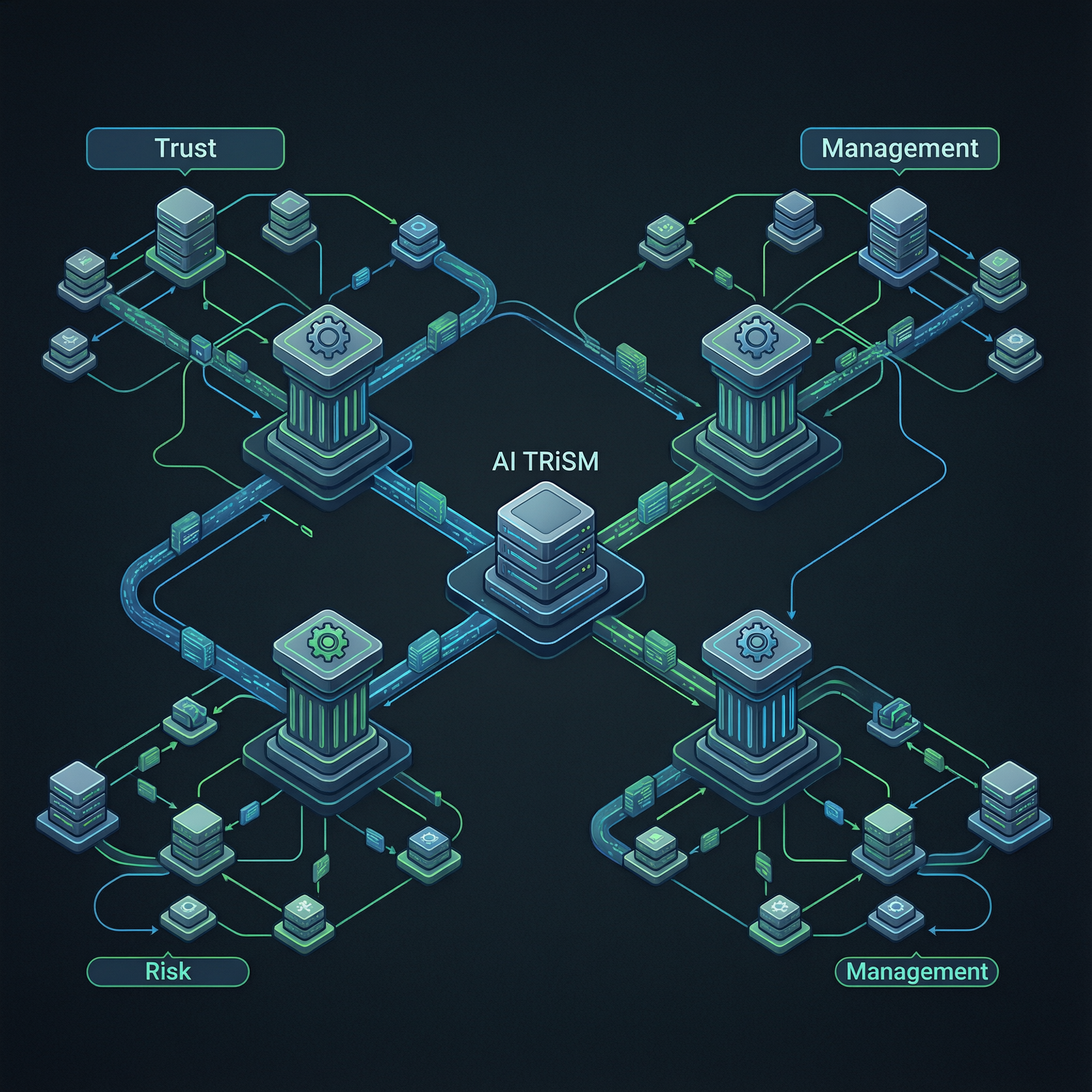
Trust is no longer a philosophical concept in network design; it is a mathematically verifiable metric enforced by automated security protocols.
When autonomous agents execute smart contracts, the underlying risk management engine must evaluate millions of variables in milliseconds.
This requires a fundamental shift from reactive patching to predictive threat modeling powered by deep learning algorithms.
“A decentralized network without automated trust verification is just a distributed ledger waiting to be exploited.”
Industry leaders at Gartner.com emphasize that organizations ignoring these frameworks will face exponential vulnerability to model drift and data poisoning.
By embedding continuous monitoring directly into the consensus layer, we eliminate the latency between threat detection and network isolation.
- Continuous behavioral analysis of node operators to detect anomalous voting patterns.
- Automated rollback mechanisms triggered when smart contract execution deviates from expected parameters.
- Cryptographic proof of model integrity ensuring that AI governance agents have not been compromised.
Engineering the Security Perimeter
The security perimeter in a decentralized architecture is not a traditional firewall; it is the consensus mechanism itself.
Securing the perimeter requires encrypting the governance logic so that only mathematically verified agents can propose state changes.
Researchers at MIT.edu have demonstrated that zero-knowledge proofs can validate governance decisions without exposing the underlying proprietary algorithms.
This ensures that the network remains transparent to its participants while keeping the core risk management logic shielded from adversarial reverse engineering.
We must also account for physical layer vulnerabilities, which is why automotive and robotics engineers at Honda.com are pioneering hardware-level security for autonomous systems.
Applying these hardware-rooted trust principles to digital governance nodes creates an impenetrable foundation for automated decision-making.
Check out My Teach collection Amazon products
| TRiSM Component | Decentralized Application | Risk Mitigated |
|---|---|---|
| Trust Management | Node Reputation Scoring | Sybil Attacks |
| Risk Management | Dynamic Quorum Adjustment | 51% Takeovers |
| Security Management | Zero-Knowledge Proofs | Data Poisoning |
The integration of these components creates a self-healing network topology that adapts to emerging threats in real-time.
Scaling Governance Through Predictive Analytics
As we push into the next iteration of network architecture, predictive analytics become the central nervous system of decentralized governance.
Predictive models allow the network to anticipate governance bottlenecks and automatically reallocate computational resources before congestion occurs.
The National Institute of Standards and Technology at NIST.gov outlines strict guidelines for AI risk management that must be hardcoded into these predictive engines.
Compliance is not an afterthought; it is a structural requirement embedded directly into the smart contract execution environment.
When an AI agent proposes a network upgrade, the TRiSM framework instantly simulates the macro-economic impact across all connected nodes.
“Automation without predictive risk modeling is just accelerating the speed of your own obsolescence.”
This simulation layer prevents catastrophic cascading failures by rejecting proposals that exceed the network’s predefined risk tolerance thresholds.
Furthermore, the IEEE.org advocates for standardized telemetry data to ensure cross-chain interoperability and secure data transmission.
Standardized telemetry allows our TRiSM tools to monitor and secure assets across multiple decentralized environments simultaneously.
- Real-time stress testing of proposed governance parameters against historical market crash data.
- Automated liquidity provisioning to stabilize token economics during periods of high volatility.
- Cross-chain state verification to prevent bridge exploits and double-spending attacks.
Hardware-Level Root of Trust and Cryptographic Verification
The foundation of any secure decentralized governance model must begin at the silicon level.
Check out My Teach collection Amazon products
Software-defined security is inherently vulnerable to memory scraping and kernel-level exploits.
By anchoring the AI TRiSM tools for decentralized governance to a hardware root of trust, we ensure that the cryptographic keys governing node identity cannot be extracted.
Trusted Platform Modules and secure enclaves provide the physical isolation necessary to protect the model weights of our governance AI agents.
When an AI agent signs a governance proposal, the private key never leaves the secure enclave, rendering remote code execution attacks completely ineffective.
This hardware-backed identity verification is critical for preventing Sybil attacks and ensuring absolute systemic integrity in high-stakes decentralized networks.
Mitigating Adversarial Machine Learning Threats
Adversarial machine learning poses a severe threat to autonomous governance agents that rely on continuous learning algorithms.
Without robust TRiSM protocols, malicious actors can inject subtle perturbations into the training data, gradually shifting the model’s decision boundary.
This model drift can lead to catastrophic governance failures, where the AI inadvertently approves malicious proposals or rejects critical security patches.
To counter this, we implement differential privacy techniques and federated learning architectures that allow nodes to update their models without exposing raw data.
Furthermore, we deploy ensemble methods where multiple independent AI agents must reach a cryptographic consensus before any governance action is executed.
The Future of Autonomous Asset Networks
We are transitioning from human-managed protocols to fully autonomous digital asset networks that operate with zero manual intervention.
The ultimate objective is to create a self-sustaining digital economy where AI TRiSM tools for decentralized governance enforce absolute systemic integrity.
This requires a fundamental rethinking of how we allocate capital, manage risk, and distribute value across global networks.
Systems architects must design these frameworks to be inherently antifragile, meaning they grow stronger when subjected to stress and adversarial attacks.
By leveraging advanced cryptographic primitives and machine learning, we can build networks that are practically immune to traditional vector attacks.
“The network of the future will not just process transactions; it will autonomously defend its own existence.”
Implementing these advanced trust frameworks is the definitive competitive advantage for any enterprise operating in the decentralized space.
Those who fail to integrate automated risk management will inevitably be outmaneuvered by systems that optimize for survival and growth at machine speed.
The architecture of tomorrow is being written today, and it demands absolute rigor, technical excellence, and strategic foresight.
Search Helpful “AI TRiSM tools for decentralized governance” Videos on YouTube
https://www.youtube.com/watch?v=
🔍 Explore More: See all guides for AI TRiSM tools for decentralized governance.
Check out My Teach collection Amazon products