

API Integration Nightmares? Common Errors and Best Practices 🌐
The modern digital landscape is a vast, interconnected ecosystem powered by APIs. 🔌
Nearly every application relies on complex third-party APIs to deliver functionality.
While APIs offer unparalleled speed and capabilities, integration often brings development headaches.
Simple changes in response formats or expired tokens can halt entire applications.
Successful API integration requires defensive programming and robust error handling.
This guide illuminates common pitfalls and provides frameworks for resilient integrations.
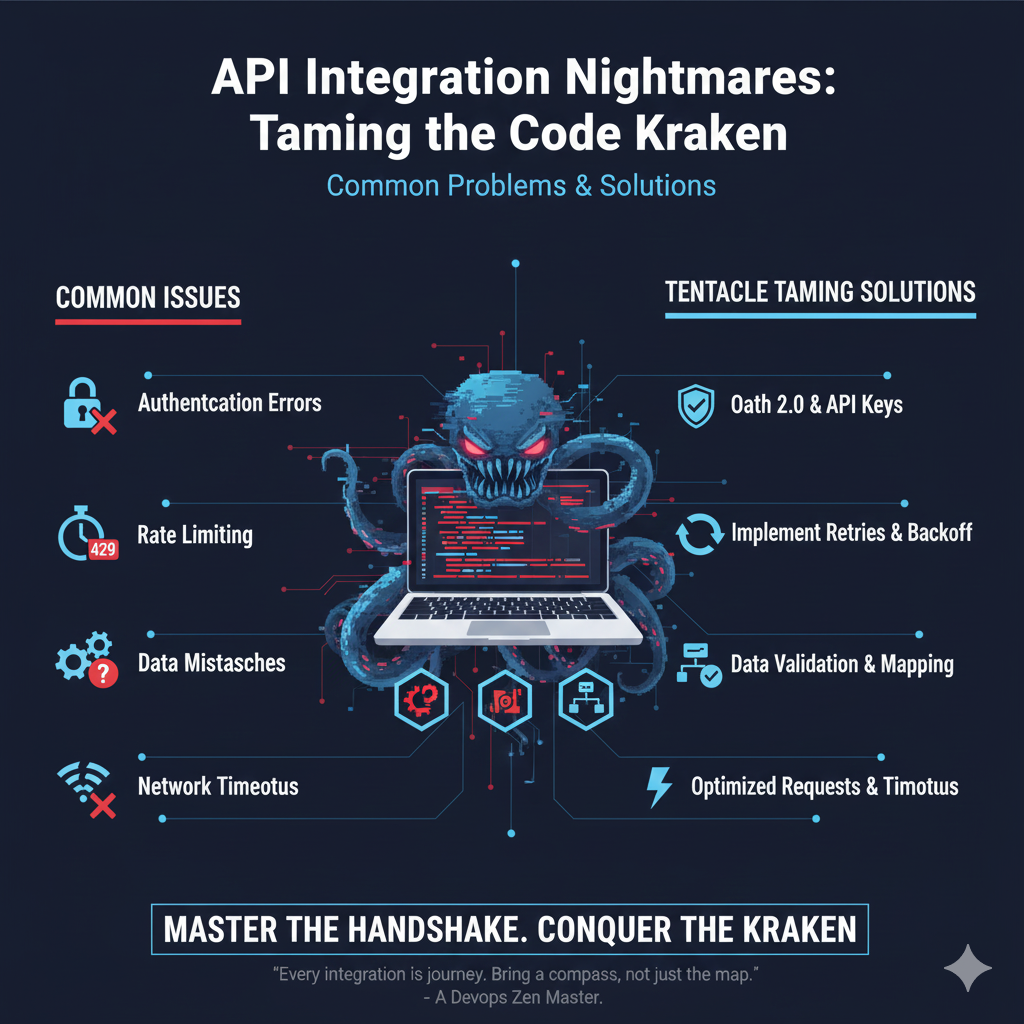
The Four Horsemen of API Errors 🐎
HTTP status codes provide the first critical information when API calls fail.
These codes categorize into client errors (4xx) and server errors (5xx).
Understanding their nuances is essential for effective troubleshooting.
Client Errors (4xx Status Codes) 👤
Client errors indicate problems with the request from the consuming application.
The application must change something before retrying these failed requests.
| Status Code | Name | Common Causes | Resolution Practice |
|---|---|---|---|
| 400 | Bad Request | Malformed JSON, missing parameters | Implement client-side validation |
| 401 | Unauthorized | Expired API keys, invalid tokens | Automatic token refresh logic |
| 403 | Forbidden | Insufficient permissions | Check API key scope and roles |
| 404 | Not Found | Incorrect endpoints, deleted resources | Verify API documentation paths |
| 429 | Too Many Requests | Rate limit exceeded | Exponential backoff retry strategy |
Server Errors (5xx Status Codes) 🖥️
Server errors indicate problems on the API provider’s side beyond client control.
While clients cannot fix these, they must handle them gracefully and appropriately.
- 500 Internal Server Error: Generic catch-all for provider exceptions requiring safe retry mechanisms. 🔄
- 503 Service Unavailable: Temporary server overloads often including Retry-After headers to respect. ⏰
Network and Timeout Issues 🌐
Network-level errors create ambiguity about request processing status.
Timeouts don’t confirm whether requests were processed by the server.
This ambiguity leads directly to the critical need for idempotency implementation.
Authentication and Security Pitfalls 🔐
Security lapses in API integration can expose sensitive data and enable unauthorized access.
Proper authentication practices prevent catastrophic security failures.
Expired Credentials and Token Management 🔑
Expired authentication tokens are the most frequent cause of 401 errors.
Modern APIs using OAuth 2.0 require robust token management systems.
Best practices include automatic token refresh upon detecting 401 responses.
Failure to automate this process guarantees service disruption and user frustration.
Learn about secure OAuth 2.0 implementation for your applications.
Secure Storage of Secrets 🗄️
Hardcoding API keys in source code represents catastrophic security failure.
Secrets must be stored securely outside application repositories.
| Security Practice | Description | Example Tools |
|---|---|---|
| Environment Variables | Development use for non-sensitive keys | .env files, shell exports |
| Secret Managers | Secure credential storage and rotation | AWS Secrets Manager, HashiCorp Vault |
| Least Privilege | Minimum permissions for tasks | Custom IAM policies, scoped tokens |
HTTPS and Data Integrity 🔒
All API communication must occur over encrypted HTTPS connections.
Unencrypted HTTP attempts should trigger critical failure responses.
This prevents man-in-the-middle attacks and maintains data integrity during transit.
The Performance and Reliability Challenge ⚡
Functional API integration isn’t enough—it must perform reliably under load.
Scalable applications handle performance challenges gracefully and efficiently.
Rate Limiting and Throttling 🚦
API providers enforce rate limits to protect infrastructure and ensure fair usage.
Hitting 429 errors is inevitable, but graceful handling separates robust integrations.
The gold standard is Exponential Backoff with Jitter for retry strategies.
- Exponential Backoff: Wait exponentially increasing times between retries (1s, 2s, 4s…). 📈
- Jitter: Add random delays to prevent simultaneous client retries overwhelming servers. 🎲
Respect X-RateLimit-Remaining and Retry-After headers for intelligent request pacing.
Handling Large Payloads with Pagination 📄
Fetching massive datasets in single calls causes timeouts and memory exhaustion.
Robust integrations must respect API pagination schemes for efficient data handling.
- Offset/Limit: Request specific page numbers and sizes for simple but potentially inefficient traversal. 🔢
- Cursor-Based: Use tokens pointing to next result pages for robust, consistent large dataset handling. 🔄
Always implement page-by-page processing to prevent memory overloads.
Idempotency: The Key to Safe Retries 🔑
Idempotency allows operations to execute multiple times without changing results.
This is crucial for handling timeouts and 5xx errors without duplicate actions.
Consider payment APIs where timeout uncertainty risks double-charging customers.
The solution is Idempotency Keys—unique UUIDs sent in request headers.
API providers return original results for duplicate keys within time windows.
This makes retries safe and predictable for critical operations.
Best Practices for Robust Integration 🛡️
Moving from functional to robust integration requires comprehensive defensive strategies.
These practices ensure applications remain stable despite dependency fluctuations.
Defensive Programming and Validation 🛠️
Third-party API data should never be trusted implicitly without validation.
- Schema Validation: Validate response structure and data types before usage with JSON Schema tools. 📋
- Input Sanitization: Clean user inputs passed to APIs to prevent injection attacks. 🧼
Read our guide on API security best practices for comprehensive protection.
Monitoring and Alerting 📊
You cannot fix invisible problems—robust integration requires continuous monitoring.
Track API performance from the client perspective for proactive issue detection.
| Metric to Monitor | Importance | Alert Threshold Example |
|---|---|---|
| Success Rate (2xx) | Overall health and reliability | Below 99.5% for 5 minutes |
| Error Rate (4xx/5xx) | Client or provider issues | Exceeds 0.5% for 5 minutes |
| Latency (P95) | API call speed | Exceeds 500ms consistently |
Versioning and Documentation 📚
Always treat API provider documentation as the single source of truth.
Explicitly specify API versions in requests via URLs or custom headers.
Relying on “latest” versions invites disaster when providers release breaking changes.
The Circuit Breaker Pattern ⚡
When API dependencies fail, naive clients continue hammering failing services.
This consumes resources and risks cascading failures in consuming applications.
The Circuit Breaker pattern prevents this destructive behavior effectively.
- Closed State: Requests pass through normally until error thresholds trigger opening. ✅
- Open State: Requests fail immediately without API calls during timeouts. ❌
- Half-Open State: Single test requests determine if dependencies have recovered. 🔄
This pattern gives failing dependencies recovery time while protecting applications.
Conclusion: Mastering API Resilience 🏆
API integration forms the cornerstone of modern software development.
This relationship requires constant vigilance and trust between providers and consumers.
Integration nightmares—400s, 500s, rate limits—are predictable events requiring planning.
Master HTTP status codes, secure credentials, and implement intelligent retry logic.
Adopt defensive programming with schema validation and circuit breaker patterns.
Robust integration handles errors gracefully, ensuring application resilience despite dependency failures.
Transform integration anxiety into stability and strength for your applications.
For more integration insights, explore our microservices communication guide and REST API best practices.