
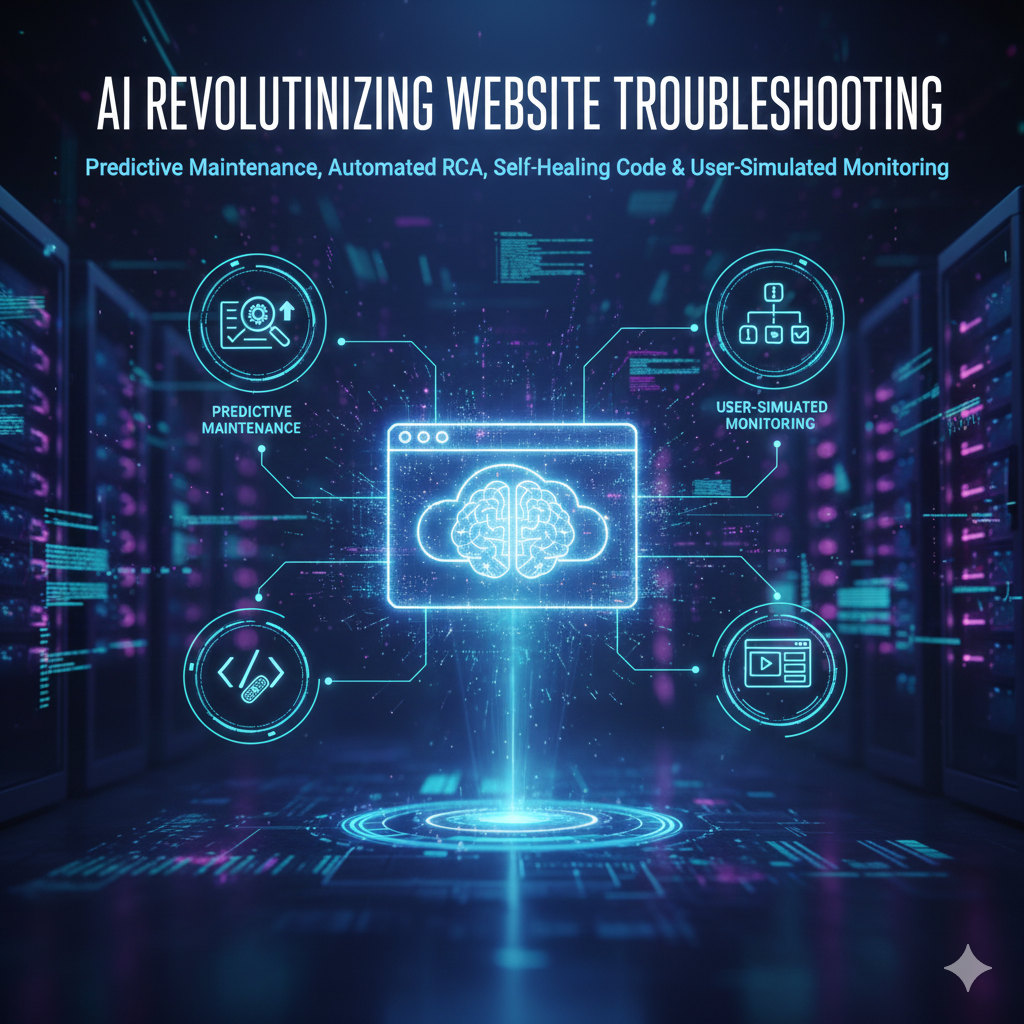
🤖
Modern web architecture represents a marvel of distributed complexity and interconnected services. 🌐
Microservices, serverless functions, and global CDNs create systems generating overwhelming data volumes.
Traditional troubleshooting methods struggle with terabytes of logs, metrics, and trace data.
Artificial Intelligence transforms website operations from reactive firefighting to predictive maintenance.
AI augments human developers with intelligent systems diagnosing problems faster than ever before.
This guide explores AI’s transformative role in monitoring, analysis, and automated remediation.
AI-Powered Monitoring: From Reactive to Predictive 📊
Traditional monitoring relies on static thresholds prone to alert fatigue and missed degradations.
AI-powered monitoring establishes dynamic baselines learning normal system behavior patterns.
Anomaly Detection and Dynamic Baselines 📈
AI models analyze historical data across all metrics to understand typical system patterns.
This enables sophisticated anomaly detection beyond simple static threshold monitoring.
| Traditional Monitoring | AI-Powered Monitoring | Advantage |
|---|---|---|
| Alert if latency > 500ms | Alert if latency exceeds learned 99th percentile | Context-aware thresholding |
| Triggers for expected spikes | Suppresses expected pattern alerts | Reduced alert fatigue |
| Reactive problem detection | Predictive failure identification | Hours of advance warning |
AI identifies subtle deviations like gradual latency increases long before user impact.
User-Simulated Monitoring (AI Agents) 👤
Traditional synthetic monitoring uses scripted paths with fixed selectors and interactions.
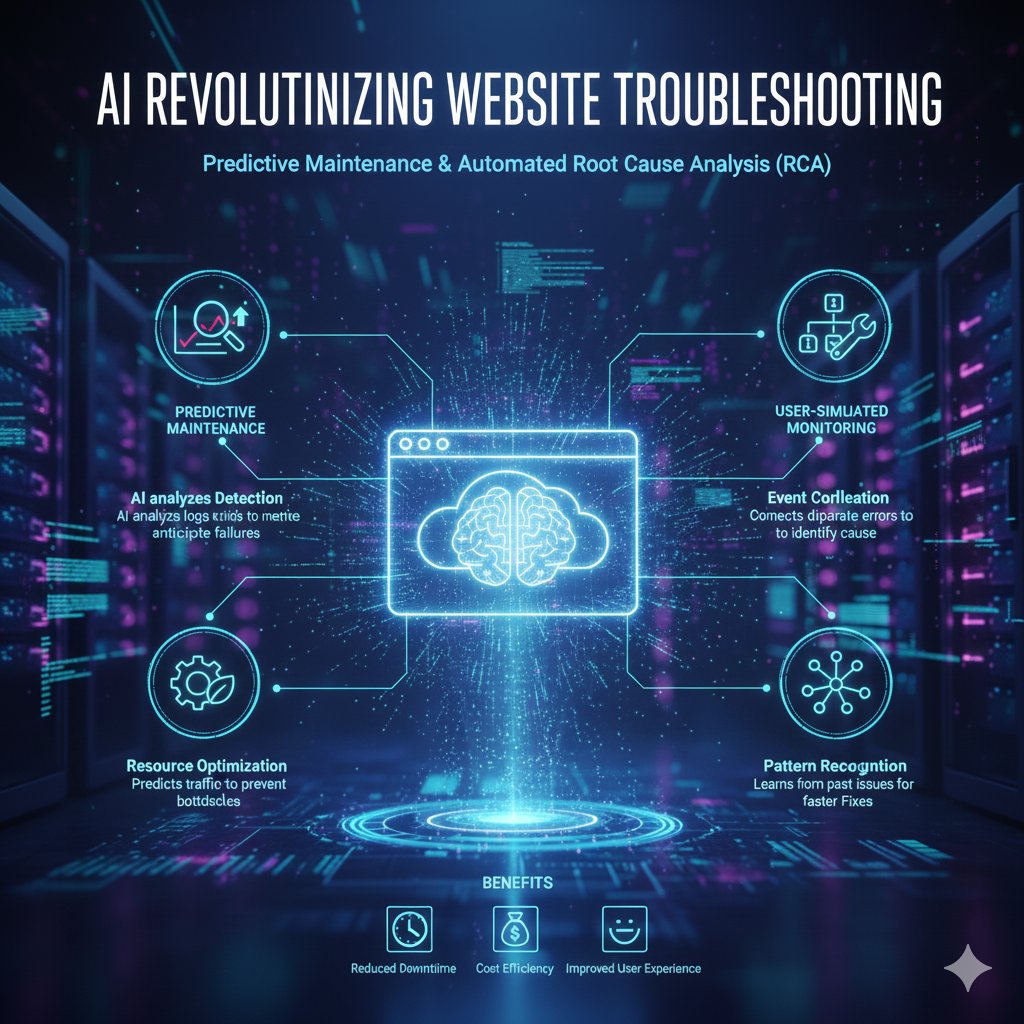
AI Agents revolutionize this approach by simulating genuine human user behavior patterns.
- Dynamic Exploration: Navigate sites using visual cues and natural language instructions. 🧭
- Visual Regression Detection: Computer vision compares screenshots for subtle layout changes. 👁️
- Complex Flow Simulation: Interact with forms, CAPTCHAs, and multi-step processes. 🔄
AI Agents ensure websites remain fully functional beyond simple uptime monitoring.
Log and Metric Correlation 🔗
AI systems excel at processing massive log volumes that overwhelm human analysts.
Natural language processing clusters log entries identifying patterns and anomalies.
AI correlates log events with metric spikes and trace data for immediate context.
Learn about implementing AI-powered monitoring for your web applications.
Automated Root Cause Analysis (RCA) 🎯
Root Cause Analysis represents the most time-consuming outage investigation phase.
Distributed systems require multiple team coordination and dashboard navigation.
AI revolutionizes RCA through causal inference and dependency tracing algorithms.
AI-Driven Causal Inference 🔍
AI applies graph theory and machine learning to trace dependency flows across systems.
Instead of simple correlation, AI identifies true causal factors triggering chain reactions.
| Scenario | Human Observation | AI-RCA Conclusion |
|---|---|---|
| Service Failure | API Gateway and database spiked simultaneously | Faulty cache configuration caused database overload |
| Performance Issue | Multiple services experiencing high latency | Specific microservice deployment introduced inefficient queries |
AI provides diagnosis and prescription within seconds of incident detection.
The Automated “5 Whys” Technique ❓
Traditional “5 Whys” root cause analysis requires manual iterative investigation.
AI automates this process through recursive data drilling and pattern recognition.
- Why 1: Service failure reason identification. 🔍
- Why 2-4: Dependency and resource issue tracing. 📊
- Why 5: Root cause code or configuration change pinpointing. 🎯
Automated analysis eliminates human bias ensuring consistent root cause identification.
Automated Remediation and Self-Healing Systems 🔧
The ultimate AI troubleshooting goal moves from diagnosis to automated remediation.
Self-healing systems represent the future of autonomous website operations.
Automated Runbooks and Playbooks 📋
AI diagnoses trigger pre-defined remediation actions without human intervention.
This approach evolves traditional runbooks into automated healing processes.
- Resource Exhaustion: Automatic horizontal scaling of containers and services. 📈
- Certificate Expiration: Automated renewal with CDN cache refresh. 🔄
- Database Issues: Connection pool optimization and query killing. 🗄️
Automated remediation significantly reduces Mean Time to Repair for common issues.
AI-Powered Code Debugging and Fixing 🐛
The most exciting AI frontier involves analyzing stack traces and suggesting code fixes.
AI debugging tools transform developer workflows from investigation to review.
- Context Analysis: Ingest stack traces, logs, and relevant code snippets. 📝
- Fix Suggestions: Propose null checks, variable corrections, and logic fixes. 💡
- Patch Generation: Create Pull Requests with explanations and unit tests. 🔄
Explore AI-powered debugging tools for your development workflow.
The New Role of the Human Developer 👨💻
As AI handles repetitive troubleshooting tasks, human roles evolve strategically.
Developers transition from reactive firefighters to system architects and AI trainers.
From Triage to Training 🎓
Less time spent sifting logs means more focus on complex architectural challenges.
Human creativity addresses novel problems while AI manages routine operations.
Developers ensure AI model accuracy and safe automated remediation procedures.
The Need for Explainable AI (XAI) 💬
Production AI systems require transparency and understandable decision processes.
Explainable AI enables auditing and understanding of AI diagnoses and actions.
Human teams maintain ultimate control and accountability over production environments.
Conclusion: The AI-Human Partnership 🤝
AI represents a fundamental paradigm shift in website troubleshooting approaches.
Reactive manual processes transform into proactive automated sciences.
Dynamic anomaly detection and self-healing remediation achieve unprecedented stability.
The future features powerful partnerships between human ingenuity and artificial intelligence.
Developers gain tireless intelligent co-pilots ensuring web reliability and performance.
For more AI insights, explore our AI operations guide and Google AI resources.