
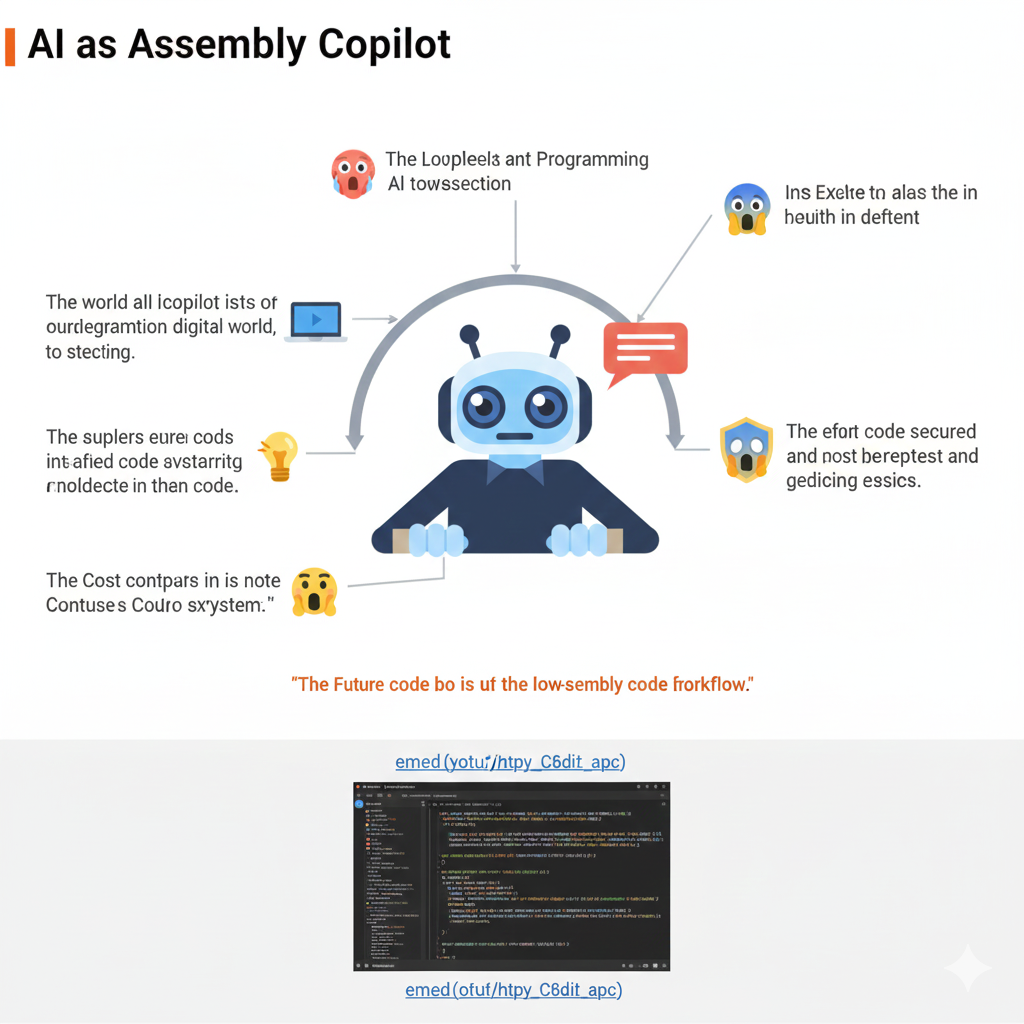
For decades, assembly language programming has been the domain of specialists—those willing to engage directly with the CPU’s instruction set, managing registers, memory, and control flow with meticulous precision. 💡
The barrier to entry has been formidable: assembly requires not only an understanding of high-level programming concepts but also deep knowledge of CPU architecture, calling conventions, and optimization techniques.
However, the emergence of large language models (LLMs) and AI-powered code generation tools is fundamentally transforming this landscape.
Tools like GitHub Copilot, ChatGPT, and specialized AI code generators are now capable of assisting developers in writing assembly code, optimizing low-level routines, and even explaining complex assembly patterns.
This democratization of assembly programming represents a paradigm shift in how we approach low-level code generation, making it accessible to a broader audience while simultaneously enabling expert developers to work more efficiently.
The implications are profound.
AI copilots can analyze high-level requirements and generate corresponding assembly code, suggest optimizations based on CPU architecture, and help debug cryptic assembly routines.
They can accelerate the development of performance-critical sections, reduce human error in manual assembly writing, and serve as an educational tool for those learning low-level programming.
Yet, this technological advancement also raises important questions about code quality, security, and the role of human expertise in an increasingly automated landscape.
This article explores the current state of AI-assisted assembly programming, examining the capabilities and limitations of modern AI copilots, their practical applications, and the future trajectory of this transformative technology.
Section 1: The Evolution of Code Generation and AI Copilots 🤓
The journey from traditional compilers to modern AI-powered code generation represents a fundamental shift in how we think about programming assistance.
From Compilers to AI
Traditional compilers have long served as the bridge between high-level languages and machine code.
They parse source code, perform semantic analysis, and generate optimized assembly or machine code.
However, compilers operate within a rigid, rule-based framework.
They follow predetermined algorithms for code generation and optimization, and while modern compilers are remarkably sophisticated, they cannot adapt to novel programming patterns or provide creative solutions to complex problems.
AI-powered code generation, by contrast, is based on statistical models trained on vast corpora of code.
These models learn patterns, idioms, and best practices from millions of examples, enabling them to generate code that is not just correct but idiomatic and often optimized.
When asked to generate assembly code for a specific task, an AI copilot doesn’t simply follow a deterministic algorithm; it draws on learned patterns to produce code that reflects real-world practices.
GitHub Copilot and the Rise of AI Pair Programming
GitHub Copilot, powered by OpenAI’s Codex model, has emerged as one of the most widely adopted AI coding assistants.
It integrates directly into popular IDEs like Visual Studio Code and provides real-time code suggestions as developers type.
For assembly programming, Copilot can suggest instruction sequences, help with register allocation, and even generate entire functions based on comments describing the desired behavior.
The effectiveness of Copilot for assembly programming depends on several factors.
First, the quality of the prompt or context matters significantly.
A well-written comment describing the function’s purpose and parameters will yield better suggestions than a vague one.
Second, the target architecture matters—Copilot has seen more x86-64 and ARM assembly in its training data than, say, RISC-V, so it performs better on more common architectures.
Third, the developer’s expertise is crucial; an experienced assembly programmer can evaluate, refine, and optimize Copilot’s suggestions, while a novice might accept suboptimal code without question.
The ability of Copilot to understand the surrounding code context and provide relevant, low-level suggestions is a game-changer for productivity in C and C++ development, where inline assembly is often used.
ChatGPT and Conversational Code Generation
ChatGPT and other conversational AI models offer a different paradigm for code generation.
Rather than providing inline suggestions as you type, these models engage in dialogue with the developer.
A programmer can describe a complex algorithm in natural language, ask ChatGPT to generate assembly code, and then iteratively refine the result through conversation.
This conversational approach is particularly valuable for assembly programming, where the relationship between high-level intent and low-level implementation can be complex and non-obvious.
For example, a developer might ask ChatGPT: “Generate x86-64 assembly code for a function that takes an array of 32-bit integers and returns the sum, using SIMD instructions for performance.”
ChatGPT can provide a complete implementation, explain the register usage, and even discuss optimization trade-offs.
This level of interaction enables rapid prototyping and exploration of different implementation strategies.
The conversational nature of these tools makes them excellent for learning and for generating complex, self-contained low-level routines.
Section 2: Practical Applications of AI in Low-Level Code Generation 📌
The real-world benefits of AI-assisted assembly programming are becoming increasingly apparent across diverse domains.
Performance-Critical Code Optimization
One of the most compelling use cases for AI copilots is the optimization of performance-critical code sections.
Modern CPUs have complex instruction sets with subtle performance characteristics.
Certain instruction sequences are faster than others, cache behavior is non-obvious, and branch prediction can significantly impact performance.
AI models, trained on vast amounts of optimized code, can suggest instruction sequences that leverage these characteristics.
For instance, an AI copilot might suggest using SIMD instructions (SSE, AVX, NEON) to vectorize a loop, or recommend specific instruction orderings to minimize pipeline stalls.
While a skilled assembly programmer might arrive at similar optimizations through experience and knowledge, an AI copilot can accelerate this process and provide suggestions that even experts might not have considered.
This is where AI truly shines, acting as a force multiplier for optimization efforts.
Embedded Systems and Firmware Development
Embedded systems often require hand-written assembly code for tasks like interrupt handlers, context switching, and hardware initialization.
These routines are often small but critical, and bugs can have severe consequences.
AI copilots can assist in generating these routines, reducing the likelihood of human error and accelerating development.
For example, an embedded systems developer might use an AI copilot to generate an interrupt handler for a specific microcontroller, specifying the registers that need to be saved, the operations to be performed, and the restoration sequence.
The copilot can generate boilerplate code that the developer then customizes for the specific application.
This capability is especially valuable in the embedded world, where development cycles are often tight and hardware-specific knowledge is paramount.
Reverse Engineering and Code Understanding
AI copilots are not just useful for generating new code; they can also assist in understanding existing assembly code.
When faced with a complex assembly routine, a developer can ask an AI model to explain what the code does, identify potential optimizations, or translate it to a higher-level language.
This capability is invaluable for reverse engineering, security analysis, and code maintenance.
Security researchers are increasingly using LLMs to decompile and analyze malware, significantly speeding up the process of threat intelligence.
The AI acts as a translator, bridging the gap between the cryptic assembly instructions and human-readable logic.
For a deeper dive into the security implications of AI-generated code, read this article: AI-Generated Code: A Double-Edged Sword for Developers.
Educational Applications
For students and newcomers to assembly programming, AI copilots serve as patient tutors.
They can generate simple assembly routines, explain the purpose of each instruction, and help students understand the relationship between high-level algorithms and their low-level implementations.
This educational role is democratizing assembly programming, making it more accessible to those without decades of experience.
The AI can provide instant feedback and examples, which is a powerful supplement to traditional learning methods.
Section 3: Capabilities and Limitations of Current AI Models 🛠️
While AI copilots are powerful tools, they are not panaceas.
Understanding their capabilities and limitations is crucial for effective use.
Strengths of AI-Assisted Code Generation
Modern AI models excel at pattern recognition and code synthesis.
They can generate syntactically correct code, follow common idioms, and produce code that compiles and runs correctly in many cases.
For well-established patterns—such as function prologues and epilogues, basic loops, and standard algorithms—AI copilots are remarkably reliable.
Additionally, AI models can handle the tedious, repetitive aspects of assembly programming.
Generating register allocation schemes, managing stack frames, and writing boilerplate code are tasks that AI can automate, freeing developers to focus on the algorithmic and architectural aspects of their code.
AI copilots are particularly effective when the problem is well-defined, the target architecture is common, and the desired code pattern exists in the training data.
Limitations and Pitfalls
Despite their capabilities, AI models have significant limitations when it comes to assembly programming.
First, they can generate code that is syntactically correct but semantically incorrect.
An AI model might suggest an instruction sequence that doesn’t correctly implement the intended algorithm, or that violates calling conventions in subtle ways.
Second, AI models can be overly confident in their suggestions.
They may generate code that appears reasonable but has subtle bugs, such as incorrect register usage, missing memory barriers, or improper handling of edge cases.
A developer who blindly trusts the AI’s output might introduce bugs that are difficult to detect.
Third, AI models struggle with domain-specific knowledge and constraints.
For example, generating code for a specific microcontroller might require knowledge of its particular instruction set, memory layout, and peripheral interfaces.
While AI models can learn these details from training data, they may not have comprehensive knowledge of every architecture and may make assumptions that are incorrect for less common platforms.
Fourth, AI models can struggle with optimization.
While they can suggest common optimizations, they may not find the optimal solution for a specific problem.
An expert assembly programmer, with deep knowledge of CPU architecture and profiling tools, might achieve significantly better performance than code generated by an AI model.
The security risks are also non-trivial, as highlighted in this article: Velocity vs. Vulnerability: Why AI-Generated Code Demands Human-Led Security.
| AI Copilot Capability | Low-Level Programming Strength | Primary Limitation |
|---|---|---|
| Code Completion (e.g., Copilot) | Real-time instruction sequence suggestions, boilerplate generation. | Contextual errors, lack of deep architectural knowledge. |
| Conversational Generation (e.g., ChatGPT) | Generating full functions from natural language, explaining complex routines. | Requires iterative refinement, potential for semantic errors. |
| Optimization Suggestions | Suggesting SIMD usage, instruction reordering for common patterns. | Sub-optimal solutions for highly specialized or novel problems. |
Section 4: The Human-AI Collaboration Model 🛡️
The most effective use of AI copilots for assembly programming is not to replace human developers but to augment their capabilities.
A collaborative model, where humans and AI work together, leverages the strengths of both.
The Feedback Loop
In this model, a developer provides high-level specifications or pseudocode, and the AI copilot generates initial code.
The developer then reviews, tests, and refines the code, providing feedback that helps the AI improve its suggestions.
This iterative process combines the AI’s ability to quickly generate code with the human’s ability to reason about correctness, performance, and architectural constraints.
For example, a developer might ask an AI copilot to generate x86-64 assembly code for a sorting algorithm.
The copilot generates an initial implementation.
The developer tests it, identifies that it doesn’t handle certain edge cases correctly, and asks the copilot to fix the issue.
The copilot refines the code, and this process repeats until the result is satisfactory.
This collaborative approach is the key to unlocking the full potential of AI in low-level development.
Best Practices for AI-Assisted Assembly Programming
To maximize the benefits of AI copilots while minimizing risks, developers should follow several best practices:
- Provide Clear Context: Write detailed comments describing the function’s purpose, parameters, return values, and any architectural constraints. The better the context, the better the AI’s suggestions.
- Verify Generated Code: Never blindly trust AI-generated code. Test it thoroughly, review it for correctness, and validate that it meets performance requirements.
- Understand the Underlying Architecture: Knowledge of the target CPU architecture is essential for evaluating and refining AI suggestions. An AI copilot is a tool for experts, not a replacement for expertise.
- Use Profiling Tools: After generating code with AI assistance, use profiling tools to measure performance and identify optimization opportunities. AI suggestions are not always optimal.
- Maintain Code Quality Standards: Ensure that AI-generated code adheres to your project’s coding standards, documentation requirements, and security policies.
The principle of “human-in-the-loop” is non-negotiable for low-level code generation.
Section 5: The Future of AI-Assisted Low-Level Programming 🚀
The trajectory of AI-assisted assembly programming is clear: these tools will become more capable, more integrated into development workflows, and more widely adopted.
Emerging Trends
One emerging trend is the integration of AI copilots with specialized domain knowledge.
Rather than relying solely on general-purpose language models, future tools might incorporate knowledge about specific CPU architectures, microcontrollers, and embedded systems.
This specialization would enable more accurate and optimized code generation for specific domains.
Another trend is the development of AI models specifically trained on assembly code and low-level programming patterns.
While current models like Copilot are trained on general code corpora, future models might be fine-tuned specifically for assembly programming, leading to better suggestions and fewer errors.
The idea of “AI-driven compilers” that translate English or pseudocode directly into highly optimized, architecture-specific assembly is becoming a tangible reality.
For a look at this future, consider this perspective: The Return of Assembly: When LLMs No Longer Need High-Level Languages.
Challenges and Considerations
As AI-assisted code generation becomes more prevalent, several challenges and considerations emerge.
First, there are concerns about code security.
AI-generated code might inadvertently introduce security vulnerabilities, such as buffer overflows, use-after-free errors, or race conditions.
Developers must remain vigilant in reviewing AI-generated code for security issues.
Second, there are questions about intellectual property and licensing.