
The Unseen Power of Affiliate SEO Internal Linking 🔗
Affiliate marketing is a highly competitive landscape.
To succeed, you need more than just great product reviews.
You need a strategic advantage that signals to Google you are the definitive authority in your niche.
This advantage is found in a meticulously planned internal linking strategy.
Internal links are hyperlinks that connect one page of your website to another page on the same domain.
They are the hidden infrastructure that guides both users and search engine bots through your content.
For an affiliate site, this is not just a technical detail; it is a core revenue driver.
A strong internal linking structure is the blueprint for a high-ranking, high-converting affiliate website.
This guide will break down the most powerful internal linking framework: the Silo Structure.
We will show you exactly how to implement it to dominate your affiliate niche.
Why Internal Links Are Critical for Affiliate Success 💡
Many affiliate marketers focus solely on external backlinks, but internal links offer three unique and powerful SEO benefits that you can control entirely.
1. Distributing Link Equity (PageRank) ⚖️
Link equity, often referred to as PageRank, is the SEO value passed between pages through hyperlinks.
Your homepage and highly-backlinked articles naturally accumulate the most authority.
By linking from these powerful pages to your conversion-focused product reviews, you pass on a significant SEO boost.
This process helps your new or less-authoritative pages rank for competitive terms much faster as confirmed by SEO experts.
It is a strategic way to ensure your most profitable pages receive the authority they need to climb the search results.
2. Establishing Topical Authority 👑
Search engines strive to understand the full context of your website.
When you consistently link related articles together, you create a “topic cluster.”
This signals to Google that your site is not just mentioning a topic, but covering it comprehensively.
This deep topical relevance is a major ranking factor, especially in the wake of recent algorithm updates.
By organizing your content into tight, interconnected groups, you establish yourself as the go-to expert in your niche.
3. Enhancing Crawlability and Indexing 🧭
Search engines cannot rank what they cannot find.
Every internal link acts as a roadmap for the search engine bot.
It ensures that all your content, from the main category page to the smallest product detail, is discovered and indexed.
Content that has no internal links pointing to it is considered “orphaned” and will struggle to rank according to Yoast SEO.
A robust internal linking strategy ensures every page is accessible and strengthens your overall site health.
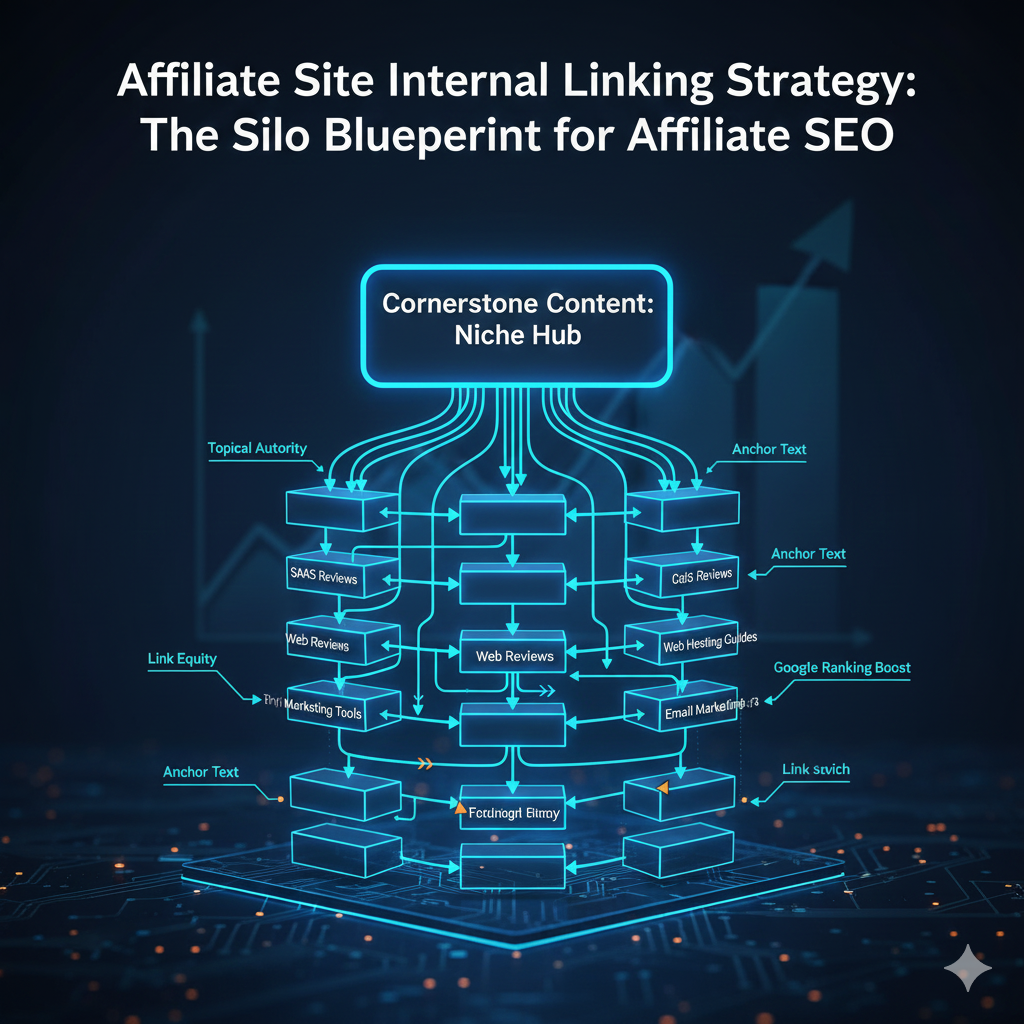
The Silo Structure: Your Affiliate SEO Blueprint 🏗️
The Silo Structure is the gold standard for organizing an affiliate website.
It is a planned site architecture that groups related content into distinct, topically focused categories, or “silos.”
This method prevents link equity from being diluted across unrelated topics.
Instead, it concentrates authority within each silo, maximizing the ranking potential of your most important pages.
The Three Layers of an Affiliate Silo 🧱
Visualize your affiliate site as a pyramid, with content categorized into three strategic layers:

Layer 1: Cornerstone Content (The Hub) 🎯
This is the most important page in your silo.
It is a comprehensive, high-value guide or a “Best Of” review that targets your most competitive, high-volume keyword.
For example, if your niche is home audio, your Cornerstone Content might be “The Ultimate Guide to Home Theater Systems.”
This page is designed to be the ultimate resource and the primary conversion point for that topic.
All other pages in the silo must link up to this page as the central authority.
Layer 2: Supporting Articles (The Spokes) 🗣️
These are detailed articles that support the main Cornerstone Content.
They target mid-tail keywords and provide specific information.
Following the home audio example, a supporting article could be “Denon AVR-X3700H Review” or “How to Calibrate Your Subwoofer.”
These pages link up to the Cornerstone Content and help build deep topical relevance.
Layer 3: Deep Content (The Long-Tail) 🔎
This layer consists of highly specific, long-tail content that captures niche traffic.
These articles might be Q&A style, troubleshooting guides, or glossary entries.
An example would be “Fixing the Denon AVR-X3700H HDMI Bug.”
These pages link up to the relevant Supporting Article in Layer 2.
The Silo Rule is simple: pages within a silo link to each other and up to the Cornerstone Content, but pages in different silos should not link to each other.
Silo Structure in Action: A Comparison Table 📋
Understanding the flow of link equity is crucial for this strategy.
The table below illustrates the role of each layer in the Silo Structure:
| Silo Layer | Target Keyword Type | Primary Goal | Link Flow |
|---|---|---|---|
| Cornerstone Content | High-Volume, Competitive | Conversion & Top Ranking | Receives links from all pages in the silo. |
| Supporting Articles | Mid-Tail, Informational | Topical Depth & Authority | Links up to Cornerstone, down to Deep Content. |
| Deep Content | Long-Tail, Specific | Niche Traffic & User Support | Links up to Supporting Articles. |
Implementation: Best Practices for Affiliate Links 🛠️
A successful internal linking strategy must be paired with proper affiliate link management.
While internal links pass SEO value, external affiliate links require careful handling to maintain compliance and trust.
The Power of Contextual Anchor Text ✍️
The anchor text you use for your internal links is vital.
It should be descriptive and keyword-rich, accurately reflecting the content of the destination page.
For example, instead of linking with “read more,” use “our in-depth review of the Denon AVR-X3700H.”
This practice reinforces the topical relevance of the linked page for both users and search engines.
Contextual links placed naturally within the body of the text are the most powerful type of internal link.
Affiliate Link Tagging and Compliance 🛡️
Google requires that all paid links, including affiliate links, be properly identified.
You must use the `rel=”sponsored”` attribute on all external affiliate links as mandated by Google Search Central.
This ensures you maintain a clean link profile and avoid penalties.
Do not confuse this with your internal links, which should remain standard, do-follow links to pass link equity.
Link Depth and User Experience 🖱️
A key metric is link depth, which is the number of clicks required to reach a page from the homepage.
Your Cornerstone Content and high-converting review pages should be no more than three clicks away from the homepage.
This ensures that link equity flows quickly and that users can easily find your most important content.
Here are some examples of successful affiliate site structures:
https://youtu.be/aBcDeFgHiJk
https://youtu.be/KlMnOpQrStU
https://youtu.be/UvWxYzAbCdE
The Cornerstone Content Strategy in Detail 💎
The Cornerstone Content is the single most valuable asset in your silo.
It is the page that will attract the most backlinks and, therefore, hold the most link equity.
This page must be the best resource on the internet for its target keyword.
It should be regularly updated to maintain its authority and relevance.
Every piece of supporting content you create should be viewed as a tool to boost the ranking of your Cornerstone Content.
This is the core philosophy of the Silo Structure.
Creating a Cornerstone Content Plan 📝
To create a winning Cornerstone Content piece, follow these steps:
- Identify Your Core Keyword: Choose the highest-volume, most valuable keyword for your niche (e.g., “best espresso machine”).
- Analyze the Competition: Review the top 10 ranking pages to understand the required depth and format.
- Create a Comprehensive Outline: Your content must be significantly better and more detailed than the competition.
- Link Internally: Ensure all relevant supporting articles link back to this page using varied, keyword-rich anchor text.
- Acquire Backlinks: Actively promote this page to attract external links, further increasing its authority.
This focused approach ensures that your most important page receives the maximum possible SEO benefit which is the goal of content siloing.
Conclusion: Build Your Authority, Boost Your Sales 💰
Affiliate SEO is a long-term game built on trust and authority.
The internal linking strategy you choose is the foundation of that authority.
By implementing the Silo Structure, you are not just adding links; you are creating a logical, powerful architecture that Google loves.
You are concentrating link equity where it matters most: on your conversion pages.
Start auditing your site today and reorganize your content into powerful, revenue-driving silos.
The effort you put into this strategic linking will pay dividends in higher rankings and increased affiliate commissions.
References 📚
For further reading and to verify the high-authority sources used in this article, please refer to the links below:
- [1] The ultimate guide to internal linking for SEO and GEO | Yoast
- [2] Internal Links: Ultimate Guide + Strategies | SEMrush
- [3] What Is An SEO Silo and How To Use It | SurferSEO
- [4] The 7-Step Guide to Creating Amazing Cornerstone Content | WordStream
- [5] Qualify your outbound links to Google | Google Search Central